
Before AI came into the picture, I'd rarely hear non-developers talk about building their own apps, tools, or automations. Now it's everywhere, and a lot of that is thanks to "vibe-coding" tools, including Claude Code. The reason I'm highlighting Claude Code specifically is that Claude has turned into the tool everyone (and I literally mean everyone) has been talking about lately.
Even users who would have never traditionally touched a tool with the word "Code" in it have been setting it up just to make sure they're getting their money's worth out of that $20 subscription. Now, I'm not going to be dramatic here and say that I don't use Claude Code. Contrary to that, it's one of my favorite tools, and I've used it for months just because of how impressive it is. But somewhere along the way, I started using OpenCode alongside it, and then more than it, and then I realized I wasn't really missing anything.
Want to stay in the loop with the latest in AI? The XDA AI Insider newsletter drops weekly with deep dives, tool recommendations, and hands-on coverage you won't find anywhere else on the site. Subscribe by modifying your newsletter preferences!
OpenCode handles multiple models more seamlessly
This isn't surprising at all, but given that Claude Code is an Anthropic product, you're limited to Claude models. That's it. No GPT, no Gemini, no local LLMs, nothing. You get access to Claude's Haiku, Sonnet, and Opus models. To be fair, they're excellent and the entire reason why Claude Code is absolutely worth paying for. But also, that's the entire menu. If tomorrow Google drops a model that's better at your specific use case, or you want to run something locally for privacy, you're out of luck.
For instance, GPT-5.5 launched last week, and it's significantly better at certain coding tasks. It scored 82.7% on Terminal-Bench 2.0, well ahead of Claude Opus 4.7's 69.4%. That's a benchmark that tests actual command-line workflows, which is literally what these tools do. Now, Opus still wins on other things like SWE-Bench Pro, but that's kind of the point! Different models are better at different tasks. With Claude Code, you don't get to pick. With OpenCode, you do since the tool is strictly bring-your-own-model. You get a very similar Claude Code-like terminal interface, but you pick what runs underneath. OpenCode uses the AI SDK and Models.dev to support over 75 LLM providers, as well as local LLMs.
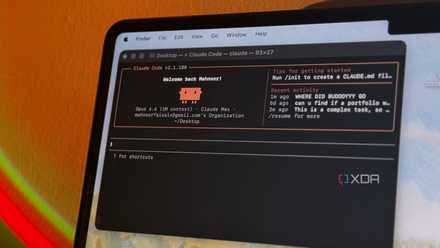
I gave Claude Code control of my desktop for a week, and it automated things I didn't think were possible
I was seriously stunned.
The best part is you can also use some of your existing AI subscriptions with OpenCode. This includes ChatGPT Plus, GitHub Copilot, and GitLab Duo. For the rest, you'll need to tinker around with API keys, but it's straightforward! You run a /connect command, your keys are stored locally, and you're up and running. OpenCode also technically lets you connect your Claude subscription to it, but Anthropic explicitly prohibits this now. You can still use Claude with OpenCode through an API key, though. You just can't piggyback on your Pro or Max subscription anymore.
It's worth noting that Claude Code can technically be pointed at non-Claude models by setting the ANTHROPIC_BASE_URL environment variable to a compatible server. Tools like Ollama, LM Studio, and llama.cpp all support the Anthropic Messages API format, meaning local LLMs work with Claude Code's harness without any proxy. We've covered how to automate this setup with a simple script.
However, this isn't the same as native multi-provider support. The server has to speak Anthropic's API format, and it's not a first-party feature in the way OpenCode's built-in support for 75+ providers is. OpenCode still has the edge in how seamlessly it handles model switching, and in our testing, it also runs leaner than Claude Code regardless of which model is behind it.
You can alternate between models depending on the task. Use GPT-5.5 for terminal-heavy workflows where it benchmarks higher, switch to a Gemini model for quick iteration, and drop down to a local model through Ollama for quick commit messages where you don't need the big guns. Same tool, same interface, different brain behind it!
It has a bunch of Claude Code-like features too
When I first installed OpenCode, I thought it'd miss a lot of features that made Claude Code...Claude Code. Turns out, the majority of the things I assumed were Claude Code exclusives were already there. For instance, a Claude Code feature I really find handy in my coding sessions is Plan mode. Given I'm not a developer in the traditional sense, I rely on Plan mode a lot. Whether I'm making a change to an existing codebase or building something from scratch, it's super helpful to have the model analyze and map things out before it goes haywire and makes changes itself.
Plan mode is designed to do exactly that. It keeps the agent in read-only mode so it can explore your project structure, understand dependencies, and lay out a full-fledged strategy before touching anything. OpenCode has this too! You switch to Plan mode, get your analysis, and then flip to Build mode when you're ready to begin building. OpenCode is also fully capable of editing files across your entire project, running terminal commands, and iterating on errors without you having to hold its hand.

How much do you know about Claude?
Trivia challenge
Think you know Anthropic's AI assistant? Put your knowledge of Claude to the test.
Which company created Claude?
What is the name of the safety and values framework Anthropic developed to guide Claude's behavior?
What is the name most commonly associated with inspiring Claude's name?
Which of the following best describes Claude's context window capability in its more advanced versions?
Which of the following principles is NOT part of Anthropic's core goal for Claude?
What was a key distinguishing feature of Claude 2 when it launched compared to many rival models at the time?
Anthropic describes itself primarily as which type of company?
Which of the following tasks is Claude specifically designed to handle well?
Your Score
Thanks for playing!
It supports MCP servers, so you can connect it to all your favorite tools. You can also create Skills — reusable sets of instructions that your agent can load on demand for specific tasks. It works the same way as in Claude Code: you create a SKILL.md file, define what it does, and the agent pulls it in when it's relevant.
Claude Code's edge is the model, not the tool
The advantage isn't Claude Code, it's Claude
Something I've tried to ensure throughout this article is that this doesn't come across as a hit piece. I genuinely like Claude Code, and I'm subscribed to the Max 5x plan with no plans of canceling my subscription. However, the more I used OpenCode, the more I realized that what I liked was Claude itself, not Claude Code.
The intelligence, the reasoning, the quality of code — it's all Claude. Claude Code is essentially just the shell around it, so why would you really want to lock yourself into one tool when the model works just as well in another? One that also happens to support 75+ other providers, local models, and your existing subscriptions.
And if you're migrating from Claude Code, OpenCode natively reads your existing CLAUDE.md files and skills directory as fallbacks, so you don't have to start from scratch! The tool is also completely free and open-source, so what do you really have to lose by giving it a shot?