
Summary
- Intel's 2014 peak saw the best CPU with AMD's cheaper competition, but now, Intel is struggling in 2024 with falling stock prices.
- AMD's 3D V-Cache favors gamers while Intel's CPUs face stability issues and high power wattage, facing criticism for value proposition.
- Despite current challenges, Intel aims for an exciting future with Lunar Lake and potential 20A production to make an industry-leading comeback.
The year is 2014. Intel just announced its Devil's Canyon CPUs as a refresh of its Haswell architecture. The best CPU on the market is the Intel Core i7-4790K, and the best AMD has to offer is the AMD FX-8350. AMD is still massively behind what Intel has to offer, but AMD also offers a significantly cheaper CPU with comparable multi-threaded performance.
For years, Intel maintained this dominance that it had over the market, but 2014 is arguably when the company truly peaked; at least in terms of market share. Intel was still following its "tick-tock" strategy where a "tick" was a shrink of its manufacturing process and other improvements, whereas a "tock" was the introduction of a new microarchitecture. Intel later changed this up.
Fast forward to 2024, and Intel is in dire straits. The company's CEO recently (and bizarrely) took to X to post prayers amidst a tumbling stock price, the cancellation of dividends, and mass layoffs. Intel is in a nearly unrecognizable state, but how did we get here?
Intel 15th-gen Arrow Lake
Here's everything we know about Intel's next-gen processors.
Intel's state of play in 2024
Falling stock prices and failing CPUs
Intel has really been struggling in the last while, but this last year has arguably been the worst for the company. While its commitment to its roadmap which sees it reaching process parity in the near future is exemplary, there's not much else going for Intel right now. Its 14th-gen CPUs have been lauded for how power-hungry they are, but things have gone from bad to worse with the massive stability issues mostly plaguing its Core i9 series. What's more, it turns out those same problems affect the 13th Gen, too.
To put things into perspective for how bad things are for Intel right now, even without stability problems, can hit peak wattages of well above 300W. You'll see significantly reduced peaks than that from AMD's equivalents, though Intel does have multithreading efficiency at reduced power limits on its side. AMD, though, has managed to garner considerable favor from gamers with its 3D V-Cache, which sees significant performance benefits and reduced 1% lows in many titles.
Where things get even worse for Intel is the value proposition of its CPUs. AMD is still supporting its AM4 platform to this day with new releases, and AM4 launched in September 2016. With an Intel CPU, you'll typically get two generations at most, certainly nowhere near the seven years and counting that AMD is offering consumers. While AM5 has a number of benefits (new technology like DDR5 and PCIe 5.0), consumers are more price-conscious than ever. This means upgrading your motherboard is a significantly less common affair, which can be considerably cost-effective.

Intel's process roadmap to 2025: Intel 7, 4, 3, 20A, and 18A explained
Intel has outlined its new processes for the next few years, but what does it all mean?
Intel's future looks uncertain
Things could get better
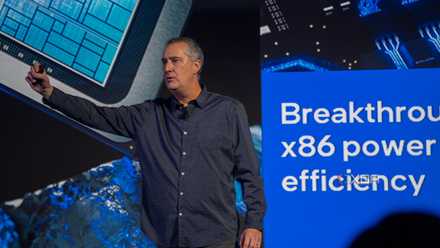
Right now, Intel is in a rough spot, but things could get better in 2025. The company is saying that Lunar Lake will "bust the myth" that Arm is more efficient than x86, which in itself is a bold claim to make. On top of that, while Lunar Lake looks to be outsourced entirely to TSMC, Arrow Lake, Intel 15th Gen, looks slated to be produced on Intel 20A. This would be equivalent to a comparable 2nm fabrication process on TSMC or Samsung.
In the case of Intel 20A, it will debut not just Arrow Lake, but the company's PowerVia and RIbbonFET, where RibbonFET is simply another name (given by Intel) to a Gate All Around Field-Effect Transistor, or GAAFET. TSMC is moving to GAAFET for its 2nm N2 node, whereas Samsung is moving to it with its 3nm 3GAE process node.
What's special about PowerVia is that it allows for backside power delivery throughout a chip, where signal wires and power wires are decoupled and optimized separately. With frontside power delivery, the standard of the industry now, there is a lot of potential for bottlenecking due to space while also potentially opening up to issues like power integrity and signal interference. PowerVia separates signal and power lines, resulting in theoretically better power delivery.
If Intel 20A shapes up as well as it looks to be, and if RibbonFET and PowerVia are as industry-leading as they may seem, then Intel might be about to make an incredible comeback. As it stands right now, though, the company is unrecognizable in its market position to where it was a decade ago. Intel still retains significant market share, but it's slowly dropping, and with AMD well and truly solidified ahead of Intel in most workloads while also still retaining a lower price and lower power consumption, the CPU race has never been hotter.
We're excited to see if Intel can pull things back, as not only is that good for Intel, but for consumers as well. I'm hopeful that the company's claims around Lunar Lake hold true, and with Arrow Lake potentially shaking things up in the industry if it manages to be a successful launch, the CPU world may be on the verge of something exciting.
Is Arm actually more efficient than x86?
Intel wants to "bust the myth" that Arm is more efficient than x86, but it's going to be an uphill battle to get there.