
If you're looking to upgrade your home lab, old enterprise gear can be a tempting proposition. It's often available for inexpensive rates online and is great for developing a deeper understanding of the technologies and tools powering your home lab. This isn't limited to networking gear either - old server hardware can be a tempting proposition, especially with high-spec boxes available for a reduced price. But there are some things you should consider carefully before taking the plunge with ex-enterprise gear for your home.
Why is ex-enterprise gear so cheap?
A full server with 64gbs of RAM for $300?
If you've ever trawled eBay for ex-enterprise hardware, you'd be forgiven for wondering if there is a catch. Often, this gear is available for meager prices relative to specs. The reason for this kind of availability is that it is fundamentally no longer suitable for use in a data center or enterprise environment. This might be due to many reasons, ranging from expiring support contracts and availability to simply the age of the hardware. Often you'll find these switches and servers are no longer receiving enterprise support, which is a killer in a professional environment, or have simply been upgraded to newer equipment. Demand for second-hand enterprise gear is generally low - companies with these kinds of requirements don't often cheap out by going with ten-year-old gear. Often, decommissioned hardware is simply scrapped, given away, or sold off cheaply.
There's a trick in knowing which hardware is coming to the end of its life cycle, though often the market will be flooded for a period as specific types of hardware no longer receive support.
Your power bill could get crazy
The European mind can easily comprehend this
Depending on where you live in the world, your mileage on this factor might vary - and it may also affect the prices you pay for hardware. While legacy hardware offers enticing performance, it is often extremely inefficient per watt compared to more modern hardware. CPUs and other on-board chips have generally been consuming (within some limits) a similar amount of power for decades now - we haven't yet upgraded to several kilowatt power supplies for most applications. They have gotten faster, however, and this represents an increase both in the overall speed of hardware but also its efficiency. This means that legacy chips, especially those from 5+ years ago, offer very poor 'performance-per-watt,' which is an important factor for a machine that's intended to be run 24/7 like a home server or network switch.

I created a surveillance system on my Proxmox home lab - here's how I did it
Monitor your living space with the help of a self-hosted ZoneMinder server
If you're in an expensive area for power, like I am in the UK, then this is a serious consideration. While the low upfront cost of a well-specced HP Proliant DL360 Gen 9 might seem appealing, the ongoing costs to run it might quickly make a more modern, power-sipping machine more appealing (or even a small cluster of smaller, more efficient, consumer-grade machines). If you are in an area where power is an expensive commodity, we'd suggest you estimate the increase to your monthly bill in advance.
Redundancy adds cost
Another aspect to consider if power is a concern is that redundancy adds cost. If you're considering buying enterprise gear for its improved reliability - like redundant network cards, power supplies and cooling - then keep in mind that all of that extra gear is in itself power-hungry, and likely to add cost over a smaller consumer machine.
Enterprise hardware is seriously loud
Definitely don't run it under your bed
This is another big issue to be aware of. Enterprise gear is loud, and as we've mentioned, often designed for data center use. Standing next to a switched-on vacuum cleaner is a good comparison for a relatively loud server, though quiet options (and far louder ones) do exist. There are a couple of tips and tricks to avoiding very loud gear you can use though.
Firstly, size often matters. Rack-mount hardware is usually designed with space at a premium, so fitting the most performance into a 1U or 2U rack-mount is important. For a home scenario, dense, small hardware is a bad idea, as it often contains small, very high RPM fans designed to push a large volume of air through a tiny chassis. If you've got the space, look for larger hardware, with larger fans. Do some research on the brand of hardware you're buying, as well as what other users are saying about the noise, and if there are any software settings or hardware modifications you can make to keep a device quiet. Modding out lower-RPM fans is a common one, especially for network switches. If you're feeling bold, you might find that some hardware doesn't need any cooling at all. (I got away with this while using a frankly ridiculous Cisco Catalyst 3750g for longer than I'd like to admit on the internet.)
If you've got the space, look for larger hardware, with larger fans. Do some research on the brand of hardware you're buying, as well as what other users are saying about the noise
Tower-chassis servers are generally a quieter option for ex-enterprise hardware, but as people are aware of this, they normally come at more of a price premium on the second-hand market.
Watch out for licensing issues
No one wants to buy e-waste
One more minor point to be cautious about is licensing issues. Some components inside enterprise gear can require their own licenses, or even a license to work at all. This can make these devices extremely cheap, but if something is too good to be true, it often is. Do some research around the model of hardware you're interested in, and check out other people's experiences on r/homelab or other similar forums. The last thing you want is a shiny old enterprise switch to show up, only to refuse to boot without a valid license.
Look locally for great deals
Older tech is available in your own area
👁 A server on a trolley being moved from one location to another.
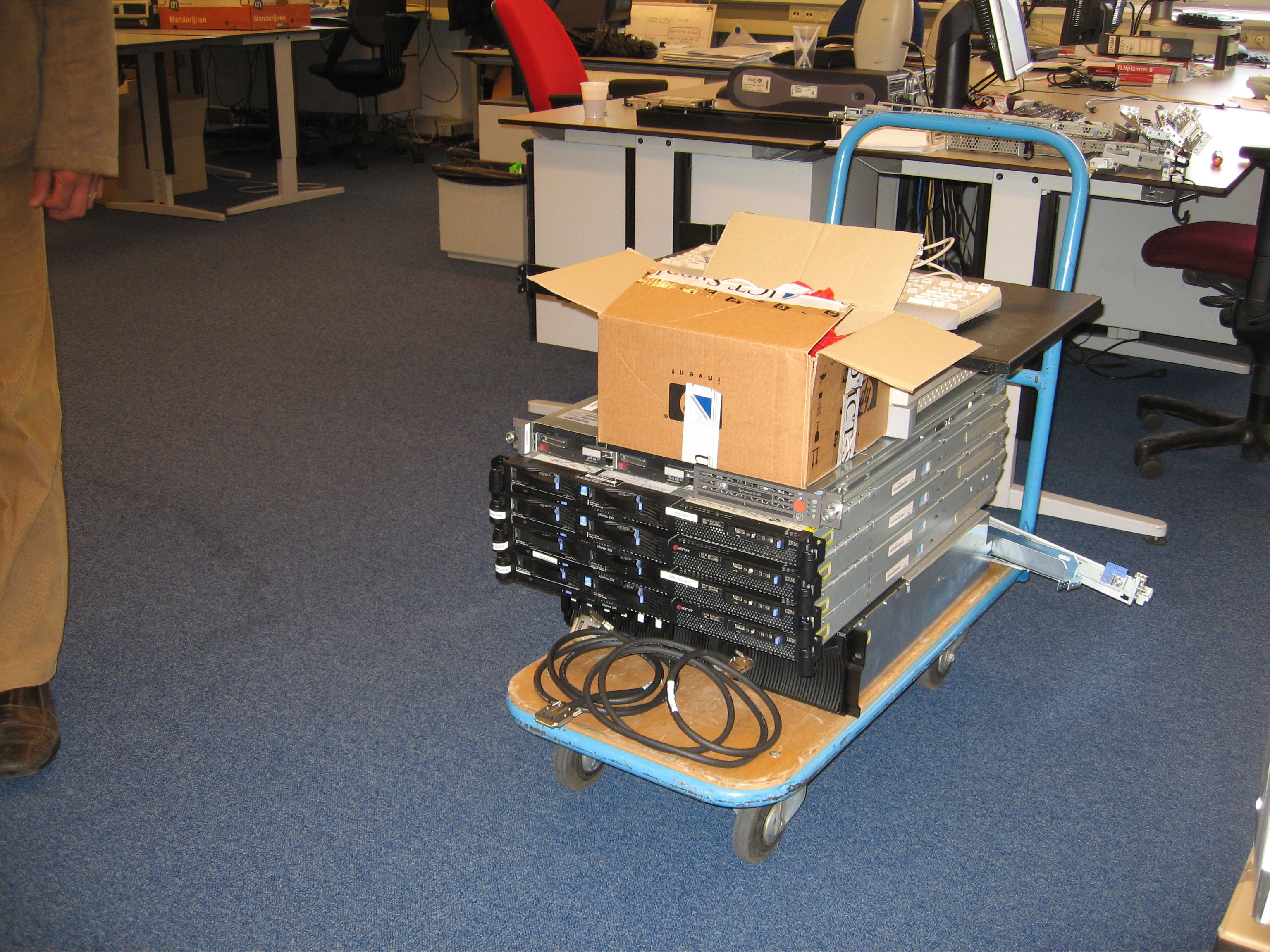
If you are considering second-hand enterprise gear, consider looking nearby for a great deal. Businesses of all kinds will often use a piece of hardware up until some arbitrary lifespan - enforced or not for a variety of reasons - and then simply dispose of it. Things like hard drives likely need to be disposed of securely, but old hardware is often freely or cheaply available if you're willing to collect it. Universities and schools are also great places to find great deals (or even freebies) for old hardware, but it can sometimes involve knowing the right person on their IT team, or a go-getter, friendly attitude and an interest in learning.
Enterprise gear is great for learning - but don't get overwhelmed
One of the benefits of picking up ex-enterprise gear, especially if you're using your lab to upskill or learn, is that it gives you a glimpse into the world of "doing things properly" (read - expensively). You'll quickly get exposure to some great tools for learning, with plenty of potential for scalability, complicated custom setups, and often little to no limitations (licensing issues aside), but be careful not to get overwhelmed. Part of handling enterprise gear isn't necessarily just knowing what everything does, but also knowing the settings you can ignore.
If you do decide to take the plunge, make sure you've scoped out where you'll be storing and running your gear first. If you've got the space and power-bill appetite, there are some great deals out there on everything from old HP servers to Cisco networking gear.