
The Linux desktop debate has been ongoing for a couple of decades now. The narrative changes every few months with the release of a new kernel, architectural improvements or integrations, but the conclusion remains quite the same: "It's promising, but not quite there." Sometimes it's due to too many compatibility gaps, a departure from traditional professional workflows, or just plain and simple usability. That conversation remains ongoing, but the problems aren't being resolved anytime soon.
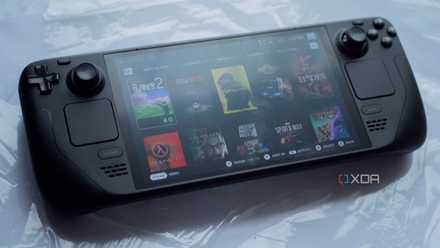
The conversation, however, consistently misses the fact that Linux has decisively won somewhere else entirely. The Steam Deck runs SteamOS, which is a Linux-based OS, and has delivered an experience that Windows-based handhelds have not even come close to matching. While the desktop may still be Windows territory, Linux reigns in the handheld space. Here's why.
Most users would pick a Linux handheld over a Windows one
The Steam Deck proved that beyond doubt
The Steam Deck is the best-selling PC handheld to date, having outsold every other Windows counterpart, but that has nothing to do with this argument at all. When I say most users would pick a "Linux handheld" over a Windows platform, I don't mean they would necessarily choose a Steam Deck over an ASUS ROG Ally or a Legion Go. The more interesting observation is that, amongst users, there's a trend of migrating away from the Windows ecosystem towards SteamOS for a variety of reasons. Owners of Windows-based handhelds have been installing SteamOS on their devices and reporting a better gaming experience, and that sentiment has been mirrored across various consumer forums.
Even users who purchased Windows handhelds specifically for the platform have found themselves switching after a few months of daily use and described the experience as "transformative".
Part of the reason for this is the fact that, despite being the preferred platform for gaming on the desktop, the integration of Windows on handhelds has always felt unnatural, whether it was the controller navigation that was clearly never designed to be a primary input method, a sleep mode that drains the battery rather than preserving it, the endless background processes and telemetry that thermally constrained hardware could not afford, or even companion software like Armoury Crate that introduced its own layer of instability. To most users, SteamOS offered a path to escape all the ill-optimized overhead that Windows brought to the form factor, and amongst those who switched, very few actually found any reason to go back.
SteamOS's showed that Linux can deliver a superior handheld experience
Well-optimized, seamless, and crafted for one purpose
When you experience handheld gaming on SteamOS, it becomes clear that Valve built the operating system around a single use case, and that singular focus is found evident in every layer of the experience right from the moment you boot. The interface is controller-native, power management is tuned for the thermal and battery constraints of the Deck, and the sleep and resume behavior works the way a handheld should.
This is not to say that the Steam Deck was built only and only for gaming. In itself, it's a powerful x86 device that outperforms almost every similarly priced laptop, with 16GB of LPDDR5 memory running at 6400 MT/s, giving it more memory bandwidth than several other budget ultrabooks. When you pair it with a $60 monitor, a keyboard, and the Nested Desktop mode, you've got yourself a legitimate portable workstation.
The fact that the same OS can pull double duty as a capable desktop without ever compromising the handheld experience reinforces the central point. The SteamOS was engineered with intent, and every part of it serves the form factor first. That very intentionality is what Windows has never managed to replicate. Nested Desktop is the perfect illustration, as the desktop environment is fully there for anyone who wants it, but with an important distinction. Valve made the deliberate choice to decouple it from the gaming experience entirely, rather than doing what every Windows handheld does by bolting a gaming interface onto a desktop OS that was never designed to be once. On SteamOS, gaming is the default and the desktop is the option, whereas on Windows, it has always been the opposite, and no amount of manufacturer skinning has ever fully hidden it.
Valve's SteamOS has already won the war on Windows
It's getting too late for Microsoft to fight back
AMD's Vulkan drivers are magical on Linux
And Windows can't compete. The benchmarks said so
No comparison is ever truly honest without the performance side of the equation, and delightfully enough, it is one aspect where Linux pulls ahead of Windows decisively in the handheld territory. The technical root of that advantage lies in AMD's Vulkan driver stack, which, on Linux, is frequently better optimized for the specific APU inside gaming handhelds than its Windows counterpart.
The benchmarks have been out for a while, and the data demonstrates this perfectly. After running extensive tests on Lenovo Legion Go S, which ships in both Windows and SteamOS configurations, Ars Technica found that recent games generally run at higher frame rates on SteamOS 3.7 than on Windows 11 on the same hardware. Even after sideloading newer, unofficial AMD drivers to equalize the performance and give Windows the best possible shot, the benchmark frame rates still came in anywhere from 8 to 36 percent lower than those same tests on SteamOS.
The context makes it doubly remarkable. Games on SteamOS run through the Proton translation layer, convert native Windows instructions on the fly, and yet, SteamOS still comes out ahead. The Vulkan driver stack is clearly doing the heavy-lifting here, and it is doing it well enough to overcome a translation penalty that should have handed Windows the advantage.
Linux has clearly outclassed Windows in the handheld arena
The desktop debate will rumble on, and Windows will likely remain its default answer for the foreseeable future. In the handheld arena, though, something unexpected has happened. The platform that spent twenty years being dismissed as "not quite ready" turned out to be exactly what a form factor dedicated to gaming needed all along. SteamOS delivers a markedly better experience on handhelds than Windows on even the very same hardware in both performance and user experience, and it's all because it was built for the job, from the ground up. If that doesn't characterize Linux in the best way for what it is, I don't know what else does.
Steam Deck OLED
- Dimensions
- 11.7 x 4.6 x 1.9 inches (298mm x 117mm x 49mm)
- Weight
- 1.41 pounds (640 grams)
Valve's upgraded Steam Deck features a larger OLED display with HDR support, faster Wi-Fi, and a bigger battery. Plus, this new model is slightly lighter, has slightly faster RAM, and it comes with storage up to 1TB. If you're looking for the ultimate Steam Deck, this is the version for you.