
I consume a lot of media and information every day. Between books, articles, research papers, and, of course, videos, it's a lot of information overload. The problem isn't finding all this information; it's turning it into something I can actually use.
A lot of my workflow involves highlighting information, saving articles, and clipping interesting quotes, which I usually copy into a notes app like SimpleNote. I've also tried dedicated services like Readwise, but it's yet another subscription I'd rather avoid. Plus, it doesn't help that all of this information remains disconnected, with no clear path to joining the dots and making use of it.
Lately, I've accidentally stumbled into a workflow that solves this problem rather elegantly. I've combined NotebookLM and Claude, even though each tool plays a unique role. While the former helps me understand and question the source material, the latter helps me transform those insights into action. And for the first time in a long time, I'm finding I can actually take advantage of the information I've been collecting. Here's what I do.
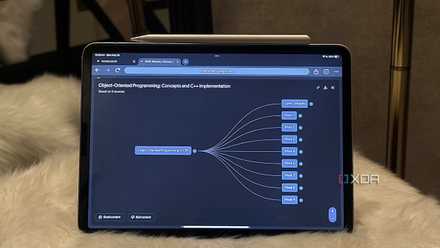
5 ways NotebookLM completely changed my workflow (for the better)
Hey Siri, how did I ever survive before NotebookLM?
NotebookLM helps me explore the source better
Turning highlights into a conversation with the material
AI-based article summarization is everywhere, but let me be the first to tell you I absolutely detest it. You can upload a document or an article, ask for a summary, and completely skip the output and move on. You might think you gained some insights, but summaries often remove the context that made that information important. It's why I made NotebookLM such a key part of my research process.
Instead of using NotebookLM as a summarization engine, I use it more like a research assistant that knows my source material extremely well. When I make a new notebook, I upload all the books, a collection of articles, or exported Kindle highlights that are relevant to the specific topic. Once NotebookLM has processed all of this, I can start asking it questions about themes, patterns, even contradictions and recurring ideas across the source material I have uploaded to it.
The biggest difference is that NotebookLM grounds all of its responses in the material that I've provided. That helps it avoid hallucinations but also avoids tainting the data sources with external information. Often, I only want to query the specific paper or document I've uploaded. I don't want external information.
This allows me to trace a particular idea that recurs throughout a book. When I ask NotebookLM that question, it takes me to the source material and to specific points within it to answer it. Similarly, all the highlights and notes from my reading that I've collected are useful when I put them into NotebookLM.
In a notes app, I would either forget those highlights or just skim them. In Notebook LM, I can explore why those highlights mattered in the first place, since the tool can help surface connections across dozens or even hundreds of pages. Since there is a risk of spoilers, I prefer to use this once I've finished reading a book so I can go back and identify things I might have missed or gain more insight into world-building.
Claude helps me figure out what to do next
Turning insights into actions
But as good as NotebookLM is at connecting my train of thought with my highlights and notes, it doesn't solve the problem of taking action. If I have just finished reading a book, I already know what it says and understand the author's argument. My highlights already contain all the interesting ideas, but what do I do with that? That's the point where I bring Claude into the process.
After I've used NotebookLM to explore and understand the source material, I export these notes, observations, and insights as a markdown document and bring them to Claude. Over here, instead of using Claude to create a summary, I query it. Think of questions like, how should I apply these ideas to my specific context, or which concepts explored in a book apply to my current projects.
You can even ask it open-ended questions like, "What habits, systems, or decisions should I make or consider for my life based on my learning from those books?" Grounded on the research that you did within NotebookLM, you can now get an actionable compendium in Claude. This is especially useful if you read books on philosophy or productivity, as Claude can help turn abstract principles into real-world workflows.
The results aren't always perfect. In fact, I would say that quite often they're not straight-up answers that you can apply to your particular situation; however, you get a very different perspective or even an alternate train of thought. All of which, combined, gives you a clearer understanding of what to do next with everything you've been reading and learning. That's something that most note-taking systems cannot offer.
Information is only useful if you act on it
At the end of the day, this two-part system solves a very specific problem for me, and neither of those problems inherently has anything to do with AI.
As an avid reader, I find that collecting information, highlights, and notes feels like a productive day. So does understanding that information. But none of that information that I've gathered actually makes a difference unless I act on it. Often enough, the insights that you've been gathering aren't something that you can directly apply. However, between NotebookLM and Claude, you can surface the key idea or approach that applies to your work and helps you move in that direction.
NotebookLM changed how I interact with source material by helping me explore it more deeply. Meanwhile, Claude changed what happens afterward by helping me convert those insights into plans and experiments. Between the two of them, these tools are actually feeding into the decisions that I make today, and it's the first workflow in a very long time that I have stuck with.