
Nvidia hasn't hit its stride this generation, and the RTX 5060 Ti doesn't change that. Leveraging the same node as last-gen Ada Lovelace GPUs, it's no surprise that we've seen price drops on RTX 50-series graphics cards as Nvidia tries to provide value to gamers with the right balance of raw performance and a healthy boost from DLSS Multi-Frame Generation (MFG). The RTX 5060 Ti is just uniquely positioned to benefit from both those price cuts and MFG.
The generational improvements aren't as high as I'd like them to be, and prices are sure to climb a few weeks after release. But for the first time this generation, it feels like Nvidia has nailed the balance of performance, price, and features. It's far from a perfect graphics card, but when the rubber meets the road and I need to recommend a GPU around $400, the RTX 5060 Ti will be the first one that comes to mind.
About this review: Nvidia provided XDA with a sample for testing, but had no input ahead of publication.

Asus Prime GeForce RTX 5060 Ti
- Memory Clock Speed
- 1750MHz
- Architecture
- Blackwell
- Process
- 5nm
- Shader Units
- 4608
Nvidia's RTX 5060 Ti doesn't provide a massive generational uplift, but it hits the sweet spot on pricing and performance with DLSS 4 at the helm.
- DLSS 4 enables otherwise impossible performance
- Large price cut on 16GB model
- Single, 8-pin power connector
- Falls short of the RTX 4070
- 16GB frame buffer still uses a 128-bit bus
Nvidia GeForce RTX 5060 Ti pricing and availability
The RTX 5060 Ti follows a trend we've seen with Nvidia this generation. Leveraging the same node for Blackwell as it did for last-gen Ada Lovelace GPUs, Nvidia has shifted pricing down to provide better value for its GPUs. The RTX 5060 Ti benefits the most from these price adjustments. The RTX 5070 missed the right balance of price against performance, but the RTX 5060 Ti nails it at a $429 MSRP for the 16GB model.
That's the model I reviewed here, and it's the one I recommend you go for. Like the previous generation, Nvidia is offering an 8GB model of the RTX 5060 Ti with a more modest price cut down to $379. The extra $60 is money well spent here, considering the performance of the RTX 5060 Ti and how 8GB graphics cards can run into issues in games like Indiana Jones and the Great Circle. Regardless of the model, Nvidia has carved out a comfortable space for itself at this price. Outside of Nvidia's own RTX 4060 Ti, the only other competition is AMD's RX 7700 XT. And that card has climbed north of $500 over the last few months.
By today's standards, the RTX 5060 Ti is a downright deal, even with its tariff-impacted price.
Still, Nvidia is releasing the RTX 5060 Ti in a broken GPU market. Right now, the early bird gets the worm with GPUs, and that's not changing with the RTX 5060 Ti. I'm seeing models priced around $480 at retailers for the 16GB model, accounting for tariffs. That's a pretty good deal considering how difficult it is to get a GPU under $500 otherwise. Even something as weak as the RTX 3060 is selling for above $400 on Newegg, and by that standard, the RTX 5060 Ti is a downright deal even with its tariff-impacted price.
A few weeks after release, the situation will change. Prices will climb, inventory will dwindle, and it's impossible to say where tariffs will go. Right now, the bar for the RTX 5060 Ti is $500. Below that price, it's a solid buy, and it becomes more attractive the closer it gets to $400. Once that line is crossed, it's worth considering other options, like the last-gen RTX 4070 and RTX 4070 Super, as well as AMD's RX 7700 XT. With all of these cards, weigh the price you can find the cards at against the performance results I've gathered here.
Nvidia GeForce RTX 5060 Ti 16GB
- Shader Units
- 4608
- Ray Accelerators/Cores
- 36
- AI Accelerators/Cores
- 144
- Base Clock Speed
- 2407MHz
- Boost Clock Speed
- 2572MHz
- Memory Clock Speed
- 1750MHz
- Memory Capacity
- 16GB GDDR7
- Memory Bus
- 128-bit
- Memory Bandwidth
- 448GB/s
- Power Draw
- 180W
- Architecture
- Blackwell
- Process
- 5nm
Nvidia's RTX 5060 Ti hits the sweet spot for PC gaming
An adjustment in price makes all the difference
I looked at two RTX 5060 Ti models for this review -- the PNY RTX 5060 Ti OC, and the Asus Prime RTX 5060 Ti. Out of the two, Asus definitely wins the day with its model. Although it's a longer three-fan card compared to the compact two-fan design PNY uses, the Prime variant still clocks in at 2.5 slots and features a dual BIOS toggle; a feature that the PNY model lacks.
Unlike all other Nvidia GPUs this generation, the RTX 5060 Ti comes with a single 8-pin power connector. Neither Asus nor PNY used a 12-pin connector with an adapter, which is a very welcome change compared to the last couple of generations. Asus places the 8-pin squarely in the center of the GPU, but PNY oddly placed the connector toward the back of the card, near the display outputs. If you spring for the PNY model, you'll probably need to readjust some of the wiring in your PC to account for the odd 8-pin placement.

The 12VHPWR cable needs fixing (properly this time)
If you're using an Nvidia GeForce RTX 40 or 50 series GPU, there's a good chance you've come across the 12VHPWR cable that has found itself in the news for all the wrong reasons.
PNY's take is better if you're looking for an extremely compact GPU, however. As mentioned, it's shorter than the Prime version Asus sent out, but more importantly, it's only two slots. The cooler shroud on the Prime model extends out by half a slot, which could cause some complications in a small form factor build. I only had the chance to look at these two models, but there are dozens of options available from Nvidia's board partners. Nvidia isn't making a Founder's Edition design for the RTX 5060 Ti, so it's a good idea to shop around to find the right card for your build.
Most board partners have listed the 8GB version at $420 and the 16GB version at $480, likely to account for tariffs. Naturally, the RTX 5060 Ti is less attractive the more expensive it is, but it's hard to blame Nvidia or board partners for a GPU market that hangs on the whim of rotating international trade policies.
Nvidia's RTX 5060 Ti delivers the goods at 1440p
Just be careful not to overspend on it
The RTX 5060 Ti stands on its own in the GPU market right now, for better and worse. There isn't another card for around $400 that delivers the performance that the RTX 5060 Ti is offering, despite the fact that the generational improvements aren't as good as I'd like them to be. The main issue is that the RTX 5060 Ti falls short of last-gen's RTX 4070, despite a massive bump in VRAM capacity. On the other hand, you're looking at a generational improvement of around 19% at 1080p, 22% at 1440p, and a massive 54% at 4K, largely on the back of the 16GB frame buffer.
I would've liked to see performance that could match the RTX 4070. That was Nvidia's unicorn in the previous generation, but the RTX 5060 Ti falls just short. The inclusion of MFG more than makes up the performance gap, thankfully, but the RTX 5060 Ti feels less like a unicorn and more like a Goldilocks product. It's priced just right to slot into the market without stiff competition.
Here's a quick look at the test bench I used before diving into the individual games:
|
CPU |
AMD Ryzen 9 9950X |
|
Motherboard |
Gigabyte X870E Aorus Master |
|
Cooler |
MSI MEG CoreLiquid S360 |
|
Memory |
2x16GB Corsair Vengeance DDR5-6000 |
|
Storage |
2TB Samsung 990 Pro |
|
PSU |
1,200W Gigabyte Aorus P1200 |
The closest competitor to the RTX 5060 Ti is AMD's RX 7700 XT, not only at 1080p and 1440p, but also at 4K due to both cards pushing above 8GB of VRAM. Forza Motorsport exposes why. At 4K, but the RX 7700 XT and RTX 5060 Ti provide a frame rate of around 60 fps, while the 8GB RTX 4060 Ti can't even must 25 fps. Similarly, the weakest card of the bunch, AMD's RX 7600 XT, crosses 45 fps.
It's not all about VRAM, though, particularly when looking at 1440p results. In games like Assassin's Creed Mirage, Cyberpunk 2077, and Horizon Zero Dawn, the RTX 5060 Ti provides a consistent generational uplift of around 20%, which is nothing to sneeze at. More importantly, it's coming out ahead of the RX 7700 XT. In some games, such as Horizon, the margins are fairly large. In others, such as Mirage, they're so small that both cards might as well offer identical performance.
|
RTX 5060 Ti (16GB) |
RTX 4060 Ti (8GB) |
RX 7700 XT |
RX 7600 XT |
|
|---|---|---|---|---|
|
Assassin's Creed Mirage (Ultra High) |
|
|
|
|
|
Cyberpunk 2077 (Ultra) |
|
|
|
|
|
Black Myth: Wukong (Cinematic/DLSS@68%) |
|
|
|
|
|
Dying Light 2 (High Quality) |
|
|
|
|
|
Returnal (Epic) |
|
|
|
|
|
Forza Motorsport (Ultra) |
|
|
|
|
|
Horizon Zero Dawn Remastered (Very High) |
|
|
|
|
One of the more interesting games to look at is Black Myth: Wukong, and that's for a few reasons. Upscaling is basically a requirement to play the game at its highest graphics settings, and its use of baked-in ray tracing means that you'll need some RT horsepower even if you don't turn on the game's full path tracing mode. This is where the RTX 5060 Ti really shines. None of the cards here can manage 60 fps with these settings, even at 1080p. But the RTX 5060 Ti gets close, and with MFG available, you can easily get into the triple digits in this game with maxed-out settings.
I'd spring for the 16GB model of the RTX 5060 Ti if you can.
The RTX 5060 Ti 16GB nails balance. The generational improvement is decent, even if the card can't match what the RTX 4070 offered in the previous generation. But Nvidia is offering better performance than the main competitor at this price (AMD's RX 7700 XT), and with MFG available, it can push visual quality that would otherwise be impossible for this class of GPU.
My main reservation concerns the 8GB model. I haven't tested that version, but the results in Forza Motorsport provide a clear view into where that GPU can run into problems. Thankfully, the gap of $60 between the 8GB and 16GB versions is much more acceptable than what we saw in the previous generation, and even moreso when you consider both cards have seen a price cut this generation. It's hard to say where prices will end up in a few weeks, but I'd spring for the 16GB model of the RTX 5060 Ti if you can.
DLSS 4 completely transforms what the RTX 5060 Ti is capable of
It feels like performance barriers are being properly broken in this class of GPU
Nvidia is still leading the way on ray tracing, especially at this price. AMD's RX 9070 XT was an impressive showing for Team Red, but until we see lower-end options for RDNA 4, Nvidia remains in the driver's seat for ray tracing at prices around $400. A quick look at Cyberpunk 2077 shows why. While the RX 7700 XT was competitive in rasterized games, it gets clobbered by the RTX 5060 Ti in demanding ray tracing situations across resolutions.
|
RTX 5060 Ti (16GB) |
RTX 4060 Ti (8GB) |
RX 7700 XT |
RX 7600 XT |
|
|---|---|---|---|---|
|
Cyberpunk 2077 (Ultra RT) |
|
|
|
|
|
Returnal (Epic RT) |
|
|
|
|
|
Dying Light 2 (High Quality RT) |
|
|
|
|
Especially in 2025, there are loads of games with demanding implementations of ray tracing. However, there are also plenty of games from a few years back that take a lighter approach, so Returnal and Dying Light 2 are good reminders of what you can expect across titles. AMD is much more competitive in these games, and it even managed a slight lead in Returnal. That said, the ray-traced effects in these games -- and similar titles like Resident Evil 4 -- are much less prominent, so it might be best to leave RT off and get a little extra performance.
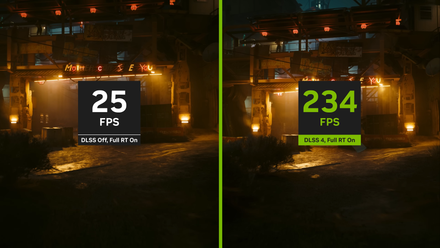
Toggling between DLSS 4 on and off during my testing, it felt like I had installed a completely different GPU.
Those heavier titles are what make the RTX 5060 Ti so special. With the assistance of MFG and DLSS 4, the card is able to push quality settings that would otherwise be impossible at this price. Below, you can see some games I tested with DLSS 4 and MFG. These results are at 1440p with the highest possible quality settings. That means in games like Cyberpunk 2077 and Indiana Jones and the Great Circle, I turned on full ray tracing in addition to the highest graphics options (even those not included in the highest graphics preset).
|
Native |
DLSS |
DLSS Settings |
|
|---|---|---|---|
|
Stalker 2 |
51.6 fps |
113.3 fps |
2X + Balanced |
|
Monster Hunter: Wilds (RT) |
36.1 fps |
75.5 fps |
2X + Balanced |
|
Indiana Jones and the Great Circle (PT) |
25.9 fps |
137.9 fps |
4X + Balanced |
|
Cyberpunk 2077 (PT) |
17 fps |
122.4 fps |
4X + Balanced |
|
Half-Life 2 RTX (PT) |
15.1 fps |
133.8 fps |
4X + Performance |
And short of Monster Hunter: Wilds, you're looking at frame rates comfortably in the triple digits. It's really astounding what DLSS 4 can offer to a card like the RTX 5060 Ti. Even with a single generated frame, you wouldn't be able to get 60 fps in demanding path tracing titles like Cyberpunk 2077. With MFG and conservative upscaling settings, however, you're getting a fantastic experience at 1440p. Yes, there are some visual artifacts, and the quality isn't always perfect. But it's very good. Toggling between DLSS 4 on and off during my testing, it felt like I had installed a completely different GPU.
Nvidia's DLSS 4 multi frame generation works best when it doesn't make sense to use it
If you want to use Nvidia's new multi frame generation, keep in mind that there are very specific times where it can actually make a difference.
There's plenty of discourse around generated frames, but Nvidia is pushing the window of what's acceptable forward. A few years ago, we were complaining about upscaling, and now DLSS 4 is so good that turning upscaling on actually leads to better image quality. Now, the conversation has moved to MFG. You might be opposed to the idea of generated frames over rendered ones, but the RTX 5060 Ti proves that's to your detriment.
Should you buy the Nvidia GeForce RTX 5060 Ti?
You should buy the RTX 5060 Ti if:
- You're willing to spend extra for the 16GB model
- You can find one below $500
- You want to play the latest games, maxed-out at 1440p
You should NOT buy the RTX 5060 Ti if:
- You aren't willing to turn on DLSS 4 and MFG
- Prices climb above $500
- You want to play at 4K
I have no doubt that the RTX 5060 Ti will cause discourse. The 8GB model will run into issues in recent, demanding games, and the impact of tariffs has effectively killed the MSRP of the GPU before it's even had a chance to go on sale. But, if you go a step deeper and accept the dire state of the GPU market as it stands right now, the RTX 5060 Ti doesn't look too bad. The generational performance is a bit lower than I'd like it, but it's still hard to argue with the price and what the card is capable of with DLSS 4 at the helm.
You should be very careful about pricing, however. Prices on PC components are rapidly changing, and a big reason the RTX 5060 Ti is able to hold up is the fact that it clocks in at under $500. Once it crosses over that line, it gets into the territory of the RTX 4070 Super, RTX 5070, and RX 9070, all of which are better options.
Asus Prime GeForce RTX 5060 Ti
- Memory Clock Speed
- 1750MHz
- Architecture
- Blackwell
- Process
- 5nm
- Shader Units
- 4608
Nvidia's RTX 5060 Ti doesn't provide a massive generational uplift, but it hits the sweet spot on pricing and performance with DLSS 4 at the helm. Just be careful with pricing, aimming to spend less than $500 on one.