
Nvidia's RTX 5080 arrived with a thud. Offering only a marginal performance improvement over the previous generation, and selling out within minutes of releasing, it's been hard to justify spending up for Nvidia's second in command. Thankfully, the list of the best graphics cards is long, and there are some excellent RTX 5080 alternatives to keep in mind.
4 Nvidia RTX 4080 Super
It's closer than you think, and you can actually buy it
The RTX 5080 is supposed to cost $1,000, but anyone who's been unfortunate enough to plumb the depths of Newegg and Micro Center know that's not the case. You'll spend well over $1,500, if you can find the GPU in stock at all. Despite being in short supply, you can find the RTX 4080 Super more readily available, particularly through open-box deals, and it clocks in around $1,000 to $1,200. Sure, you're spending the list price of an RTX 5080 for a less powerful GPU, but the margins are tighter than you might expect.
At 4K where these GPUs shine the most, you're looking at around a 10% difference between the RTX 5080 and RTX 4080 Super, which is even smaller than it sounds. In a game like God of War: Ragnarok, where the RTX 5080 can manage around 95 fps at 4K, the RTX 4080 Super can manage around 87 fps. The RTX 5080 is objectively faster across games, but that performance bump doesn't do much to actually enhance the 4K gaming experience.
The main downside of going with the RTX 4080 Super is that you don't have access to DLSS Multi-Frame Generation (MFG). You can still use DLSS 4, including the enhanced transformer upscaling model and single Frame Generation. If you're looking to generate multiple frames, however, you'll need to resort to a third-party tool like Lossless Scaling.
If you can't find the RTX 4080 Super for a reasonable price, the RTX 5080 is the card to buy. From what I can see online, there are a handful of models available for around $1,200, as well as secondhand models for around $1,100. It's a great card at those prices, but I wouldn't recommend spending much more.
MSI GeForce RTX 4080 SUPER EXPERT
The MSI GeForce RTX 4080 Super Expert is a capable GPU with enough horsepower for heavier creative software and 4K gaming. Its single-fan cooling solution isn't as good as other RTX 4080 Super cards, but it's a more affordable GPU.

Best Nvidia GeForce RTX 4080 Super GPUs in 2025
Enjoy incredible 4K gaming experiences with one of these GPUs
3 AMD RX 7900 XTX
More VRAM, less ray tracing
If you can't find an RTX 4080 Super, your next best option is the RX 7900 XTX. AMD's last-gen flagship is still a monster of a GPU, packing a hefty 24GB of memory and plenty of grunt to run demanding games at 4K. Compared to the RTX 5080, it's also about 10% slower, but it depends on the game you look at.
In demanding ray tracing scenarios like Alan Wake 2 and Indiana Jones and the Great Circle, the RX 7900 XTX is as much as 40% slower than the RTX 5080. That's only true in games that heavily lean on ray tracing, however. For instance, in Resident Evil 4, the RX 7900 XTX and RTX 5080 post basically identical results. In games without ray tracing, the RX 7900 XTX looks even more attractive, often beating the RTX 4080 Super and sometimes getting close to the RTX 5080.
The big feature you're missing is, of course, DLSS. AMD has done some excellent work with FSR 3.1, and although it can't match the quality or game support of DLSS, it still represents a massive boost in performance. AMD also offers its Fluid Motion Frames feature through the driver, allowing you to inject frame generation into basically any game.
Although the RTX 4080 Super is a better choice due to its ray tracing prowess, the RX 7900 XTX isn't far behind. It's cheaper, too. On the secondhand market, I've seen models go for around $800, while on Newegg, open-box models are available for about $1,000.
ASRock Phantom Gaming Radeon RX 7900 XTX
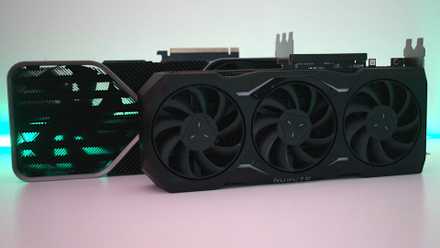
AMD Radeon RX 7900 XTX vs Nvidia GeForce RTX 4090: Which flagship GPU is best for you?
How well does the AMD Radeon RX 7900 XTX stack up against the Nvidia GeForce RTX 4090?
2 Nvidia RTX 5070 Ti
If Multi-Frame Generation is a dealbreaker
The RTX 5070 Ti isn't a great graphics card, but given how prices are for GPUs right now, it's an option to consider over the RTX 5080. It's sold out at most retailers just like the RTX 5080 is, but you can find models on the secondhand market for around $900 to $1,000. That's a significant bump over the card's list price of $750, but it's a lot more reasonable than shelling out $1,500 for an RTX 5080.
The RTX 5080 and RTX 5070 Ti aren't too far apart in raw performance. The RTX 5070 Ti is about 10% to 15% slower on average, with the numbers shifting depending on the specific game. It's just a notch below the performance that you'll get with the RTX 4080 Super or RX 7900 XTX. Those two GPUs are still better options, but given that they're last-gen cards, you're almost forced to shop for secondhand or open-box models.
That said, the real reason to go with the RTX 5070 Ti is MFG. Particularly in demanding ray tracing games like Black Myth: Wukong and Cyberpunk 2077, the difference in performance between the RTX 5080 and RTX 5070 Ti becomes irrelevant once you tick on MFG. It's not available in every game, but if you're interested in upgrading your GPU specifically to enable MFG, the RTX 5070 Ti is a serviceable vessel for the feature.
Although the card is sold out right now, I suspect it'll be available for list price much sooner than the RTX 5080. Board partners like Asus and MSI have raised prices on the RTX 5090 and RTX 5080, but those price increases haven't worked their way down to the RTX 5070 Ti. Given the awkward positioning of the card, it might be a sleeper hit if you can find one at or near list price.
MSI GeForce RTX 5070 Ti Gaming Trio OC Plus

3 Nvidia GeForce RTX 5070 Ti GPUs you should buy (and 2 you shouldn't)
Grab your dream RTX 5070 Ti for butter-smooth 1440p and 4K gaming.
1 AMD RX 9070 XT
Slower but significantly cheaper
It feels like every PC gamer is after AMD's new RX 9070 XT right now. Given the disappointing release of the RTX 5070, the RX 9070 XT has become the de facto 4K option under $1,000, and by a significant margin. It has a list price of just $600, which is very attractive if you've been considering dropping $1,000 on the RTX 5080. Unfortunately, like all new graphics cards right now, the RX 9070 XT is sold out at most retailers.
It's not a lost cause, though. Board partners suggest inventory will be better next month, and I've seen models pop up for list price at my local Micro Center a handful of times since launch. Given the popularity of the card, prices on the secondhand market are ruthless right now. Models are selling for about $900, which is tough to swallow given how low the list price of the card is.
If you want to upgrade immediately, you can justify spending a bit over list price. The RX 9070 XT performs about as well as the RTX 5070 Ti, and with a bit of tweaking, it can even get close to the RTX 5080. I wouldn't recommend spending over $750 for the card, however. Although that's still a large jump over the list price, that's the MSRP of the RTX 5070 Ti.
ASRock Radeon RX 9070 XT Steel Legend
- Memory Clock Speed
- 2518 MHz
- Architecture
- RDNA 4
- Process
- 5 nm
- Shader Units
- 128
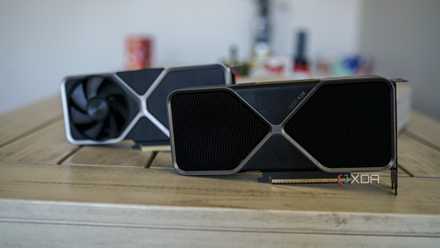
I tested AMD's RX 9070 XT against the Nvidia RTX 5070, and it isn't pretty
Two $600 GPUs. Two different performance classes.
You'll need to dig for a deal
Prices and inventory for current and last-gen graphics cards are all over the place, so the right card for you largely comes down to what you can find in stock, and for what price. All the options on this list are slower, but you have a decent chance at finding them for a reasonable price.
If you're shopping around, there are a couple of other cards to keep in mind. The RTX 4090 is faster than the RTX 5080, and it comes with DLSS. The RTX 3090 Ti is a decent option if you can find a preowned model for a good price, but it's slower than all the other options on this list, and it doesn't come with DLSS Frame Generation.