
I've been pretty frustrated with Google for a while now. The search engine has become increasingly bloated, and typing a straightforward query returns ads, affiliate-heavy pages, promoted pages, and, effectively, results that are engineered for visibility instead of answering the question I'm asking. And now, on top of that, are AI overviews that try to summarize everything, often with wrong information. Honestly, I find these more distracting than helpful. Plus, even when the answer is there, getting to it takes effort, and it led me to try to self-host a search aggregator.
That's how I landed on DeGoog, a fairly simple tool that combines results from multiple search engines into one clean interface. The service runs on my own server and has replaced Google in my day-to-day use. It might sound like a big shift, but once you start using it, it's surprising how quickly you never want to go back.
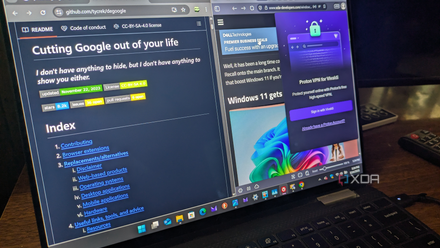
I'm de-Googling my life, and here's how I'm starting
If you want to remove Google from your life, this is the best place to learn about privacy-focused alternatives.
A simpler, more transparent way to search
Aggregated results without the clutter
Installing DeGoog is simple using the provided Docker Compose commands and the biggest difference shows up the moment you start using it. To start with, DeGoog doesn't maintain its own index of the web. That wouldn't even be feasible. Instead, it pulls requests from several search engines at the same time and presents them together. That changes how the results look and feel, not just in quality but also in presentation. You're not relying on a single opaque ranking system anymore.
As far as appearances go, the first thing you'll notice is just how uncluttered everything looks. There's no aggressive push towards sponsored links, nor will you find AI-generated summaries at the top to preempt your intent. Similarly, there's no attempt to funnel you into specific platforms. Just simple results.
That simplicity is extremely handy when you're researching things and don't want to get stuck chasing useless leads that waste time. Whether it's troubleshooting Docker containers, or figuring out a problem with your NAS, the last thing you want is to be pointed towards promoted results. I'm usually looking for documentation, forum results, even issues surfacing from GitHub that point me towards real-world fixes. With this setup, I get all of that in one pass instead of jumping between different search engines.
It also changes how I search. My search queries and parameters are more direct instead of me adding specific tags to my search term optimized for Google's results. Elsewhere, since DeGoog lets you define custom search engines, you can route searches directly to places like GitHub or specific forums without leaving the interface. There's much less friction than I'm used to. And, of course, it goes without saying that, since there are no accounts and the base aggregator runs on my own server, there's no tracking or profiling tied to my searches, making it an all-around quieter user experience.
A search experience built around my workflow
Search that adapts to how I work
What matters more than the presentation of search results is how DeGoog fits into my workflow. As a self-hosted app, it's become an integral part of my existing setup instead of something that I check in on from time to time. At home, it's my homepage, and much the same when I remotely log in on-the-go. There is no dependency on accounts, nor is there a need to sync across across devices.
And since it's my default homepage, it's what I've gotten used to using all the time as my search engine. I make significant use of the custom search engine feature and the ability to aggregate results. If I'm doing deep research, I tend to open multiple sources, anyway. With Google, I'd often find myself rephrasing the same query or switching between engines when results feel too curated. Plus, with AI overviews trying to summarize things, I feel I'm not getting the results I'm looking for, anyway. DeGoog, on the other hand, queries a much wider set of sources right from the beginning, which goes a long way towards cutting down the back and forth.
And yes, if you prefer it, there's an option for summaries within DeGoogl itself, but the difference lies in the implementation. It's not forced on you and doesn't replace the results. You can look at the quick breakdown and continue reading through the sources directly.
Since it's just an aggregator, there's no performance penalty to pay here. It runs on your own hardware, and you don't need to worry about load times or slow-downs. Predictably, you won't get cross-device integration the way Google can offer, but that's the point and the penalty of opting for a system like this. I don't see anyone complaining about it.
A search experience that works reliably, on my terms
While my frustrations with Google search weren't all-pervasive, the fact of the matter is that I need a more predictable system. I just don't have the time to be wading through irrelevant search results. DeGoog gives me that. By removing unnecessary layers, pulling in results from a much wider source base, I spend less time refining my search terms and more time actually reading and understanding the results. And at the end of the day, that's precisely what a search engine is supposed to do.
DeGoog
DeGoog is a self-hosted search aggregation tool that pulls results from multiple search engines into one clean, private interface.