
Notion is an integral part of my productivity setup. Over the last few years, I've built a comprehensive portfolio of databases, linked pages, and template workflows that help me get on top of my work and personal interests. When Notion introduced Notion AI, I thought that it would help me make sense of everything in an easier way, and yes, it works, but over time I found that its scope of work is fairly narrow. It could summarize a page or fix a sentence and help me draft something that I had already started, but all of that is fairly basic.
If I wanted it to do something with my notes, like connecting ideas across documents or creating research, that's where I found Notion AI to be less than optimal. It's fine with what it is, but it's far from the most impressive AI tool around. I realized I was wasting money on it and decided to build something that actually works better. I swapped it out and swapped out this entire stack and switched to NotebookLM for research and grounded thinking and Cloud Projects for everything that needs persistent context and reasoning. This combination solved a problem that I'd been working on for years with Notion.
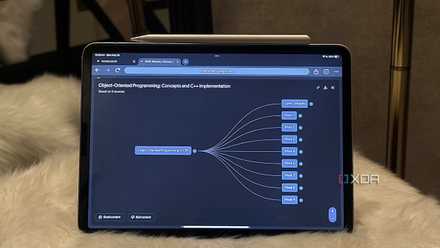
5 ways NotebookLM completely changed my workflow (for the better)
Hey Siri, how did I ever survive before NotebookLM?
NotebookLM thinks and works like a research assistant
Turning your data into a queryable knowledge base
The fundamental issue with Notion AI is that it's optimized for the wrong thing, or let me say that it's not optimized for what I was looking to do with it. Yes, it does help you produce content fast inside Notion, but it doesn't really help you think. It can't access data outside the Notion ecosystem, and even pulling connections across documents isn't perfect.
Meanwhile, NotebookLM approaches the whole thing differently. The entire service is geared towards grounded thinking. You bring the sources, which could be anything from PDFs to Google Docs, even web pages, Word documents, and YouTube links, and NotebookLM grounds every single answer in exactly that material. It might sound like a constraint, but that's exactly why I use NotebookLM. My use case is such that I do not want hallucinations. I want answers that are grounded in the encyclopedia of research that I have compiled.
I use NotebookLM as my database for every research-heavy project. Yes, I know it's not really a database, but keep reading. When I am writing something that requires pulling from multiple sources, like reports and transcripts or interviews, I put all of that information into a notebook and start talking to it. NotebookLM's massive 1 million token context window allows it to comfortably parse all of that information without losing context.
The most useful part is that once this raw information is updated, unlike my standard research workflow where I would be reading all of these documents and taking notes, Notebook lets me query all of this research. So, instead of searching for a specific quotation or a piece of information in a 100-page document, I can just ask it. But more than that, I can ask it to connect the dots between sources. For example, you might ask it a question saying, "Do the two different uploaded reports contradict each other," or you might ask it to list every train of thought connecting the entirety of a research document. Since NotebookLM bases its information on only your sources, and all of your sources, it can create these threads very easily. That's something that Notion AI didn't even attempt to do.
And that's before we even talk about additional features like audio overviews, where it helps me learn from my research by creating a two-person podcast-style discussion. Or deep research, which lets you open it up to external sources to add more data and information to your research.
Claude Projects handles what NotebookLM can't
Specifically geared for reasoning tasks
So you might be wondering where Claude Projects fits into this? Notebook LM is excellent at what it does, but it doesn't replace a proper reasoning model with memory. That's where Cloud Projects fills the gap for me.
Similar to NotebookLM, every Claude Project that I create gets a knowledge base of the same documents and notes that I've written alongside custom instructions. When I open a conversation inside that project, Claude already knows the context without me having to re-explain it. The custom instructions are where a lot of the value actually lives. I can tell Claude exactly how I wanted to respond inside a given project, the level of detail and the perspective I needed to take. A project that I'm using for research has instructions specifically tuned for it. This allows Claude to adapt to how I work instead of me adapting to it.
The other aspect is actionability. While NotebookLM is specifically built for information retrieval and learning, it doesn't really do all that well with taking action. That's where Claude Projects come in. I might ask Claude to draft a project report based on the material that I've uploaded to it, and it will do that for me. That's not something NotebookLM can do. I can also ask it to create analysis or generate graphs based on the material given to it. NotebookLM can do a few of these things, but Claude is just more versatile.
Claude Projects also benefit from the RAG architecture, where adding more data keeps improving the responses without slowing down retrieval. All that to say that NotebookLM is a research tool and Claude Projects is a workflow tool. The combination is perfect if your workflow is something like mine.
Building a better AI workflow without Notion AI
I've been using this setup for a while now, and despite it being somewhat disjointed, I don't miss Notion AI at all. Notion AI appeared like an intelligent system, but compared to what I'm doing with NotebookLM and Claude Projects, it was fairly limited in its capabilities. I miss the structure that Notion provided, but that's about it.
Between NotebookLM and Cloud Projects, I have two tools that each do one thing very well and cover the full range of research, reasoning, and project drafting that I require. I still use Notion from time to time to manage projects and keep notes organized, but the actionability and AI layer is completely separate from it, and the results have been better for it.