
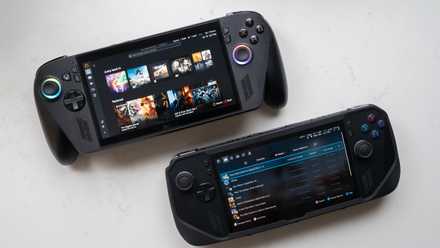
If you take a look at the modern handheld landscape with devices like the ROG Ally X, the Lenovo Legion Go, and the MSI Claw, the numbers are just jaw-dropping, with 8-core CPUs, 24GB of DDR5 RAM, and massive screens. On paper, these devices absolutely annihilate the Steam Deck's aging custom APU, but in practice you plug them in, boot up a game, and watch the battery drain 1% every minute while the fans shriek like a server rack.
The Steam Deck proved that a portable PC market existed, and hardware makers opted to copy the form factor but ignored the philosophy. They chased raw performance metrics, turning what should be an effortless pick-up-and-play console experience into a heavy, expensive, unoptimized Windows IT project. Handheld gaming requires a delicate balance of battery life, software abstraction, ergonomics, and cost. By making mini gaming laptops with controllers attached, they created expensive, power-hungry, and frustrating devices.
Steam Deck sold out? Here are 4 great gaming handhelds to buy instead
The gaming handheld market's chock-full with great alternatives to the Steam Deck OLED
The Steam Deck was revolutionary
And yet, the following handhelds still did everything wrong
Valve understood that portability means being untethered from the wall, so there's no use implementing a 30W turbo mode if it means you have to be plugged in to play. I could just do that on my PC or gaming laptop. Valve optimized the Steam Deck's APU to operate at peak efficiency between 4W and 15W. While this means that the performance he gives you might not be as groundbreaking as some of the other handhelds on the market, this simply isn't important.
When playing on a handheld device with a screen that is barely larger than the size of a standard smartphone, you don't need to be playing on high or ultra graphics; it's likely you won't notice the difference, anyway. Something that will majorly impact your experience with the handheld is the battery life. The Steam Deck being able to run efficiently at a lower wattage means that you can comfortably play for hours at a time, particularly when games are less demanding. This really makes it a portable gaming device rather than a handheld that still requires charging more often than not.
SteamOS feels like a miracle compared to other gaming handhelds. Valve built a bespoke Linux compositor to hide the Linux desktop completely. The user interacts with a unified controller-native UI that handles system-level game suspends flawlessly. You never have to worry about poking and prodding at the screen to find your tiny cursor and navigate what feels like a full-scale desktop on a tiny display. Realistically, the operating system is what hardware makers should have taken the most inspiration from, as it makes using the Steam Deck feel completely painless.
Windows handhelds did everything wrong
Despite having a blueprint, the vision was not achieved
The first major issue that you encounter if using a gaming handheld is that they are completely inefficient. Modern Windows handhelds are bragging about 30W turbo modes. While this sounds great in theory, because you can maximize your performance when it comes down to the fundamentals behind a handheld, maximizing your performance likely isn't the reason the consumer has purchased one.
When it comes to the physical reality behind mobile silicon, doubling the power draw from 15W to 30W doesn't in turn double your framerates. It usually yields a 15 to 20% performance bump, and whilst this is significant, it results in your handheld generating twice the heat and cutting the battery life to under an hour. It's not really worth the payoff here, particularly for on-the-go gaming.
Another barrier to entry is the lack of software cohesion. Compare SteamOS to Windows on a gaming handheld, and the difference makes the former feel like an absolute miracle. Hardware makers just slapped proprietary software launchers (whether that's Armory Crate or Legion Space) on top of a standard Windows 11 UI, and this led to a ton of different points of friction. From Windows updates interrupting gaming sessions, to aggressive anti-cheat software tanking mobile CPU threads right down to the inevitable moment a game crashed drops you onto a microscopic desktop where your controller stops working.
A price no one could compete with
Its low cost propelled the Steam Deck ahead
Prior to the recent Steam Deck price hike, it felt like the cost of the Steam Deck was a feature too. Valve launched the Steam Deck at a disruptive baseline price that other hardware competitors just couldn't match. Even the premium OLED models sat comfortably in console purchasing territory. They subsidized the hardware costs through Steam game sales.
Traditional hardware companies like Asus, Lenovo, and MSI don't own a massive game storefront. This means they have to make a profit entirely on the hardware margins themselves. This forces them to position their devices as premium luxury goods that cost $700 to $900 and sometimes more. At that price point, a handheld is no longer a companion console. It's competing directly with dedicated gaming laptops and even mid-range desktop builds.
A successful next-gen handheld should be a true Steam Deck killer, but there are a variety of different elements it needs to implement in order to do this. Realistically, it'd need to prioritize battery density over CPU TFLOPs. There's no use chasing 80Wh batteries just to sustain a baseline 30W drain. Chips should be optimized for maximum performance per watt at sub-12W limits in order to compete with the Steam Deck.
I just don't care about the Steam Deck 2 anymore
The Steam Deck's sequel won't revolutionize the industry in the same way the original did.
They should also fund a dedicated software fork, rather than relying on Microsoft to fix the handheld experience. They should either deeply collaborate with Valve to license SteamOS natively or fund an open-source, locked-down Linux/Windows shell that obliterates desktop background processes.
Gaming Gear Deals: Save on Handhelds, Accessories & More
The device should also be optimized for acoustics and ergonomics. A handheld must feel good in the hands for more than 30 minutes. Shrink the PCB footprints, prioritize lighter materials, and engineer larger, slow-spinning fans that don't whine during gameplay.
A handheld shouldn't be treated as a PC
It should be treated as a handheld
The Steam Deck wasn't a hit because it was a powerful PC. It was a hit because it was a brilliant handheld, and despite being one of the first of its kind in the modern era, it did everything seemingly correctly. Realistically, it's time for hardware makers to stop treating handhelds like miniature laptops until they stop chasing benchmark charts and start designing for the realities of mobile ergonomics. Valve's low-spec, high-optimization masterpiece will continue to run circles around them as they completely misunderstood why the Steam Deck captured the world's attention. Valve didn't win because of raw teraflops. They won because of value optimization and software cohesion.
Steam Deck OLED
- Dimensions
- 11.7 x 4.6 x 1.9 inches (298mm x 117mm x 49mm)
- Weight
- 1.41 pounds (640 grams)
- Chipset
- Custom AMD Zen 2 APU (4 cores/8 threads, up to 3.5GHz boost)
- RAM
- 16GB LPDDR5 6400MT/s
- Storage
- 512GB or 1TB NVMe SSD, microSD card slot
- Wireless Connectivity
- Wi-Fi 6E & Bluetooth 5.3
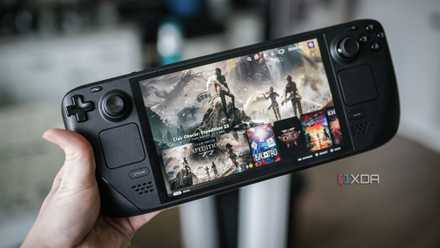
Valve's upgraded Steam Deck features a larger OLED display with HDR support, faster Wi-Fi, and a bigger battery. Plus, this new model is slightly lighter, has slightly faster RAM, and it comes with storage up to 1TB. If you're looking for the ultimate Steam Deck, this is the version for you.