
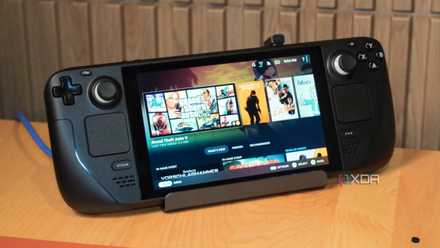
Steam has long dominated the PC gaming landscape with software. Valve's storefront is far and away the most popular place to buy and play PC games, complete with features like achievements, game recording, and shared game libraries. With the Steam Deck, though, Valve also started breaking ground in the hardware space, and it's easily dominating the PC gaming handheld market.
In my opinion, this is (at least in part), both a cause and consequence of how great the Steam Deck Verified program is. And with the upcoming Steam Machine, that same principle could benefit even more gamers in the long run. These verification programs have brought the best part of console gaming to the PC market, and I hope it only gets better from here.

4 ways the Steam Deck changed PC gaming forever
Valve broke new ground with the Steam Deck that launched PC handhelds into the stratosphere.
Finding common ground
A single platform to optimize for
The thing I love about console gaming is that it's a unified, predictable experience. Barring some unusual bugs, every game for a console runs exactly the same for everyone who buys that game. It's the same game with all the same optimization work done for it, so no user in the community feels left out if they end up buying the game. Sure, some consoles have "pro" models that may give you better performance, but games still have to be designed to work on the base hardware, which is where most users are anyway.
This means everyone generally has a good experience, and when they don't, it's easy to trace the blame back to the developer, rather than the platform. A game running poorly on a given console can't be chalked up to your particular device not being good enough, or having some weird configuration that breaks it. It's entirely up to the developer to make sure the game runs optimally on that hardware.
PC gaming has never really had that. There's an incredible amount of variety in the PC world, even for devices that are aimed at gaming. You can combine dozens of different CPUs and GPUs, different RAM brands, and you can make changes to the operating system that might break something. Typically, games should run well as long as you have decent specifications, but it's always a bit of a gamble.
The Steam Deck Verified program, and the upcoming Steam Machine Verified program, change things because they give the PC community a common platform that a lot of people will be using. The Steam Deck alone has sold over four million units (the last comprehensive report is almost a year old, so that number is likely higher), so it would be unwise for a developer to ignore that platform and not optimize the game for it. And while the success of the Steam Machine is up in the air, the same could happen for it.
This benefits Valve's own devices most of all, but it also helps everyone else. A game that runs and works well with the Steam Deck and Steam Machine is that much more likely to work well on similar pieces of hardware that previously didn't get enough of a focus.
4 reasons Valve's full SteamOS release will change PC gaming again
Valve's full SteamOS release will change PC gaming again, and here are some of the most important ways.
Optimizing for low-end hardware
And specific unusual configurations, too
Before the Steam Deck, it was easy to assume that certain devices just weren't a priority for optimizing games. If your PC doesn't have a discrete GPU, it's probably not trying to be particularly great at gaming in the first place, so no modern game was particularly focused on optimizing for that kind of hardware. Especially because cheap devices are a dime a dozen, and they all have different components that make attempting to optimize for that hardware not worth the effort.
However, the Steam Deck itself is a fairly weak piece of hardware compared to contemporary PC components, as you'd expect from a handheld device. It's powered by what's essentially a laptop-level processor, and in many ways, not even one of the best laptop processors at the time. At the same time, it's an extremely successful device, especially within that price range, which gives developers a very clear target they need to aim for in order to reach as wide of an audience as possible.
Because of this, have a clear incentive to optimize games for lower-end hardware. Not only is the Steam Deck a very successful device that constitutes a large addressable market for any game, but the Steam Deck Verified badge helps make it that much clearer that your game is optimized to run on that hardware, increasing sales potential that much more. And in obtaining this verification, developers end up creating a game that runs well on any gaming handheld, whether it's the Steam Deck or not, as well as most laptops. I've always defended that AMD's Ryzen Z series should have its own certification program, but as it stands, the Steam Deck does a lot of that heavy lifting because it's an even lower performance target.
Companies want their games to have a good reputation on the Steam Deck
It's true that the Steam Deck Verified program doesn't necessarily guarantee that a game will have great performance on the Steam Deck, but developers who want that badge on their games want to make sure their games actually work well. When aiming to obtain the Verified badge, they'll also optimize performance. Bethesda did it with Quake, and even a game like Cyberpunk 2077, which is typically very intensive, has a dedicated Steam Deck profile to ensure it runs well on the handheld, and that graphics preset will also run well (potentially even better) on any other handheld, even though no other PC gaming handheld would be likely to sway the developers to create a dedicated performance profile. Companies want their games to have a good reputation on the Steam Deck because it's such a large platform, so they have to optimize it the performance as much as possible. Only the Steam Deck can do that because it has the sales numbers and a dedicated page on the Steam storefront to find verified games. You would never see that with the Asus ROG Ally or Lenovo Legion Go.
The verification program also helps ensure that games look great on a small, low-resolution display with readable text, which is a pretty big aspect of making games more accessible. Plus, it helps ensure games support controllers out of the box and make it easier to get started without a mouse and keyboard. While the infinite inputs of a PC keyboard are great, the simplicity and intentional design of a gaming controller still make gaming easier for most people, so this opens up PC gaming to even more people.

If I needed a gaming laptop on a budget, I'd just get a Steam Deck
Gaming laptops have a new competitor in town, and it's here to stay
Still not quite a console
I'll stick with my Switch 2
Of course, there's only so much that can be done when it comes to optimizing games for PCs. Even with the common ground provided by devices like the Steam Deck, the variance in hardware between different computers is simply too vast, and the software is almost just as likely to be a problem. Computers may be set up in different ways or run into all kinds of issues that break certain games, and while the Steam Deck does address some of those issues with its immutable operating system, it can only do so for itself. The majority of gaming PCs will keep running Windows and other versions of Linux, which means they'll always be prone to some problems.
It's still different on consoles where the scope of hardware configurations is much more limited and users have far fewer options (if any) for modifying the operating system, which makes more likely performance will be great on every single unit of that console, whereas PC games can still have some variations due to all the different hardware configurations. Plus, consoles are even more popular than the Steam Deck, so there are more incentives to optimize games even more on those platforms.
6 things the Steam Deck could learn from the Nintendo Switch 2
The Steam Deck is great, but it's far from perfect.
Valve is helping PC gamers everywhere
While I will be keeping my gaming time focused on consoles like the Switch 2, I do like how the Steam Deck is making PC gaming better. A more predictable and reliable experience is the best part about playing on consoles, and seeing something even resembling that on PC can only be a good thing. Hopefully things get to a point where PC gaming is just as painless as console gaming, though we can only dream of such a time.