
For the sake of honesty, I'll admit something upfront: I don't know Linux the way I know Windows, in and out. I didn't grow up dual-booting Ubuntu, and I wasn't the guy on forums telling people to "just use the terminal" like it's a personality trait. But I have used a Steam Deck, and more importantly, I've seen what SteamOS represents.
Because SteamOS hasn't magically turned Linux into the world's default desktop OS overnight. Linux remains a small slice of the desktop pie globally, but what SteamOS has done is prove something way more valuable: Linux doesn't need to look like Windows to earn more users. It needs to feel like it knows what it's trying to be. And SteamOS might be one of the clearest answers Linux has ever had to that problem.

Linux doesn't need to be just "Windows, but free"
What it needs is a self-reliant confidence
For years, it felt like the Linux desktop chased the same idea: "If we can just make this look familiar enough, people will switch." And sure, that makes sense on paper. Familiarity lowers friction. But SteamOS doesn't chase Windows energy at all — not on the Steam Deck, and not even on any desktop or laptop you load it with. It doesn't greet you like a desktop first, either. It greets you like a platform. Something you can hand to a normal human being without also handing them a YouTube playlist titled "Linux basics beginners 2026."
That matters way more than people realize. The average person isn't hunting for an operating system. They're hunting for an experience that doesn't fight back at all. SteamOS proves Linux can get more adoption by being self-assured, not by being a Windows impersonator with a different logo. It doesn't scream that it's an alternative. It just quietly says, "Here's what I do. Press play."
Linux Mint
"Windows clone" Linux distros are a total disservice
They are counterproductive for everyone involved
Some Linux distros have this genuinely misguided idea that the fastest way to get Windows users onboard is to trick them first. They try providing the same taskbar, start menu, icons, and vibes to users who, for the most part, are new to Linux. On paper, that sounds comforting, and a lot of users come in expecting a familiar UI, an easier transition to a new platform, and less fear. Sadly, it ends up being more of a trap rather than a transition.
That's because Linux isn't Windows with a different coat of paint. It's not even trying to be. The second a new user tries a Windows-specific workflow in something like Wubuntu or Winux, the illusion cracks, because the usual commands, installers, and EXE files don't work. When it cracks, they don't blame the distro for being a confused cosplay attempt, but they end up blaming Linux itself. That's how you end up creating brand-new Linux haters who were this close to actually giving it a fair shot.
And what's annoying is that taskbar position alone doesn't lock users in. People use Windows because the software ecosystem is glued to it. Office, Adobe, all multiplayer games, anti-cheat kernels, and the whole "it just works because everything supports it" reality. So, instead of pushing these "Windows-but-worse" distros, Linux would genuinely be better off embracing its own workflow and identity — like SteamOS does. It's a different OS with different rules that breeds new habits. All it does is sidestep being a fake Windows parody that collapses the moment you touch it.
Credit where it's due, distros like Zorin and Linux Mint really do help onboard new Windows users through familiarity and their use of Flatpak and Proton for most apps. There's no trickery involved there, but that doesn't mean that it's the way forward. A clear, Windows-less identity is what Linux distros need so they don't backfire by creating false expectations.
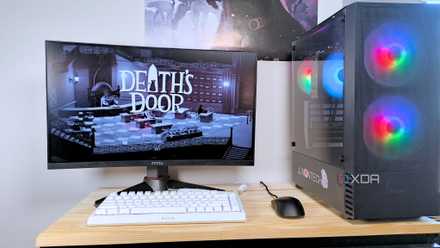
I built a Steam Machine out of spare PC parts and you can, too
If you have old PC hardware lying around or an aging Windows laptop, you might be able to breathe new life into it with SteamOS
SteamOS makes Linux approachable by making desktop optional
That's the biggest difference, and it's kind of genius
SteamOS is Linux, yes, but it doesn't throw you into Desktop Mode as a rite of passage. It gives you a clean Gaming Mode first, and only lets you "go desktop" if that's what you actually want and choose. That one choice changes so much, because the truth is that most people don't wake up excited to manage an OS. They just want their games, their library, their settings, and their downloads without feeling like they've enrolled in a computer science elective.
SteamOS lowers the intimidation factor by hiding the complexity behind a UI that behaves like a console. It doesn't demand that Linux be your whole identity, either. Instead, it just lets Linux be the plumbing underneath something friendly. If Linux wants more users, it needs more "you don't need to understand this" moments. SteamOS, thankfully, is packed with them, and for a first-time Linux user like me, that makes all the difference.

10 of the best AAA games you can play on Linux in 2025
A formidable number of AAA titles are fully playable on Linux today, proving that the OS is no longer an underdog when it comes to gaming.
SteamOS's Desktop Mode isn't pretending to be Windows, either
Desktop Mode isn't the main character here
Despite everything SteamOS provides its users with — simplicity, ease-of-use, and a Big Picture Mode that cuts right to the chase — it still has a desktop. It isn't some weird, bargain-bin copy of Windows, either. It's KDE Plasma, a full desktop environment that's been around for years with its own identity and flexibility. You've got mouse-and-keyboard PC behavior, you've got the ability to tinker, and if you even need your Steam Deck to turn into a mini computer, it can do that.
But SteamOS doesn't force Desktop Mode to be the main character. Rather, it's a side door instead of the front entrance, which is kind of the entire thesis in one sentence: Linux doesn't need to win by looking like Windows. It can win by being useful without the user needing to think about it. That's the lesson SteamOS offers the Linux desktop world: build an experience people actually want to join, and stop assuming the only path forward is copying the OS they already know.

PC gaming handhelds will never escape being second-class consoles
The ceiling will always be "console-like."
SteamOS's "curated Linux" approach makes it work
Valve's OS removes any uncertainty or friction, giving you confidence instead
Linux desktops can sometimes feel like walking into a warehouse full of tools — they're all technically impressive, but you don't know where to start. SteamOS, on the other hand, gives you a clean showroom with transparent shelves to get you started. It does that through things like Steam Deck Verified, where Valve, in no-nonsense fashion, just tells you whether a game works well, needs tweaking, or shouldn't be bothered with. That's the kind of consumer-friendly clarity Linux has historically struggled to provide.
If there's one thing mainstream users despise more than anything else in the world, it's uncertainty. SteamOS absolutely gets that right by not giving you options, but confidence instead. Through SteamOS, a messy PC question gets answered console-style. Linux-based distros don't need to become restrictive to grow. They just need better defaults, better guardrails, and fewer moments where users feel like they've fallen off the map. "Curated Linux" can be a gateway, and it's that approach wherein lies the answer the Linux platform needs to succeed and find more adoption worldwide.

5 reasons you shouldn't install Windows on the Steam Deck
The Steam Deck can install Windows and has drivers for its hardware, but it's not a great experience.
Linux needs to become digestible first, mainstream later
SteamOS hasn't rewritten the global desktop market overnight. It's still not the default choice for the majority of people using a desktop or laptop, and anyone pretending otherwise is engaging in propaganda. The OS has made some significant strides in growth lately, but what it needs is to shed its tag of being "complex." SteamOS has proven that Linux could do just that by actively trying to not look like Windows. Instead, all it needs to do is feel like it was designed for humans.
Give it a purpose-led interface, a console-first experience, and compatibility solutions that immediately work with new users. Make the desktop available when you want it, not shoved in your face like homework — that's the blueprint for gaming-focused users. If Linux desktops want more users, the answer is never going to be behind a Windows costume. It needs to become frictionless to succeed, not "more like Windows."