
Whether you're assembling a new rig or upgrading your old powerhouse, 2025 delivered some compelling GPUs across the stack, for every use case and budget. The year brought a mix of solid entries from both NVIDIA and AMD. Amid the show of the Blackwell-powered muscle of Team Green to the value-driven RDNA 4 advancements from Team Red, we also witnessed a surprisingly robust response from Intel with its wild card entry into the market, as the chipmaker continues to win back its place in the GPU market.
Here are the best GPUs released in 2025, all of which can transform your gaming experience, revitalize your productivity, and bridge the gap between what's good enough and what's utterly groundbreaking.
AMD Radeon RX 9070 XT
Best overall, no questions asked
Team Red has flipped the script, and the AMD Radeon RX 9070 XT takes the crown as the premier GPU of 2025. Thanks to its robust RDNA 4 architecture, which delivers strong rasterization performance at a very compelling price point, the 9070 XT rivals the RTX 5070 Ti in both throughput and VRAM buffer. Equipped with 16GB of GDDR6 VRAM, the card offers stellar performance at 1080p, 1440p, and 4K resolutions, making it one of the most affordable cards to support UHD gaming.
The real triumph of the card, however, lies in its revamped features, which saw a significant jump versus preceding cards in the Radeon family. AMD brought demonstrable improvements with FSR 4 over FSR 3, and as developer adoption continues to grow steadily, the upscaling technology is emerging as a formidable opponent to NVIDIA's DLSS. The RX 9070 XT's excellent raster performance, optimized power efficiency, and competitive pricing make it the go-to choice for most gamers and creators alike in 2026.
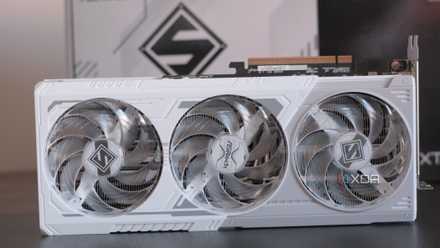
AMD's Radeon RX 9070 XT is the most exciting GPU to launch in years
It's here. It's brilliant. Go and buy one.
Nvidia RTX 5090
The best high-end graphics, second to none
It is often said that it gets lonely at the top, and such has been the case for the NVIDIA RTX 5090, which stands uncontested in its position. AMD and Intel are yet to come up with an answer to it, and that absence defines the card as much as its raw performance. This is the fastest consumer GPU on the market, and without its mention, the list would be justifiably disingenuous.
So, what can you do with one? There really isn't much you can't do, since the RTX 5090 is built for users who want raw, uncompromising performance at every turn. Whether it's heavy rendering, advanced ML workloads, large-scale productivity tasks, or performance gaming, this card can do it all. Its massive 32GB of GDDR7 memory offers a headroom that extends past typical desktop usage.
That being said, the performance does come with a few trade-offs you'd want to be wary of. The RTX 5090's price is still prohibitively high, keeping it firmly out of reach for most buyers. The power consumption is equally punishing, with the card hitting 575–600W under full load, sometimes even overloading its power connectors in the process during transient spikes. With great power comes great electricity bills. But that's the price you pay for performance that defies all ceilings.
AMD Radeon RX 9060 XT
The best mid-range card
Choosing between the RX 9060 XT and the RTX 5060 Ti wasn't straightforward, and in many ways, you can call this spot a tie. In many workloads, the two trade blows quite evenly, and when comparing pure hardware specifications, I would lean in favor of Team Green. However, markets don't operate in a vacuum, and the 9060 XT pulls ahead on its value proposition.
AMD's approach to the mid-range market is simple and effective, which is to offer neck-to-neck rasterization performance while undercutting the closest competitor. At an MSRP of $350, the 16GB variant comes close to the RTX 5060 Ti's performance but ultimately takes the crown in the price-to-performance arena. As has always been the case, GPU economics play a greater role in determining victory in the consumer market. However, this also means that if you can't find a 9060 XT at MSRP or one that competes with Team Green's mid-range entry, it would be wiser to go for the latter.
Intel Arc B570
The king of the budget builds
With the new Arc B570, Intel has yet again delivered one of the most compelling budget GPUs the market has seen in years. The B570 is marked $30 below the Arc B580; it shares the same 272 mm² die, but with a 10% reduction in Xe cores and a modest 4% drop in peak clock speed. It must sound like a compromise, but it doesn't feel close to one.
The B570 is still miles ahead of the competition, with VRAM allocation being a key differentiator. With 10GB of GDDR6 memory on a 160-bit bus, it offers a tangible advantage over budget cards stuck at 8GB. While not a lot, the VRAM allocation helps avoid a significant amount of time wasted dabbling in settings gymnastics, especially for first-time budget builders.
What's worth a mention is that Intel has been proactive with its support for both its Battlemage and Alchemist series of GPUs. Team blue addressed one of the Arc platform's early pain points by fixing the CPU overhead issues on older processors that deterred buyers, making them far less picky about system pairings. As the B750 is built on the Battlemage (Xe2) architecture, Intel has confirmed that it will fully support XeSS 3, including multi-frame generation features to come. The card offers a fantastic entry point into PC gaming by empowering gamers where it counts.
As for the GPUs, what's true, and what always will be, is that there is no single 'right choice', but only one that's best aligned with your workflow. That being said, you can't really go wrong with any of these four.
Competition, finally
The GPU market is getting healthier, and it most certainly is in a better shape now than it was before. While NVIDIA still owns the performance extremes, AMD has greatly refined its value proposition, and it's a pleasure to see it fast escalating into something genuinely disruptive. Intel's wild-card entry with its Battlemage family of GPUs continues its momentum against the longstanding duopoly, which is always worth celebrating in one of the most competitive markets in the world.
As for the GPUs, what's true, and what always will be, is that there is no single 'right choice', but only one that's best aligned with your workflow. That being said, you can't really go wrong with any of these four.