
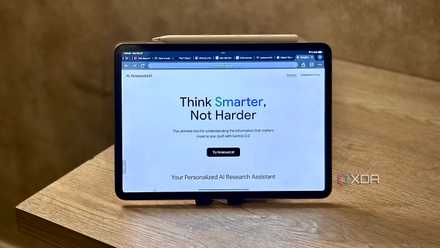
Anyone following along with the AI boom in the past couple of years has likely heard of and used Google's NotebookLM, an academically oriented research assistant grounded solely in the sources you define. It's a brilliant use of Gemini's big data handling capabilities at an individual level, especially paired with tools like Audio Overviews, Interactive Mode, and Flashcard generation.
However, NotebookLM is plenty useful even if you're out of college. In the past year alone, I've used it to find words I overuse in all the articles I've written, sharpen an elevator pitch for a friend's start-up, and teach myself the art of re-grinding a fountain pen nib. Of all these uses, I find one non-research application the most fascinating: giving my complex user manuals a voice.
The premise: wanting information without opinions
Unbiased is next to impossible
Often, I need a certain question answered, and using the web has ingrained the instinct of Googling for it immediately. When you're seeking definitions, like what an "M.2 2280 SSD" is, or anything with a singular, definitive correct answer, Google won't let you down. Chances are, the AI summary will contain all that you need to know. Follow that up with one reading of an informed source, like a dictionary for a definition, or a forum post for more technical topics, and your question stands answered in under a minute.
Unfortunately, I can't say the same for more technical subjects and questions about procedures, processes, and techniques. You see, in decades of doing something, like "cleaning dust from a PC," every subject-matter expert has inevitably developed their own efficient method depending on the available resources, time at hand, and the scale of the task they're tackling. But I, seated on the other side of the Google search results, still need to read four or five webpages about this method to understand the variables, and adjust them to my needs, like requiring a can of pressurized air or re-pasting the CPU.
This information is typically opinionated and not strictly by the book. It doesn't hurt to follow learned best practices in some scenarios, like the pattern of thermal paste application when re-pasting the heat spreader, but in a hobby like photography, I just want to find the option that saves my current camera settings as a preset, instead of a 10-minute video from someone about what they think are the best camera settings.
The solution: NotebookLM makes manuals interactive
Like talking to the book as if it were sentient
When I need information straight from the source, the manufacturer-issued manual is typically the most reliable resource. Everything from cameras to cars comes with one, and feeding them to NotebookLM is a sure-shot way of sidestepping opinionated best-practices guides and instructions for something simple like cleaning dust off the image sensor or changing the oil on your car. All I do is upload the manual or documentation for each product I need help with, and then ask the chat section about my specific query.
In the rare situation where the AI struggles to provide a convincing, well-annotated answer, I can use the internal source discovery tools to find more pertinent information from well-informed academic sources instead of the typical click-hungry ones looking to make quick bucks off ad revenue without adding much value. That's seldom needed because product manuals tell you the correct way to do things, forming a foundation for experiential optimization, where you refine your technique based on learning in the process.
For instance, I had a fair amount of trouble trying astrophotography initially. So, I just fed NotebookLM, NASA's guide to smartphone astrophotography, and my Sony mirrorless camera's user manual. The Google AI seamlessly adapted the beginner-friendliness of NASA's guide to the additional flexibility of using a camera instead of a smartphone. Carefully inquisitive questioning helped me understand how aperture control on my camera improves light-gathering capabilities way more than a fixed-aperture smartphone. The text was well-annotated and purely based on technical facts ungarnished by preferences. I thoroughly enjoy the freedom of quizzing documentation this way, as though it were a sentient being that could talk back to me. Setting up new cameras for specific shoot scenarios is also way easier with NotebookLM by your side.
Add to this the plethora of Studio tools NotebookLM includes even in the free tier. They've grown from just five when the project launched, to almost 10 now, with personalization embedded in each option. I can tune the length and focus of Audio Overviews, hear it out in a language I prefer, and still interrupt the podcast-style readout to quiz the hosts in real-time. This isn't quite as seamless and informative as Gemini Live, but is plenty useful with the anti-hallucination guardrails afforded by your curated source list. So, I can always listen to a podcast about Aperture Priority mode on my camera and pause at any point to ask if I could manually lock the ISO setting later. With Flash Cards, I can make glanceable cheat sheets for how to use such features, too.
Save on AI tools, software subscriptions, and productivity deals
Mind Maps aren't the most well-arranged yet, but they help break complex topics or setting groups from my camera's manual into logical groups. So, you might see the custom settings featured above basics like exposure, shutter speed, and ISO in the generated map, but expanding the branches allows creating your own on a sheet of paper. I sincerely hope Google allows us to click and drag to reposition mind map nodes in NotebookLM soon. Perhaps most importantly, I can test my knowledge of concepts I think I understand using the Quiz option from the Studio sidebar.
Go beyond simple research
NotebookLM was created to help academicians research subjects, but integrated source discovery, a chatbot, and several Studio tools make this Google AI utility far more versatile. Even on the free tier, it's great for interrogating texts through citations, structuring disorganized content, and managing complex projects. The only limits to its applications are what you'd think the AI cannot do.
NotebookLM is Google’s AI-powered research assistant that turns your uploaded documents, notes, and sources into an intelligent, conversational workspace that helps you connect ideas, summarize insights, and generate new ones.
NotebookLM can now search the web, and it’s a game changer for research
Let NotebookLM handle the research for you