
The primary reason for picking up a network-attached storage (NAS) unit for your home may be to store your files. But you can easily go beyond the basics to make the most of your NAS. If you’re new to the world of NAS, you might be surprised to learn about the numerous ways you can use the device you already own. And if you’re still on the fence about buying a NAS for your home, this could give you reasons to take the plunge and make your digital life much easier to manage.
Here are all the ways you can use your NAS to simplify your tech life at home.
8 Back up your family’s devices
A NAS is a robust backup solution for your computers
As a central storage device in your home, a NAS can safely back up all your computers. Mac’s Time Machine feature can use your network storage unit as a direct destination for periodic backups and restorations when needed. While the native backup solution on Windows doesn’t support NAS backups, you can use the bundled tools provided by NAS makers to bridge the gap — and they work reliably well.
For example, I use Synology’s Active Backup for Business to automate backups on my Windows laptop. This method creates a complete image of the PC on the NAS, which can be used to restore the system if the laptop dies or needs a reset.
While smartphones don’t typically support full-device backups to a NAS and rely on cloud storage, you can still save important files, like your photos and videos, to the NAS.
7 Keep your media in a safe space
What Google Photos?
Many of us pay for a Google One subscription to have ample space for our countless cat videos and photos in Google Photos. But if you have a NAS, you can save on that recurring subscription fee by using it as a Google Photos alternative. Plus, you won’t have to deal with Google’s compression, which reduces the file resolution in storage saver mode. That means your 4K videos can remain at their original quality without you worrying about running out of storage on your phone or in the cloud.
Since each family member can have their own NAS account, they can share the storage pool to keep all home videos safe. Personally, I use a combination of Synology Photos and Google Photos — the former to preserve high-quality media and the latter for smart AI tools and sharing features, giving me the best of both worlds.
6 Your own security manager
Your security cameras can call your NAS their new hub
Many NAS brands come with built-in complementary software to handle live security camera feeds, manage those cameras, and store footage for the long term. This provides a one-stop solution for managing your home’s security system.
Some security cameras integrate directly with the CCTV software provided by NAS makers, simplifying the management of multiple cameras. Additionally, certain third-party cameras, like my Xiaomi model, support backing up footage to a NAS in tandem with onboard SD card storage for added security.
For privacy-conscious users, this approach keeps security data under their control, away from paid cloud storage solutions offered by security camera brands.

I saved money by building a NAS-powered home surveillance system
Creating your DIY home security system is easy with a NAS and IP cameras.
5 Media streaming over Plex
This has to be the biggest reason to install a NAS at home
If you’ve put in the work to digitize your Blu-ray collection, setting up your own Netflix-like streaming service on a NAS is the next logical step. Unlike Netflix, there’s no monthly fee, and you own the content without worrying about licensing expiration, which is usually the cause of your favorite movies disappearing from streaming services.
Plex is by far the most popular choice for setting up a media server and is natively supported by mainstream NAS brands like Synology and QNAP. Once configured, Plex (or alternatives like Kodi) indexes your content, allowing you to stream movies on any device within your home network just like you would use an online streaming service.
A lot of people actually purchase a NAS to stream Plex itself. Modern NAS models are ideal for powering your home theater system as they can decode 4K movies without a hiccup. You can further personalize the experience with multiple user profiles for each family member.
4 It’s your personal cloud, too
Turns out you don’t need to rely on Google Drive
You get cloud storage to easily access your files, irrespective of your device or location. But you know what, a NAS can do that too! Your NAS can provide cloud storage-like features, enabling quick and easy file access from anywhere. In fact, Synology has its own alternative to Google Drive, unimaginatively called Synology Drive, that looks and feels like the former to make it easier for people to transition over. It even comes with robust collaborative features to share documents with your teammates.
A key benefit of having personal cloud storage is control over your data. Sensitive files, such as tax records or health documents, can be securely stored without the risk of third parties processing them for advertising purposes. Additionally, a NAS offers ample storage for freelancers without hefty monthly subscriptions, eliminating the need for portable hard drives that are prone to failure.
3 Cross-device file syncing
Your files available everywhere
It is often difficult for professionals to eliminate cloud storage from their workflow since services like Google Drive and Microsoft OneDrive are commonly used tools for sharing files with external users. A more sensible middle ground is to use these services concurrently with your NAS. Most NAS brands let you sync files between your NAS and online storage services from Google and Microsoft, while Docker solutions exist (albeit, quite involving) for iCloud syncing, too.
Furthermore, apps like Synology Drive also enable file and folder syncing across computers and your NAS, ensuring that all your files are up to date across your devices, allowing you to jump between your work and personal laptops without missing a beat. Even non-professionals can use these tools (often bundled for free with the NAS) to keep family files synchronized, no matter the device.
2 Host your own website and email account
You have your own server — put it to use!
If you are a freelance professional with a website to show off your work portfolio and a custom email address, you can save on those costs by moving the two to the server that is sitting right on your desk. A mid-tier NAS has enough power to host a small website along with your email server. Setting those up is not that difficult either, with support for WordPress for websites and a native mail exchange server to power your email account.
Privacy is definitely a compelling reason to set up your email server, but there are other advantages as well. For instance, you get virtually unlimited storage, which is often restricted on online services, and greater control over spam filters, while offline email access during internet downtime is another bonus.
1 Adding a layer of data security
No device offers redundancy like a NAS
All these features would be meaningless if your data isn’t secure. Frequently moving all your data to portable hard drives may seem convenient and low-cost, but these drives are known to fail unexpectedly, leading to permanent data loss. While NAS-specific hard drives can also fail, these enclosures are far more resilient to drive failures thanks to abundant redundancy measures.
Even a basic two-bay NAS uses RAID to protect your data if one drive fails, with larger units offering even better efficiency. This level of security ensures that years of family photos or critical business files won’t vanish one random morning — that peace of mind alone justifies investing in a NAS.
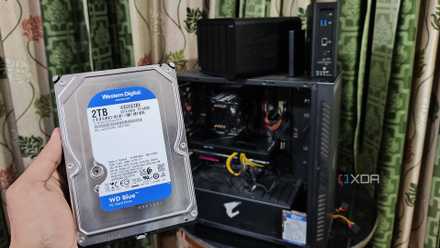
Pre-built NAS vs. DIY storage server: Which one’s better for you?
Having a hard time deciding whether you should assemble a NAS or buy a pre-built enclosure? We're here to help out!
My NAS, my way
NAS enclosures are designed to handle all these tasks and more simultaneously. However, you don’t need to use every single one of these features and complicate your setup. If Google Drive suits you better, skip cross-device syncing on your NAS. Want a NAS for media streaming or surveillance only? Go for it — they excel at those tasks. The point is that a NAS is a versatile tool you can customize to meet your needs, and as a new user, you should know its full potential.
QNAP TS-464
- Brand
- QNAP
- CPU
- Intel Celeron N5095
- Memory
- 8GB DDR4 (max. 8GB)
- Drive Bays
- 4
- Expansion
- 2x M.2 PCIe 3.0, 1x PCIe Gen 3 x2
- Ports
- 2x 2.5 GbE, 2x USB-A 3.2 Gen 2, 2x USB-A 2.0, 1x HDMI
QNAP's TS-464 is an impressive four-bay NAS with a striking design, powerful internal specs, and IR support for a remote control. If you're looking for the best-equipped NAS for running Plex (or other media solutions) without spending a small fortune, this is the NAS for you.