
Summary
- New tablet devices like the iPad Pro M4 and Surface Pro 11 are powerful but lack great detachable keyboards.
- The Flex Keyboard for Surface Pro 11 offers Bluetooth support for detached use, providing better viewing angles.
- Modern tablets lacking balance when connected to detachable keyboards prompt a need for heavier keyboards or lighter tablets.
Tablet computers are becoming impossibly powerful, and this year's new releases prove it. The new iPad Pro is Apple's thinnest device ever — smaller in thickness than an iPod Nano — and yet it includes the company's most powerful M4 chipset. The just-announced Surface Pro 11 has the Snapdragon X chipset, and that platform is going to give Apple Silicon a run for its money. So, what's holding tablets back? The popular answer is software, and it applies to both the Surface Pro 11 and the iPad Pro. Windows 11 is still lacking in optimization for touchscreens and Arm chips, and iPadOS is, well, iPadOS. But if you ask me, I'll give you a different answer: it's their detachable keyboards.
Touchscreens are the preferred way to interact with tablets when you're using them as a tablet. You can use your fingers when you don't need precision, or a pen when you do. However, when you want to use a tablet like the Surface Pro 11 or the iPad Pro M4 as a computer, you'll need a keyboard. The problem is that detachable tablet keyboards are inherently flawed, and I don't see them getting fixed anytime soon. Microsoft has a new Flex Keyboard for the Surface Pro 11, and it's an improvement. Still, it's frustrating to know that we've managed to figure out how to get desktop-class processors into tablets, but we can't figure out how to make a great detachable keyboard.
What's new with the Flex Keyboard
You can now use it while it's detached with Bluetooth support
If we look past the Snapdragon X upgrade for a minute, the Flex Keyboard is one of the biggest highlights of the Surface Pro 11. Surface devices have always had detachable keyboards, but this one still works when it's detached. There are pins that connect straight to the Surface Pro 11 when it is attached, but it also has an inbuilt battery that lets the Flex Keyboard connect over Bluetooth. For me, the biggest advantage to this is that you can get better viewing angles. It's now possible to move the Surface Pro 11 back and keep the Flex Keyboard close to you. Better yet, as Microsoft showed off at its Redmond event, you can use a stand to bring the Surface Pro 11 closer to eye level.
The Flex Keyboard gives the Surface Pro 11 a ton of flexibility, but it isn't perfect. Microsoft puts the stand for the Surface Pro 11 on the back of the device, as opposed to integrating it into the keyboard apparatus. This is generally a solid choice, and I sometimes wish my iPad Pro had an inbuilt stand. However, when you want to put the lap in laptop, it causes some problems. The Surface Pro 11 and the Flex Keyboard won't work as well on your lap, and they really excel on flat surfaces. With the Flex Keyboard specifically, you can keep the keyboard and touchpad on your lap and put the Surface Pro 11 somewhere else. It still could be better, though.

Hands on: The Surface Pro 11 is just so much better than it's ever been
It's not just Copilot+
Apple's Magic Keyboard is better — and worse
To support the weight of the iPad Pro, the Magic Keyboard is heavy
Apple recognizes that having a built-in kickstand creates a bunch of problems, and really only works as intended when you're at a desk or table. That's why it created the Magic Keyboard, which uses a dual-hinge design that makes an iPad feel like it's floating. However, the first Magic Keyboard version was downright awful. The balance was terrible, and it would topple over if you kept it on your lap without applying pressure to the palmrest. Plus, the trackpad was tiny — even on the 12.9-inch version — and the keyboard lacked a function row. In trying to solve one problem, the original Magic Keyboard created many more others.
Now that I've used the new Magic Keyboard side-by-side with the old one, I'm happy to report that it's better. The trackpad is better, with the new 11-inch Magic Keyboard having a trackpad about the same size as my old 12.9-inch Magic Keyboard. It also feels nicer, and is almost identical to the one on my M2 MacBook Air. There's also a function row now, and an aluminum palm rest. But what isn't fixed? The balance. Even the 11-inch version of the iPad Pro M4 and Magic Keyboard starts to slightly tip when sitting on my lap. Despite taking two completely different approaches, neither Apple nor Microsoft has solved the biggest problem with detachable keyboards.

iPad Pro (M4, 2024) review: The best tablet in the world gets better, but by how much?
The new iPad Pro with M4 is the most capable and powerful tablet on the market. But is it that much better than the M2 iPad Pro?
Making tablets thinner and lighter is the solution
It's one of the few ways to fix the balance issues with modern tablet computers
The core problem is simple. Tablet computers have all the heavy internals, most notably the motherboard and battery, stored in one place. When they're connected to a detachable keyboard, the heavy components of a tablet are suspended in the air. The balance issue isn't a problem on the best laptops, since nearly all of their components are housed in the bottom case. This dilemma limits possible solutions. There are really only two that seem feasible. Manufacturers could make tablets lighter, which is an ongoing effort that will become more difficult as it continues. Or, they can make detachable keyboards heavier, ideally by shifting some components (like additional battery cells) from the tablet side to the keyboard side.
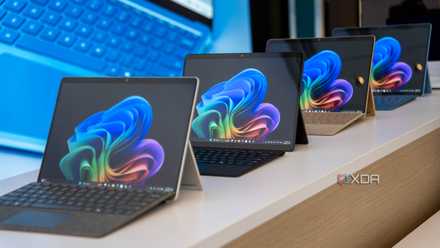
5 reasons Surface Pro 11 is the most versatile computing device we've ever seen
The Surface Pro 11 is the one Microsoft wanted to make all along, and it looks to be worth the wait.
What I hope happens
Bring back the Surface Book, it's time
That last idea, of shifting components to a detachable keyboard and making it heavier, might sound familiar. Microsoft itself once employed a similar strategy when it made the Surface Book. I haven't been shy about my opinion that it's time for the Surface Book to make a comeback. It's perhaps the easiest way to fix the balance issues affecting detachable keyboards. And with Snapdragon X, the original Surface Book concept could be adapted into a much smaller and more attractive form factor. Unless devices take notes from the Surface Book, I doubt detachable keyboards and tablets will be able to overcome their balance issues for a while.

4 tech products that should be revived thanks to new advancements
Products come and go all the time, but some are primed to make a comeback