.webp?width=1921&height=622&name=usecase-banner%20(1).webp)
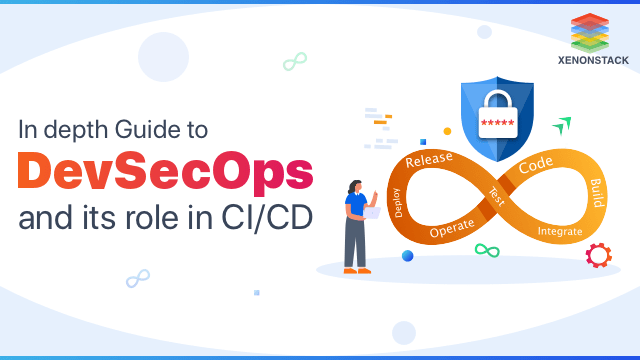
Introduction to DevSecOps in CI/CD
The DevSecOps is the theory, or we can say the philosophy of adopting security practices with the DevOps process. It is also used to describe a continuous delivery, security-focused software development life cycle (SDLC). It is often seen that the Security into DevOps is treated as the secondary system. InfoSec often comes at the end of the Software development life cycle(SDLC). It can be very frustrating to discover the security vulnerabilities at the end of the SDLC. DevSecOps promotes security engagement to a major or active part of the Software development life cycle (SDLC). The General DevOps have introduced processes like Continuous Integration and Continuous Delivery, also known as the CI/CD. The Continuous Integration and Continuous Delivery process ensure continuous testing and verification of the code correctness during the Agile process development.A software development philosophy that encourages security adoption across the software development lifecycle. Click to explore about, DevSecOps Framework and Tools
Why DevSecOps?
In Short- we can say that our technology-driven livelihoods will be at risk without Security, so it is important to adopt it in the earlier stages of our Software development life cycle (SDLC). Security breaches have become one of the largest threats that governments and organizations face today. Several major organizations face security breaches in recent times, causing consumers to continue to lose trust resulting in huge fallouts of financial loss each year. Before DevSecOps, your product may be insecure at the last minute, which may cause multiple costly iterations. After DevSecOps, your product is baked with the gold standards of Security. However, the probability of finding unexpected issues in the last minutes is much lower. Overall, Adopting DevSecops enhances your credibility in the market and builds trust with consumers. Keeping all the things in mind, this is a good segue way to discuss how DevSecOps fits into the continuous paradigm.
What is the DevSecOps Pipeline?
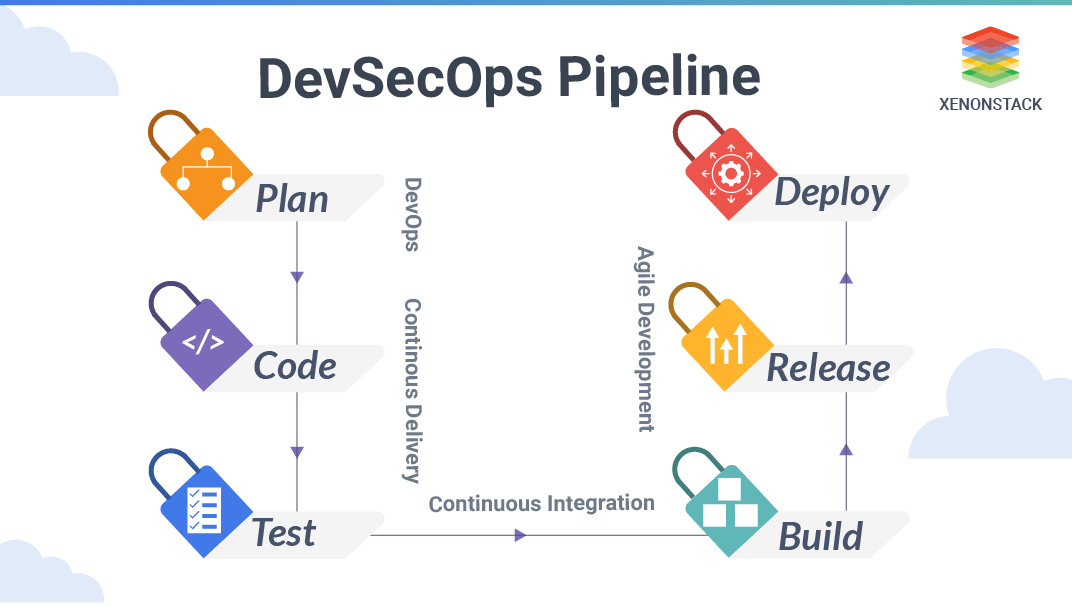
The typical DevOps pipeline included phases like Plan, Code, Build, Test, Release and Deploy. In DevSecOps, specific security checks are applied in each phase of the DevOps pipeline. Here we can understand the security checks used by adopting DevSecOps in the CI/CD pipeline.
- Plan: In the planning phase, execute security analysis and create a plan to determine scenarios for how, where, and when testing will be done.
- Code: Deploy and use linting tools, and Git controls to secure passwords and API Keys.
- Build Use of Static application testing (SAST) tools to track down flaws in code before deploying it on production. These tools are specific to programming languages.
- Test: While testing your application, The dynamic application security testing (DAST) tools are used to detect errors associated with user authentication, authorization, SQL injection, and API-related endpoints.
- Release: The security analysis tools are used to perform vulnerability scanning and penetration testing. These tools should be used just before releasing the application.
- Deploy: After completing the above test in runtime, send a secure infra or build to production for final deployment.
Relationship of DevSecOps with CI/CD Pipeline?
Security vulnerabilities can exist in OSS (Open source software) libraries that we import as much as we write. Tons of developers do programming every day, and manual code reviews don't scale. Here is the real power of DevSecOps lies. DevSecOps brings continuity to securing our software deliverables. Continuous delivery pipelines, also known as CI/CD pipelines, are implementing the continuous everything paradigm and helping in the validation of every commitment our team makes. Integrate automated security checks in our continuous pipelines to give you early warnings and monitor any security vulnerabilities that may come in any steps in the pipeline. Continuous security approaches scale as your business expands.
A practice of implementing security at every step in the DevOps Lifecycle with DevSecOps Tools. Taken From Article, DevSecOps Tools and Continuous Security
How to Implementing Continuous Security?
The first implementation of continuous security should be into security unit tests. The needs of the Security unit test are as important as the other unit tests we write.SAST
The SAST code analyzers detect security vulnerabilities in our code and in libraries that you import. This is called SAST (Static Analysis Security Testing), and different modern tools are integrated well with the continuous delivery pipeline. These tools are specific to programming languages, so make sure that you choose a SAST scanner compatible with your choice's programming language. A word of caution: SAST can also report false positives and hence plan a persistence of layer that helps pipelines "remember." False positives can annoy the team to the point where they stop responding to the broken pipeline's notification, and that's dangerous. Once the team finds the false notification with proper justification, adjust the pipeline to flag it repeatedly.DAST
Unlike Static analysis security (SAST), DAST validates your application in its running state from outside, as an attacker would do. The DAST (Dynamic Application Security Testing) scanners don't depend on specific languages since they interact with the outside application. Integrate both approaches in our pipeline so that you get early feedback on any security vulnerabilities.DevSecOps is the Future of Security
In today's world, security is everyone's job. Don't let the mentality of a self-proclaimed expert limit your vision. Many active corporations once did so face dire consequences and are now adopting and updating their security strategy with a new budget. Now security is not just the business priority. It is one of the most needed things that should be integrated with the continuous delivery pipeline.
Conclusion
DevSecOps is a complex topic that can cause friction between the team and with the auditors. Thus, its deployment should be down infractions and broken down infractions, giving full attention to each step. We also remember that detecting vulnerabilities is just half of the job, and empowering developers can quickly fix the detected issues. The DevSecOps is a new approach to security, and tools aimed explicitly should be widely adopted. Adopting DevSecOps principles in our continuous pipeline will lower the risk of security vulnerabilities, resulting in increased consumer trust in the organization.
What's Next?
- Explore here about Infrastructure as Code in CI/CD Pipeline
- Read more about DevSecOps vs SecDevOps