VOOZH about

URL: https://apify.com/mdhorilabs/owid-scrapper

⇱ Owid Scrapper Β· Apify


Pricing

$500.00 / 1,000 one charts

Go to Apify Store

Scrapper and Automation serving dataset of charts from Our World In Data, make fast your projects

Pricing

$500.00 / 1,000 one charts

Rating

5.0

(1)

Developer

πŸ‘ MDHorilabs

MDHorilabs

Maintained by Community

Actor stats

0

Bookmarked

3

Total users

3

Monthly active users

a year ago

Last modified

Share

OWID (Our World In Data) Scrapper Charts

Automation serving dataset of charts from Our World In Data, make fast your projects

🎯 Features

  • Multiple Charts Scrapping: allow multiple input in single action
  • Export the requested dataset with a neat structure: one chart one dataset

πŸš€ How To Use

1. Fill Urls Chart

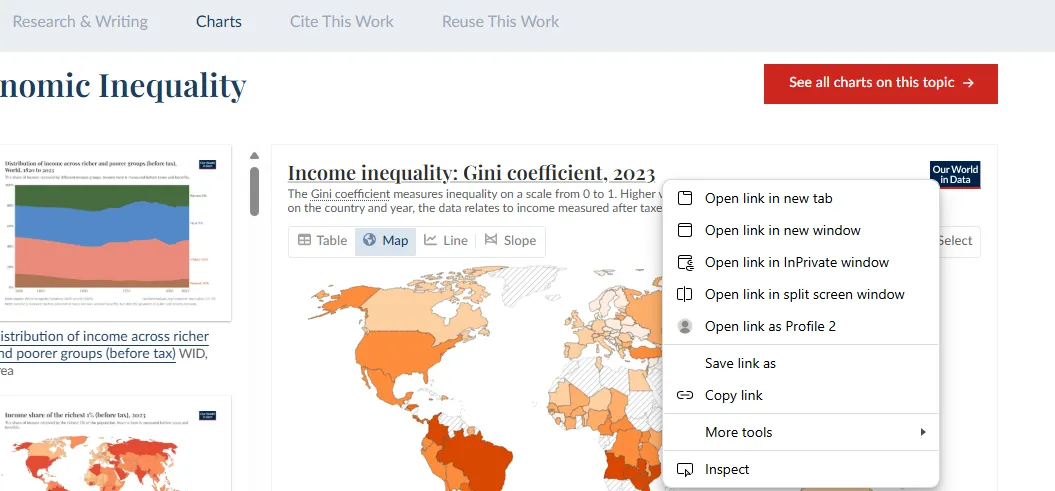
the url mostly with prefix "https://ourworldindata.org/grapher/{chart_name}" example source bellow πŸ‘ image

2. Collect your data

After click your run, click section storage and select many dataset for this run πŸ‘ image 2025 06 27 02 58 28

πŸ“Œ Dataset Details

metadata: This is a note from the received dataset and details of the dataset chart. {chart_name}: The primary datasets name is from chart name default: Default dataset is not used

πŸ“Œ Sample Output

# dataset/metadata
{
"url":"https://ourworldindata.org/grapher/gini-coefficient-after-tax-lis",
"datasetId":"gini-coefficient-after-tax-lis",
"detail":{
"chart":{
"title":"Income inequality: Gini coefficient (after tax)",
"subtitle":"The [Gini coefficient](#dod:gini) measures inequality on a scale from 0 to 1. Higher values indicate higher inequality. Inequality is measured here in terms of income after taxes and benefits.",
"note":"Income has been [equivalized](#dod:equivalization).",
"citation":"Luxembourg Income Study (2024)",
"originalChartUrl":"https://ourworldindata.org/grapher/gini-coefficient-after-tax-lis?v=1&csvType=full",
"selection":[
"United States",
"Chile",
"South Africa",
"Brazil",
"France",
"China"
]
},
"columns":{
"Gini coefficient (Disposable household income, equivalized)":{
"titleShort":"Gini coefficient (Disposable household income, equivalized)",
"titleLong":"Gini coefficient (Disposable household income, equivalized)",
"descriptionShort":"The Gini coefficient measures inequality on a scale from 0 to 1. Higher values indicate higher inequality.",
"descriptionKey":[
"Income is \"post-tax\" β€” measured after taxes have been paid and most government benefits have been received.",
"Income has been equivalized – adjusted to account for the fact that people in the same household can share costs like rent and heating."
],
"descriptionProcessing":"We create the Luxembourg Income Study data from standardized household survey microdata available in their [LISSY platform](https://www.lisdatacenter.org/data-access/lissy/). The estimations follow the methodology available in LIS, Key Figures and DART platform.\n\nWe obtain after tax income by using the disposable household income variable (`dhi`).\n\nWe estimate before tax income by calculating the sum of income from labor and capital (variable `hifactor`), cash transfers and in-kind goods and services from privates (`hiprivate`) and private pensions (`hi33`). We do this only for surveys where tax and contributions are fully captured, collected or imputed.\n\nWe obtain after tax income (cash) by using the disposable household cash income variable (`dhci`).\n\nWe convert income data from local currency into international-$ by dividing by the [LIS PPP factor](https://www.lisdatacenter.org/resources/ppp-deflators/), available as an additional database in the LISSY platform.\n\nWe top and bottom-code incomes by replacing negative values with zeros and setting boundaries for extreme values of log income: at the top Q3 plus 3 times the interquartile range (Q3-Q1), and at the bottom Q1 minus 3 times the interquartile range.\n\nWe equivalize incomes by dividing each household observation by the square root of the number of household members (nhhmem). Per capita estimates are calculated by dividing incomes by the number of household members.\n\n\nWe obtain Gini coefficients by using [Stata’s ineqdec0 function](https://ideas.repec.org/c/boc/bocode/s366007.html). We set weights as the product between the number of household members (nhhmem) and the normalized household weight (hwgt). We also calculate mean and median values from this function.",
"shortUnit":"",
"unit":"",
"timespan":"1963-2022",
"type":"Numeric",
"owidVariableId":1009263,
"shortName":"gini_dhi_eq",
"lastUpdated":"2025-01-24",
"nextUpdate":"2025-07-26",
"citationShort":"Luxembourg Income Study (2024) – with major processing by Our World in Data",
"citationLong":"Luxembourg Income Study (2024) – with major processing by Our World in Data. β€œGini coefficient (Disposable household income, equivalized) – Luxembourg Income Study” [dataset]. Luxembourg Income Study, β€œLuxembourg Income Study (LIS)” [original data].",
"fullMetadata":"https://api.ourworldindata.org/v1/indicators/1009263.metadata.json"
}
},
"dateDownloaded":"2025-06-26",
"activeFilters":{}
}
}
# dataset/gini-coefficient-after-tax-lis
[
{
"Entity":"Australia",
"Code":"AUS",
"Year":1981,
"Gini coefficient (Disposable household income, equivalized)":0.282
},
{
"Entity":"Australia",
"Code":"AUS",
"Year":1985,
"Gini coefficient (Disposable household income, equivalized)":0.293
},
{
"Entity":"Australia",
"Code":"AUS",
"Year":1989,
"Gini coefficient (Disposable household income, equivalized)":0.304
},
{
"Entity":"Australia",
"Code":"AUS",
"Year":1995,
"Gini coefficient (Disposable household income, equivalized)":0.311
},
...
]

You might also like

Youtube Scrapper

getdataforu/youtube-scrapper

Website scrapper URLs

quartz_owl/website-scrapper-urls

πŸ‘ User avatar

saikumar Ganneboyina

17

AI Tools Scrapper

automataevox/AIToolsScrapper

Scrapper for "There's An AI For that"

πŸ‘ User avatar

Jaroslav MaΕ‘a

3

X-Scrapper/Twitter-Scraper

akshaynceo/x-scrapper-twitter-scraper