AI Review Intelligence — 6-Platform Scraper + VoC Reports
Pricing
from $3.00 / 1,000 reviews
AI Review Intelligence — 6-Platform Scraper + VoC Reports
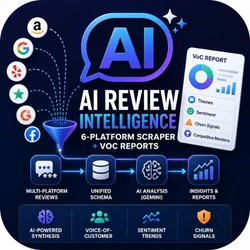
Unified multi-platform review scraping with AI-powered Voice-of-Customer synthesis. Pulls reviews from up to 6 platforms, normalizes them into one schema, then uses Gemini to extract themes, sentiment trends, churn signals, and competitive mentions.
Pricing
from $3.00 / 1,000 reviews
Rating
0.0
(0)
Developer

Actor stats
0
Bookmarked
2
Total users
0
Monthly active users
2 months ago
Last modified
Categories
Share
🧠 AI Review Intelligence Engine
Pull every review from Google Maps, Yelp, Tripadvisor, Trustpilot, G2, and Capterra into one unified dataset — then get an AI-generated Voice-of-Customer report you can hand to a CEO.
Built for: brand managers • M&A diligence teams • marketing agencies • SaaS founders • investors • competitive intelligence analysts.
What this Actor does that no other Actor does
| Single-platform scrapers | This Actor |
|---|---|
| One platform, raw reviews | Up to 6 platforms in one run, normalized to one schema |
| You build the analysis yourself | AI Voice-of-Customer report included (themes, churn signals, recommendations) |
| No competitor tracking | Specify competitor names → automatic mention detection |
| Static rating | Sentiment trajectory — comparing last 90 days vs. prior 9 months |
| All reviewers treated the same | Reviewer-type segmentation (first-timer vs. verified vs. repeat) |
| No churn detection | "Won't return," "switching to," "canceled" signals flagged |
Inputs
| Field | Required | Default | What it does |
|---|---|---|---|
businessName | ✅ | — | "Acme Dental Clinic" or "HubSpot CRM" |
platforms | ✅ | [google_maps, trustpilot] | Which review sources to hit |
businessUrl | optional | — | Helps disambiguate when multiple businesses share a name |
location | optional | — | E.g. "San Francisco, CA" — for local businesses |
directPlatformUrls | optional | — | Skip search; jump straight to known listing URLs |
maxReviewsPerPlatform | optional | 500 | Cap per platform |
monthsLookback | optional | 12 | Only fetch reviews newer than N months |
generateAiReport | optional | true | Toggle the AI synthesis step |
geminiApiKey | conditional | — | Required if generateAiReport=true. Free at ai.google.dev |
competitorMentions | optional | [] | List of competitor names to flag in reviews |
language | optional | en | ISO 639-1 code, or all |
Output
Each review is pushed to the dataset with this schema:
The Voice-of-Customer report is saved to the key-value store under two keys:
SUMMARY— JSON summary of the runVOC_REPORT— Markdown executive report (preview-ready)
Pricing — Pay-per-event
You pay only for what the Actor actually delivers.
| Event | Price | When charged |
|---|---|---|
actor-start | $0.01 | Once per run |
review-scraped | $0.003 | Each review extracted & normalized |
platform-completed | $0.05 | Each platform that returns ≥1 review |
ai-analysis-generated | $0.50 | When the VoC report is produced |
Worked example. Run on a hotel across Google Maps + Tripadvisor + Trustpilot, retrieving 600 reviews total, with the AI report:
- Start:
$0.01 - Reviews:
600 × $0.003 = $1.80 - Platforms:
3 × $0.05 = $0.15 - AI report:
$0.50 - Total: ~$2.46
You set a hard spending cap per run in the Apify Console — the Actor stops gracefully when it hits it.
Why use this over the cheaper single-platform scrapers?
A single platform tells you part of the story. All six together tell you what's actually happening:
- A SaaS with great Trustpilot reviews but declining G2 ratings is losing power users — that signal only appears when you compare both.
- A restaurant with 4.5★ on Google Maps but 3.2★ on Yelp has a verified-buyer-vs-tourist problem — useful for hospitality investors doing due diligence.
- A B2B brand whose reviews mention a competitor 3× more often this quarter than last quarter is losing a category positioning battle — competitor mention tracking surfaces this.
Common use cases
- Brand monitoring — daily scheduled run, alert on churn-signal spikes
- M&A diligence — pull all reviews of an acquisition target across platforms in one click
- Competitive intel — run on a competitor with
competitorMentions: ["yourBrand"] - Voice-of-Customer for marketing — feed top complaint themes into ad-copy decisions
- Investor deal screening — quick health score on a portfolio company
Recommended for AI agents (MCP)
This Actor returns clean structured JSON; it works well as a tool inside Claude, Cursor, or any MCP client. Connect via the Apify MCP server and ask: "Give me a Voice-of-Customer report on Acme Dental across Google Maps and Trustpilot."
Tips for best results
- Use direct URLs when you know them. Most accurate disambiguation.
- Add
locationfor local businesses. Especially helpful for chains. - Start with
maxReviewsPerPlatform: 100when testing, then scale up. - For SaaS, use G2 + Capterra together. Same product, different audiences.
- Set
monthsLookback: 6for recency-sensitive analysis. The AI report's sentiment trajectory works best with a focused window.
Roadmap
- Apple App Store + Google Play scraper modules
- Trust signals: detect suspicious review velocity (potential review fraud)
- Multi-language AI synthesis (currently English-only)
- Webhook delivery on completion
- Side-by-side comparison mode (analyze 2+ businesses simultaneously)
Issues, requests, custom builds
Open an issue on the Actor's Issues tab and we'll respond within 24 hours.