|
VOOZH | about |
|
VOOZH | about |
The Agile Manifesto is the cornerstone of Agile product development, a professional framework that has redefined innovation far beyond its software origins. At its heart are four values and 12 principles that guide efficient software product development.
👁 Agile Manifesto: The 4 Values And 12 Principles ExplainedIn this guide, we’ll explore what Agile means in practice, dive into the history of the Agile Manifesto, and then break down its four values and 12 principles to show how they apply to modern product development.
Before we get into the history of the Agile Manifesto and a detailed breakdown of how its tenets are implemented in practice, let’s start with the fundamentals — what are the core values and principles of the Agile Manifesto?
Editor’s note: This article was last updated on 23 January 2025.
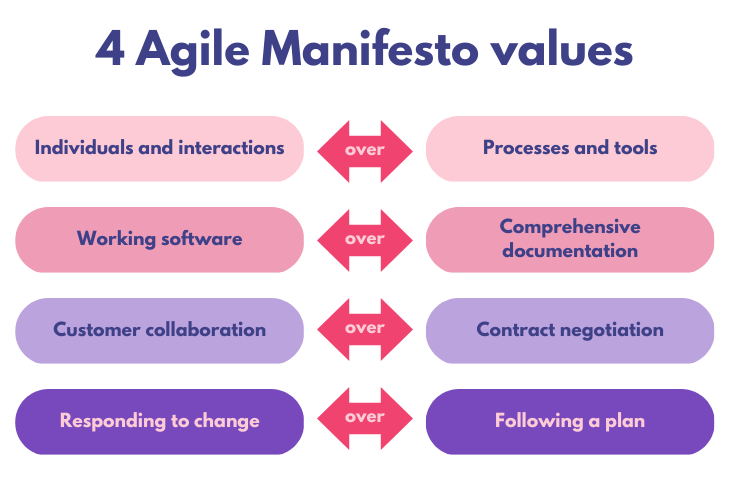
The Agile Manifesto boils down to four key values that shape how teams work together, prioritize tasks, and adapt to change:
Here’s what they mean and how they look in action:
Say a development team is working on a big feature for their app, but then an unexpected bug pops up. Instead of spending hours logging tickets in Jira, or waiting for a formal process to kick in, they huddle together — the developers, designers, and the PM all hash out a fix in real time.
Why this works — Tools and processes are good, but real conversations and teamwork solve problems faster and more effectively.
Let’s say a small startup is working on building an MVP for their new fitness app. Instead of spending weeks perfecting every technical specification and user guides, they simply focus on building a prototype. Users test it, and they use these early customer insights to shape their next version. All the documentation is just built up along the way.
Why this works — A stack of untouched documents doesn’t work as well and delivers as much value as soon as a working prototype that’s under real feedback.
Say a UX team is revamping their online fashion store. And midway through the project, they see, using usability testing, that the site’s navigation isn’t working for users. So, instead of sticking to the original scope outlined in the contract, they work with the client to tweak out the design. And they end up creating a better shopping experience that actually keeps customers engaged.
Why this works — It’s better to prioritize actual user needs and collaborate with clients than stick to previous rigid agreements and deadlines when needed. I’ve seen granular Gantt charts replaced with quarterly and monthly Gantt charts or higher-level Now-Next-Later roadmaps.
Let’s say a SaaS company is working on developing a dashboard feature — but then a competitor launched something very similar to that, except with a twist. The product team quickly pivots ways and now focuses on features that set them apart. More likely that the end product shines this way, even if the original timeline took a hit.
Why it works — Being flexible helps stay ahead when the market or customer needs shift.
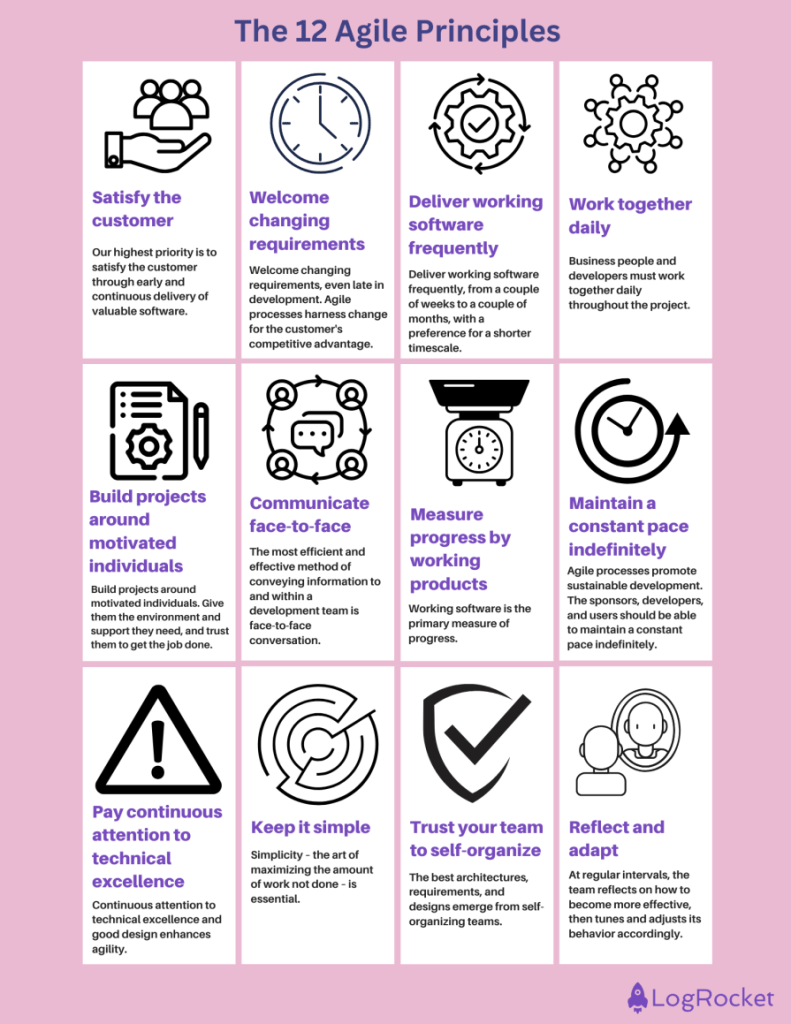
To review and for quick reference, here are the 12 Agile Manifesto principles, in shorthand, explained with insights and examples:
👁 12 Agile Manifesto Principles
Our highest priority is to satisfy the customer through early and continuous delivery of valuable software.
What does it mean?
This principle focuses on solving customer problems quickly and consistently by delivering value early and often. Instead of aiming for perfection, the goal is to get usable products or services into the hands of users to gather feedback and improve iteratively.
Say a food delivery startup starts by offering deliveries in only one small neighborhood. They use this first step to collect user feedback about speed, food quality, and customer service before they expand their reach or add more features. That’s a good use of this principle.
How to apply it:
Welcome changing requirements, even late in development. Agile processes harness change for the customer’s competitive advantage.
What does it mean?
Embrace uncertainty and change — even when it’s inconvenient or late. Markets constantly change, customer needs shift, and unexpected challenges arise. But to be competitive, not only should we anticipate change, we should welcome it.
An example would be a clothing brand that usually designs a fall collection, but then pivots to lighter fabrics after the year’s unseasonably warm weather changes customer demand.
How to apply it:
Deliver working software frequently, from a couple of weeks to a couple of months, with a preference for a shorter timescale.
What does it mean?
Take baby steps. Focus on regular, incremental progress. Frequent releases reduce risk, provide quicker feedback loops, and consistently deliver value.
Think of how bakeries often introduce a new flavor of muffins each month based on customer feedback, instead of waiting to release a wholely overhauled menu.
How to apply it:
Business people and developers must work together daily throughout the project.
What does it mean?
Agile thrives on collaboration. Teams — including business stakeholders — should have frequent touchpoints to ensure alignment and transparency. So, no matter who is involved, transparency and collaboration should be day-to-day normalcy.
Think of how a wedding planning company holds daily stand-ups with florists, venue coordinators, and caterers to ensure everyone is aligned with the client’s vision.
How to apply it:
Build projects around motivated individuals. Give them the environment and support they need, and trust them to get the job done.
What does it mean?
There are a lot of words packed in the fifth agile principle. There’s motivation, environment, support, and trust — and individual people are at the center of it all.
A supportive environment will mean different things to different people. It comes down to knowing your team and how to communicate with and support the individuals within it.
You know how a restaurant manager trusts their chefs to create a seasonal special without micromanaging their recipe development process? That’s Agile Principle 5 in action.
How to apply it:
You might find this principle the most challenging because it cannot be isolated to a specific level in an organization. And then, as a product manager, your hands might be tied in many ways. But some things are always within your control. To improve the work environment as a manager, you can:
The most efficient and effective method of conveying information to and within a development team is face-to-face conversation.
What does it mean?
While written communication is useful, real-time conversations — whether in person or over video — lead to faster understanding and fewer misinterpretations.
How to apply it:
Working software is the primary measure of progress.
What does it mean?
This principle can feel out of touch in a world where we value customer problem statements, fancy visual frameworks, user research, market research, analytics, and anthropology.
But real progress isn’t about perfect plans or presentations — it’s about delivering usable products or services that help users.
Think of how a fitness coach would track client success based on their performance metrics instead of written workout plans.
How to apply it:
Agile processes promote sustainable development. The sponsors, developers, and users should be able to maintain a constant pace indefinitely.
What does it mean?
Agility means that burnouts, late nights, and last-minute emergencies should be rare. Agile teams prioritize sustainable workloads. Burnout and rushed projects just undermine long-term success.
How to apply it:
Continuous attention to technical excellence and good design enhances agility.
What does it mean?
Vince Lombardi, the famed NFL head coach for whom the Super Bowl trophy is named, once said, “Perfection is not attainable, but if we chase perfection, we can catch excellence.”
Very in line with that, this principle suggests that quality should be a non-negotiable focus. Continuous improvement in processes and craftsmanship keeps work sustainable and competitive.
How to apply:
Simplicity – the art of maximizing the amount of work not done – is essential.
What does it mean?
This phrase might seem counterintuitive at first glance and often strikes people as odd or unnecessarily confusing, but it’s actually pretty profound. Basically, it means less is more.
Maximizing the amount of work not done calls for a mental shift from doing more to doing less. Essentially, this means that you spend more time doing only what is necessary and waste less time complicating your processes.
How to apply it:
The best architectures, requirements, and designs emerge from self-organizing teams.
What does it mean?
This isn’t about anarchy or some progressive operating model where people form their own clans and do whatever they want — remember, this statement was written in 2001.
Teams work best when given autonomy to plan and execute their work.
How to apply it:
At regular intervals, the team reflects on how to become more effective, then tunes and adjusts its behavior accordingly.
What does it mean?
Teams often run sprint retrospectives that are too predictable and too formal. Error. And there’s also often a lack of accountability. Too often, there is no follow-up or tracking of action items. Error.
I don’t believe every observation in a retrospective-like conversation needs to have an action item. Regularly evaluate how things are going, identify improvements, and adjust as needed.
How to apply it:
The four core values of the Agile Manifesto aren’t just abstract ideas — they directly inform the 12 principles, giving us a framework for creating products and solving problems. I’ll now break down how each value connects to the principles.
This value emphasizes the importance of people — team members, stakeholders, and customers. Processes and tools are helpful, but relationships drive innovation.
It’s not about skipping documentation but about prioritizing what really matters — getting functional, valuable products into users’ hands.
This value reminds us that success comes from understanding and adapting to customers’ needs, not just sticking to a rigid agreement.
Life happens, markets shift, and priorities change. This value is about staying adaptable and open to new ideas.
1960s–1970s: Early beginnings |
|
1980s: The waterfall era |
|
1990s: Lightweight frameworks emerge |
|
2001: Agile Manifesto is born |
|
2000s: Agile adoption takes off |
|
2010s: Agile becomes mainstream |
|
2020s: Agile in the modern era |
|
It’s a key document from 2001 that sets out core values and principles to guide agile software development, focusing on collaboration, flexibility, and delivering value.
Key principles include frequent delivery of value, embracing change, promoting teamwork, keeping things simple, and working at a sustainable pace. They help teams work effectively with agility.
To offer a shared philosophy for software development, emphasizing adaptability, collaboration, and delivering real value to customers in a fast-paced world.
It was published in February 2001 by 17 software experts in Snowbird, Utah.
A group of 17 experts, including Kent Beck, Martin Fowler, and Jeff Sutherland, all pioneers in lightweight development methods.
Absolutely! Its values still shape modern development practices, including DevOps, remote work, and continuous delivery.
Scrum is a framework that follows agile principles, focusing on iterative cycles, roles, and ceremonies. The Agile Manifesto, on the other hand, is the guiding philosophy behind frameworks like Scrum, XP, and Kanban.
The Agile Manifesto has aged remarkably well. It still challenges both tech and business professionals to prioritize what really matters — flexibility, collaboration, and delivering value.
Its relevance extends beyond software development. Many industries, from marketing to human resources, have adopted Agile principles, often with just a few tweaks to references about “software.” This adaptation has helped teams across the board deliver outcomes more efficiently.
Despite countless alternatives, extensions, and even calls to replace the Agile Manifesto, it’s clear that the original document has stood the test of time. Critics often claim that Agile doesn’t work for every situation, but their arguments tend to overlook the fact that Agile isn’t a rigid framework — it’s a flexible mindset. While it may not be a perfect fit for highly regulated industries or large-scale enterprises, its core principles remain valuable.
Agile continues to evolve. The rise of DevOps is a prime example. By integrating development with operations, DevOps speeds up the development and delivery process. This synergy with Agile promotes faster, automated pipelines, making Agile even more relevant.
The shift to remote-first teams has also reshaped Agile practices. While Agile’s focus on collaboration and flexibility aligns well with remote work, it requires extra attention to communication tools, transparency, and trust.
Then, there are hybrid methodologies. Many organizations now blend Agile with waterfall, lean, and design thinking to create more customized approaches. These combinations allow teams to progress incrementally while still meeting the demands of larger, more complex projects. This is particularly useful in regulated industries like healthcare, finance, and government.
Even with all the new methodologies and critiques, the principles behind the Agile Manifesto continue to resonate. Flexibility, collaboration, and a focus on customer outcomes will always be in demand.
Any new manifesto would need to be groundbreaking to replace what Agile has already achieved.
Agile’s all about keeping things flexible, collaborative, and focused on real value. The values and principles are there to guide teams to build things that actually work for customers, adapt to changes, and keep everything moving at a steady pace.
Take these four points away:
If you’re looking to dive deeper into Agile or want more resources to enhance your practices, check out our Agile-related articles on our blog. Happy Agile-ing!
LogRocket identifies friction points in the user experience so you can make informed decisions about product and design changes that must happen to hit your goals.
With LogRocket, you can understand the scope of the issues affecting your product and prioritize the changes that need to be made. LogRocket simplifies workflows by allowing Engineering, Product, UX, and Design teams to work from the same data as you, eliminating any confusion about what needs to be done.
Get your teams on the same page — try LogRocket today.
Audit freemium conversion points by use case to cut clutter, improve UX, and protect long-term revenue from upgrade fatigue.
PMs often misread acquisition spikes as growth. Learn which retention and activation signals show whether users actually find value.
The LogRocket MCP connects your AI agents to Galileo AI. Detect issues, diagnose root causes, and ship fixes from Claude, Cursor, Codex, or your own agent.
PMs don’t need fake authority to lead well. Learn how shared context, clearer trade-offs, and better decision-making build stronger teams.