|
VOOZH | about |
|
VOOZH | about |
It’s been a big year for AI coding assistants, and Amazon has entered the space with Kiro, its own AI-powered code editor. Although it launched only a few weeks ago and remains behind a waitlist, it has already drawn in thousands of developers excited to try it.
👁 i tried kiro and here is what i learnedI got early access, and in this article, I’ll share my experience with Kiro, highlight what makes it different from other AI coding tools, and explore whether it lives up to the hype.
The Replay is a weekly newsletter for dev and engineering leaders.
Delivered once a week, it's your curated guide to the most important conversations around frontend dev, emerging AI tools, and the state of modern software.
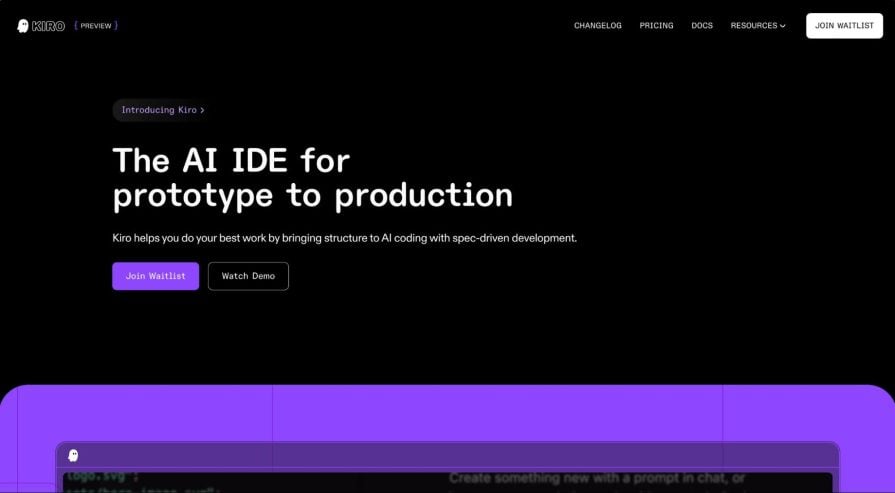
Kiro is an AI-powered IDE from AWS that autonomously interprets your goals, navigates your codebase, and makes targeted modifications to build what you describe. It’s the next in a long line of AI coding technologies, promising to help you vibe code your way through your application. Kiro belongs to this class of tools, and like other popular players such as Cursor and Windsurf, it is also built on top of the VS Code editor:👁 kiro homepage
With Kiro, you can do the usual things most AI coding tools offer: asking for code snippets, debugging, and generating explanations. But unlike the others, Kiro brings something new. It introduces a spec-driven development workflow that forces you to define requirements and designs before any code is written.
One of the biggest issues with AI coding tools and large language models in general is prompting. Since AIs are not human (obviously), they often misinterpret vague sentences or fill in gaps incorrectly. You only get good results if you give clear and specific instructions.
Kiro’s spec-driven approach makes this process more reliable. Instead of jumping straight into a vibecoding session where you throw instructions at the AI and hope it understands, Kiro guides you to create a structured documentation first.
These files capture what you are building and the design approach you want to take. Once you are satisfied with the plan, Kiro converts those tasks into subtasks that you can run one at a time. That way, you can build in batches rather than dumping everything into a single prompt. We will look at this in practice in a later section.
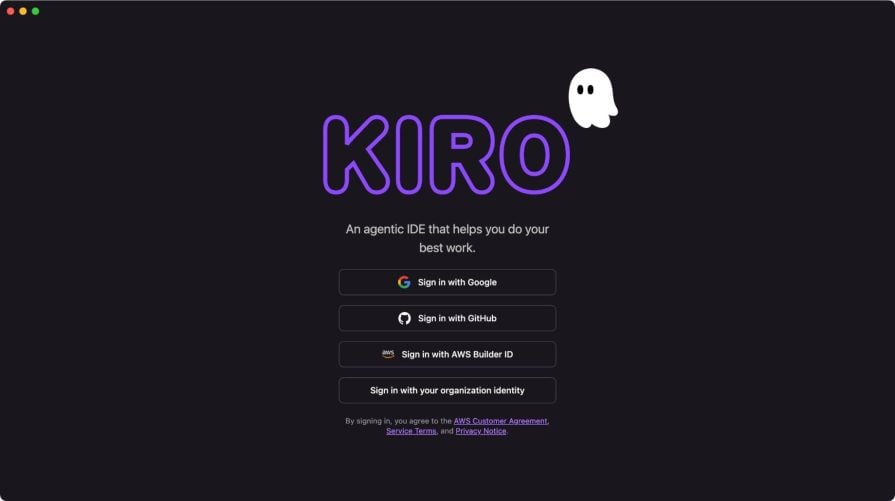
Kiro is currently on a waitlist, so you’ll need to sign up before you can get access. Once your email is approved, you can download and install Kiro and then sign in using the same email:👁 kiro sign on page
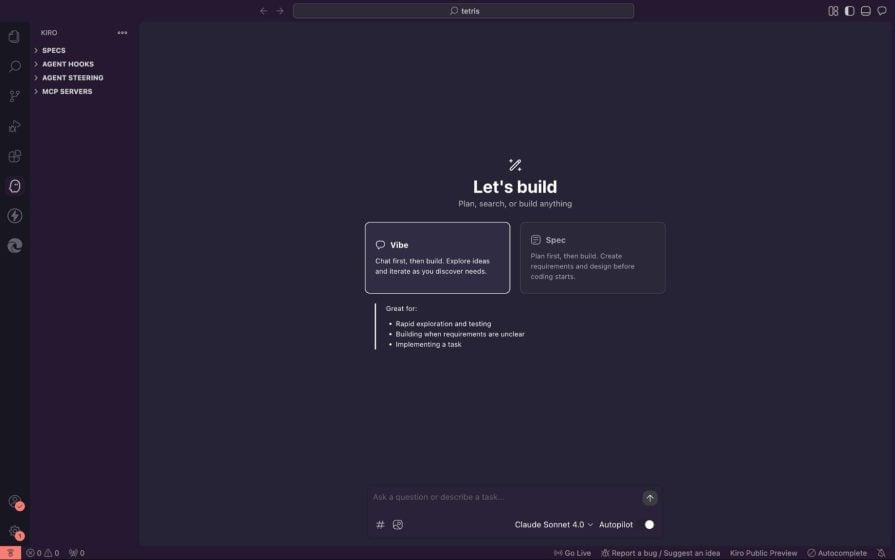
After signing in, you can choose to import your existing VS Code settings and extensions. And once the post-installation setup is complete, you’ll land on the Kiro coding interface:👁 vibe mode with kiro
As shown in the image above, you can choose between two different chat options: Vibe mode, where you simply provide a prompt and it builds things for you, or Spec mode, where it helps you plan things out before building.
Let’s put it to the test!
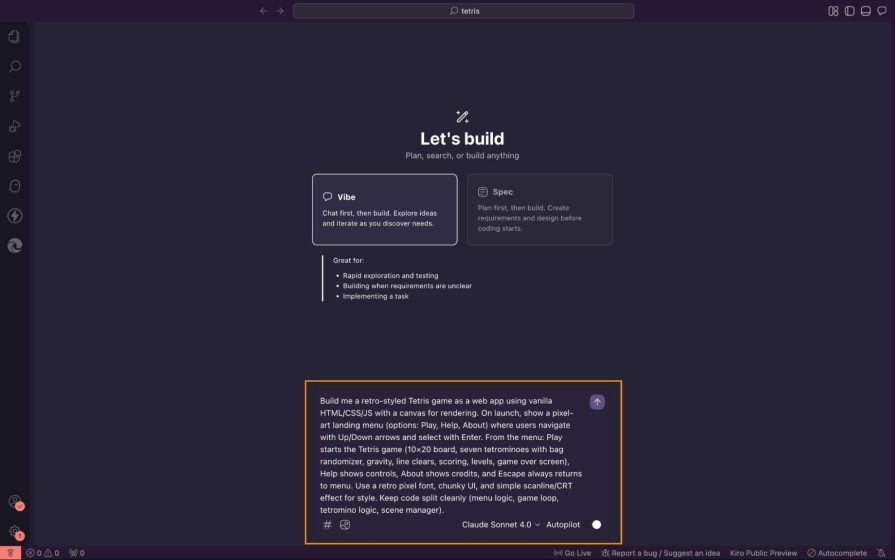
To test Kiro’s capabilities, I asked it to build a retro-styled Tetris game as a web app. I used the Vibe option with the Claude Sonnet 4.0 model and provided the following prompt:
“Build me a retro-styled Tetris game as a web app using vanilla HTML/CSS/JS with a canvas for rendering. On launch, show a pixel-art landing menu (options: Play, Help, About) where users navigate with Up/Down arrows and select with Enter. From the menu: Play starts the Tetris game (10×20 board, seven tetrominoes with bag randomizer, gravity, line clears, scoring, levels, game over screen). Help shows controls. About shows credits. Escape always returns to the menu. Use a retro pixel font, chunky UI, and simple scanline/CRT effect for style. Keep code split cleanly (menu logic, game loop, tetromino logic, scene manager).”:👁 prompting vibe mode in kiro
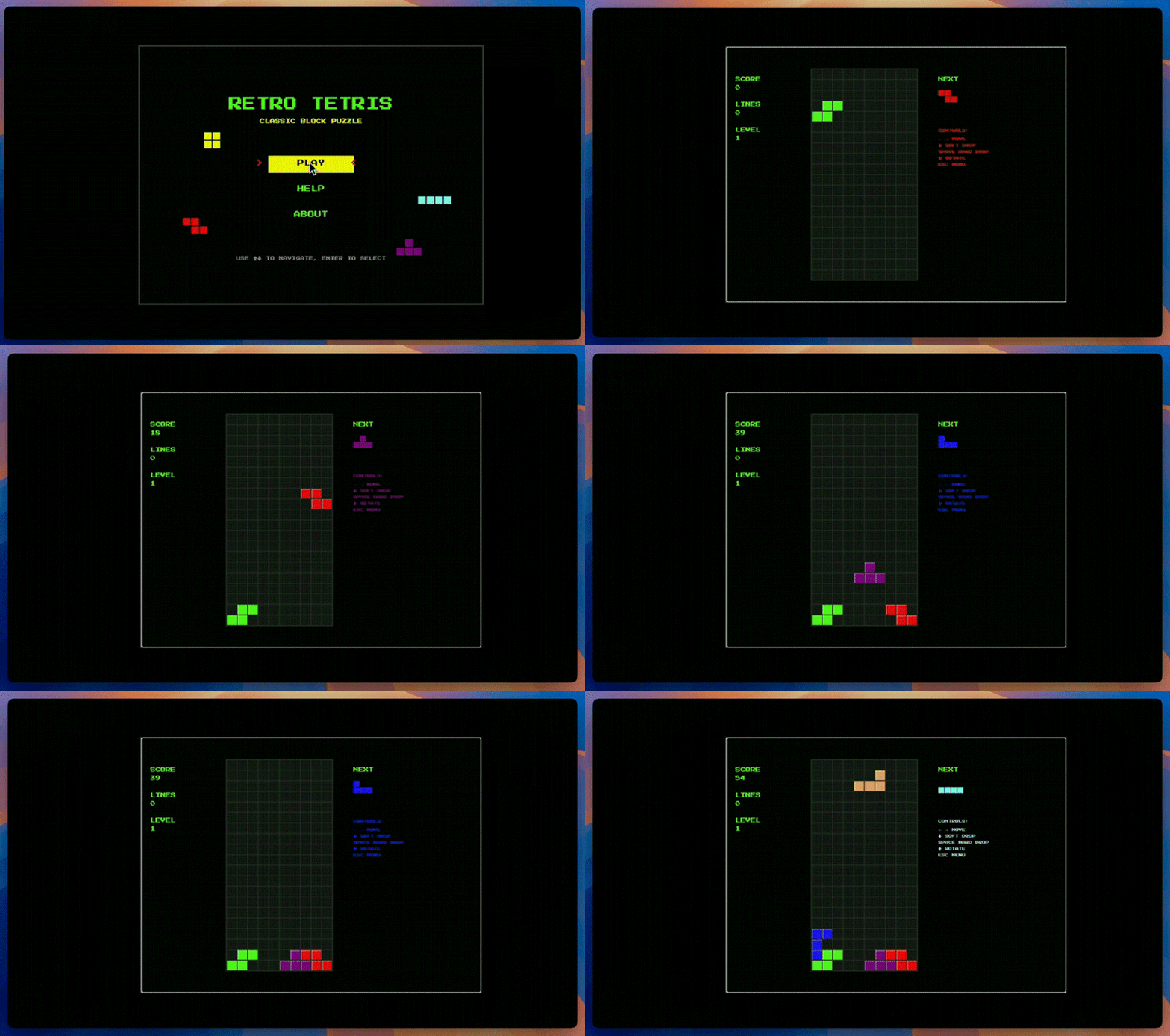
Kiro produced a complete working demo in just a few seconds. The generated project included a functional menu, a playable Tetris game with scoring and level progression, and cleanly separated code files for game logic and rendering. The styling also matched the retro theme I described, including the pixel font and CRT-like screen effect, as shown below:👁 first try of tetris game
This was impressive for a first try. It showed that Kiro can handle complex and multi-step instructions without much extra tweaking. You can also play the live game demo or view the complete source code here.
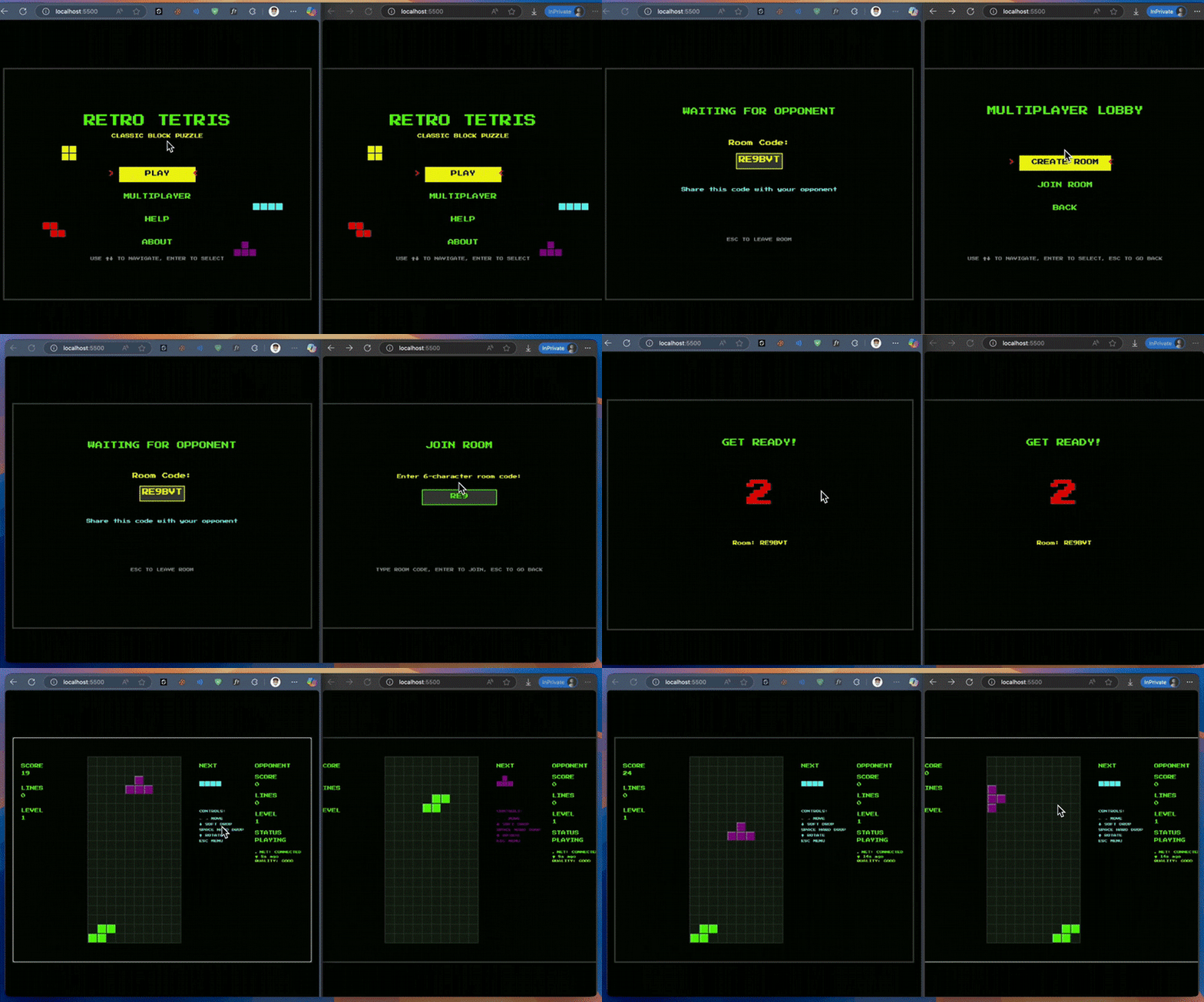
To try out Kiro’s spec-driven mode, I decided to extend the Tetris game with a multiplayer option. In this version, two players receive the same sequence of blocks, and their scores update in real time through WebSockets.
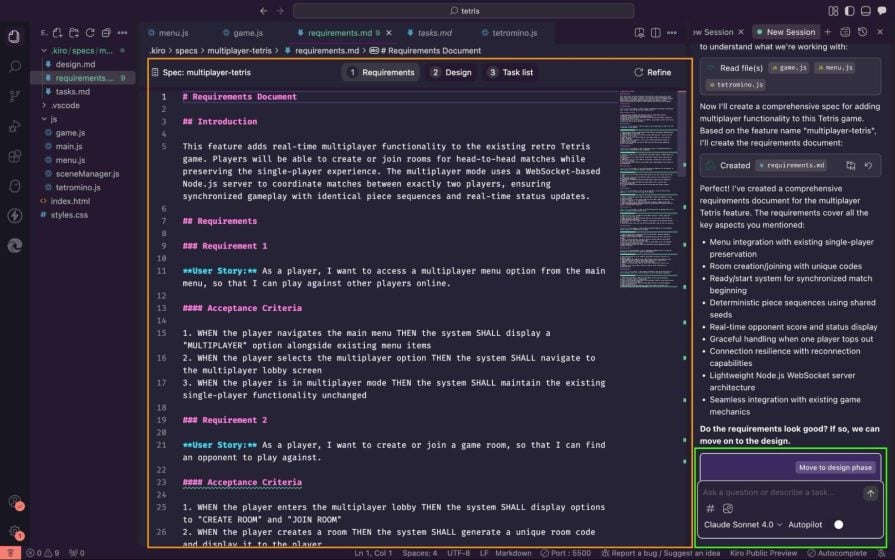
I prompted Kiro with my request. Kiro responded by generating a requirements.md file that outlined the new feature, along with clear acceptance criteria:👁 requirements md file from kiro
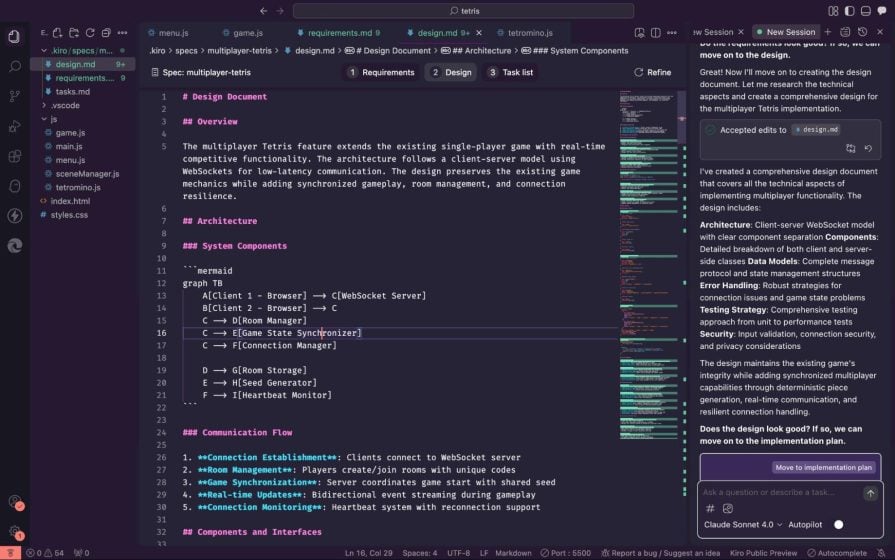
If the requirements don’t match what you want, you can also edit them directly before moving on. Once I was satisfied with the requirements, I clicked Move to design phase, which created a design.md file detailing how the feature would work. It also included explanations, Mermaid diagrams, and sample code:👁 design md file from kiro
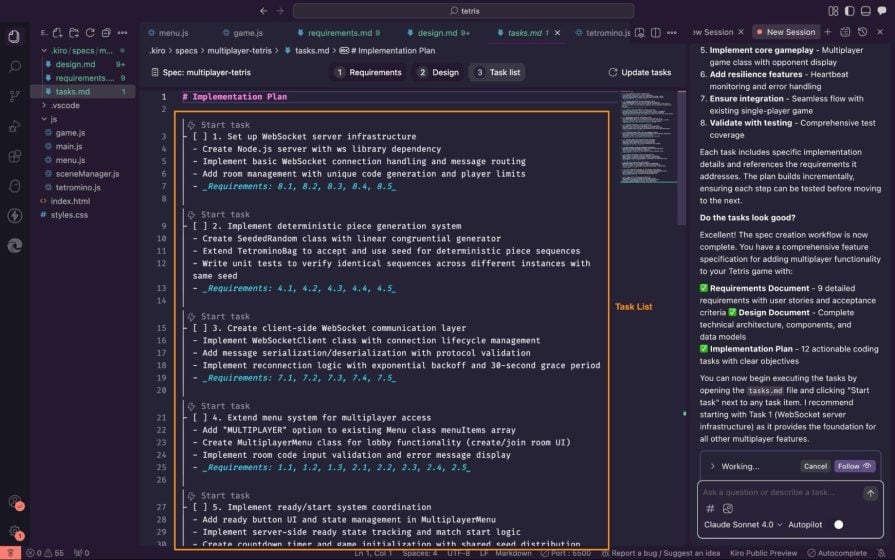
After reviewing the design.md file, I clicked the Move to implementation plan button to proceed to the final step. This generated a new tasks.md file in which Kiro broke the feature into subtasks and set up a queue:👁 implementation plan from kiro
Each subtask was executed one by one, and unit tests were automatically run to ensure they passed before proceeding. Once all the tasks were completed, the multiplayer mode was successfully implemented!:👁 gif of completed multiplayer mode
What stood out here was how structured the whole process felt. Instead of dumping a massive prompt and hoping for the best, Kiro forced a clear plan, verified each step, and delivered working code with minimal friction. You can also explore the code for the multiplayer mode here to try it yourself.
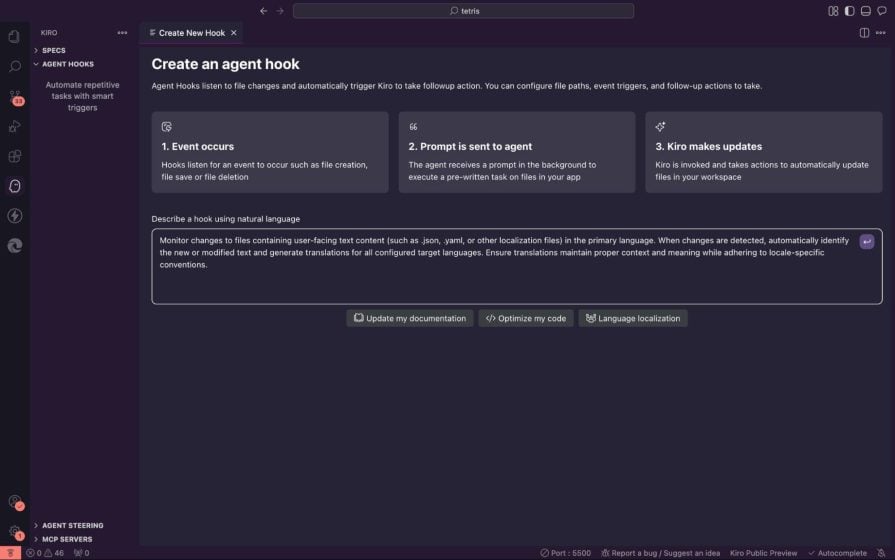
Another unique feature in Kiro is its agent hook system. This lets you automate repetitive tasks using smart triggers that run in the background while you code. Instead of manually asking the AI to handle every little detail, agent hooks can be set to fire automatically on events like saving a file, making a commit, or updating documentation. For example, you could configure hooks to monitor localization files such as .json, .yaml, or other formats:👁 create agent hook in kiro
When changes are detected, the agent can identify the modified text and automatically generate translations for all target languages while preserving context and adhering to locale-specific conventions.
The AI coding space is already crowded, and the obvious question is how Kiro compares to existing tools like Cursor, Copilot, and Windsurf.
Overall, Kiro (especially with the spec-driven workflow) feels closer to an engineering assistant than a coding copilot.
The short answer is not yet – but the early ingredients are there for a breakthrough.
Kiro is already drawing a lot of attention. Even though it is still behind a waitlist, thousands of developers have signed up to try it. Its unique features already make it stand out from other AI coding tools that mostly focus on autocomplete and chat.
Then there’s the Amazon factor. Kiro has the resources and reach to become more than just another coding assistant.
The current version isn’t perfect, but it’s improving fast. Amazon could add new features, make it run faster, and expand its integrations before the full launch. If that happens, Kiro could go from being an experiment to one of the tools that shapes the next generation of coding.
Learn how to test Nuxt apps with Vitest, @nuxt/test-utils, runtime mocks, server route mocks, and Playwright e2e tests.
I had four weeks to build a complete app from scratch using AI tools like OpenCode and Claude Opus: here’s how it went.
Learn how to build a reusable Vue 3 table engine that powers tables, cards, and lists with shared sorting and pagination logic.
Compare the best React chart libraries for 2026, including Recharts, Nivo, visx, Apache ECharts, MUI X Charts, and more.
Would you be interested in joining LogRocket's developer community?
Join LogRocket’s Content Advisory Board. You’ll help inform the type of content we create and get access to exclusive meetups, social accreditation, and swag.
Sign up now