VOOZH
about
URL: https://chandra.harvard.edu/xray_sources/blackholes.html
⇱ Chandra :: Field Guide to X-ray Sources :: Black Holes
Skip to Main Content
👁 NASA
NASA's flagship mission for X-ray astronomy.
👁 NASA
Home
About Chandra
Learning
Field Guide
Photo Album
Press Room
Resources & Multimedia
Video Series
Blog
Research
X-ray Astronomy
History
Major Milestones
X-ray Universe
X-rays & Light
VS. Medical X-ray
X-ray Absorption
X-ray Images 101
Galactic Navigation
Dark Matter
Dark Energy
Chemistry & Cosmos
X-ray Sources
Solar System
Stars
White Dwarfs
Supernovas
Neutron Stars
Black Holes
Galaxies
Quasars & AGN
Galaxy Clusters
X-ray Background
Brown Dwarfs
Gamma Ray Bursts
Web Shortcuts
Chandra Blog
RSS Feed
Image Use Policy
Questions & Answers
Glossary of Terms
Black Holes
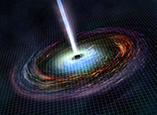
👁 black hole illustration
A Black Hole Primer with Chandra:
An introduction to black holes and recent scientific discoveries about them.
Black Hole Classifications:
👁 CYGX399
Stellar
— Black holes with a mass of about 5 – 100 Suns formed at the end of very massive star's evolutionary cycle.
👁 thumbnail
Mid-mass
— A newly discovered type of black hole that has a mass of 500 – 1,000's of Suns.
👁 thumbnail
Supermassive
— Black holes with a mass of a million or more Suns located in the centers of galaxies.
More Information:
👁 thumbnail
Infographic:
Black Holes
Learn About:
Black Holes
Chandra Podcast:
Black Holes: Tall, Grande, Venti
Chandra Special Feature:
Exploring Black Holes
Chandra Images:
Black Holes
Questions & Answers:
Black Holes
CXC Home
|
Search
|
Help
|
Image Use Policy
|
Latest Images
|
Privacy
|
Accessibility
|
Glossary
|
Q&A
👁 RSS Feed
Photo
|
👁 RSS Feed
Press
|
👁 Blog Icon Image
Blog
|
👁 Blog
More Feeds
[News by email:
Chandra Digest
]
[Contact us:
cxcpub@cfa.harvard.edu
]
Center for Astrophysics | Harvard & Smithsonian
60 Garden Street, Cambridge, MA 02138 USA
Phone: 617.496.7941 Fax: 617.495.7356
👁 Image Map for NASA's, Smithsonian and Chandra's Home Pages
Operated for NASA by the Smithsonian Astrophysical Observatory
This site was developed with funding from NASA under Contract NAS8-03060.
Revised: April 15, 2019