
Home / Discovery Toolkit / Descriptor Generation Toolkit

Chemaxon Descriptor Generation Toolkit
Chemistry calculators for increasing certainty in drug discovery
Want to start using Descriptor Generation Toolkit?
Descriptor Generation Toolkit
Assessing compounds in-silico is the most efficient way to prioritize new ideas, making sure only the best options are pursued and so minimizing effort spent on less promising compounds.
The Descriptor Generation Toolkit gives you the scientifically accurate property predictions needed to achieve this. It also allows you to generate the descriptors needed to thoroughly characterize the structures to train new models on your data.
Descriptor Generation Tools
hERG Inhibition
Optimizing ADMET predictions, pharmacokinetics and toxicity attributes are profound goals across all drug discovery projects. Exploit the power of machine learning methods on curated data sets to support the drug design and medicinal chemistry optimization with reliable models and predictions, targeting the elimination of cardiotoxicity risk during drug discovery.
- Continuous affinity prediction (pActivity=-log(Activity)) and classification
- State-of-the-art conformal prediction framework for error estimation
- Domain of applicability assessment: report on the top 5 most similar training data points
- Extendability: model can be re-trained with in-house data
Elemental Analysis
Elemental Analysis provides fundamental molecular properties for general chemistry workflows and analytical scientists.
- Exact and nominal mass, molecular weight and atom count
- Elemental composition
- Molecular formulae
- Molecular composition
- Mass spectrum (isotope distribution) calculation
Partitioning
The partitioning of drugs in microscopic environments (e.g.: lipid bilayers of biological membranes) of different lipophilicity and hydrophilicity heavily influences its pharmacokinetic behavior. The partitioning is described by the logP and logD values of a drug, which are major descriptors in predicting ADMET properties.
The Partitioning calculator provides:
- LogP values using scientifically sound methods – LogP documentation
- LogD (pH vs. logD) plot – LogD documentation
- HLB (Hydrophilic Lipophilic Balance) number
Solubility
Solubility in water (commonly referred to as logS) is one of the most important parameters to achieve for desired pharmacological response. Any drug to be absorbed must be present as a solution at its site of absorption.
As the majority of drugs are molecules that have ionizable groups, the solubility of the compound depends highly on the pH environment. The Solubility Predictor is able to predict:
- Intrinsic (thermodynamic) solubility in water
- pH-dependent solubility (pH-logS plot)
- A qualitative solubility category
NMR Predictor
Nuclear Magnetic Resonance spectroscopy is the primary experimental technique to confirm and determine the chemical structure of organic compounds.
As NMR spectrometers are relatively expensive, predicting NMR spectra for a set of possible structures and comparing them with experimental data is a well established approach to facilitate structure elucidation. The NMR Predictor is able to:
- Predict 13C and 1H NMR spectra for molecules composed of the most frequent elements (H, C, N, O, F, Cl, Br, I, P, S, Si, Se, B, Sn, Ge, Te and As)
- Import and display NMR spectra from JCAMP-DX files
Structural Calculations
Structural Calculations provide:
- Hydrogen Bond Donor/Acceptor (HBDA) count
- 2D topological descriptors
- 3D geometrical descriptors
- Molecular surface calculations
- 3D conformer generation, molecular dynamics
- 3D Alignment
- Different electron structural property calculations
Isomers
The ability to deal with molecular structures that have identical atomic composition, but different arrangement of bonds or spatial orientation is crucial in the identification, search and property calculation of compounds. Tautomerism, stereoisomerism and resonance are examples of isomerism.
Tautomerization can affect identification, searching and physico-chemical properties of molecules. Stereoisomers have the same physico-chemical properties (e.g.: melting point, solubility), but they differ in pharmacokinetic and pharmacodynamic behavior. Resonance describes the rearrangement of delocalized electrons in the molecule, which results in a set of contributing structures of the original structure.
The Isomer calculator can:
- Generate different tautomer sets useful for searching and tautomer handling
- Calculate tautomer distribution and major tautomer form in water
- Generate tetrahedral and double-bond stereoisomers starting either from a 2D or 3D structure
- Generate resonance structures
Protonation
Ionization has an essential impact on compound behavior in nearly all protic environments. On top of its application in general and analytical chemistry, relationships to drug pharmacokinetics and pharmacodynamics are well-established. Acidic and basic dissociation constants (pKa) and the microspecies distribution at different pH values are important to quantitatively describe ionization and comprehend physical and biological processes.
The Protonation calculator includes:
- Highly-accurate calculation of pKa values along with pH dependent distribution plots of relevant microspecies in water – pKa documentation
- Calculation of the major microspecies form at a given pH value – Major microspecies documentation
- Isoelectric point calculation
Availability
The Toolkit bundles are built to easily integrate with most systems using a range of different APIs including Java, Python, Microservices and .NET.
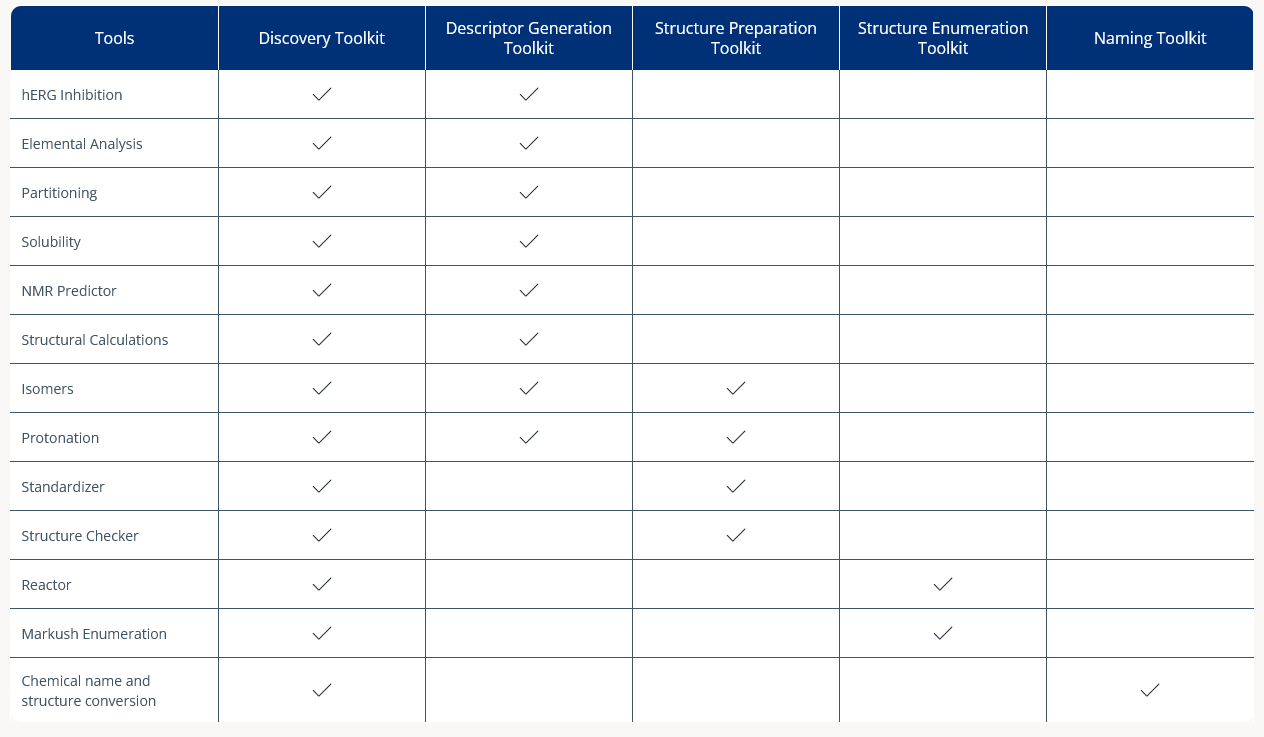
Toolkit Offerings
| Tools | Discovery Toolkit | wdt_ID | Descriptor Generation Toolkit | Structure Preparation Toolkit | Structure Enumeration Toolkit | Naming Toolkit |
|---|---|---|---|---|---|---|
| hERG Inhibition | 👁 Image |
1 | 👁 Image |
|||
| Elemental Analysis | 👁 Image |
2 | 👁 Image |
|||
| Partitioning | 👁 Image |
3 | 👁 Image |
|||
| Solubility | 👁 Image |
4 | 👁 Image |
|||
| NMR Predictor | 👁 Image |
6 | 👁 Image |
|||
| Structural Calculations | 👁 Image |
8 | 👁 Image |
|||
| Isomers | 👁 Image |
9 | 👁 Image |
👁 Image |
||
| Protonation | 👁 Image |
10 | 👁 Image |
👁 Image |
||
| Standardizer | 👁 Image |
11 | 👁 Image |
|||
| Structure Checker | 👁 Image |
12 | 👁 Image |
|||
| Reactor | 👁 Image |
13 | 👁 Image |
|||
| Markush Enumeration | 👁 Image |
14 | 👁 Image |
|||
| Chemical name and structure conversion | 👁 Image |
15 | 👁 Image |


With Discovery Toolkit, your data is secure
Certara holds ISO 27001 certification for Certara’s Information Security Management System (ISMS). We have implemented robust security controls, undergone rigorous risk assessments, and continuously strive for improvement. Discovery Toolkit ensures full compliance with global data protection standards, offering peace of mind for sensitive analysis.
Related Contents
View allKey Properties in Drug Design | Predicting Lipophilicity, pKa and Solubility
NMR Predictor Guide: Which Type Is Best for You?
Comparison of Nine Programs Predicting pKa Values of Pharmaceutical Substances
Pushing the limit of logP prediction accuracy: ChemAxon’s results for the SAMPL 6 blind challenge
Why Certara
Certara delivers leading-edge solutions that empower scientists to make data-driven decisions, accelerating drug discovery timelines and improving outcomes.
Early drug discovery is a core area of expertise at Certara, supported by a team of highly experienced and renowned experts in the field.
The dynamic community of users from drug discovery empowers us to continuously refine our solutions to meet the ever-evolving demands of innovative research.
Using Chemaxon’s suite of tools as core components of our chemistry workflows, they save us time while supporting strong, science-driven decisions. What sets them apart is that their team is professional, approachable, and genuinely invested in helping us succeed.

Xin Zhang
Sr. Director, Cheminformatics and AI/ML
Cellarity
Discovery Toolkit Resources
Training & Examples
Support
Calculator Plugins History of Changes
Standardizer – History of Changes
Structure Checker – History of Changes
Name to Structure – History of Changes
Structure to Name – History of Changes
Document to Structure – History of Changes
JChem Microservices – History of Changes
Book a Demo
Discovery Toolkit contains every cheminformatics toolkit we have to offer.
For more specific needs, we offer workflow-specific bundles:
Descriptor Generation Toolkit
Structure Preparation Toolkit
Structure Enumeration Toolkit
Naming Toolkit
Reach out to us
– Leave your contact information
– Summarize what you are looking for
– Our colleagues will get back to you soon
Related products
Use the top cheminformatics tools for drug discovery to support all your workflows from in-silico descriptor generation to structure standardization.
Learn moreMolecular design & tracking platform turning drug discovery into a team sport. Use Design Hub to formalize medicinal chemistry workflows.
Learn moreCompound Registration is an end-to-end chemical registration system out of the box. Use its flexible configuration options to apply your own business logic
Learn moreJChem Engines is the industry-leading chemical search engine integrating chemical intelligence into your research informatics system.
Learn moreCompliance Checker matches chemistry to controlled substance regulations at the click of a button. cHemTS automates HS code assignment for chemicals
Learn moreEnhance drug discovery workflows with D360™, the premier informatics platform for managing and analyzing complex data.
Learn more