VOOZH about

URL: https://commons.wikimedia.org/wiki/File:Relation1110.svg

⇱ File:Relation1110.svg - Wikimedia Commons


Jump to content
From Wikimedia Commons, the free media repository
Original file (SVG file, nominally 384 Γ— 280 pixels, file size: 4 KB)

Captions

Captions

Add a one-line explanation of what this file represents
πŸ‘ Image
 This W3C-unspecified vector image was created with Inkscape .
πŸ‘ Image
 W3C-validity not checked.

Summary

[edit]

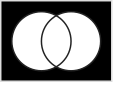
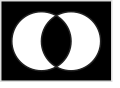
This Venn diagram is meant to represent a relation between


Set theory: The disjoint relation

[edit]

The relation πŸ‘ Image
tells, that the set πŸ‘ Image
is empty:   πŸ‘ Image
= πŸ‘ Image

It can be written as πŸ‘ {\displaystyle A\subseteq B^{c}}
or as πŸ‘ {\displaystyle B\subseteq A^{c}}
.
It tells, that the sets πŸ‘ {\displaystyle ~A}
and πŸ‘ {\displaystyle ~B}
have no elements in common: πŸ‘ {\displaystyle A\cap B=\emptyset }

Under this condition several set operations, not equivalent in general, produce equivalent results.
These equivalences define disjoint sets:

Venn diagrams written formulas
πŸ‘ Image
   πŸ‘ {\displaystyle \Leftrightarrow }
   πŸ‘ Image
= πŸ‘ Image
      πŸ‘ {\displaystyle A\subseteq B^{c}}
   πŸ‘ {\displaystyle \Leftrightarrow }
   πŸ‘ {\displaystyle A\cap B=\emptyset }
πŸ‘ Image
   πŸ‘ {\displaystyle \Leftrightarrow }
   πŸ‘ Image
= πŸ‘ Image
      πŸ‘ {\displaystyle A\subseteq B^{c}}
   πŸ‘ {\displaystyle \Leftrightarrow }
   πŸ‘ {\displaystyle B=B\setminus A}
πŸ‘ Image
   πŸ‘ {\displaystyle \Leftrightarrow }
   πŸ‘ Image
= πŸ‘ Image
      πŸ‘ {\displaystyle A\subseteq B^{c}}
   πŸ‘ {\displaystyle \Leftrightarrow }
   πŸ‘ {\displaystyle A=A\setminus B}
πŸ‘ Image
   πŸ‘ {\displaystyle \Leftrightarrow }
   πŸ‘ Image
= πŸ‘ Image
      πŸ‘ {\displaystyle A\subseteq B^{c}}
   πŸ‘ {\displaystyle \Leftrightarrow }
   πŸ‘ {\displaystyle A\cup B=A\Delta B}
πŸ‘ Image
   πŸ‘ {\displaystyle \Leftrightarrow }
   πŸ‘ Image
= πŸ‘ Image
      πŸ‘ {\displaystyle A\subseteq B^{c}}
   πŸ‘ {\displaystyle \Leftrightarrow }
   πŸ‘ {\displaystyle (A\Delta B)^{c}=(A\cup B)^{c}}
πŸ‘ Image
   πŸ‘ {\displaystyle \Leftrightarrow }
   πŸ‘ Image
= πŸ‘ Image
      πŸ‘ {\displaystyle A\subseteq B^{c}}
   πŸ‘ {\displaystyle \Leftrightarrow }
   πŸ‘ {\displaystyle A^{c}\cup B=A^{c}}
πŸ‘ Image
   πŸ‘ {\displaystyle \Leftrightarrow }
   πŸ‘ Image
= πŸ‘ Image
      πŸ‘ {\displaystyle A\subseteq B^{c}}
   πŸ‘ {\displaystyle \Leftrightarrow }
   πŸ‘ {\displaystyle A\cup B^{c}=B^{c}}
πŸ‘ Image
   πŸ‘ {\displaystyle \Leftrightarrow }
   πŸ‘ Image
= πŸ‘ Image
      πŸ‘ {\displaystyle A\subseteq B^{c}}
   πŸ‘ {\displaystyle \Leftrightarrow }
   πŸ‘ {\displaystyle \emptyset ^{c}=(A\cap B)^{c}}

The sign πŸ‘ {\displaystyle \Leftrightarrow }
tells, that two statements about sets mean the same.
The sign = tells, that two sets contain the same elements.

Propositional logic: The contrary relation

[edit]

The relation πŸ‘ Image
tells, that the statement πŸ‘ Image
is never true:   πŸ‘ Image
πŸ‘ {\displaystyle \Leftrightarrow }
πŸ‘ Image

It can be written as πŸ‘ {\displaystyle A\Rightarrow \neg B}
or as πŸ‘ {\displaystyle B\Rightarrow \neg A}
.
It tells, that the statements πŸ‘ {\displaystyle ~A}
and πŸ‘ {\displaystyle ~B}
are never true together: πŸ‘ {\displaystyle A\land B=false}

Under this condition several logic operations, not equivalent in general, produce equivalent results.
These equivalences define contrary statements:

Venn diagrams written formulas
πŸ‘ Image
   πŸ‘ {\displaystyle \equiv }
   πŸ‘ Image
πŸ‘ {\displaystyle \Leftrightarrow }
πŸ‘ Image
      πŸ‘ {\displaystyle A\Rightarrow \neg B}
   πŸ‘ {\displaystyle \equiv }
   πŸ‘ {\displaystyle A\land B\Leftrightarrow false}
πŸ‘ Image
   πŸ‘ {\displaystyle \equiv }
   πŸ‘ Image
πŸ‘ {\displaystyle \Leftrightarrow }
πŸ‘ Image
      πŸ‘ {\displaystyle A\Rightarrow \neg B}
   πŸ‘ {\displaystyle \equiv }
   πŸ‘ {\displaystyle B\Leftrightarrow \neg A\land B}
πŸ‘ Image
   πŸ‘ {\displaystyle \equiv }
   πŸ‘ Image
πŸ‘ {\displaystyle \Leftrightarrow }
πŸ‘ Image
      πŸ‘ {\displaystyle A\Rightarrow \neg B}
   πŸ‘ {\displaystyle \equiv }
   πŸ‘ {\displaystyle A\Leftrightarrow A\land \neg B}
πŸ‘ Image
   πŸ‘ {\displaystyle \equiv }
   πŸ‘ Image
πŸ‘ {\displaystyle \Leftrightarrow }
πŸ‘ Image
      πŸ‘ {\displaystyle A\Rightarrow \neg B}
   πŸ‘ {\displaystyle \equiv }
   πŸ‘ {\displaystyle A\lor B\Leftrightarrow A\oplus B}
πŸ‘ Image
   πŸ‘ {\displaystyle \equiv }
   πŸ‘ Image
πŸ‘ {\displaystyle \Leftrightarrow }
πŸ‘ Image
      πŸ‘ {\displaystyle A\Rightarrow \neg B}
   πŸ‘ {\displaystyle \equiv }
   πŸ‘ {\displaystyle A\leftrightarrow B\Leftrightarrow \neg (A\lor B)}
πŸ‘ Image
   πŸ‘ {\displaystyle \equiv }
   πŸ‘ Image
πŸ‘ {\displaystyle \Leftrightarrow }
πŸ‘ Image
      πŸ‘ {\displaystyle A\Rightarrow \neg B}
   πŸ‘ {\displaystyle \equiv }
   πŸ‘ {\displaystyle A\rightarrow B\Leftrightarrow \neg A}
πŸ‘ Image
   πŸ‘ {\displaystyle \equiv }
   πŸ‘ Image
πŸ‘ {\displaystyle \Leftrightarrow }
πŸ‘ Image
      πŸ‘ {\displaystyle A\Rightarrow \neg B}
   πŸ‘ {\displaystyle \equiv }
   πŸ‘ {\displaystyle A\leftarrow B\Leftrightarrow \neg B}
πŸ‘ Image
   πŸ‘ {\displaystyle \equiv }
   πŸ‘ Image
πŸ‘ {\displaystyle \Leftrightarrow }
πŸ‘ Image
      πŸ‘ {\displaystyle A\Rightarrow \neg B}
   πŸ‘ {\displaystyle \equiv }
   πŸ‘ {\displaystyle true\Leftrightarrow \neg (A\land B)}

The sign πŸ‘ {\displaystyle \equiv }
tells, that two statements about statements about whatever objects mean the same.
The sign πŸ‘ {\displaystyle \Leftrightarrow }
tells, that two statements about whatever objects mean the same.


Important relations
πŸ‘ Image
πŸ‘ Image
πŸ‘ Image
πŸ‘ Image
πŸ‘ Image
Set theory: subset disjoint subdisjoint equal complementary
Logic: implication contrary subcontrary equivalent contradictory


Operations and relations in set theory and logic

[edit]
 
c
 
A = A
πŸ‘ 1111
πŸ‘ 1111
 
Ac πŸ‘ {\displaystyle \scriptstyle \cup }
 Bc
true
A ↔ A
 
πŸ‘ {\displaystyle \scriptstyle \cup }
 B
 
πŸ‘ {\displaystyle \scriptstyle \subseteq }
 Bc
AπŸ‘ {\displaystyle \scriptstyle \Leftrightarrow }
A
 
 
πŸ‘ {\displaystyle \scriptstyle \supseteq }
 Bc
πŸ‘ 1110
πŸ‘ 0111
πŸ‘ 1110
πŸ‘ 0111
 
πŸ‘ {\displaystyle \scriptstyle \cup }
 Bc
Β¬A πŸ‘ {\displaystyle \scriptstyle \lor }
 Β¬B
A β†’ Β¬B
 
πŸ‘ {\displaystyle \scriptstyle \Delta }
 B
πŸ‘ {\displaystyle \scriptstyle \lor }
 B
A ← Β¬B
 
Ac πŸ‘ {\displaystyle \scriptstyle \cup }
B
 
A πŸ‘ {\displaystyle \scriptstyle \supseteq }
B
AπŸ‘ {\displaystyle \scriptstyle \Rightarrow }
Β¬B
 
 
A = Bc
AπŸ‘ {\displaystyle \scriptstyle \Leftarrow }
Β¬B
 
 
A πŸ‘ {\displaystyle \scriptstyle \subseteq }
B
πŸ‘ 1101
πŸ‘ 0110
πŸ‘ 1011
πŸ‘ 1101
πŸ‘ 0110
πŸ‘ 1011
 
Bc
πŸ‘ {\displaystyle \scriptstyle \lor }
 Β¬B
A ← B
 
A
πŸ‘ {\displaystyle \scriptstyle \oplus }
 B
A ↔ Β¬B
 
Ac
Β¬A πŸ‘ {\displaystyle \scriptstyle \lor }
 B
A β†’ B
 
B
 
B =
AπŸ‘ {\displaystyle \scriptstyle \Leftarrow }
B
 
 
A = c
AπŸ‘ {\displaystyle \scriptstyle \Leftrightarrow }
Β¬B
 
 
A =
AπŸ‘ {\displaystyle \scriptstyle \Rightarrow }
B
 
 
B = c
πŸ‘ 1100
πŸ‘ 0101
πŸ‘ 1010
πŸ‘ 0011
πŸ‘ 1100
πŸ‘ 0101
πŸ‘ 1010
πŸ‘ 0011
Β¬B
 
 
πŸ‘ {\displaystyle \scriptstyle \cap }
 Bc
A
 
 
(A πŸ‘ {\displaystyle \scriptstyle \Delta }
 B)c
Β¬A
 
 
Ac πŸ‘ {\displaystyle \scriptstyle \cap }
 B
B
 
BπŸ‘ {\displaystyle \scriptstyle \Leftrightarrow }
false
 
AπŸ‘ {\displaystyle \scriptstyle \Leftrightarrow }
true
 
 
A = B
AπŸ‘ {\displaystyle \scriptstyle \Leftrightarrow }
false
 
BπŸ‘ {\displaystyle \scriptstyle \Leftrightarrow }
true
 
πŸ‘ 0100
πŸ‘ 1001
πŸ‘ 0010
πŸ‘ 0100
πŸ‘ 1001
πŸ‘ 0010
πŸ‘ {\displaystyle \scriptstyle \land }
 Β¬B
 
 
Ac πŸ‘ {\displaystyle \scriptstyle \cap }
 Bc
πŸ‘ {\displaystyle \scriptstyle \leftrightarrow }
 B
 
 
πŸ‘ {\displaystyle \scriptstyle \cap }
 B
Β¬A πŸ‘ {\displaystyle \scriptstyle \land }
 B
 
AπŸ‘ {\displaystyle \scriptstyle \Leftrightarrow }
B
 
πŸ‘ 1000
πŸ‘ 0001
πŸ‘ 1000
πŸ‘ 0001
Β¬A πŸ‘ {\displaystyle \scriptstyle \land }
 Β¬B
 
 
πŸ‘ {\displaystyle \scriptstyle \land }
 B
 
 
A = Ac
πŸ‘ 0000
πŸ‘ 0000
false
A ↔ Β¬A
AπŸ‘ {\displaystyle \scriptstyle \Leftrightarrow }
Β¬A
 
These sets (statements) have complements (negations).
They are in the opposite position within this matrix.
These relations are statements, and have negations.
They are shown in a separate matrix in the box below.
more relations
πŸ‘ Image

The operations, arranged in the same matrix as above.
The 2x2 matrices show the same information like the Venn diagrams.
(This matrix is similar to this Hasse diagram.) 
 
In set theory the Venn diagrams represent the set,
which is marked in red.
 
πŸ‘ Image

These 15 relations, except the empty one, are minterms and can be the case.
The relations in the files below are disjunctions. The red fields of their 4x4 matrices tell, in which of these cases the relation is true.
(Inherently only conjunctions can be the case. Disjunctions are true in several cases.)
In set theory the Venn diagrams tell,
that there is an element in every red,
and there is no element in any black intersection.
πŸ‘ Image

Negations of the relations in the matrix on the right.
In the Venn diagrams the negation exchanges black and red.
 
In set theory the Venn diagrams tell,
that there is an element in one of the red intersections.
(The existential quantifications for the red intersections are combined by or.
They can be combined by the exclusive or as well.)
πŸ‘ Image

Relations like subset and implication,
arranged in the same kind of matrix as above.
 
In set theory the Venn diagrams tell,
that there is no element in any black intersection.


Public domainPublic domainfalsefalse
πŸ‘ Image
This work is ineligible for copyright and therefore in the public domain because it consists entirely of information that is common property and contains no original authorship.

File history

Click on a date/time to view the file as it appeared at that time.

Date/TimeThumbnailDimensionsUserComment
current22:50, 7 May 2010πŸ‘ Thumbnail for version as of 22:50, 7 May 2010
384 Γ— 280 (4 KB)Watchduck (talk | contribs)layout change
18:01, 26 July 2009πŸ‘ Thumbnail for version as of 18:01, 26 July 2009
384 Γ— 280 (9 KB)Watchduck (talk | contribs)
16:16, 10 April 2009πŸ‘ Thumbnail for version as of 16:16, 10 April 2009
615 Γ— 463 (4 KB)Watchduck (talk | contribs){{Information |Description={{en|1=Venn diagrams of the sixteen 2-ary Boolean '''relations'''. Black (0) marks empty areas (compare empty set). White (1) means, that there ''could'' be something. There are corresponding diagrams of th

You cannot overwrite this file.

File usage on Commons

The following 36 pages use this file:

File usage on other wikis

The following other wikis use this file: