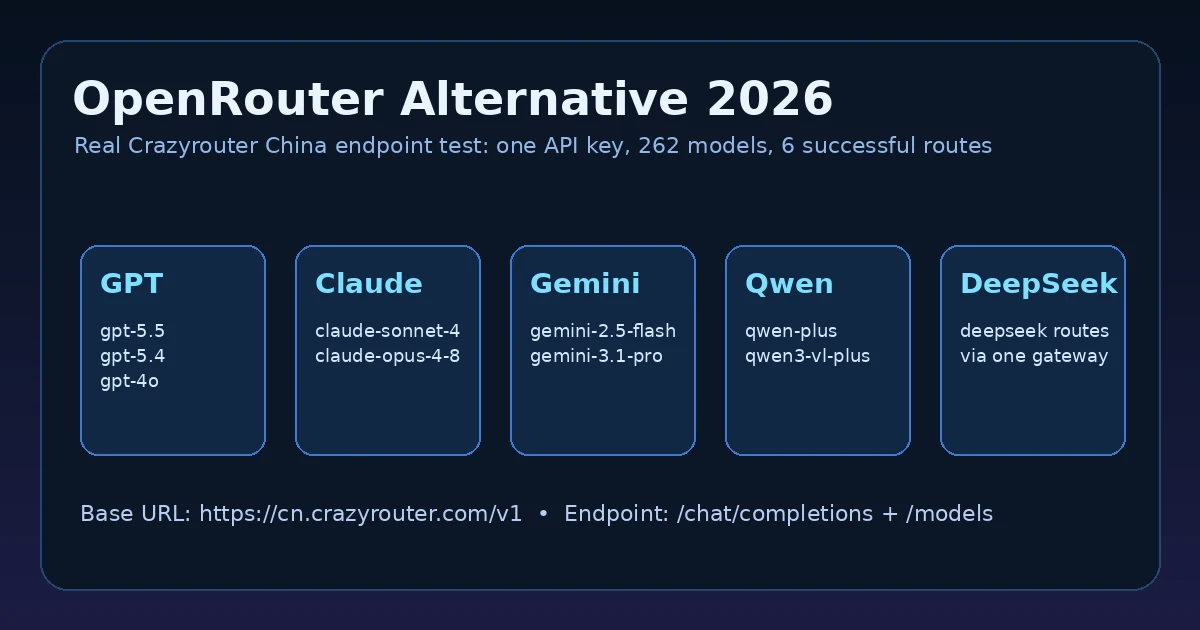
OpenAI has released its most powerful models yet: GPT-5, GPT-5.2, and the reasoning-focused o3-pro. This guide shows you how to access these cutting-edge models through Crazyrouter's unified API.
Supported OpenAI Models#
Crazyrouter provides access to the complete OpenAI model lineup:
| Model | Input ($/1M tokens) | Output ($/1M tokens) | Best For |
|---|---|---|---|
| gpt-5.2 | $1.75 | $14.00 | Latest flagship, complex tasks |
| gpt-5.2-pro | $3.50 | $28.00 | Enhanced reasoning |
| gpt-5 | $1.25 | $10.00 | General tasks |
| gpt-5-pro | $2.50 | $20.00 | Advanced analysis |
| gpt-5-mini | $0.25 | $2.00 | Cost-effective |
| gpt-5-nano | $0.05 | $0.40 | High-volume tasks |
| o3-pro | $20.00 | $80.00 | Complex reasoning |
| o3-mini | $1.10 | $4.40 | Efficient reasoning |
| o4-mini | $1.10 | $4.40 | Latest reasoning model |
Quick Start#
1. Get Your API Key#
- Visit Crazyrouter Console
- Navigate to "Token Management"
- Click "Create Token"
- Copy your API key (starts with
sk-)
2. Make Your First Request#
Using Python (Recommended)#
python
from openai import OpenAI

client = OpenAI(
 api_key="sk-your-api-key",
 base_url="https://crazyrouter.com/v1",
 default_headers={
 "User-Agent": "Mozilla/5.0 (Windows NT 10.0; Win64; x64) AppleWebKit/537.36"
 }
)

response = client.chat.completions.create(
 model="gpt-5.2",
 messages=[
 {"role": "system", "content": "You are a helpful assistant."},
 {"role": "user", "content": "Explain quantum computing in simple terms."}
 ],
 temperature=0.7,
 max_tokens=1000
)

print(response.choices[0].message.content)
Using Node.js#
javascript
import OpenAI from 'openai';

const client = new OpenAI({
 apiKey: 'sk-your-api-key',
 baseURL: 'https://crazyrouter.com/v1',
 defaultHeaders: {
 'User-Agent': 'Mozilla/5.0 (Windows NT 10.0; Win64; x64) AppleWebKit/537.36'
 }
});

async function main() {
 const response = await client.chat.completions.create({
 model: 'gpt-5.2',
 messages: [
 { role: 'system', content: 'You are a helpful assistant.' },
 { role: 'user', content: 'Explain quantum computing in simple terms.' }
 ],
 temperature: 0.7
 });

 console.log(response.choices[0].message.content);
}

main();
Using curl#
bash
curl https://crazyrouter.com/v1/chat/completions \
 -H "Content-Type: application/json" \
 -H "Authorization: Bearer sk-your-api-key" \
 -H "User-Agent: Mozilla/5.0 (Windows NT 10.0; Win64; x64) AppleWebKit/537.36" \
 -d '{
 "model": "gpt-5.2",
 "messages": [{"role": "user", "content": "Hello, GPT-5.2!"}],
 "temperature": 0.7
 }'
Streaming Responses#
For real-time output, enable streaming:
python
from openai import OpenAI

client = OpenAI(
 api_key="sk-your-api-key",
 base_url="https://crazyrouter.com/v1",
 default_headers={
 "User-Agent": "Mozilla/5.0 (Windows NT 10.0; Win64; x64) AppleWebKit/537.36"
 }
)

stream = client.chat.completions.create(
 model="gpt-5.2",
 messages=[{"role": "user", "content": "Write a short story about AI."}],
 stream=True
)

for chunk in stream:
 if chunk.choices[0].delta.content:
 print(chunk.choices[0].delta.content, end="", flush=True)
Using Reasoning Models (o3-pro)#
The o3-pro model excels at complex reasoning tasks:
python
response = client.chat.completions.create(
 model="o3-pro",
 messages=[
 {"role": "user", "content": "Solve this step by step: If a train travels 120 miles in 2 hours, then stops for 30 minutes, then travels another 90 miles in 1.5 hours, what is the average speed for the entire journey including the stop?"}
 ]
)

print(response.choices[0].message.content)
GPT-5 Codex Models#
For code generation tasks, use the specialized codex models:
python
response = client.chat.completions.create(
 model="gpt-5-codex",
 messages=[
 {"role": "user", "content": "Write a Python function to implement binary search"}
 ]
)
Available codex variants: gpt-5-codex, gpt-5-codex-high, gpt-5-codex-medium, gpt-5-codex-low, gpt-5.2-codex
Best Practices#
- Choose the right model: Use gpt-5-nano for simple tasks, gpt-5.2 for complex ones
- Set appropriate temperature: Lower (0.1-0.3) for factual tasks, higher (0.7-1.0) for creative tasks
- Use streaming: For better user experience in chat applications
- Handle errors gracefully: Implement retry logic for rate limits
Next Steps#
- View Model Pricing for detailed costs
- Read the API Documentation for advanced features
- Join our Discord Community for support
For questions, contact support@crazyrouter.com
Implementation Guides
AuthenticationCreate and use API keys with the required authorization headers.Quick Start GuideMake the first Crazyrouter API call and validate your setup.Making RequestsSend chat completion requests, stream responses, and debug calls.List ModelsQuery models available to the current API key through GET /v1/models.
Available in other languages: