|
VOOZH | about |
|
VOOZH | about |
Second Edition, Revised and Extended
Since the book has proved to be a success, Peter Lang Publishers have proposed preparing a second, revised and extended edition. I am grateful for this opportunity.
Some minor corrections of an editorial nature have been introduced. As far as substantive issues are concerned, I have added some arguments in Section 7.3, in support of my claim that the story about the sharing of wives is a part of a test of virtue given to the audience of Plato’s Socrates (and also to readers of the Republic). I would like to thank Professor Wojciech Żełaniec, who mentioned in his review that he would appreciate seeing more elaborate argumentation on this point. I am aware of the far-reaching consequences of my claims, for instance that Plato’s story of philosophers as kings should be read as a kind of seduction which aims to test the virtue of the reader, and not as a part of a political project.
I will provide more in-depth argumentation in a new book, on which I am currently working. I have also added a short comment in Section 2.5 on Thomas Aquinas’ approach to the connection between something’s being immortal and being willed for its own sake. I find this comment important, because it demonstrates that reasoning analogous to that provided by Plato in the Demiurge’s speech in the Timaeus is present also in mediaeval thought on dignity.
I owe my gratitude to the Institute of Law of the SWPS University for its financial support for this edition. I would like to thank John Catlow for his linguistic expertise, Wojciech Wrotkowski for his fascinating stories about the intricacies of the Greek language, and my wife Celina, who checked the whole manuscript, for everything.
This book is the result of many years of research. I would like to thank Jacek Sobczak, who supported me in writing an early outline of this project; Dorota Zygmuntowicz for her helpful critiques of the early draft of this book; Wojciech Żełaniec and Krzysztof Wroczyński for their helpful comments; and Jerzy Czarnowski for his suggestions and encouragement during my work on this book. Last but not least, I extend my thanks to the students who attended my seminars at Zielona Góra University and Adam Mickiewicz University for helping me to deepen my understanding of Plato.
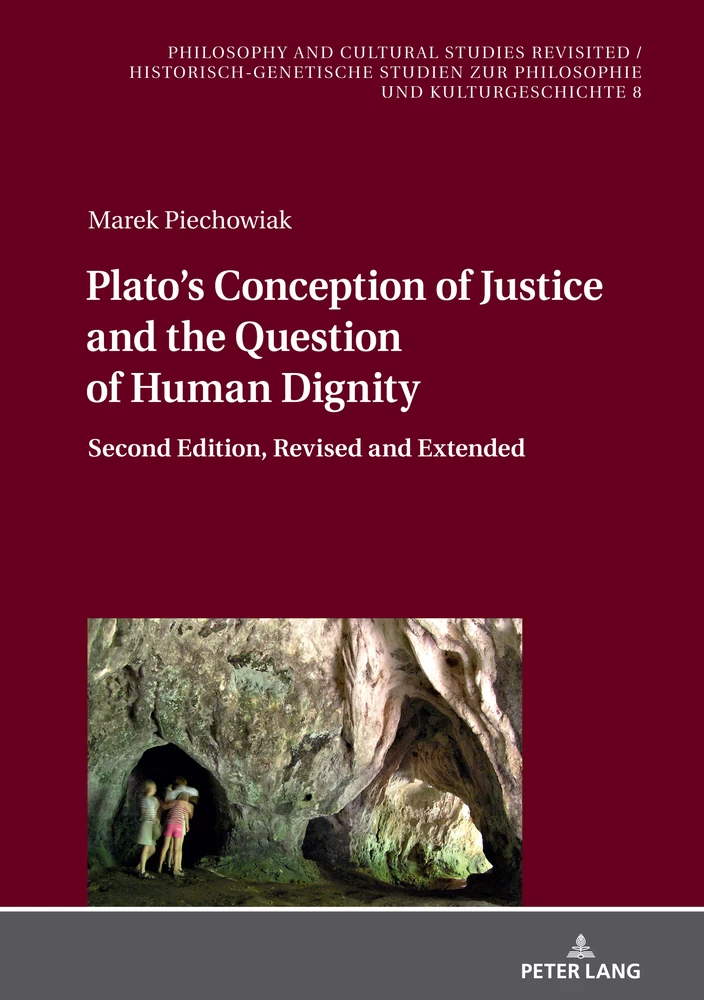
Since I am not a native speaker of English, I needed help in the preparation of the manuscript. I wish to thank my wife Celina, Jerzy Czarnowski, and—most of all—Thomas Anessi and John Catlow, who reviewed the final version, for sharing their linguistic expertise. I am also grateful to Emilia Przylepa for her help in reviewing the Greek expressions introduced in the text. I would also like to thank Marek Moszyk for his ideas on the choice of cover photo.
I have decided to leave some references to the scholarship written in Polish, although it is not accessible to many readers of this book. I feel obliged to pay tribute at least to some of the works written in Polish which shape my thinking about Plato.
Last but not least my thanks go to the Polish National Science Centre—without its generous financial support this book could not have appeared.
Earlier versions of some sections of this book have been previously published as follows:
Parts of the Introduction and Chapter II are based on ‘Plato and the Universality of Dignity’ (2015), and ‘Przemowa Demiurga w Platońskim „Timajosie” a współczesne pojęcie godności’ [Demiurge’s Speech in Plato’s ‘Timaeus’ and the Contemporary Notion of Dignity] (2013).
Parts of Chapter III, Section 7 were published as ‘Platońskie widziadło sprawiedliwości’ [Plato's Phantom of Justice] (2013).
Chapter IV is based on ‘Sokrates sam ze sobą rozmawia o sprawiedliwości’ [Socrates in a Dialogue with Himself on Justice] (2009).
The analysis of I. Berlin’s argument contained in Chapter V, Section 2 was presented in ‘Tomasza z Akwinu koncepcja prawa naturalnego. Czy Akwinata jest myślicielem liberalnym?’ [Thomas Aquinas’ Conception of Natural Law: Is Aquinas a Liberal Thinker?] (2013).
Chapter V, Section 3 was published (with minor changes) as ‘Plato’s Conception of Punitive Justice’ (2015).
Parts of Chapter VI, Section 3 were published as ‘Kallikles i geometria. Przyczynek do Platońskiej koncepcji sprawiedliwości’ [Callicles and Geometry: On Plato’s Conception of Justice] (2013).
Plato’s thought is a cornerstone of European philosophy and European culture. As Alfred N. Whitehead once wrote, ‘The safest general characterization of the European philosophical tradition is that it consists of a series of footnotes to Plato’. In philosophical reflection about law and the state it is impossible to ignore the notions and issues introduced by Plato into philosophical debate and into culture in general. As Martin Heidegger noted, one has to accept that we are talking the language of Plato even if one does not share his views.
This book is chiefly about Plato’s account of justice. Nevertheless, certain substantially modern questions underlie this effort—questions that are vital for understanding the foundations of modern-day legal orders. Plato is therefore read here from the perspective of the legal orders functioning today rather than from the perspective of the philosophy of law.
In the book, I focus on human dignity, which is broadly recognised as the source of all human rights, the axiological basis of law, and a criterion of justice. Did Plato have any idea about human dignity, so critical to modern legal orders? If so—and this is what I argue for in this book—then dignity should play a crucial role in Plato’s understanding of justice. Since the concept of justice stands at the centre of his philosophy, it also seems to be essential to understanding the overall Platonic project. Is it the case that Plato provides the foundations for modern-day human rights protection rather than for modern-day totalitarianism?
Dignity is generally regarded today as a fundamental value across legal systems at both the international and national levels. It is considered inviolable, and therefore ←17 |
The dignity which is at stake here, and which can be called the ‘dignity of a person’, should be distinguished from dignity as moral excellence or as honour, or dignity of other types. The dignity of a person—as the source of all human rights—is a fundamental value found across legal systems. And only dignity of this kind is recognised as equal in all human beings and as an inherent quality which is present independently of any action by its holder or other persons, or of one’s life circumstances.
It is something of a paradox that the recognition in law of the inherent nature of the dignity of a person and of its universality is accompanied in contemporary culture by the widespread acceptance of cultural relativism—the belief that values are a ‘product’ of a given culture rather than something which exists objectively, independently of human activity. If such a point of view is adopted, it ought to be acknowledged that dignity, as an axiological foundation of a legal system, is also a product of the culture of a given time and place, and thus giving it certain characteristics is not based on cognition (knowledge of reality); dignity cannot therefore be considered as existing objectively. The assumption that dignity is ←18 |
However, it should be noted here that even a radical historicity of the notion of dignity cannot be considered a sufficient reason for rejecting the existence of inherent dignity, since one could argue that the development of culture leads to the creation of better intellectual tools, like concepts or ideas, for understanding reality, and that we should not suppose that things corresponding to certain concepts did not exist in the past merely because the concepts themselves had not yet been invented.
It would be momentous for establishing the universality of dignity if reflections on the concept of dignity, or—more likely—on what today is understood and expressed through this concept, could be found in ancient philosophy. Nonetheless, deliberations on how Plato’s work provides insights into the dignity of a person, rather than giving a basis for a totalitarian framework contrasting with the dignitarian approach, ←19 |—as someone who laid down the theoretical foundations of totalitarianism, as someone who provided justifications for the view that an individual is meant to serve the state rather than the state to serve the individual. Plato is seen as one who rejects the fundamental thesis upon which the recognition of universal human dignity is founded. In the Republic, in developing his model of a hypothetical state, Plato writes that
it isn’t the law’s concern to make any one class in the city outstandingly happy but to contrive to spread happiness throughout the city by bringing the citizens into harmony with each other through persuasion or compulsion and by making them share with each other the benefits that each class can confer on the community. The law produces such people in the city, not in order to allow them to turn in whatever direction they want, but to make use of them to bind the city together.
In accordance with the absolute subordination of the good of an individual to the good of the state, the state sets aims for particular individuals to specialise in. Every citizen
must be brought to that which naturally suits him—one man, one job—so that each man, practicing his own, which is one, will not become many but one; and thus, you see, the whole city will naturally grow to be one and not many.
The ultimate aim of the laws and organisation of a state seems to be the very existence of the state as a supreme good: ‘Is there any greater evil we can mention for a city than that which tears it apart and makes it many instead of one? Or any greater good than that which binds it together and makes it one?’
←20 |The totalitarianism of the first type takes the view that the good of a member of a political community is entirely subordinated to the good of the community, and that if there is a conflict in the realisation of these goods, then the well-being and continued existence of the community prevails, and thus an individual can be rightly sacrificed for the benefit of the whole. Totalitarianism of the second type postulates that the authorities (the laws, the state) should exercise full control over all aspects of the life of all members of the political community. Neither of these two types necessarily implies the other. It is possible to propose full control over the life of citizens for their own benefit and not for the benefit of the state or community. It is also possible to recognise the well-being of the state as the highest value and nevertheless not demand full control over individuals.
Whenever Plato’s conception of justice is examined here, the question of totalitarianism of both types is always present somewhere in the background. Was he really blind to dignity as the reason for the non-instrumental treatment of each human being? Was he blind to the importance of individuality and autonomy for personal development? And when thinking about the place occupied by Plato’s philosophy in European culture, some other intriguing general questions have to be posed. Is an essentially totalitarian philosophy the cornerstone of European culture? Was Plato’s work so attractive through the centuries because he advocated a state in which every citizen was bound only to one occupation, and the life of each individual was completely subordinated to the benefit of the state as a whole? One could suggest that other issues than the problem of totalitarianism were important for his readers. But this seems an insufficient explanation. The issue of justice, which is inevitably engaged in the problem of totalitarianism, is central to Plato’s thought, which is systemic in character. Fundamental flaws in his theory of justice would be an important indication of the fundamentally defective nature of Plato’s philosophy as a whole.
Plato is still held to be a totalitarian, though not such an extreme one as Karl Popper alleged, and his philosophy is considered to be paternalistic and, like totalitarian approaches, to take little or no account of the autonomy of an individual. As Christopher Taylor writes, Plato’s theory
in common with other varieties of paternalism conceals a crucial evaluative gap. He needs to show that an adequate conception of a good life need not include any ←21 |
I wish to challenge this kind of view in a radical way, arguing not only that Plato was aware of the need for individual autonomy, but also that his philosophy provides strong arguments for striving for the participation of all citizens in making political decisions and, moreover, that there is room for free determination of the goals to be pursued.
The fact that Plato is suspected of helping to develop totalitarian views makes his philosophy—seemingly paradoxically—all the more attractive for research on human dignity. For the recognition of the universality of the inherent dignity, it is much more significant if reflections on such a dignity are found in a theory which is supposed to challenge such recognition than in theories which are known to support it.
There is at least one more reason to include Plato in the contemporary debate on dignity. Although observable human features (like our genome) can be accepted as criteria, as ‘diagnostic’ traits, for identifying a holder of dignity, if dignity is universal, inherent, and equal, it seems to be metaphysical, independent of any observable, changeable human traits (such as thinking, choosing, acting, or behaving in a particular way). Plato is certainly someone who has something to say about such a kind of reality and about how to learn something about it.
This study aims to give a comprehensive exposition of Plato’s conception of justice as seen from the perspective of human dignity. For us, just like for Plato, the issue of justice is crucial for understanding the relationship between an individual and the state and the law, and also for understanding the aims of laws and how and why a political community should be built. It also turns out that the reflection on human dignity contained in Plato’s philosophy provides a perspective from which these issues can and should be viewed today.
The present study is not directly aimed at identifying flaws and weaknesses in interpretations of Plato’s writings that advocate or accept the thesis that he developed a totalitarian project. Nevertheless, an approach is proposed here that very strongly opposes such interpretations. This approach rests on identifying in Plato’s works reflections on that which is today called ‘dignity’. Such an approach makes apparent his recognition in human beings of ‘something’ which is inherent, equal, and positively distinguishes them in such a way that they should be treated as aims in themselves. Moreover, these reflections play a fundamental role in the construction of Plato’s overall conception of justice and, essentially, of Plato’s philosophy as a whole. Plato’s project turns out to be a far cry from any form of totalitarian ←22 |
As the ordering of the questions indicates, practical philosophy is Plato’s first philosophy. An illustration of this is the myth of the cave, which is a standard point of reference in epistemology and ontology, but is nevertheless placed by Plato in Book VII of the Republic—the dialogue about justice. Plato’s philosophy is of a systemic kind—his teaching on being and cognition is essential for understanding moral issues. It is not the case that the practical philosophy is ‘attached’ to ontology or epistemology—rather the exact opposite. The problem of justice turns out to be central to the whole of Plato’s philosophy because it leads straight to the most fundamental ontological questions concerning the foundations of existence and to epistemological issues concerning the acquisition of knowledge about what justice is and what the content of just actions is.
Although Plato does not speak a language which directly expresses existential aspects of reality by using the verb ‘be’ (‘εἶναι’) in its existential meaning, nevertheless the question remains whether in using other words he is still talking about what is nowadays signified by ‘existential aspect’. Does Plato consider the question of the foundations of being (existence) as an issue distinct from the problem of the ‘content’ of a being? I am arguing that the problems both of justice and of dignity (of what nowadays is called ‘dignity’), which come together in the issue of the inner unity of the human being, are crucial for Plato. A special unity turns out to underlie the immortality of the soul, and acquiring or losing justice can be understood as acquiring or losing the inner unity. Unity is central to Plato’s understanding of the Good as the source of existence and being. Therefore, in the framework of Plato’s conception of justice, when read as a contribution to contemporary ←23 |
Leo Strauss advocates the view that all of Plato’s dialogues deal more or less directly with political matters. Nevertheless, the analyses that follow suggest that the goodness of individuals and their actions comes first not only in the construction of a theory of a good society, but also that they are unquestionable goals for the state and the law. Plato’s deliberations about justice in the state are often entirely subordinated to understanding of the justice of an individual and his actions. Although some teaching contained in the Republic applies both to an individual and to the state (the city), there are still cases where the theses are relevant only to an individual and not to the state; for instance, this is evidently the case when courage is considered. The analyses show that the overall narrative introduced by Plato in the Republic clearly indicates that his deliberations about the state are directed first of all at understanding of an individual’s striving for fulfilment. Discrepancies in the possibilities for applying certain claims to both an individual and the community should therefore be resolved in favour of the individual. Plato provides his reader with advice on how to proceed in this way. One example, which is extensively analysed below, can be found in Book IV of the Republic, where Plato’s Socrates not only clearly indicates that his statements are about an individual when he starts with the words ‘and in truth justice is’, but also asks his audience to treat with caution some crucial conclusions about justice that are reached in considerations about the hypothetical state, saying explicitly that justice ‘isn’t concerned with someone’s doing his own externally’. Eric A. Havelock notices that this clear statement ‘seems to imply a repudiation of a great deal of what Plato has previously said’, and ‘previously’ the model of the hypothetical state was developed. Havelock continues—‘if justice does not apply to outward action, it becomes an inner and private condition, a morality of the self but not of society’. The model of the hypothetical state cannot be treated as ←24 |
This does not mean that Plato is not interested at all in the justice of laws or of the state. Nevertheless, before these problems are considered, the issues concerning the individual have to be solved—and these solutions should be applied to questions about the justice of laws and the state. Moreover, if an individual and not the state is an aim in itself, the question of how to be a good person becomes paramount. Justice of an individual turns out to be key to understanding the aims of law and the state and the justice of them.
If the dignitarian approach is the right one, then the benefits to an individual should be recognised as the aim of laws. In Book V of the Laws, Plato’s Athenian takes this position univocally and without reservations: ‘The whole point of our legislation was to allow the citizens to live supremely happy lives in the greatest possible mutual friendship’. This statement will serve as a kind of a leitmotif throughout this book. In many elaborations of Plato’s philosophy it is considered only in passing or is interpreted as stating something about the happiness of the state rather than of individuals. This is surprising because in classical philosophy, an aim, which is the causa finalis, is the most important among all causes (it is the cause of all causes—causa causarum) which help us to understand the given reality (in this case, the laws and the state).
The happiness of an individual results from not simply safety and the preservation of life, which are goods apprehended easily on the basis of sensual experience, ←25 | Being happy goes beyond that which is visible and concerns acquiring and practising virtues, most of all justice. Hence, the conception of justice turns out to be crucial for understanding the aims of laws. It can be stated simply that the proper and primary aim of laws and of any state is to ensure that each member of the political community acts justly.
It should be observed that in Book III of the Laws one can already find a different enumeration of the aims of the state: ‘One should always remember that a state ought to be free and wise and enjoy internal harmony, and that this is what the lawgiver should concentrate on in his legislation’. And this is not the only place where the aims of laws (of legislation) are considered. This last enumeration is accompanied by a remark of a methodological nature:
Marek Piechowiak (Author)
Marek Piechowiak habilitated in philosophy and is a professor of legal sciences. His scholarly work primarily concerns the philosophical foundations of international and constitutional protection of human rights, including in the historical perspective. He works in the Institute of Law at the SWPS University.