Leonardo.AI pricing: every plan, token, and hidden cost (2026)


Last edited June 5, 2026

Table of Contents
- What you actually pay for Leonardo.AI
- Leonardo.AI pricing at a glance
- Solo plans, decoded
- Team plans
- API plans
- How tokens actually work
- What "unlimited" actually means on Leonardo.AI
- The hidden costs nobody mentions
- What real users actually say
- Leonardo.AI pricing vs Midjourney, Kling, and Runway
- Picking your Leonardo.AI plan
- Try eesel.ai if you're shopping for AI tools more broadly
What you actually pay for Leonardo.AI
Leonardo.AI is a creator-first generative AI platform that bundles image generation, video, an image editor, and an upscaler under one subscription. Since Canva acquired Leonardo in 2024, the Essential plan is also bundled with Canva Business, which is the cleanest signal that pricing isn't going up any time soon. The pitch on the homepage is one number you can quote: 4 billion+ assets generated, 80+ models, 235 countries, with logos from Coca-Cola, Ducati, NVIDIA, and Springbok on the trusted-by strip.
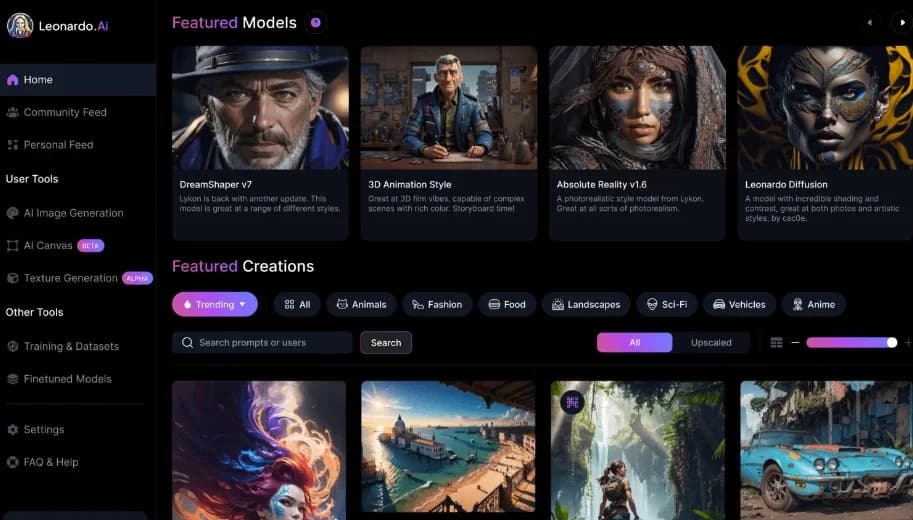
What you're paying for, in plain terms, is access to that whole shelf of models through one interface. Leonardo runs its own Lucid Origin, Lucid Realism, and Phoenix families (the ones it offers "unlimited" relaxed access to), but its real pull is letting you swap in Veo 3.1, Kling 3.0, Hailuo 2.3, Seedance, Seedream 4.5, Nano Banana Pro, Flux.2 Pro, Ideogram 3.0, and a long tail of others without juggling six subscriptions. Whether the price is worth it depends almost entirely on which models you use and how often you push them.
Leonardo.AI pricing at a glance
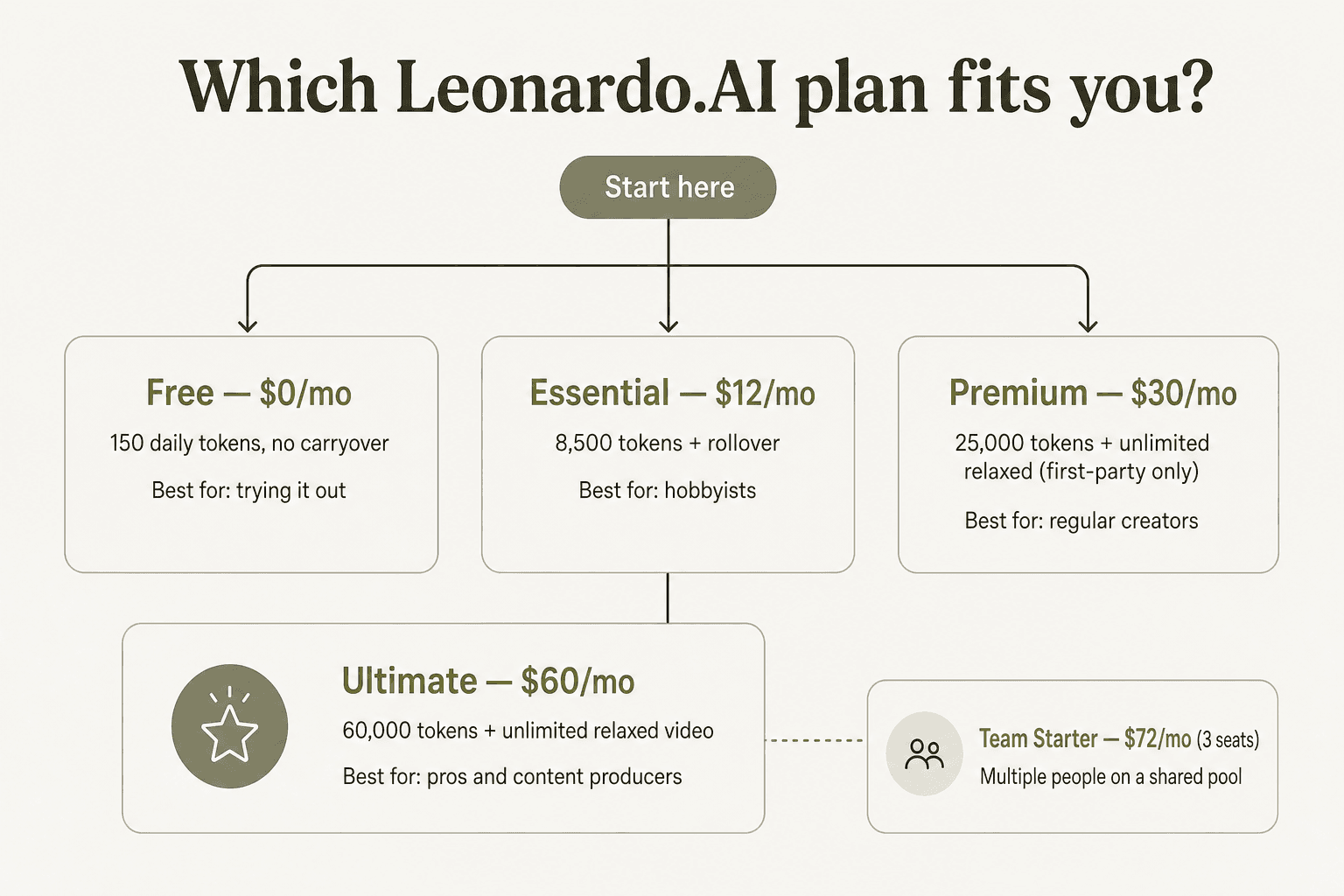
Here's every public plan in one table. All prices are monthly, exclude tax (GST and VAT are added at checkout via Stripe), and assume monthly billing. Annual billing knocks up to 20% off on every solo and team tier.
| Track | Plan | Monthly price | Fast tokens | Rollover bank | Best for |
|---|---|---|---|---|---|
| Solo | Free | $0 | 150 / day (no carryover) | None | Trying it out |
| Solo | Essential | $12 | 8,500 / mo | 25,500 | Hobbyists, daily creators |
| Solo | Premium | $30 | 25,000 / mo | 75,000 | Semi-pro creators, unlimited relaxed image gen |
| Solo | Ultimate | $60 | 60,000 / mo | 180,000 | Pros, includes unlimited relaxed video |
| Team | Starter | $72 ($24/seat × 3) | 25,000 / seat (75k shared) | 225,000 | Small teams, shared pool |
| Team | Growth | $144 ($48/seat × 3) | 60,000 / seat (180k shared) | 540,000 | Larger teams, adds model training |
| Team | Custom | Contact sales | Custom | Custom | Enterprise workflows |
| API | Pay-as-you-go | $5 starter credit | Usage-billed, never expires | n/a | Indie devs, light production |
| API | Custom | Contact sales | Volume-billed | n/a | High-volume production |
Source: Leonardo.AI pricing page, checked 2026-06-05.

Solo plans, decoded
The four solo tiers ladder cleanly: each one roughly triples your monthly token pool while adding one or two structural perks. Knowing where each break-point sits is the difference between paying $12 and constantly running dry, or paying $60 and barely using half your allowance.
Free, $0/month
You get 150 Fast Tokens per day, no rollover, and access to the basic quality setting. All your creations are public (so they can be seen and used by other Leonardo users), and you don't hold the IP, Leonardo does. You can run Blueprints with a concurrency limit of 1 and a queue limit of 5, and you can browse Presets. Per Leonardo's Tokens FAQ, the 150 daily tokens reset every 24 hours but don't accumulate, so the pool you don't burn today is gone tomorrow.
In practice the free tier is enough to test the platform for an afternoon. One Capterra reviewer put it bluntly: "The free version is quite generous, and the paid version is worth the money" (Capterra). But Trustpilot reviewers who push it hit the ceiling fast, especially on premium models, where 150 tokens often evaporate "in about 20 minutes".
Our take: Free is great for kicking the tyres for a weekend. Don't plan a project around it.
Essential, $12/month
The first real plan. 8,500 Fast Tokens per month plus a 25,500-token Rollover Bank that catches anything you didn't burn at month-end. Private creations, the Enhanced quality setting, unlimited personal Collections, up to 10 personal AI models, and two simultaneous generations with a queue limit of 5. Top-up token packs are available here and never expire.
The standout bonus most reviews miss: Essential is included with Canva Business. If your team already pays for Canva Business, you're effectively paying $0 incremental for Leonardo Essential. That's also the cleanest signal of Leonardo's intent post-acquisition.
Our take: This is the right plan for a hobbyist who logs in a few times a week and stays on Leonardo's own models. If you're running Veo 3 or Kling clips weekly, you'll blow through 8,500 tokens in a couple of days.
Premium, $30/month
The biggest functional jump on the ladder. 25,000 Fast Tokens per month, a 75,000-token Rollover Bank, three simultaneous generations, and a queue limit of 10. Personal AI models go from 10 to 20.
The real reason people pay for Premium isn't the higher token count, it's Unlimited Relaxed Image Generation on Leonardo's first-party image models: Lucid Origin, Lucid Realism, Phoenix 1.0/0.9, FLUX Dev, and FLUX Schnell. "Relaxed" means lower-priority queue and reduced concurrency, but the throughput is genuinely unlimited as long as you're on those models. If you can stay on the first-party shelf, your effective cost-per-image stops mattering at $30/month.
Our take: If you're producing images regularly on first-party models, this is the plan to land on. Skip it only if you specifically need premium third-party models (Veo 3, Kling, Sora 2, etc.) on volume.
Ultimate, $60/month
The pro plan. 60,000 Fast Tokens per month, a 180,000-token Rollover Bank, six simultaneous generations, a queue of 20, and 50 personal AI models. Everything Premium has, plus the headline upgrade: Unlimited Relaxed Video Generation on Motion 1.0, Motion 2.0, and Motion 2.0 Fast.
That video-unlimited promise is the entire reason a content producer would pick Ultimate over Premium. Once Leonardo's announcement of Motion 2.0 on X was followed up with the Veo 3 at $10/month repackaging, the video tier became Leonardo's loudest "we undercut Runway and Pika" pitch.
Our take: Ultimate makes sense if video is part of your weekly output and you can live with Leonardo's first-party Motion models. If you need Veo 3, Kling Pro, or Sora 2 on volume, the token math still wins, but you'll be topping up regardless.
Team plans
Team pricing is seat-based, with a minimum of three seats. Tokens pool across the team rather than splitting per person, so a 10-seat Starter still draws from one 75,000-token shared bank (plus per-seat allowance) rather than 10 separate buckets. That model is genuinely better for design agencies than the per-seat token caps competitors use.
Team Starter, $72/month (3 seats × $24)
75,000 shared Fast Tokens (25,000 per seat), a 225,000-token Rollover Bank, unlimited relaxed image and video generation (same selected models as Ultimate), Private Team Generations, six concurrent runs, and a 20-deep queue. Realtime Canvas and Realtime Generation are both unlimited. Enhanced quality is on by default.
Our take: A small in-house creative team (3-5 people) producing weekly social and ad assets on Leonardo's first-party shelf will be comfortable here. The shared pool is the right design.
Team Growth, $144/month (3 seats × $48)
Everything in Starter plus a 180,000 shared token pool (60,000 per seat), a 540,000 Rollover Bank, and explicit model training on team tokens, which Starter does not include. That last one matters: if your brand wants its own fine-tuned Leonardo model trained on internal style references, you need Growth or a custom plan.
Our take: This is the plan for an agency or in-house team that needs a branded model and is shipping more than 30 finished assets a week.
Team Custom
Custom token allocations, full feature parity with Growth, and tailored support. The signup CTA points to Leonardo's enterprise contact page. Worth noting: a few enterprise customers on Trustpilot reported difficulty cancelling, so write your termination clause carefully.
API plans
Leonardo's Production API is a separate billing track from the subscriptions and lives under its own pricing page. It's also where Leonardo's pricing strategy gets most aggressive vs developer-focused image APIs.
Pay-as-you-go
Every new account gets $5 of API credit at signup. The credit doesn't expire. Pay-as-you-go supports up to 10 concurrent generations, with auto top-ups to keep production running, and access to the latest models from day one (text-to-image, image-to-image, image-to-video, LoRA training, custom presets, upscaling, and Blueprints).
What Leonardo doesn't publish on the API page is the per-image or per-token rate. Everything is billed in "API Credit," and the actual cost-per-generation depends on which model you call. That's the same opacity that frustrates customers on the subscription side, just at developer scale.
API Custom
For higher volume: custom concurrency, model-based discounts, dedicated production support. Again, contact sales. Leonardo's customers cited on the API page include Coca-Cola, Canva, Ducati, and NCM.
Our take: The $5 free credit and the no-expiry policy make API Pay-as-you-go genuinely easy to evaluate without a sales conversation. The opacity on per-call rates is what slows down anyone trying to forecast a monthly bill, so plan to instrument your own usage tracking early.
How tokens actually work
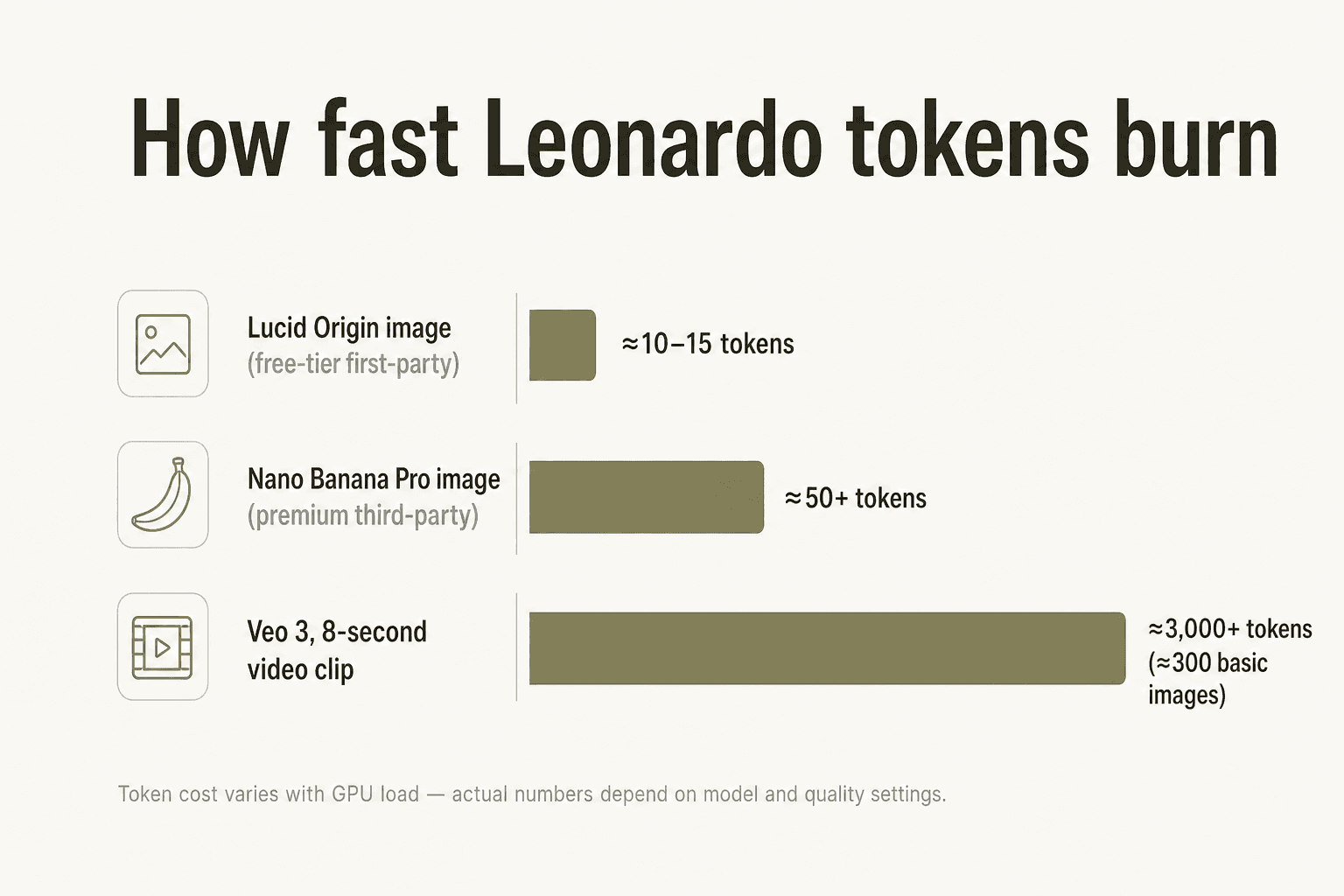
Leonardo's billing currency is the Fast Token, but the token-to-image conversion isn't fixed. Per Leonardo's own Tokens FAQ, token cost is based on GPU load: more compute equals more tokens, and there's no published per-model cost table. A single token does not correspond to a specific image, action, or resolution.
That ambiguity is the single biggest pricing complaint we found across G2, Capterra, and Trustpilot. Different models burn tokens at wildly different rates, which means a "150 free credits" allowance can disappear in roughly 10 images on heavy models. One 8-second Veo 3 clip costs about the same as 300+ basic image generations, per Leonardo's own pricing page footnotes.
A few token mechanics worth knowing:
- Free users get 150 tokens daily; they reset every 24 hours and never roll over.
- Paid subscribers get a monthly allowance that resets on the billing date.
- Rollover Bank (Essential and up) catches unused tokens at month-end, capped per plan.
- Top-up packs are bought on top, never expire, and are consumed last in the order: Fast Tokens → Rollover Tokens → Top-up Tokens. You need an active subscription to spend top-ups.
- Running out of tokens on Premium/Ultimate doesn't hard-stop you, it shifts you to Relaxed Generation, but only on eligible models (see next section).
- Flow State always requires tokens, even on a Premium/Ultimate plan.
The Rollover Bank itself was a 2024 response to vocal user frustration. Leonardo's own launch tweet led with "You asked, we listened" (@LeonardoAi_ on X), which is the cleanest possible admission that the no-carryover model was hurting retention. Worth the win, but a reminder that "you'll never run out" is structurally wrong on this platform.
What "unlimited" actually means on Leonardo.AI
If you read the pricing page quickly, Premium and Ultimate look like the unlimited-everything tiers. They aren't. The asterisk on every "unlimited" claim narrows it to selected first-party models only, and the list is small enough to memorise.
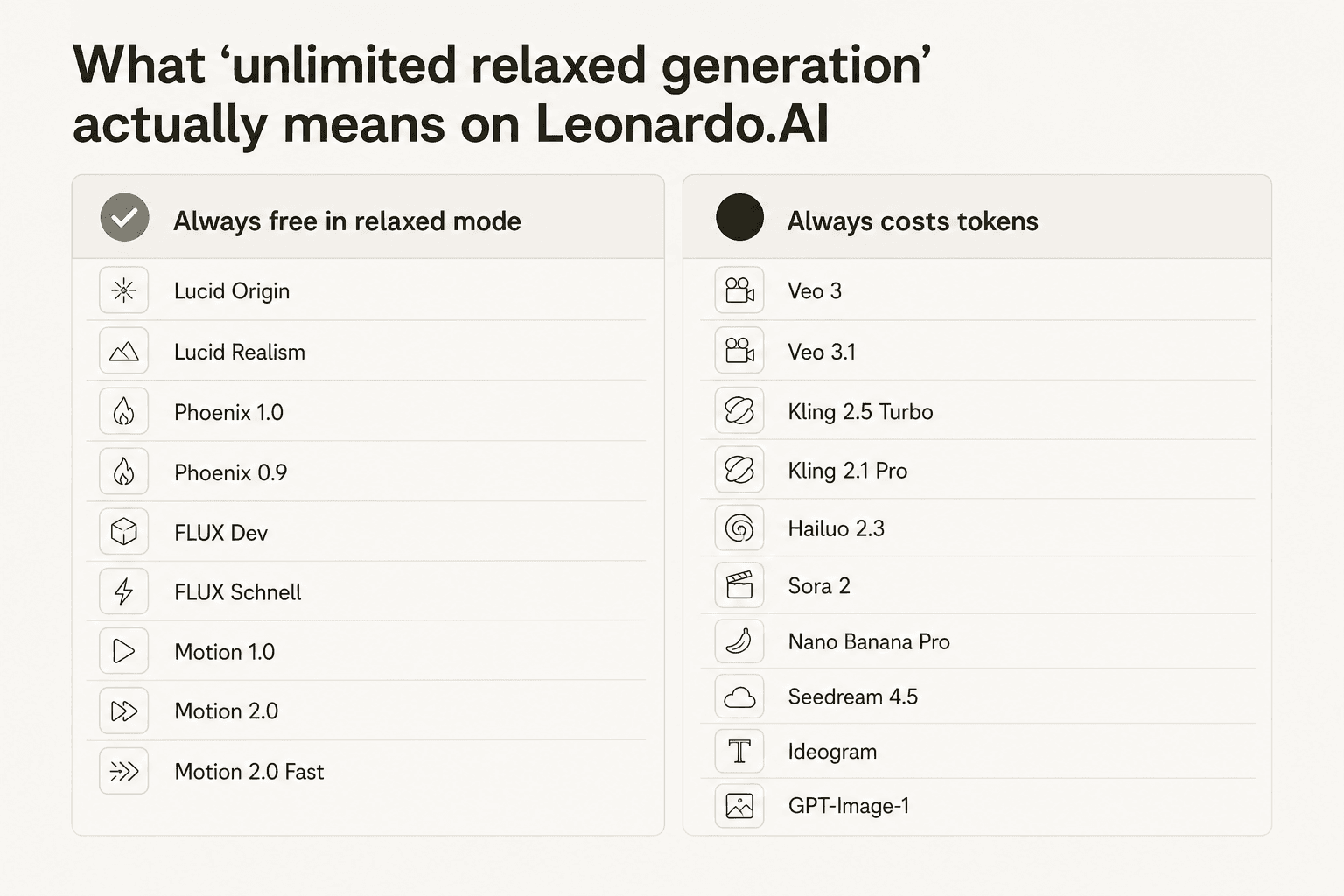
Unlimited relaxed generation covers, per Leonardo's pricing footnote:
- Lucid Origin
- Lucid Realism
- Phoenix 1.0
- Phoenix 0.9
- FLUX Dev
- FLUX Schnell
- Motion 1.0 (Ultimate only)
- Motion 2.0 (Ultimate only)
- Motion 2.0 Fast (Ultimate only)
Always costs tokens at full rate, even on Ultimate:
GPT-Image-1, Flux.1 Kontext, Ideogram, Nano Banana, Flux Kontext Max, Veo 3, Veo 3.1, Veo 3.1 Fast, Kling 2.5 Turbo, Kling 2.1 Pro, Sora 2, Sora 2 Pro, LTX-2 Pro, LTX-2 Fast, Seedream 4.0, Seedream 4.5, Nano Banana Pro.
Relaxed generation also comes with structural limits: lower-priority queue, reduced concurrency, processing time that fluctuates with demand. It's not "the same speed for free," it's "free if you can wait."
This gap is where most of the "unlimited is misleading" complaints originate. A Capterra reviewer put the consequence plainly: "creating characters cost a lot of credits and for me it's not worth it" (Capterra), and on G2 the structured "Cons" tags include "Expensive" (4 mentions) and "Limited Credits" (5 mentions) as the top two complaints in the review summary.
Our take: "Unlimited" is real if you commit to Leonardo's own model family. If your workflow needs Veo, Kling, Sora, or Nano Banana Pro on volume, you're back on the token meter regardless of plan, and you should budget for top-ups from day one.
The hidden costs nobody mentions
The headline pricing is clean. The edge cases are where teams get caught.
Failed generations still consume tokens. This is the loudest 1-star theme on Trustpilot. One reviewer described being charged for "repeated failed attempts precisely because Leonardo's own system blocks generations" (Trustpilot). If Leonardo's moderation flag-rate goes up, your effective cost-per-good-image goes up with it, and you have no recourse on those credits.
Video burns tokens disproportionately. Multiple frames per second mean far more GPU than a still. Leonardo confirms this in their pricing FAQ, and third-party video models (Veo, Kling, Sora) sit outside the unlimited-relaxed protection, so heavy video workflows on Premium will hit top-ups within a week.
Refund and cancellation friction. This is the dominant 1-star pattern across Trustpilot: recurring charges that weren't flagged clearly at signup, refused refunds on unused tokens, and at least one enterprise reviewer reporting they could not stop being billed:
"Leonardo.ai has been charging my card since March without sending a single invoice or clear notice that I was in a subscription… when I asked for a refund they only refunded one month and deleted over 100,000 unused tokens I had already paid for." Trustpilot 1-star review, trustpilot.com/review/leonardo.ai
"Even as a multi-year enterprise customer, we have found ourselves with no working path to stop being billed… Customers are left with no recourse besides filing chargebacks." Trustpilot enterprise reviewer, trustpilot.com/review/leonardo.ai
Worth noting: Leonardo's Trustpilot aggregate is propped up by support-ticket-solicited reviews (a third-party 100-review sample found 86% of positive reviews name a specific support agent, per rainaiservices.com). The actual paying-customer experience isn't as clean as a 4-star score suggests, especially around cancellation.
Plan-change asymmetry. Upgrades apply immediately and bill the prorated difference. Downgrades only apply at the end of your billing cycle, per the pricing FAQ. Plan to time your downgrade.
Image ownership on the free tier. Paid subscribers own the IP on their generations and can use them commercially. Free-tier users grant Leonardo broad rights, including the right to reproduce and distribute their public creations. Reads fine until you generate something you actually want exclusive rights to.
Tax stacks on top. Sticker prices exclude tax. GST/VAT is added at checkout via Stripe where local thresholds apply. The $30 Premium is closer to $33 with most VAT rates and around $36 with the higher European rates.
What real users actually say
The cleanest summary of practitioner sentiment we found came from designer Begum Walji on LinkedIn Pulse:
"Leonardo AI is built for execution; Midjourney is built for inspiration." Begum Walji, LinkedIn Pulse
That framing explains a lot of the pricing debate. Designers and asset-producers tolerate the token model because Leonardo gives them the deterministic edits, multi-model access, and commercial rights they need for client work. Pure art creators tend to push back on the token model because what they're after is exploration, where Midjourney's flat hours-per-tier billing feels less punishing.
On the practitioner-positive side, creator Alex Utopia framed Leonardo as "one of the most competent AI tools" and the best value pick on X. And LinkedIn reviewer Aslam Darzi summed up the comparative pitch:
"Leonardo's free tier with daily credits contrasts favorably against Midjourney's mandatory paid subscriptions." Aslam Darzi, LinkedIn Pulse
On the pricing-pain side, the most common Reddit framing across r/AIArt and r/midjourney threads is that "Leonardo has a free plan while Midjourney doesn't" (summarised here) but heavy users "burn through their entry-tier credits faster than they expect", per a Midjourney pricing analysis that quotes both subreddits.
The deeper takeaway: people on first-party models love the value. People living on premium third-party models complain about the credit burn. The plan you pick should match which side of that line you fall on.
Leonardo.AI pricing vs Midjourney, Kling, and Runway
Pricing rarely makes sense in isolation, so here's the entry-tier comparison across the four image and video tools most commonly weighed against Leonardo. Numbers are public list prices for the cheapest paid plan, monthly billing.
| Tool | Entry plan | Free tier? | What you get | Internal deep-dive |
|---|---|---|---|---|
| Leonardo.AI | $12 Essential | Yes (150 daily tokens) | 8,500 monthly tokens, image and video models, training | This page |
| Midjourney | $10 Basic | No | ~3.3 hours GPU time, image only | Midjourney pricing |
| Kling AI | $8.80 Standard | Yes (limited credits) | 660 credits/month, video-first | Kling AI pricing |
| Runway | $15 Standard | Yes (limited credits) | 625 credits/month, video-first | Runway AI pricing |
| Ideogram | $7 Basic | Yes | 400 priority gens, image only with text | Ideogram pricing |
| Pika | $10 Standard | Yes | 700 credits, video | Pika AI pricing |
| Canva AI | Bundled with Canva | Yes | Magic Studio + Leonardo Essential included | Canva AI pricing |
A few patterns to lift out of that:
- Leonardo and Midjourney sit at near-identical entry prices, but Leonardo includes both image and video; Midjourney is image-only.
- Kling and Pika undercut Leonardo on entry price if you only want video, but their credit pools are smaller.
- Runway is the priciest entry tier at $15 but is also the most pro-grade for film production.
- Canva Business subscribers already have Essential included, which is the cheapest path to a paid Leonardo tier if you're a Canva shop.
If you're not sure Leonardo is the right pick, our roundup of Leonardo.AI alternatives walks through the seven we'd consider, and our full Leonardo.AI review goes deeper on quality and workflow.
Picking your Leonardo.AI plan
Three quick rules to land on the right tier without trial-and-error:
- If you'll stay on Leonardo's own image models (Lucid Origin, Phoenix, FLUX Dev), pay for Premium at $30. The unlimited relaxed gen pays back inside a week of regular use, and you don't need video.
- If video is part of your weekly output and you're fine with Leonardo's Motion family, pay for Ultimate at $60. The relaxed-video upgrade is what justifies the extra $30.
- If you need premium third-party models on volume (Veo 3, Kling Pro, Sora 2, Nano Banana Pro), there is no plan that gives you unlimited. Pick Premium or Ultimate based on token count and plan for top-ups. Budget at least 1.5× your token allowance for a realistic first month.
The other two scenarios worth naming:
- You already have Canva Business: you have Essential for free. Don't upgrade until you've actually run the token pool dry for two months in a row.
- You're a developer prototyping a product: take the $5 API credit, log every call, and don't sign up for a custom API plan until you have a real monthly burn number.
Annual billing knocks up to 20% off on every solo and team plan. If you're confident about your tier, take the annual price; it's the cleanest discount Leonardo offers.
Try eesel.ai if you're shopping for AI tools more broadly
Leonardo handles AI for creative work. If your shopping list also includes AI for customer support, that's where eesel.ai comes in. eesel deploys autonomous AI teammates inside the tools you already use, Zendesk, Freshdesk, Slack, Gmail, Shopify, and 100+ others, so your support team can offload ticket triage, drafts, and resolutions without adopting a new interface.
eesel AI working inside Zendesk
The pricing model is the inverse of Leonardo's: instead of tokens you can't predict, eesel charges per task ($0.40 per resolved ticket, $4 per long-form blog generation, free for light Q&A) with no seat fees and a hard spend cap you set. You can see exactly what a month costs before you commit. See the full breakdown on the eesel pricing page.
Frequently asked questions

Share this article

Article by
Riellvriany Indriawan
Riell is a designer and writer at eesel AI with about two years of experience researching CX platforms, AI chatbots, and helpdesk software. She combines her design background with a sharp eye for how these tools actually look and feel in practice — making her comparisons unusually visual and user-focused.