Sierra AI pricing explained: Costs, models, and alternatives


Last edited May 8, 2026

Table of Contents
- What is Sierra AI?
- How AI agent pricing works
- Sierra AI pricing: what is publicly known
- What drives Sierra's costs
- What makes Sierra's pricing structure difficult to evaluate
- eesel AI: a transparent alternative
- Sierra AI vs eesel AI: a direct comparison
- Capabilities beyond pricing
- Choosing the right AI support platform
Disclosure: This article is published by eesel AI, a competitor of Sierra. We encourage you to read Sierra's own materials for their perspective.
Sierra AI is one of the fastest-growing enterprise software companies in recent memory. Founded in late 2023 by Bret Taylor (former Salesforce co-CEO and current chair of OpenAI's board) and Clay Bavor (18-year Google veteran), Sierra reached $100M ARR in under two years and $150M ARR by early 2026. The company raised a $950M Series C at a $15.8B valuation in May 2026.
When a platform at that scale keeps its pricing private, it creates a genuine evaluation problem. This post covers what is publicly known about how Sierra charges, what drives costs, and what businesses that require pricing transparency might consider instead.
What is Sierra AI?
Sierra positions itself as an Agent Operating System for enterprise customer experience. Its platform lets companies build, deploy, and optimize AI agents across chat, voice, SMS, WhatsApp, email, and integrations including ChatGPT plugins. 40% of Fortune 50 companies are Sierra customers. One in four of those customers generates over $10B in annual revenue.
The product has two main layers. Agent Studio is a no-code environment for CX teams: plain-English workflow building, version control, and a pre-built integration library. The Agent SDK is the developer path, with composable skills, simulation tools, and API-first connections to backend systems. Both paths are supported by Sierra's implementation team during deployment rather than being fully self-serve.
A more recent addition is Ghostwriter, launched in March 2026, which generates production-ready agents from SOPs, call transcripts, audio recordings, and even whiteboard photos. Ghostwriter also runs an automatic improvement loop that analyzes live interactions and queues validated changes for human review.

How AI agent pricing works
Understanding Sierra's approach requires knowing the main pricing structures in this market:
Usage-based pricing: You pay per API call, per token processed, per minute of voice, or per action taken. Costs scale directly with volume and are generally easy to audit before and after deployment.
Outcome-based pricing: You pay when the AI achieves a predefined result, such as a resolved support conversation, a saved cancellation, or a completed transaction. Sierra uses this approach. As Sierra's blog explains: "outcome-based pricing is tied to tangible business impacts... unlike consumption-based pricing." The appeal is clear: the vendor only wins when you do.
Per-conversation pricing: A flat fee per session from open to close, regardless of outcome. Simpler to model but less aligned with actual business value.
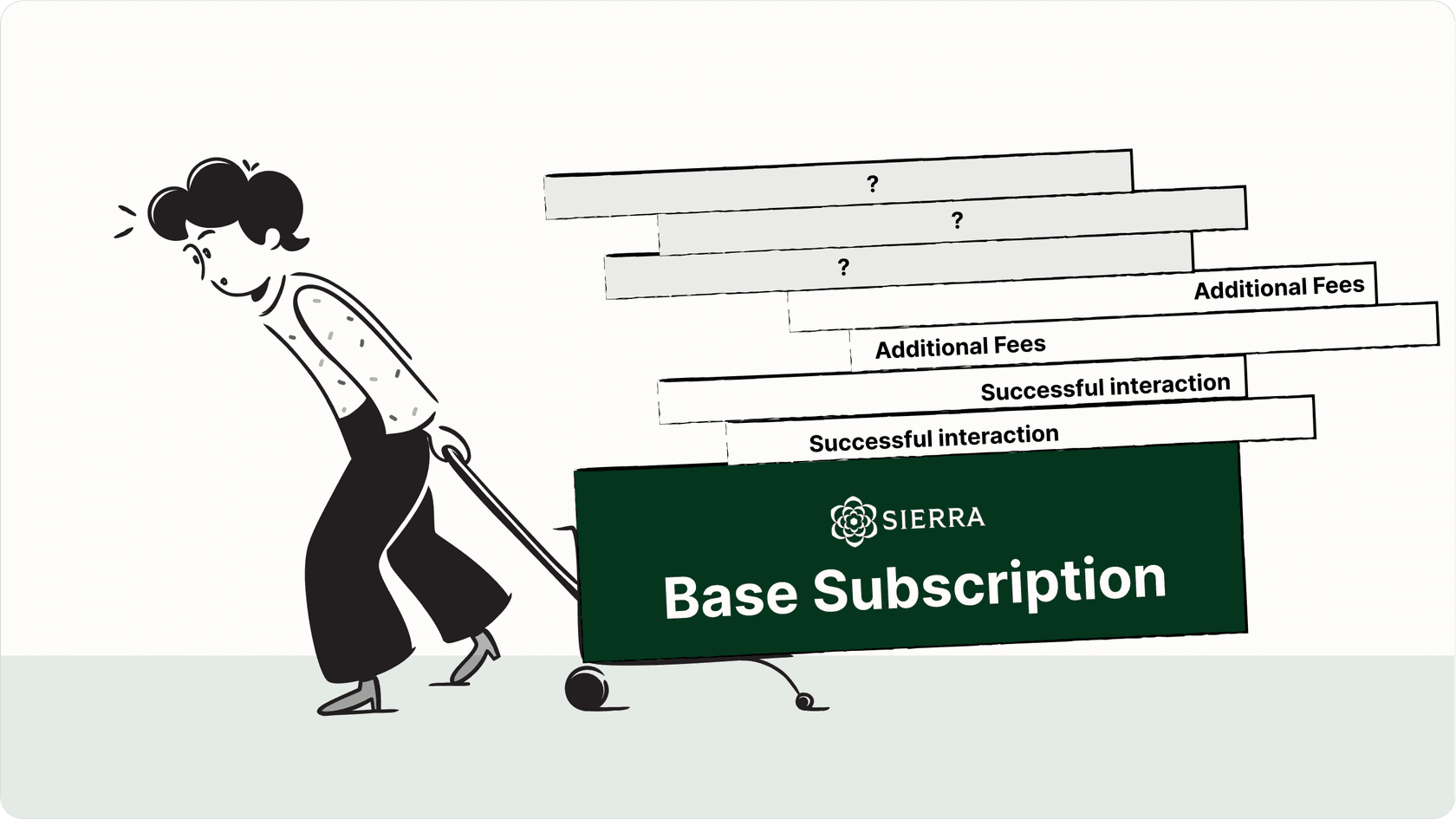
Hybrid models: Many enterprise platforms blend elements of the above. Sierra's contracts typically combine a base platform fee with per-successful-outcome charges and professional services costs.
Sierra AI pricing: what is publicly known
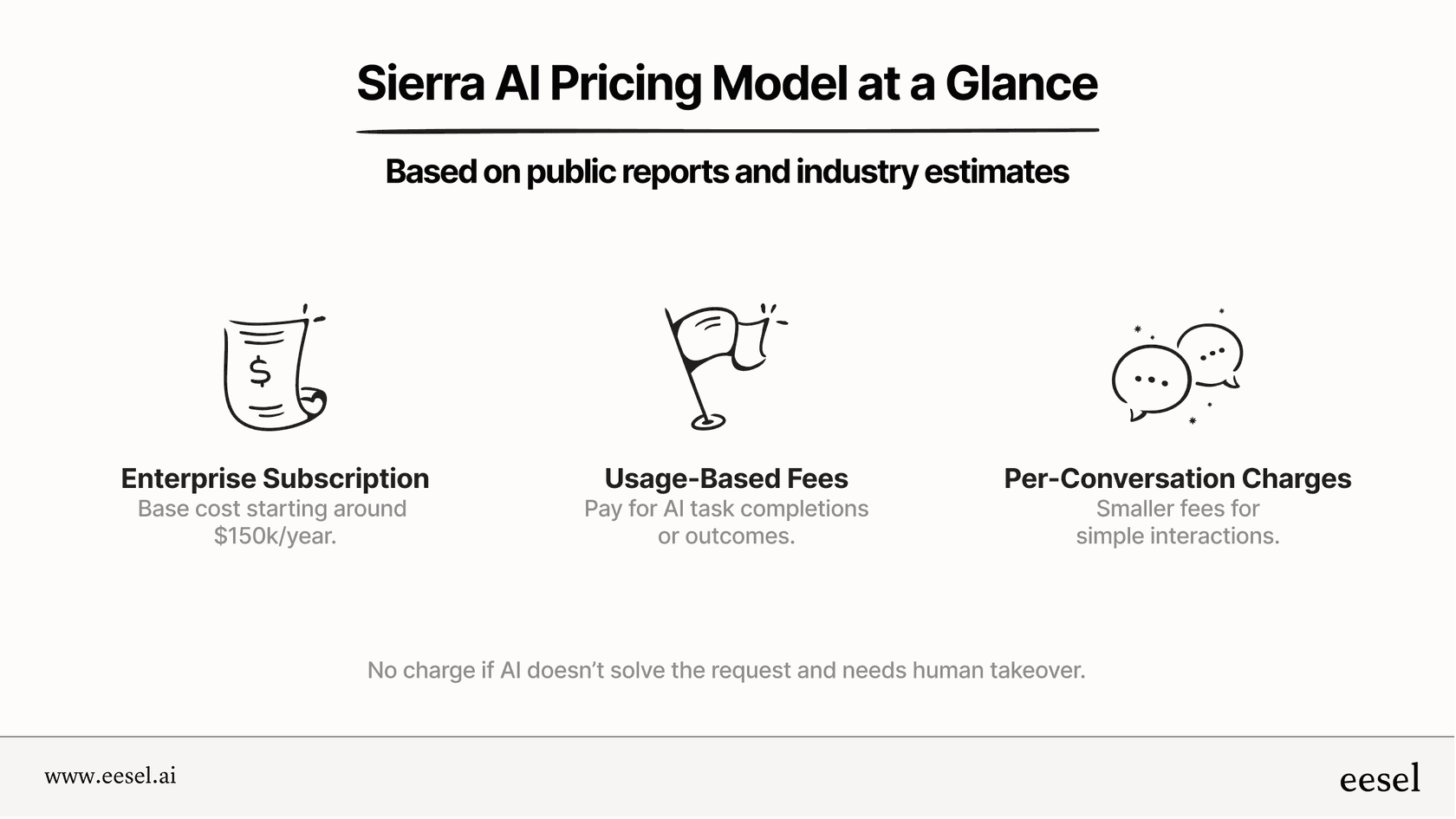
Sierra pricing is not publicly disclosed. There is no public pricing page, no self-serve calculator, and no disclosed per-interaction or per-outcome rate. Every contract is custom-quoted through their sales process.
What Sierra does describe publicly is the model itself: customers pay when their agent achieves a successful resolution. Unresolved queries and escalations to human agents typically do not trigger a charge. The specific definition of "successful resolution" and the rate attached to it are negotiated as part of each contract.
Sierra pricing is not publicly disclosed for any tier, any industry, or any deployment size.
What drives Sierra's costs
Because pricing is custom, several variables shape the final contract for any given business:
- Interaction volume: Higher counts of successful resolutions mean higher usage fees.
- Task complexity: An agent that answers FAQs costs less than one that processes returns, updates CRM records, and manages subscription changes mid-conversation.
- Channels: Each channel (voice, SMS, WhatsApp, email, chat) adds deployment and integration scope.
- Customization: Brand voice controls, guardrail configuration, and custom workflow logic require more implementation work.
- Integration depth: Connecting Sierra to a CRM, order management system, and helpdesk multiplies the engineering footprint.
- Professional services: Sierra operates more like a managed deployment than self-serve software. Implementation time ranges from 4-10 weeks based on published case studies, with complex multi-system deployments taking longer. Services fees can exceed licensing costs.
Sierra pricing is not publicly disclosed for any of these dimensions.
What makes Sierra's pricing structure difficult to evaluate
The absence of public pricing creates several practical challenges before a contract is even signed.
Budgeting requires engaging the sales process first. There is no way to model ROI independently, compare Sierra's cost against a comparable tool, or build a business case without requesting a custom quote and entering a multi-month enterprise procurement cycle.
The blended model (platform fee plus per-outcome charges plus services) involves multiple variable components. Even once a contract is in place, projecting year-two costs depends on how resolution rates evolve and how the outcome definition is interpreted at billing time.
G2 reviewers have flagged this tension: "Cost and customer support are key concerns... wonder if the high price was really worth it." (G2 reviews) A separate recurring complaint is the platform's "steep learning curve" during the onboarding period.
Sierra's model is built for enterprise buyers with the procurement capacity and engineering resources to work through long sales cycles. For teams that need to evaluate tools against a published price before committing, or that operate on tighter timelines, the opacity is a constraint that appears before any capability comparison can happen.
eesel AI: a transparent alternative
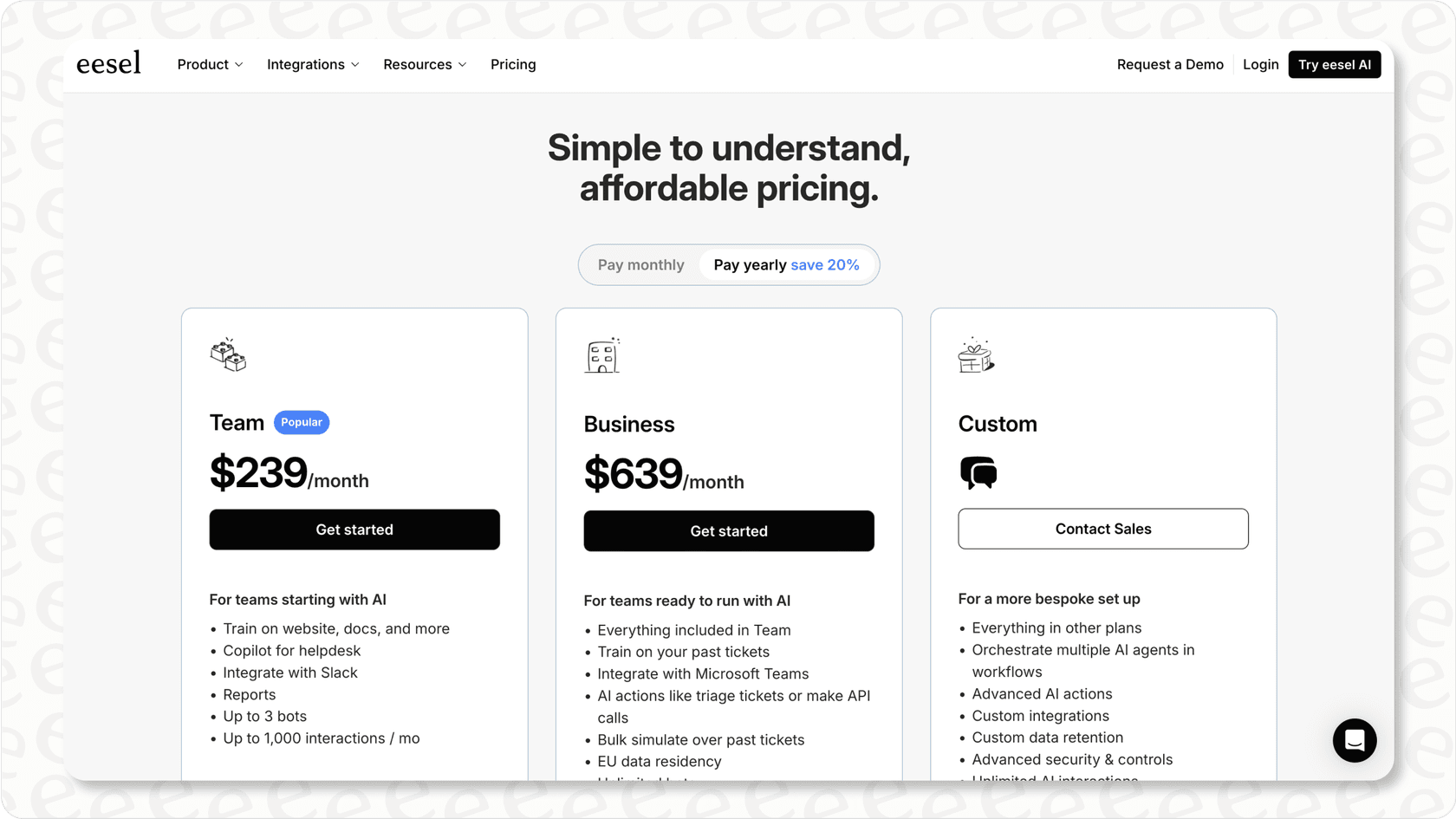
If predictable costs matter as much as capability, eesel AI takes the opposite approach. The model is pay-per-use with published rates:
- Helpdesk tasks (support tickets, live chat sessions): $0.40 each
- Heavy tasks (long-form content generation, complex analysis): $4.00 each
- Light tasks (simple lookups, dashboard questions): free
- Free trial: $50 in credits on signup, no credit card required
- Enterprise add-on: $1,000/month for SSO, HIPAA compliance, BAA, and a dedicated engineer
There are no per-seat fees and no minimum contract. Because the rate is published, businesses can calculate their expected monthly cost from existing support ticket volume before speaking to anyone.
eesel connects to Zendesk, Freshdesk, and 100+ other knowledge sources including internal wikis, uploaded documents, and past support tickets. Deployment typically takes one to two weeks without a professional services engagement.
Sierra AI vs eesel AI: a direct comparison
| Category | Sierra AI | eesel AI |
|---|---|---|
| Pricing model | Outcome-based, custom | Pay-per-use, published rates |
| Pricing transparency | Not publicly disclosed | $0.40/helpdesk task, $4/heavy task |
| Self-serve signup | No | Yes |
| Free trial | No | $50 in credits, no credit card |
| Minimum contract | Custom enterprise agreement | None |
| Deployment time | 4-10 weeks, guided by Sierra's team | 1-2 weeks, self-serve |
| Channels | All channels (chat, voice, SMS, WhatsApp, email, ChatGPT) | Helpdesk, Slack, chat |
| Training sources | CRM, backend systems, documentation | Tickets, wikis, docs, 100+ connectors |
| No-code builder | Agent Studio | Yes |
Capabilities beyond pricing
Pricing aside, Sierra and eesel AI are built for different use cases.
Sierra's strength is complex enterprise automation: multi-step transactions, real-time CRM writes, voice at scale, and omnichannel deployments that require deep backend integration. The 40+ case studies show resolution rates between 65% and 90% across financial services, healthcare, and retail. These results come from companies with large customer volumes and dedicated engineering teams to support the integration work.
G2 reviewers do flag that Sierra's AI can struggle with context in extended sessions, sometimes repeating itself or giving generic answers (G2 reviews), and that platform stability has room to improve. These are expected growing pains for a company that went from founding to $150M ARR in two years.
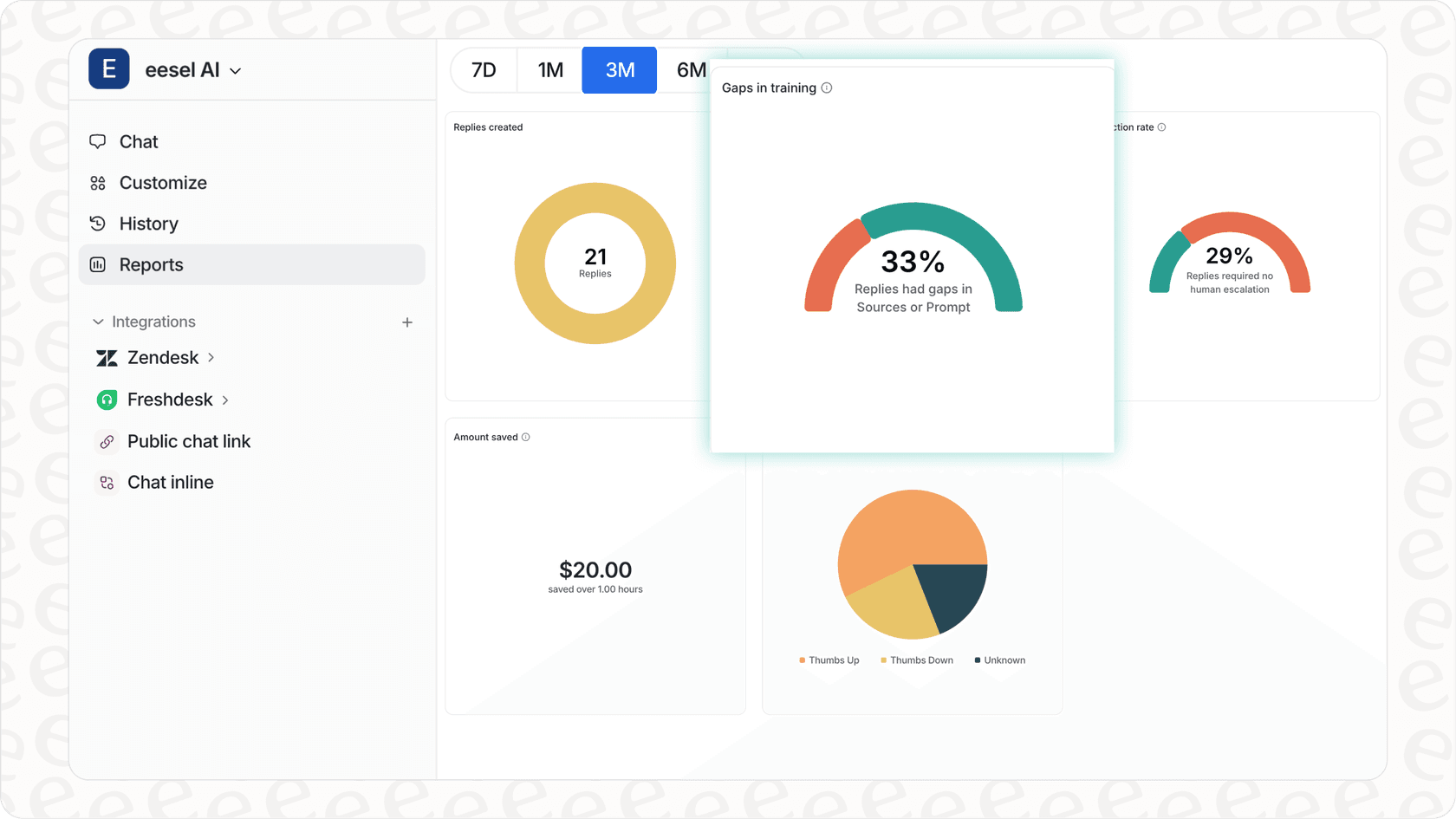
eesel AI is built for teams that need to automate tier-1 support quickly and layer AI into tools they already use. It handles both inbound and outbound interactions, offers knowledge gap detection to surface holes in your help content, and supports simulation-based testing before going live. The best platforms each occupy a different spot on the speed-vs-sophistication spectrum, and eesel is designed for teams that want fast deployment without a long procurement cycle.
Choosing the right AI support platform
Sierra is a well-funded, high-capability platform with a demonstrated track record at enterprise scale. The custom pricing and guided deployment process are by design: Sierra builds bespoke solutions for large organizations with complex requirements and the resources to match.
For businesses where transparent pricing, fast setup, and the ability to evaluate before committing matter, those structural choices become practical constraints. eesel AI offers an alternative path: published per-task pricing you can model against your own support volume, a free trial to test against real data, and integrations with the AI helpdesk tools most teams already use.
The right platform depends on where your organization sits on the spectrum between enterprise-scale complexity and straightforward automation. Start with what you can actually evaluate independently, and move toward complexity when a simpler option has proven insufficient.
Want to see what transparent AI support pricing looks like in practice? Free trial or book a demo to test eesel against your specific support workflow.
Frequently asked questions

Share this article

Article by
Kenneth Pangan
Writer and marketer for over ten years, Kenneth Pangan splits his time between history, politics, and art with plenty of interruptions from his dogs demanding attention.