The 9 best customer service AI tools in 2026 (tested and compared)


Last edited June 12, 2026

Table of Contents
- How we judged each customer service AI tool
- The best customer service AI tools at a glance
- 1. eesel AI: best customer service AI overall
- 2. Zendesk AI: best if you already live in Zendesk
- 3. Freshdesk Freddy AI: best affordable all-in-one
- 4. Gorgias: best for Shopify and ecommerce
- 5. Enjo AI: best for B2B teams keeping their existing stack
- 6. Ada: best for high-volume enterprise
- 7. Decagon: best AI-native platform for fast-iterating teams
- 8. Sierra: best for regulated and Fortune 500 teams
- 9. Gladly: best for DTC and lifetime-value brands
- What customer service AI actually costs
- How to choose the right customer service AI for your team
- Try eesel for customer service AI
How we judged each customer service AI tool
We have spent a lot of time inside these products, their docs, and their pricing pages, so the picks below are grounded in what each tool actually does, not the marketing tagline. Five things mattered most when ranking the best AI tools for customer service:
- Autonomy that's real. Can it resolve a ticket end to end, take an action (issue a refund, look up an order), and only escalate when it's actually stuck? An AI agent that takes action is a different animal from a deflection bot that just links to a help article.
- Setup and time-to-value. How long from signing up to the AI handling a live ticket? Some tools go live in an afternoon; others are 6 to 12 week implementation projects.
- Pricing honesty. Is the billing unit clear, and is there a cap so you don't get a surprise invoice? This is where the most pain hides.
- Control. Can you let the AI handle only what it's confident about, exclude sensitive ticket types, and see exactly what it's doing? This is consistently the biggest objection support leaders raise.
- Fit. SMB versus enterprise, ecommerce versus SaaS versus IT. A tool that's perfect for a 200-agent airline is overkill for a 5-person DTC brand.
One note before the list: we left a couple of well-known names off on purpose where they didn't earn a slot, and we capped the list at the nine tools we'd actually recommend to someone. Padding a "best of" list to a round number is how you end up recommending things you don't believe in.
The best customer service AI tools at a glance
Here's the whole field in one screenshot-able table. "Architecture" is the line that decides the most: native AI lives inside one suite, while a standalone layer sits on top of whatever helpdesk you already run.
| Tool | Best for | AI billing unit | Entry AI price | Architecture | Free trial | G2 rating |
|---|---|---|---|---|---|---|
| eesel AI | Fast self-serve rollout on any helpdesk | Per task (ticket/chat) | $0.40 / ticket | Standalone, 100+ integrations | Yes, $50 credit, no card | Strong, no large public sample |
| Zendesk AI | Teams already on Zendesk Suite | Per automated resolution | ~$1.20 to $1.50 / resolution | Native to Zendesk | Suite trial | 4.3 / 5 (6,837) |
| Freshdesk Freddy | Affordable all-in-one helpdesk + AI | Per AI session | ~$0.49 / session | Native to Freshworks | Yes (plan trial) | 4.4 / 5 (Capterra) |
| Gorgias | Shopify and ecommerce brands | Per resolved conversation | $0.90 to $1.00 / convo | Native ecommerce helpdesk | 7-day trial | 4.6 / 5 (560+) |
| Enjo AI | B2B teams keeping their existing stack | Per reply | Free tier; paid from ~$0.xx / reply | Standalone | Free tier (Inbox + Help Center) | Strong, growing |
| Ada | High-volume enterprise (300k+/yr) | Per conversation (implied) | Quote-only | Standalone | No self-serve trial | 4.6 / 5 (smaller) |
| Decagon | Fast-iterating enterprise CX | Volume-bracketed | Quote-only | Standalone (AI-native) | No self-serve trial | New, limited |
| Sierra | Regulated / Fortune 500 | Outcomes-based | Quote-only | Standalone (AI-native) | No self-serve trial | New, limited |
| Gladly | DTC / retail lifetime-value model | Per AI resolution | $1.50 / resolution | Native (people-not-tickets) | 30-day (Shopify) | 4.7 / 5 (1,112) |
Now the detail on each, in the order we'd shortlist them.
1. eesel AI: best customer service AI overall

Best for: support teams who want autonomous AI on top of the helpdesk they already run, live in days rather than a quarter.
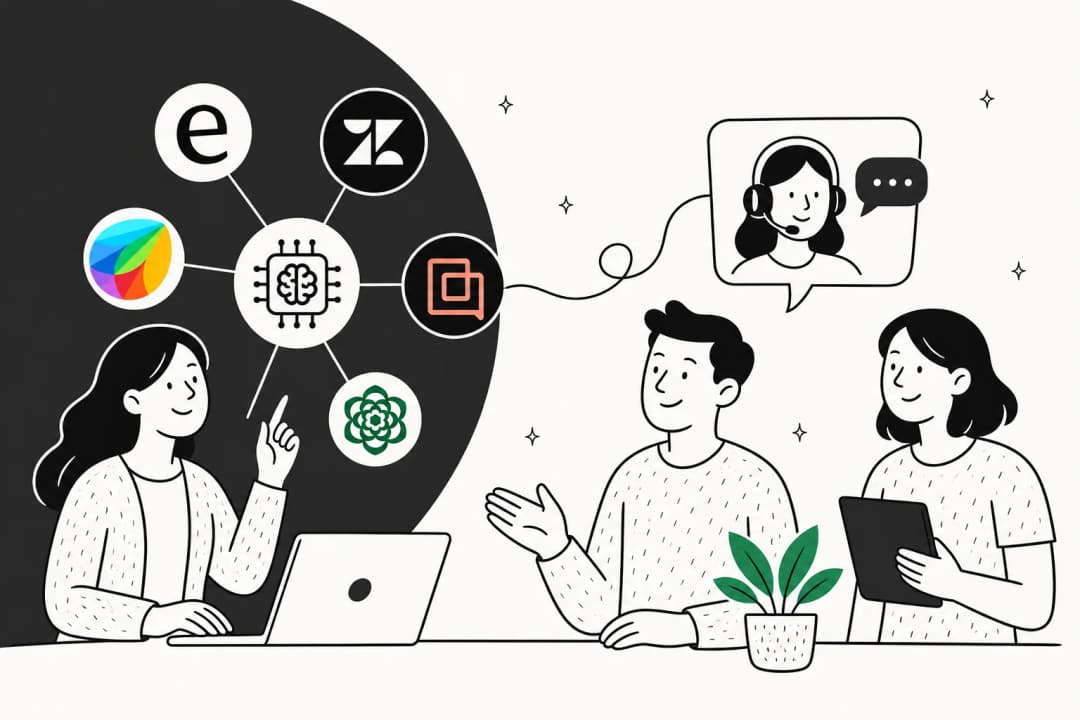
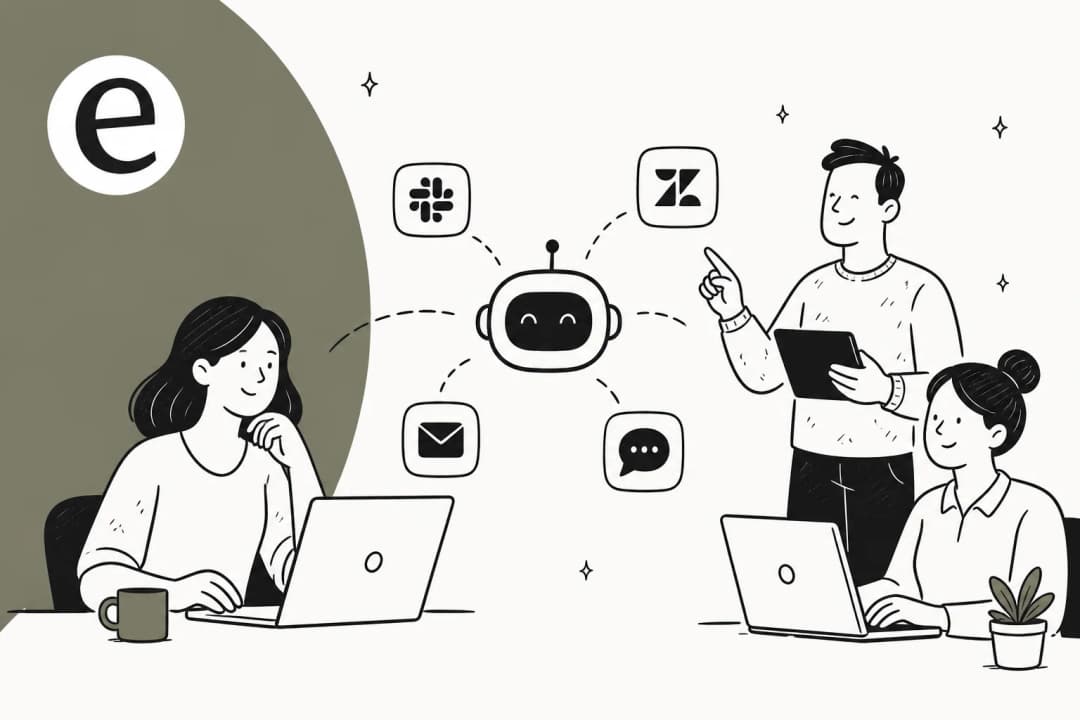
We'll declare the bias up front (this is our blog), but the reason eesel leads the list is structural, not loyalty. Most of the tools below force a choice: either bolt AI onto your existing suite (and accept its limits and its meter), or rip everything out for a sales-led platform contract. eesel is the one that does neither. It's a standalone AI helpdesk agent that plugs into Zendesk, Freshdesk, Gorgias, Help Scout, Slack, email, Shopify, and over 100 other tools, then works inside the interface your agents already have open.
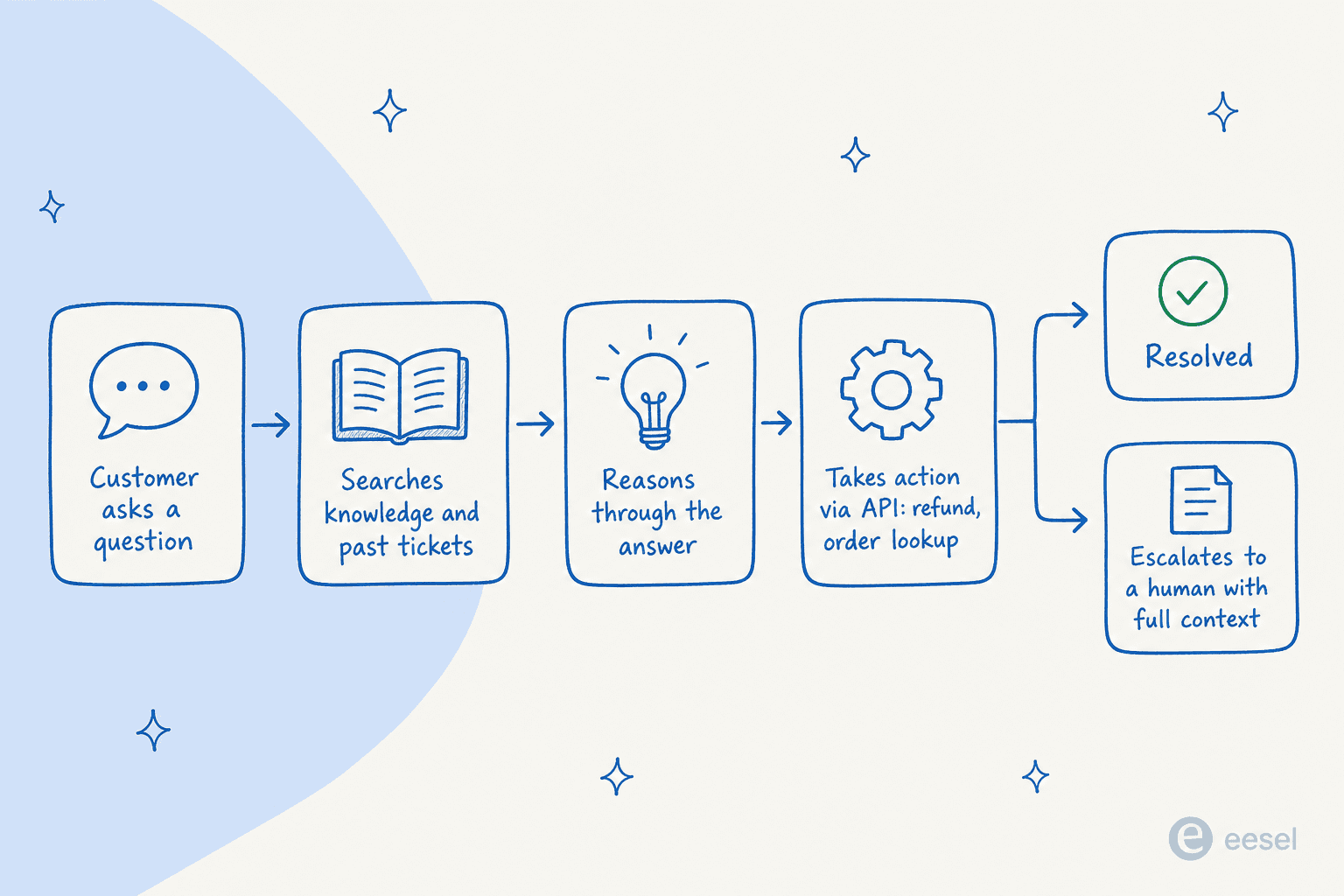
The pitch is that briefing an agent feels like onboarding a new hire: you point it at your help center, past tickets, and internal docs, give it plain-language instructions, and it starts drafting or resolving. It trains on your historical tickets, so it picks up your tone and your edge cases instead of sounding like a generic bot.
The part support leaders actually care about is control. eesel leans hard into confidence-based handling: let the AI take only the tickets it's sure about, leave the rest as drafts or escalate them with full context. That maps exactly to the single most common objection we hear, which one DTC supplements CX lead put bluntly: they wanted "an AI who is only handling the tickets that it's confident to handle and all the other ones, leave them alone."
Here's roughly how a resolution flows once it's connected:
And because it lives inside your helpdesk, the experience for a Zendesk team looks like this:
What real users say lines up with the positioning. One support lead at gig-economy analytics company Gridwise reported a fast, measurable start:
"In the first month, eesel is resolving 73% of our tier 1 requests. eesel offers easy Zendesk implementation and setup. Our team implemented and achieved results quickly during our 7-day trial."
Kim Simpson, Gridwise (G2)

And on the head-to-head question, which is what this whole article is about, an engineer at cloud-infrastructure company Gcore who'd actually shopped around put it this way:
"I've tested many AI agent solutions, but so far Eesel is one of the best. It has many features we need, such as broad sources availability, variety of options, integrations, and so on. Highly recommended."
Mikita Tsybulka, Gcore (G2)
Pros:
- Layers onto your existing helpdesk, so no migration and a setup measured in days, not weeks.
- Trains on past tickets and your docs, so answers sound like your team.
- Transparent, self-serve task-based pricing with a hard spend cap, no per-seat fees, and a real free trial.
- Strong control story: confidence-based routing, ticket-type exclusion, and full visibility into what the AI did.
Cons:
- It's the AI layer, not a full helpdesk, so you still need a ticketing tool underneath (which is the point, but worth saying).
- Usage-based pricing means very high, mostly-automated volumes need a quick sanity-check against a flat enterprise quote.
Pricing: Pure usage. $0.40 per resolved ticket or chat, $4.00 for a heavy task like a blog post draft, and dashboard questions are free. No per-seat fee, no platform fee on self-serve, and a default $250 monthly cap you can change. The free trial is $50 of usage with no credit card. A 1,000-ticket month is about $400; route only 200 of those tickets and you pay for 200.
Our take: If you already have a helpdesk and want AI handling real volume next week with a bill you can predict, this is the one to start a trial with. The teams it doesn't suit are those who want a single all-in-one suite to replace their helpdesk entirely, since eesel deliberately doesn't try to be the ticketing system too.
2. Zendesk AI: best if you already live in Zendesk

Best for: teams already standardised on Zendesk Suite who want the AI to be one toggle away.
Zendesk has repositioned itself as "the Resolution Platform": a ticketing core wrapped in an AI layer of customer-facing AI Agents (the Ultimate.ai-derived autonomous tier), a Copilot for human agents, Intelligent Triage, and AutoQA. The headline claims are real and well-supported: 80%+ automation rates on the AI Agents page and a named 2025 Gartner Magic Quadrant Leader spot for the CRM Customer Engagement Center category.
The strength is obvious. If your team already lives in Zendesk, the AI sits right where the work happens, with no extra platform contract. The weakness is just as obvious once you read the reviews: it only works as well as the knowledge base under it, and the pricing has become the dominant 2026 complaint.
Pros:
- Deeply integrated into the most widely-used helpdesk, with mature triage, copilot, and QA.
- Huge marketplace (1,800+ apps) and 80+ languages.
- The newer three-tier resolution model (since May 2026) only charges for verified resolutions, which is fairer than the old "silence equals billable" approach.
Cons:
- Per-resolution billing is the most-cited gripe, with third-party teardowns triangulating $1.20 to $1.50 per automated resolution above your commit, and no graceful cap (the only overage control is pausing AI entirely).
- Admin-side setup of Copilot and AI Agents is repeatedly described as burdensome and requiring technical knowledge.
- The bundled "Essential" tier is widely described as barely feeling like AI, pushing teams toward the $50/agent Copilot add-on or third-party tools.
Pricing: Suite plans run from $19 (Support Team) to $115 (Suite Professional) per agent/month annually, with Enterprise on request. AI bills per automated resolution on top, and Copilot is a $50/agent/month add-on. It's easy for total AI cost to hit 2 to 3x the base subscription. Our Zendesk AI pricing calculator and setup and costs guide go deeper.
Our take: Sensible if you're committed to Zendesk and have a clean knowledge base. If the per-resolution meter worries you, a standalone layer like eesel that sits inside Zendesk with task-based pricing is the obvious comparison to run before you commit.
3. Freshdesk Freddy AI: best affordable all-in-one
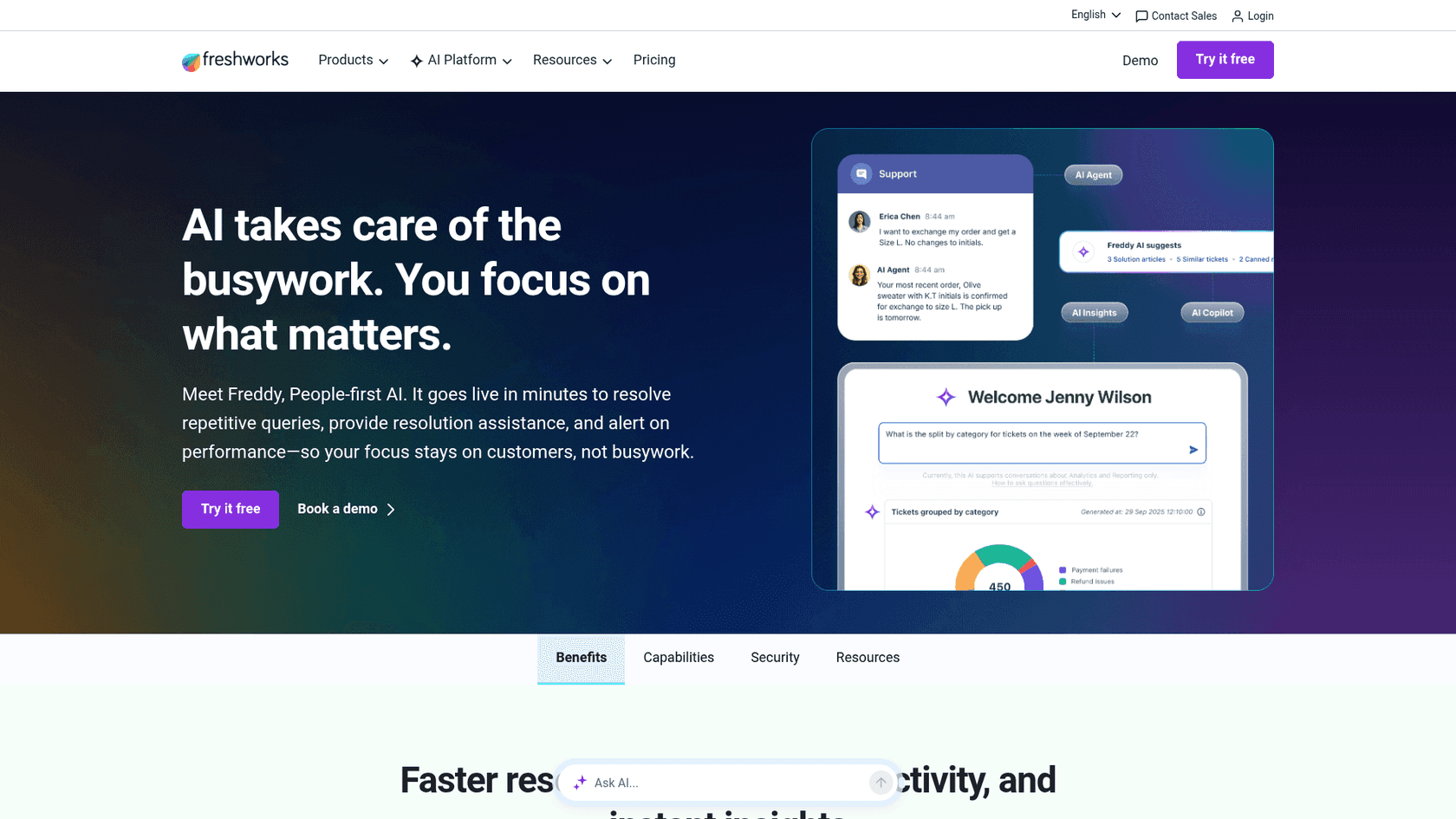
Best for: small to mid-size teams who want a capable helpdesk and AI in one affordable package.
Freshdesk, from Freshworks, bundles ticketing, omnichannel support, and a three-part Freddy AI suite (Agent for autonomous resolution, Copilot for human agents, Insights for analytics) under what it calls "people-first AI." It's trusted by 74,000+ businesses, and the entry pricing is refreshingly low: $19/agent/month on Growth, with a free tier for tiny teams.
Freddy claims up to 80% of queries resolved autonomously and a sub-2-minute average conversational resolution time. The value is the package: you get a solid, affordable helpdesk and don't have to bolt on a separate AI vendor to get started.
Pros:
- Low entry price and a real free tier for 1 to 2 agents.
- Freddy AI Agent ships with 50+ prebuilt agentic workflows and a no-code AI Agent Studio.
- Good for teams that want one bill and one login covering helpdesk plus AI.
Cons:
- Freddy AI Agent sessions are consumption-priced (about $49 per 100 sessions after a free allotment), which adds up at scale.
- The AI is native to Freshworks only, so it can't help if you're on another helpdesk.
- The Shopify integration carries a middling 3.0/5 rating, so ecommerce depth is weaker than a Shopify-first tool.
Pricing: Growth $19, Pro $55, Enterprise $89 per agent/month (annual). Freddy AI Agent gets 500 free sessions on Pro/Enterprise, then ~$49 per 100 sessions; Copilot is a per-agent add-on. Full math in our Freshdesk AI pricing breakdown.
Our take: The best value if you want an all-in-one and you're already a Freshworks shop or starting fresh. If you've outgrown Freddy's session pricing or want AI across more than one tool, look at Freshdesk alternatives before renewing.
4. Gorgias: best for Shopify and ecommerce
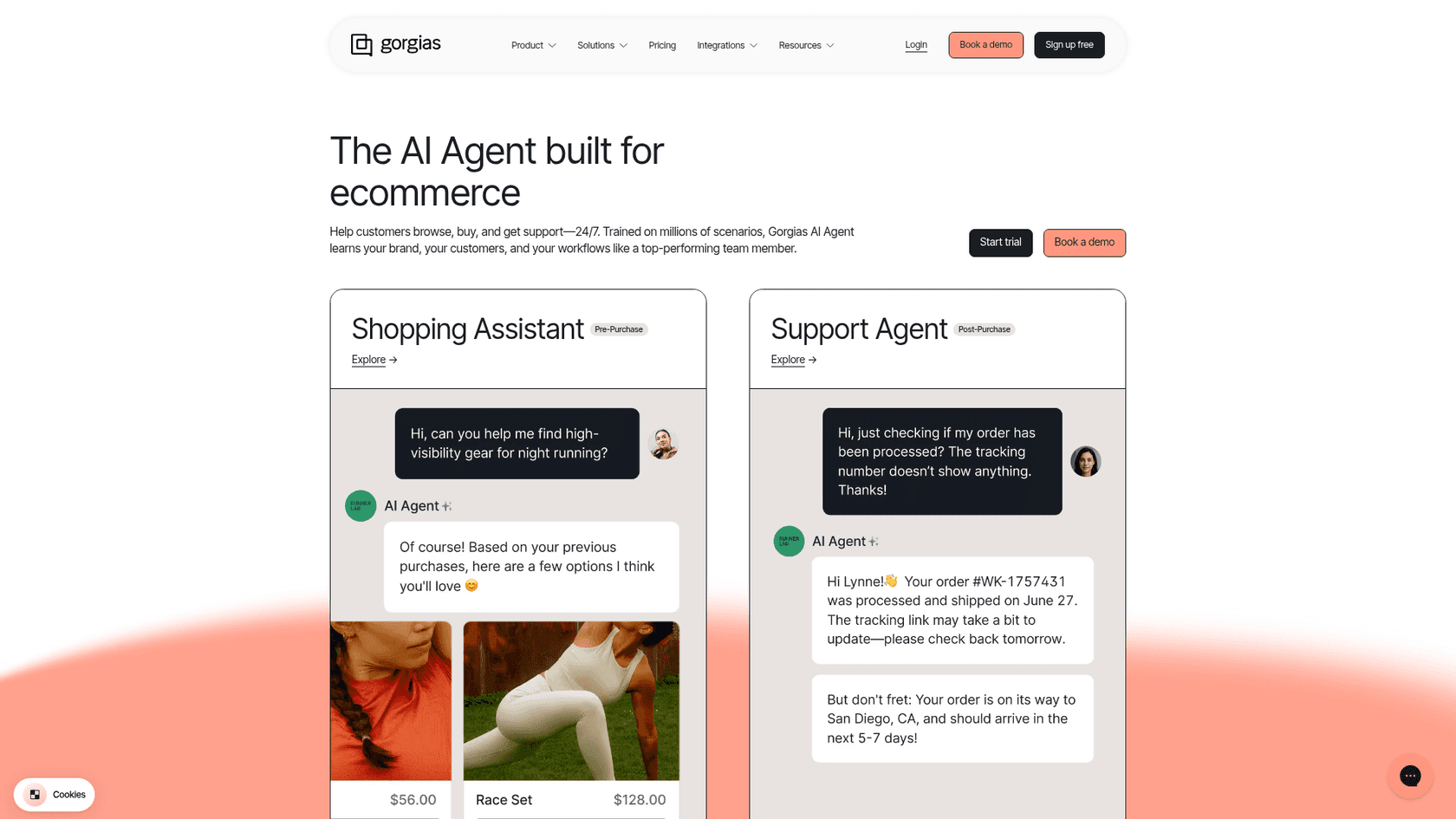
Best for: Shopify brands where support tickets are really order questions in disguise.
Gorgias is built specifically for ecommerce and it shows. It's Shopify's only Premier Partner for CX, powers around 40% of the top Shopify brands, and its AI Agent can handle order tracking, returns, refunds, and subscription edits fully automatically because the Shopify order data is right there in every conversation. The community is near-unanimous that the Shopify integration is best-in-class.
It also leans into chat as a revenue channel, not just a support cost. Customers like Orthofeet hit 56% automation in under two months, and the platform reports a 4.2x average ROI.
Pros:
- The deepest native Shopify integration on the market, with order actions inside the ticket.
- Priced by ticket volume, not seats, so you can add unlimited agents.
- Strong 4.6/5 G2 rating across 560+ reviews, and a genuine revenue-generation angle via chat campaigns.
Cons:
- Pricing is a common objection: it can run roughly 3x Zendesk for similar ticket volumes, and the community rule of thumb is that it's worth it only if 40%+ of your tickets need direct Shopify actions.
- It's ecommerce-first, so it's a poor fit for SaaS or IT support.
- The AI Agent add-on bills separately per resolved conversation on top of the plan.
Pricing: Five volume-based plans from $10/mo (Starter, 50 tickets) up to $900/mo (Advanced, 5,000 tickets), plus Enterprise. The AI Agent is an add-on at $0.90 to $1.00 per fully resolved conversation. See the full Gorgias AI pricing breakdown.
Our take: If you're on Shopify and a big chunk of tickets are order-related, Gorgias is hard to beat for fit. If the cost gives you pause, our Gorgias alternatives guide compares it against lighter options that still pull in Shopify data.
5. Enjo AI: best for B2B teams keeping their existing stack
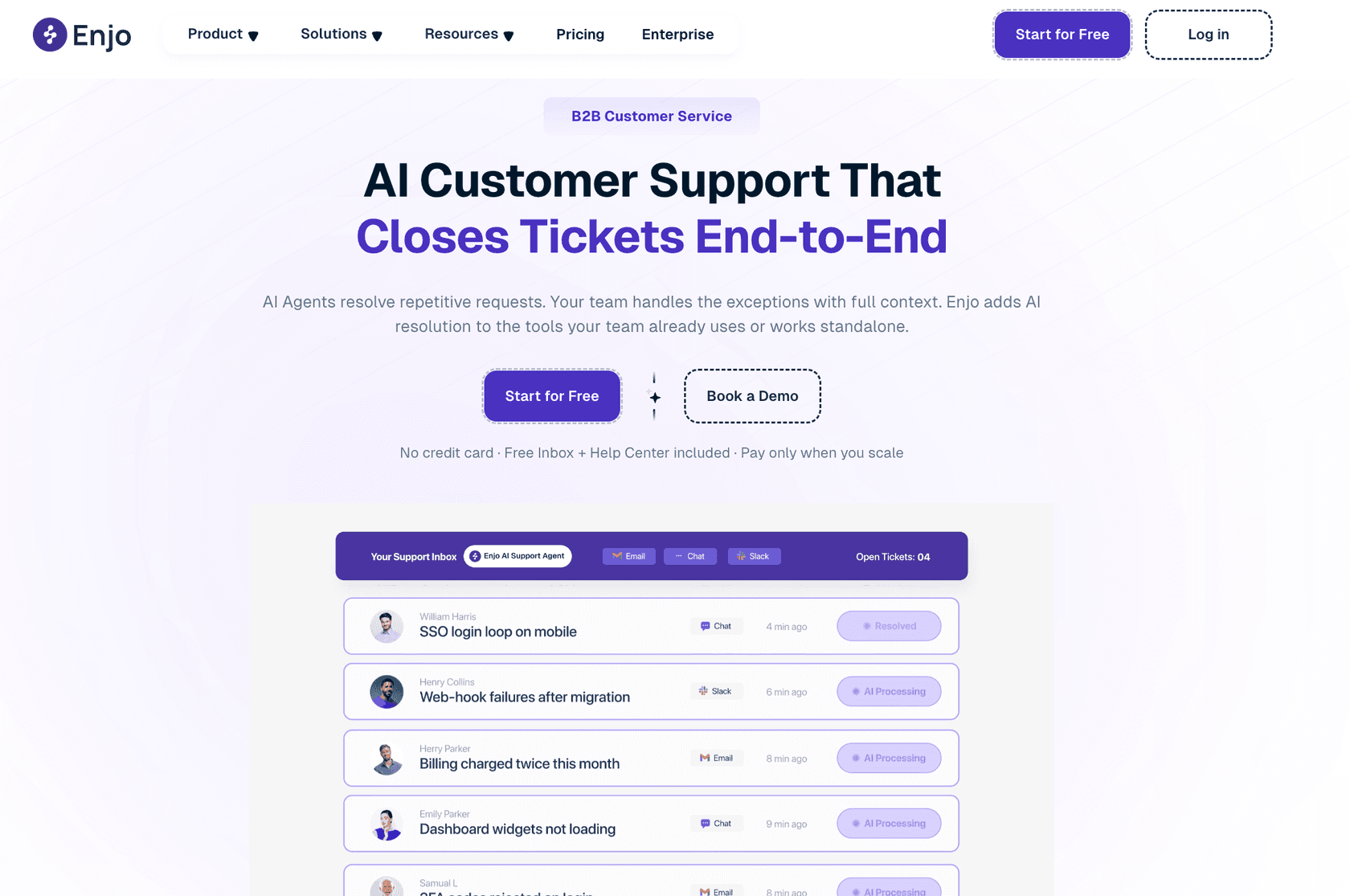
Best for: B2B customer service and IT teams that want a full agentic layer — AI Agent, Inbox, Help Center, and Agent Assist — without switching helpdesks.
Enjo AI is a B2B-focused customer service platform built around five integrated modules: AI Agent (autonomous resolution), Inbox (human-in-the-loop workspace), Help Center (self-serve portal), Agent Assist (copilot for human agents), and Guardrails + Insights for governance and analytics. It integrates natively with Slack, Microsoft Teams, Salesforce, Jira, Zendesk, ServiceNow, SharePoint, and Okta, and holds SOC 2 Type II, ISO 27001, and GDPR certifications out of the box. Its reported customer outcomes are striking: Netflix, Yahoo, Snapchat, Wayfair, DoorDash, Aptean, and Aurora are among its customers, with Aurora citing 63% autonomous resolution.
The standout commercial differentiator is its free tier. Inbox and Help Center conversations are unlimited at no cost, so teams can roll out the human-assisted and self-serve surfaces before committing to the AI Agent tier. The paid AI Agent starts at 200 replies per month, making it accessible for B2B teams with lower but high-value ticket volumes.
Pros:
- Full stack in one platform: AI Agent, Inbox, Help Center, Agent Assist, and Guardrails, with no helpdesk migration required.
- Genuine free tier for Inbox and Help Center — meaningful for teams phasing in AI gradually.
- Deep B2B integrations (Slack, Teams, Jira, ServiceNow, Okta) that most customer-service-focused vendors miss.
- Strong compliance posture: SOC 2 Type II, ISO 27001, and GDPR from day one.
- Proven at scale with enterprise names (Netflix, Wayfair, DoorDash) and a 63% autonomous resolution benchmark from Aurora.
Cons:
- Primarily B2B and IT-support-oriented; not the best fit for high-volume B2C e-commerce teams.
- The full AI Agent tier requires a paid plan; the free tier covers Inbox and Help Center only.
- Newer entrant compared to some rivals, so the public review base is still building.
Pricing: Free tier includes unlimited Inbox and Help Center conversations. Paid AI Agent plans start at 200 replies per month. Contact Enjo for volume pricing.
Our take: If you're a B2B team that wants a full agentic customer service layer without replacing your helpdesk, Enjo is one of the most compelling options at this price point — especially given the free tier and the depth of integrations with tools like Jira, ServiceNow, and Teams that most CS platforms treat as an afterthought.
6. Ada: best for high-volume enterprise

Best for: large enterprises doing 300,000+ support conversations a year.
Ada is a Toronto-based, enterprise-tier platform that brands its category as "Agentic Customer Experience." It's a standalone AI layer built on a multi-LLM Reasoning Engine, with omnichannel delivery (voice, chat, WhatsApp, email, SMS, Instagram) and a developer toolkit that notably supports MCP. Ada is one of the better-funded players, with ~$190M raised and a customer roster of airlines, big retail, and platforms like Monday.com, Pinterest, and Grab.
It's also unusually upfront about who it's for. Ada's pricing page states it's "a great fit for companies with at least 300,000 annual customer service conversations." That's a deliberate enterprise gate, not a starting point.
Pros:
- Mature, multi-LLM orchestration with strong autonomous voice and multilingual support out of the box.
- Leads on AI-specific compliance (AIUC-1, zero data retention with LLM providers) that most rivals don't surface.
- Proven at scale: Monday.com cut average handle time 42%, and IPSY reported a 943% ROI in four months.
Cons:
- Enterprise-only by stated qualification; it doesn't serve SMB or low-volume teams.
- No public pricing, no free trial, no self-serve signup.
- It's the AI layer plus a services wrap, so it's a platform commitment, not a quick add-on.
Pricing: No public rates. Conversation-volume-based annual enterprise contracts, gated by the 300k-conversation floor. Our Ada pricing and Ada review posts cover what's known.
Our take: If you're a large consumer brand doing huge volumes and want a services-led partner, Ada is a serious contender. If you're under that 300k floor, it's simply not aimed at you, and an Ada alternative like eesel will get you live without the enterprise contract.
7. Decagon: best AI-native platform for fast-iterating teams
Best for: enterprise CX teams replacing a brittle bot and tired of maintaining flow-builder logic.
Decagon, founded in 2023 by Jesse Zhang and Ashwin Sreenivas, is an AI-native platform with a distinctive technical wedge: Agent Operating Procedures (AOPs), natural-language instructions that compile into executable code. The idea is that non-technical CX operators author and iterate agent logic while engineers keep control of guardrails. It's well-capitalised (a reported ~$1.5B valuation after a 2025 Series C) and its customer logos are brand-heavy: Chime, Duolingo, Notion, Figma, Hertz.
The clearest competitive line comes from a customer. Decagon stages a quote from Duolingo on the difference versus their previous vendor:
"With the previous vendor, at least half my week was dedicated to maintaining their system. With Decagon, it's been a night-and-day difference."
Duolingo (Decagon case study)
Pros:
- AOPs make agent logic faster to iterate than decision-tree flow builders.
- One agent runtime across chat, voice, email, SMS, and custom API surfaces.
- Strong observability and QA tooling (every model call traced, simulated-conversation testing).
Cons:
- Sales-led with no public pricing and no self-serve trial.
- Bracketed by ticket volume, so it's aimed at mid-market and up, not small teams.
- Newer company, so the public review base is still thin compared to incumbents.
Pricing: No public list (the /pricing URL 404s). Sold as annual contracts bracketed by monthly support ticket volume. See our Decagon pricing and Decagon review for details.
Our take: A great pick if you're an enterprise replacing a high-maintenance bot and you value fast iteration. For smaller teams who like the AI-native idea but need to start now and see pricing, the Decagon alternatives comparison is the place to start.
8. Sierra: best for regulated and Fortune 500 teams
Best for: large, regulated enterprises that want outcomes-based pricing and top-tier credibility.
Sierra is the most-watched AI-native CX company, co-founded in 2023 by Bret Taylor (former co-CEO of Salesforce, chair of OpenAI's board) and Clay Bavor (18 years at Google). That pedigree explains its regulated-industry roster (Rocket Mortgage, SoFi, Vanguard, FINRA, Sutter Health) and its reported ~$10B valuation after a late-2025 raise.
Its commercial wedge is outcomes-based pricing: "pay for a job well done," with the bill tied to resolved outcomes rather than seats or messages. It also ships Ghostwriter, an agent that builds agents from your SOPs and transcripts, which collapses the usual long implementation cycle. Compliance is a day-one strength, including the rare ISO 42001 AI management certification.
Pros:
- Outcomes-based pricing shifts implementation risk onto Sierra.
- Exceptional enterprise and regulated-industry credibility.
- Both a code-first Agent SDK and a no-code Agent Studio, plus deployment through ChatGPT.
Cons:
- Enterprise / Fortune 500 focus, with no published pricing, no rate card, and no free trial.
- Outcomes-based contracts can be complex to define and negotiate per use case.
- Overkill for SMB and most mid-market teams.
Pricing: Outcomes-based, quote-only, via a sales contact form. No public list. Our Sierra pricing and Sierra reviews posts dig into the model.
Our take: If you're a Fortune 500 or regulated enterprise and want the most credible AI-native vendor with risk-aligned pricing, Sierra is the name to beat. Everyone smaller will get more done, faster, with a self-serve tool, which is the Sierra vs Zendesk style trade-off worth thinking through.
9. Gladly: best for DTC and lifetime-value brands
Best for: DTC and retail brands that treat support as a relationship, not a ticket queue.
Gladly takes a markedly different stance: a "people, not tickets" model where each customer is one lifelong conversation instead of discrete tickets. It bills itself as "the only AI built for LTV," and its AI agent (Sidekick) resolves end to end and takes real actions like cancelling orders or processing returns across chat, voice, email, SMS, and social. The customer list is unapologetically consumer-brand: TUMI, Ulta, UGG, Crate & Barrel, Nordstrom.
Reviewers love the unified customer view, and the numbers are good: 4.7/5 across 1,112 G2 reviews, the highest aggregate score in this list, plus a vendor claim of 76% of conversations fully resolved by AI.
Pros:
- The unified, channel-spanning customer profile is consistently praised; customers never repeat themselves.
- Highest G2 rating in this roundup (4.7/5).
- Real action-taking and strong omnichannel, with deployment in "days, not months."
Cons:
- Consistently flagged as expensive, and the per-seat / flat model is less flexible for small businesses.
- Reporting is fragmented (the #1 reviewer complaint), often needing manual Excel pulls.
- A learning curve and dense interface that new agents ramp into slowly.
Pricing: Mostly contact-sales for the core platform. The publicly listed Shopify plan confirms $1.50 per AI Resolution, $0.25 per AI Assist, and $120/mo per seat, with a 30-day free trial. Secondary sources peg the full platform around $180 to $210 per seat/month. More in our Gladly AI overview.
Our take: A great fit for DTC and retail brands that really run on lifetime value and want a relationship-first model. If the per-seat cost or the reporting gaps are dealbreakers, the Gladly alternatives comparison lines up leaner options.
What customer service AI actually costs
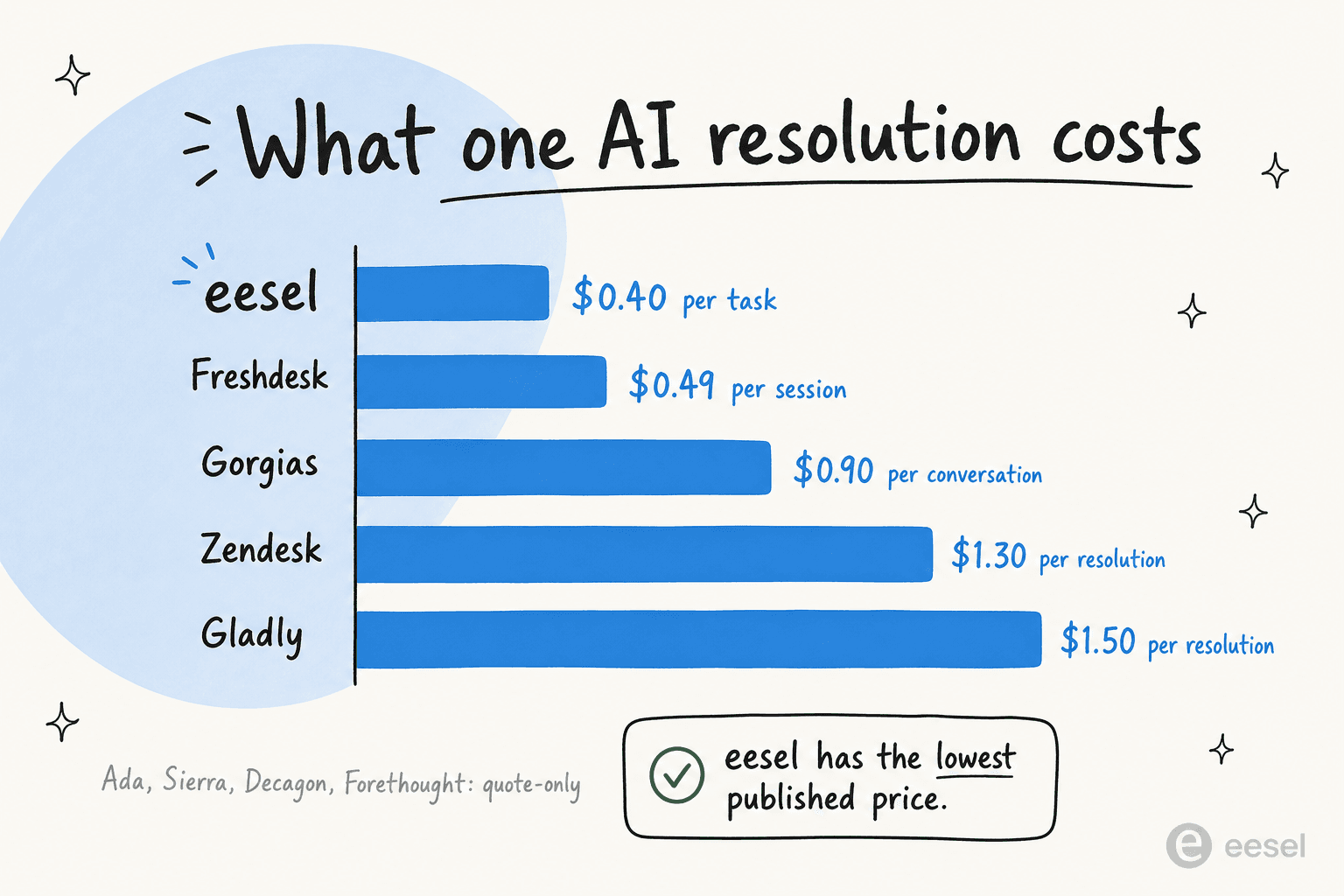
This is the part that trips up most buyers. Every vendor bills a different unit, so "cheaper per X" can be meaningless until you map it to your own volume. Here's the published per-unit pricing side by side:
A worked example makes it concrete. Say you're a mid-size team handling 2,000 support tickets a month and you want AI to take the repetitive ~60% (1,200 tickets):
- eesel: 1,200 tasks x $0.40 = $480/month, with a cap so it can't run away.
- Gorgias AI Agent: 1,200 resolved conversations x ~$0.95 = ~$1,140/month, on top of your plan.
- Zendesk: 1,200 automated resolutions x ~$1.30 = ~$1,560/month, on top of seats and any Copilot add-on.
- Gladly: 1,200 resolutions x $1.50 = $1,800/month, plus seats.
The spread is real, and it's why we'd always push you to do the per-resolution math for your own volume before signing anything. The enterprise platforms (Ada, Sierra, Decagon) are quote-only; Enjo AI has a free tier, so the only way to compare them is to get a number and run the same calculation. For the bigger picture on ROI, our guide on how much AI can save in customer support and the AI agent vs human agent cost breakdown both help.
How to choose the right customer service AI for your team
Cutting through all of it, the decision usually comes down to three questions:
- Do you want to keep your current helpdesk? If yes, go standalone: eesel, Enjo AI, or Ada layer on top. If you're happy being all-in on one suite, Zendesk AI or Freshdesk Freddy are convenient. The trade-off matters because re-platforming a helpdesk is a months-long project on its own.
- What's your volume and budget? Under a few thousand tickets a month and want to start this week? Self-serve, usage-priced tools (eesel, Freshdesk) win. Doing hundreds of thousands of conversations with budget for a sales-led contract? Ada, Sierra, and Decagon are built for you.
- What's your vertical? Shopify and ecommerce point to Gorgias; DTC and retail relationships point to Gladly; SaaS and IT support are well-served by the standalone agents. Our best AI helpdesk software and best AI customer support tools guides slice this further by use case.
The honest meta-point: the tool that looks best in a demo is rarely the one that fits your stack, your volume, and your budget all at once. Start a free trial on the one that matches all three, and let it run on your real tickets for a week before you decide.
Try eesel for customer service AI
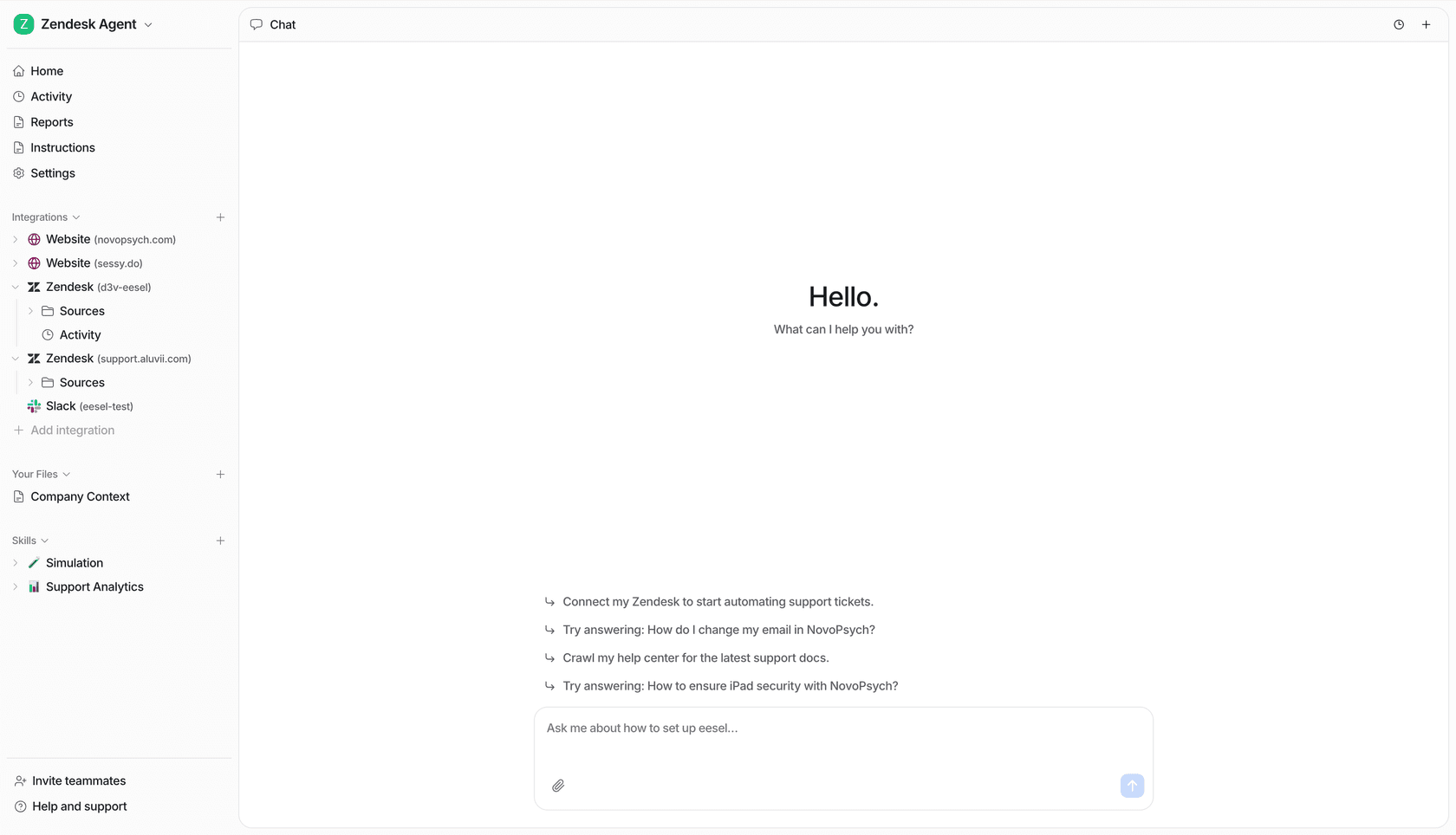
If the through-line of this list resonates (autonomy that's real, pricing you can predict, and no migration), eesel AI is built for exactly that. It plugs into Zendesk, Freshdesk, Gorgias, Slack, and 100+ other tools, trains on your past tickets and docs, and only handles the tickets it's confident about, escalating the rest with full context. The one differentiator we'd point to: you can be live and resolving real tickets in days, on task-based pricing that's $0.40 a ticket with a hard spend cap, and start free with $50 of usage and no credit card.
Try eesel and see how much of your queue it clears in a week.
Frequently Asked Questions

Share this article

Article by
Alicia Kirana Utomo
Kira is a writer at eesel AI with a Computer Science background and over a year of hands-on experience evaluating AI-powered customer service tools. She focuses on breaking down how helpdesk platforms and AI agents actually work so that support teams can make better buying decisions.