The 8 best Zendesk AI alternatives in 2026


Last edited June 13, 2026
Table of Contents
Why teams leave Zendesk's AI (and why they don't have to leave Zendesk)
Zendesk is a genuinely good ticketing platform. It's a 2025 Gartner Magic Quadrant Leader, it scores 4.3/5 across more than 6,800 G2 reviews, and the core inbox is something teams happily use for years. The friction is almost always the AI.
Three things drive the search for an alternative.
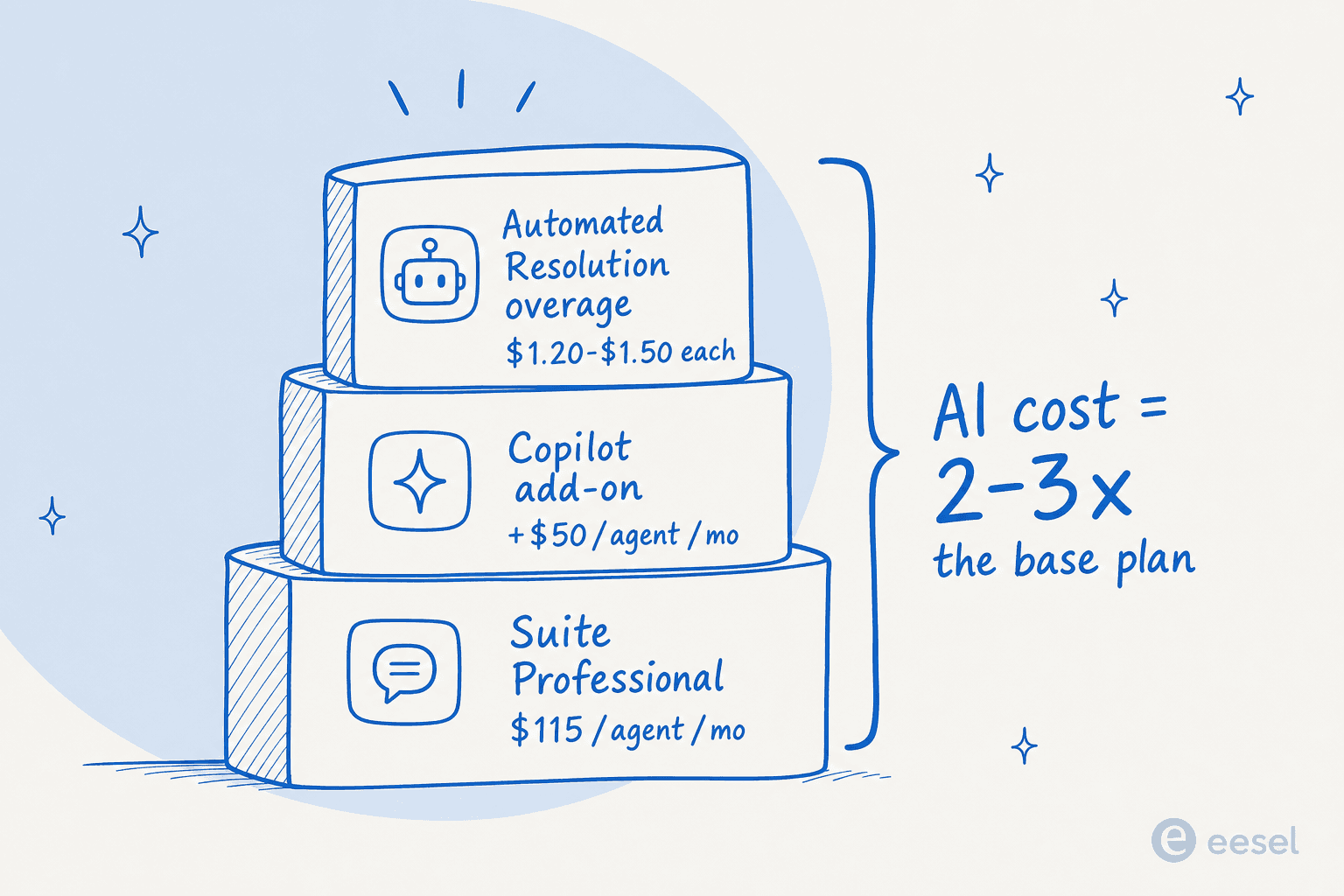
The pricing math gets scary. Zendesk's AI Agents bill on "automated resolutions." Since the May 2026 three-tier model, only verified resolutions draw from your allowance, which is an improvement, but the per-resolution rate still lands around $1.20-$1.50 above your committed volume, with no soft cap. The only overage control is to pause AI entirely. One Redditor working through the contract math put it plainly:
"From what I can see in regards to this new 'Automated Resolution' pricing model, we'll be paying about $1.50-$1.20 per resolution."
r/Zendesk, Zendesk's new AR pricing model

Stack the base plan, the Copilot add-on, and resolution overages together and the AI layer routinely costs two to three times the base subscription. Here's what that pile actually looks like.
The AI layer is hard to turn on. Reviewers consistently describe configuring Copilot, AI Agents, and Intelligent Triage as "burdensome." As one Capterra reviewer put it, setting up add-ons "could feel like a full time job in the backend." And results are gated by knowledge-base hygiene, with most teams seeing roughly 20% automation in month one, climbing toward 70% only after sustained KB cleanup.
The base tier doesn't feel like AI. The bundled Essentials tier gets described on r/Zendesk as a routing layer that "doesn't feel like AI at all" - which pushes you straight to the paid Copilot add-on or a third-party tool anyway.
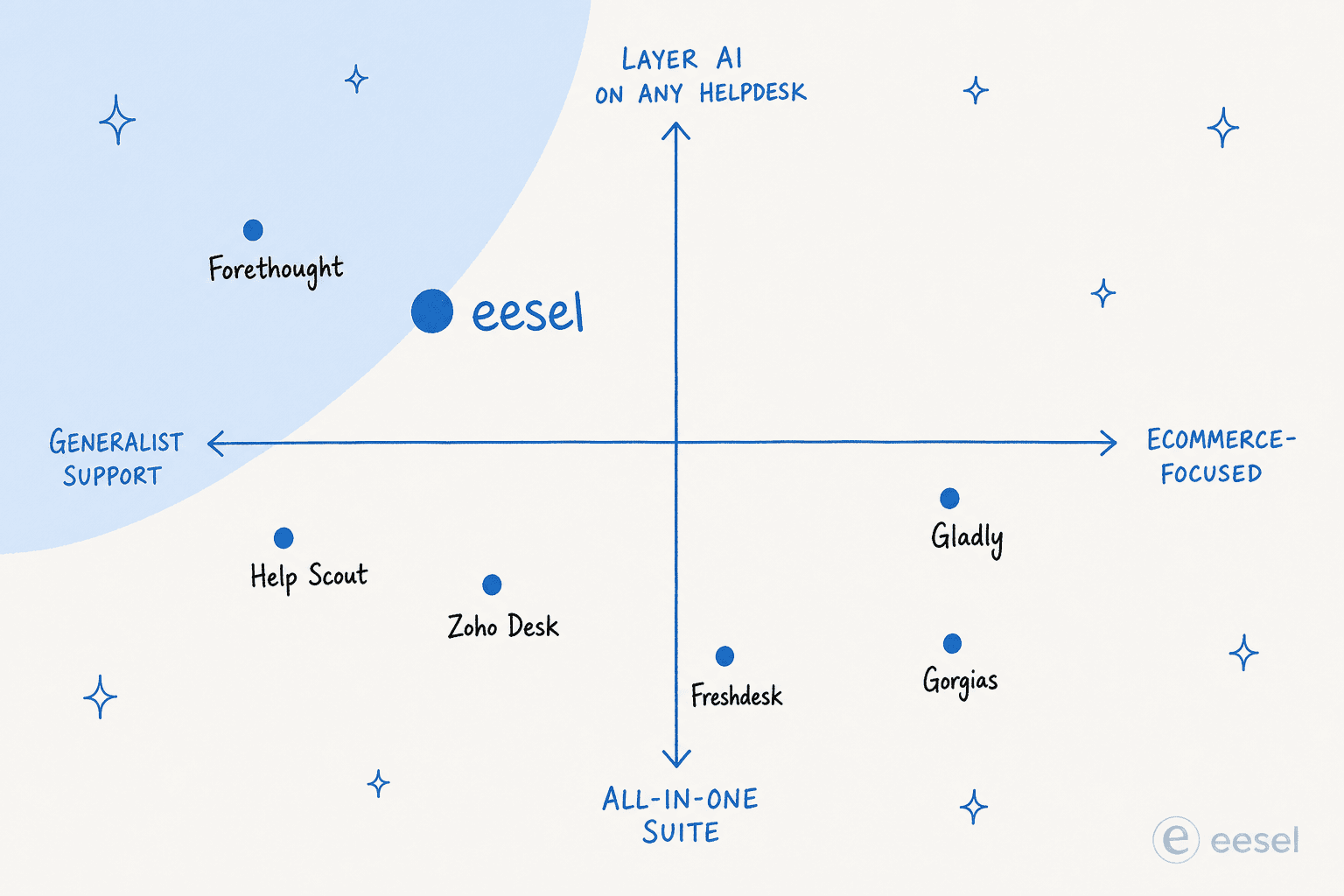
Here's the part most roundups miss: you don't have to abandon Zendesk to fix the AI. A few of the tools below sit on top of your current account. So the real first question isn't "what replaces Zendesk?" - it's "do I want to replace my helpdesk, or just its AI?" That map is worth keeping in your head as you read.
How we picked, and how to read this list
We're a team that builds AI support agents for a living, so we evaluated these the way a buyer would: we looked at each product's own docs, pricing pages, and UI, and read what real users say on G2, Capterra, and Reddit. Every tool here is one we'd genuinely recommend to someone - the work is matching the tool to the team.
The dimensions that actually move the decision:
- AI billing model. Per resolution, per seat, per ticket, or quote-only. This is where the real cost lives, not the sticker price.
- Replace vs. layer. Does it force a migration, or sit on your existing helpdesk?
- Time to value. Days and a clean KB, or weeks of consultant-led setup?
- Fit. Generalist support, ecommerce, enterprise, or small relationship-driven teams.
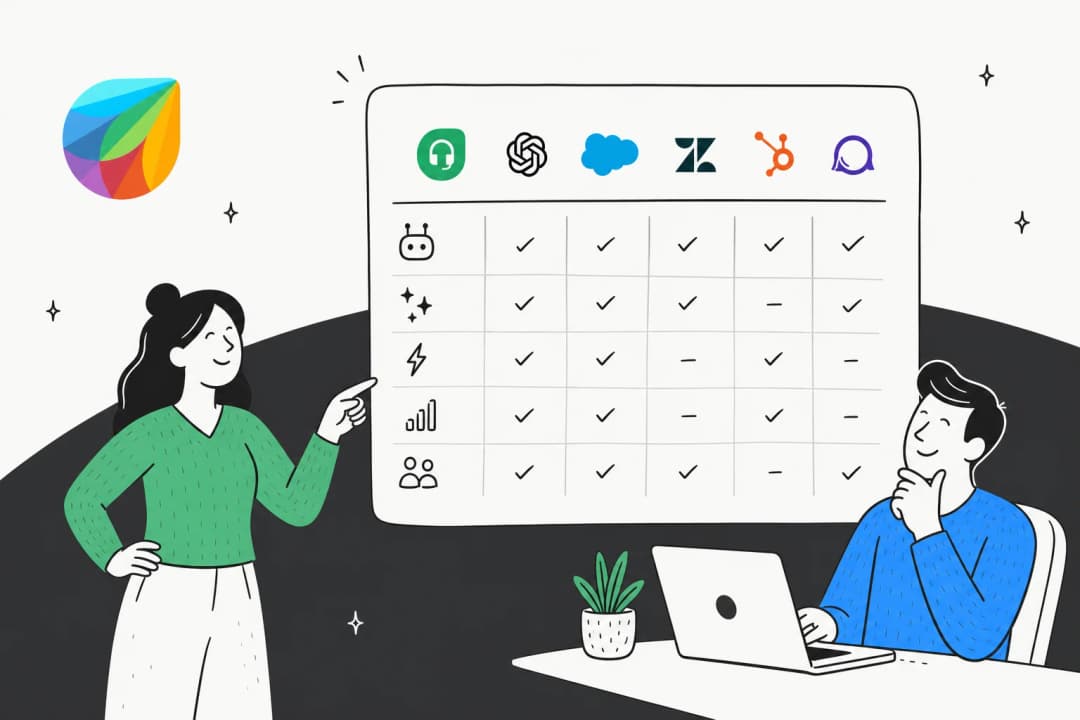
Here's the whole field at a glance.
| Tool | Best for | AI billing model | Indicative AI cost | Standout | G2 |
|---|---|---|---|---|---|
| eesel AI | Keeping Zendesk, adding AI fast | Per ticket handled | $0.40 / ticket | Simulate on past tickets before going live | - |
| Freshdesk (Freddy) | A cheaper Zendesk-style suite | Per AI session | $49 / 100 sessions | Lower seat prices, mature suite | 4.4 (Capterra) |
| Gorgias | Shopify and ecommerce | Per resolved conversation | $0.90-$1.00 / resolution | Deepest Shopify data integration | 4.6 |
| Help Scout | Small, relationship-led teams | Per resolution | $0.75 / resolution | Simplest, fastest to learn | 4.4 |
| Zoho Desk | Budget and Zoho users | Bundled tokens | From $0 (Free plan) | Half the cost of Zendesk | 4.4 |
| Kustomer | High-volume B2C / DTC | Quote-only + per-conversation | ~$0.60 / conversation | Customer-timeline data model | 4.4 |
| Forethought | Enterprise staying on its stack | Quote-only, outcome-based | Mid-5 to 6 figures / yr | Helpdesk-agnostic agentic AI | - |
| Gladly | Retail / DTC built on LTV | Per resolution / per seat | $1.50 / resolution | "People not tickets" model | 4.7 |
Now the detail, starting with the one we'd reach for first.
1. eesel AI
Best for: teams that like Zendesk's ticketing but want a better-priced, faster-to-deploy AI agent without ripping anything out.
eesel AI is the alternative that doesn't ask you to choose. It installs as a native AI Agent inside Zendesk from the Marketplace, reads your tickets and history, drafts and sends replies, updates fields, and escalates, behaving like a human agent in your existing account rather than a bolt-on chatbot. It also runs the same way inside Freshdesk, Help Scout, Slack, and 100+ other tools, so you're never locked into one stack.
Two things genuinely set it apart from Zendesk's own AI. First, you can run a simulation against your past tickets before a single live customer touches it, so you see your real resolution rate and fill knowledge gaps before launch instead of guessing. Second, the pricing is a flat $0.40 per ticket handled with a hard spend cap, so a holiday spike can't quietly triple your bill.
It isn't magic on day one, but it's fast. Gridwise hit 73% tier-1 resolution in the first month on a 7-day trial:
"In the first month, eesel is resolving 73% of our tier 1 requests... Our team implemented and achieved results quickly during our 7-day trial."
Kim Simpson, Gridwise, via the eesel Zendesk integration page
Pros:
- Keeps your existing helpdesk; no migration, live in under 30 minutes.
- Flat $0.40/ticket with a spend cap - no per-resolution roulette.
- Pre-launch simulation on historical tickets, plus knowledge-gap detection that drafts missing KB articles.
- 80+ languages, multi-brand, no model training on your data (SOC 2 Type II, GDPR).
Cons:
- It's an AI agent layer, not a full ticketing system - if you're trying to leave Zendesk's inbox entirely, you'd pair it with another helpdesk.
- Newer brand than the incumbents, so it won't have a 6,000-review G2 page yet.
Our take: if you're on Zendesk and the AI bill is what's driving you to look, this is the one to try first - you get autonomous resolution without the migration, and you can prove the ROI on your own tickets in a week. Teams replacing the whole helpdesk should still read on.
2. Freshdesk (Freddy AI)
Best for: teams that want a Zendesk-style suite with lower seat prices and a familiar feel.
Freshdesk, from Freshworks, is the closest like-for-like swap. It's a mature omnichannel helpdesk trusted by 74,000+ businesses, and its Freddy AI suite mirrors Zendesk's structure: an AI Agent for autonomous resolution, a Copilot for agents, and Insights for leadership. Freshworks claims Freddy resolves up to 80% of queries autonomously. If your team already thinks in tickets, SLAs, and routing, the learning curve is gentle. We've covered the head-to-head in detail in our Zendesk vs Freshdesk breakdown.
The pricing is the draw: Growth is $19/agent/month, Pro $55, and Enterprise $89 - undercutting Zendesk's Suite ladder. The catch is the AI billing. Freddy AI Agent runs on sessions: 500 included on Pro/Enterprise, then $49 per 100 sessions, and Freddy Copilot is a separate per-agent add-on.
Pros:
- Lower per-seat pricing than Zendesk Suite, with a similar feature footprint.
- Free for 1-2 agents for six months - a usable starting point.
- Strong omnichannel unification and a no-code AI Agent Studio.
Cons:
- Session-based AI pricing still gets expensive at volume, just in a different shape.
- It's a full migration off Zendesk, and Freddy's results are as KB-dependent as Zendesk's.
Our take: the safe, sensible swap if you want to stay in a single suite but pay less per seat. Just model the Freddy session costs at your real volume before you assume it's cheaper overall. (If you'd rather keep Freshdesk and add a better agent, eesel also runs natively inside Freshdesk.)
3. Gorgias
Best for: Shopify and ecommerce brands where most tickets are order-related.
If you sell on Shopify, Gorgias is the specialist Zendesk can't match. It's Shopify's only Premier Partner for CX, powers 40% of the top Shopify brands, and its AI Agent handles order tracking, returns, refunds, subscription edits, and discount generation with full Shopify context in every conversation. Where Zendesk treats Shopify as one more integration, Gorgias treats it as the center of gravity. For the wider ecommerce field, see our best Gorgias alternatives guide.
Pricing is by ticket volume, not seats (unlimited users): Starter $10/mo, Basic $60, Pro $360, Advanced $900. The AI Agent is an add-on at $0.90-$1.00 per fully resolved conversation. It scores a strong 4.6/5 on G2 from 560+ reviews.
"At 6pm on the second day of Black Friday week, our CX agent said: 'Alright, I'll see you tomorrow. We're at inbox zero.' Without AI Agent, that wouldn't happen."
Ron Shah, CEO of Obvi, on the Gorgias pricing page
Pros:
- Best-in-class Shopify data integration; order actions happen inside the ticket.
- Volume-based pricing with unlimited seats suits lean ecommerce teams.
- Proven revenue-driving chat campaigns, not just deflection.
Cons:
- The community's number one objection is price - roughly 3x Zendesk for similar ticket volumes, only worth it if 40%+ of tickets need Shopify actions.
- Outside ecommerce, the specialization is wasted.
Our take: the obvious pick for Shopify-heavy brands, and a poor one for everyone else. If most of your tickets are "where's my order," the native Shopify actions pay for themselves; if not, you're overpaying for ecommerce features you won't touch.
4. Help Scout
Best for: small, relationship-driven teams who find Zendesk too heavy.
Help Scout is the antidote to enterprise ticketing. Its whole pitch is a clean, email-like shared inbox you can "learn in less than an hour," used by 12,000+ companies. The AI layer is sensibly scoped: AI Answers (an autonomous agent that resolves ~73% of interactions from your knowledge base) plus an Inbox Assistant that drafts, summarizes, and edits replies. If Zendesk feels like flying a 747 to cross the street, this is the antidote. More options in our Help Scout alternatives roundup.
Plans are per user: Free (up to 5 users), Standard $25, Plus $45, Pro $75. AI Answers is a usage add-on at $0.75 per resolution, with a 3-month free trial and a spending cap you can set.
The honest caveat is pricing-model history. Help Scout switched from per-seat to per-interaction in 2025, churned customers, then reverted - and the whiplash cost trust:
"lost all trust with this flip-flopping on pricing."
Help Scout customer, surfaced in community discussion

Pros:
- Fastest tool here to learn; clean, low-clutter inbox.
- Generous free plan plus a 3-month free AI trial and resolution spending caps.
- AI Answers resolution pricing is among the more transparent.
Cons:
- Reporting and advanced features are thin; scaling teams report outgrowing it.
- The $0.75/resolution add-on stacks on seat costs and adds up at volume.
Our take: a great fit for small teams who value simplicity over depth. If you're a 5-15 person team drowning in Zendesk's settings, the relief is real - just know you may outgrow the reporting as you scale.
5. Zoho Desk
Best for: budget-conscious teams, and anyone already living in the Zoho ecosystem.
Zoho Desk is the value play. It's a capable omnichannel helpdesk used by 125,000+ businesses, and on Reddit it's the default "cheaper Zendesk" recommendation - "almost everything that Zendesk does at like half the cost." Plans run from a Free Forever tier (3 agents) up through Express $7, Standard $14, Professional $23, and Enterprise $40 per agent. Its AI assistant, Zia, spans Answer Bot, sentiment analysis, auto-tagging, and reply suggestions. We've also mapped the wider field of AI integrations for Zoho Desk.
The honest catch: most of the good Zia features are gated to the Enterprise tier, and Zia itself gets mixed reviews. One Redditor was blunt, calling Zia "a trainwreck of unhelpful responses." Many teams end up bolting ChatGPT on via the BYO-key integration to compensate.
Pros:
- Easily the cheapest serious option; a genuine Free Forever plan.
- Deep automation (Blueprint, SLAs, routing) praised as excellent value.
- Tight integration if you already run Zoho CRM and the wider suite.
Cons:
- Advanced Zia AI is Enterprise-only, pricing out the SMBs who are Zoho's core.
- Zia's quality lags; a cluttered UI and steep learning curve are common complaints.
Our take: unbeatable on price, and the right call if you're already in Zoho or running lean. Just set expectations on Zia - treat the native AI as a bonus, not the reason you buy, and budget for a stronger AI layer if automation is the goal.
6. Kustomer
Best for: high-volume B2C and DTC brands that want AI running on full customer context.
Kustomer rethinks the data model. Instead of discrete tickets, every interaction attaches to a complete customer record - order history, loyalty tier, past conversations - so its AI ("Concierge" for customers, "Envoy" for agents) reasons from the full timeline, not an isolated ticket. The pitch is "AI runs on context, not guesswork," and the results brands report are strong: Vuori automates 70% of chat, Aplazo runs 98% of WhatsApp conversations through AI. It scores 4.4/5 on G2 from 555 reviews.
The friction is buying it. Pricing is quote-only - every path routes to "Talk to Sales." Competitor teardowns peg it around $89-$139/seat/month on annual contracts with an 8-seat minimum, plus AI billed separately at roughly $0.60 per engaged conversation. One small flag: the homepage advertises a "5.0 from 500+ G2 reviews" that the actual G2 aggregate (4.4) doesn't support, so take the marketing number with a pinch of salt.
Pros:
- Unified customer timeline gives AI and agents real context; users love it.
- Proven at very high B2C volume with strong automation rates.
- Omnichannel including voice, SMS, and WhatsApp in one record.
Cons:
- Quote-only, high seat floor (8-seat minimum), AI metered on top - expensive and opaque.
- Reviewers flag a "buggy" voice channel and a complex, overwhelming UI.
Our take: worth a demo if you're a high-volume consumer brand that's outgrown ticket-centric tools and can absorb enterprise pricing. Smaller teams will find the seat floor and the sales-gated pricing a hard sell.
7. Forethought
Best for: enterprises that want serious agentic AI but are committed to their current helpdesk.
Forethought is the other tool here that doesn't make you switch. It's a standalone, helpdesk-agnostic AI platform that sits on top of Zendesk, Salesforce, or whatever you run, with a multi-agent system (Solve, Triage, Assist, Discover, plus Agent QA). Its strongest card is taking action: Autoflows, Custom Actions, and a Browser Agent that can even operate legacy systems without APIs. Founded in 2017 and backed by ~$92M in funding, it serves mature orgs like Upwork, Carta, and Grammarly, and claims up to 98% resolution rates.
One wrinkle worth knowing: Forethought is now Zendesk-owned, which makes it a slightly unusual "alternative," though it still runs across other helpdesks. Pricing is quote-only and outcome-based (no free trial - they run a Proof of Value on your data instead), typically landing in mid-five to low-six figures annually per secondary sources.
Pros:
- Helpdesk-agnostic - keep your stack and add agentic AI on top.
- Genuine action-taking, including legacy systems via the Browser Agent.
- Enterprise-grade multi-agent suite with strong reference customers.
Cons:
- No public pricing and no free trial; an enterprise sales cycle and ACV.
- Overkill for SMBs, and the Zendesk ownership muddies the "independence" pitch.
Our take: a strong fit for enterprise support orgs with complex, multi-system workflows that don't want to migrate. If that's not you, the lighter, transparently-priced layer-on options like eesel get you most of the way for a fraction of the commitment.
8. Gladly
Best for: retail and DTC brands that treat support as a revenue and loyalty channel.
Gladly shares Kustomer's "people, not tickets" philosophy but leans even harder into lifetime value, branding itself "the only AI built for LTV." Its Sidekick agent resolves end-to-end and takes real actions (cancel order, return, price adjustment) across chat, voice, email, SMS, and social, and the customer roster is a who's-who of premium retail: TUMI, Ulta, UGG, Crate & Barrel, Nordstrom. It earns the highest review score in this list at 4.7/5 from 1,112 G2 reviews, with vendors claiming 76% of conversations fully resolved by AI.
Pricing is mostly contact-sales for the core "Hero" platform (secondary sources cite ~$180-$210/seat/month annually). The one public, self-serve option is a newer Shopify plan: free to install, then a $250/month spend cap with $1.50 per AI resolution, $0.25 per AI assist, and $120/month per seat.
Pros:
- Highest G2 rating here; loved for the unified customer view and channel breadth.
- Real action-taking and a strong voice-AI story for retail.
- A new Shopify self-serve plan finally exposes some public pricing.
Cons:
- Consistently flagged as expensive; reporting is fragmented (manual Excel pulls).
- $1.50/resolution is the priciest per-resolution rate in this roundup, and platform pricing is sales-gated.
Our take: a premium choice for consumer brands where every conversation is a chance to grow LTV, and who'll actually use the personalization. Budget-sensitive teams will find both the seat pricing and the $1.50/resolution rate steep next to the alternatives.
So which Zendesk AI alternative should you pick?
Strip away the marketing and it comes down to two questions: do you want to replace Zendesk or just its AI, and what's your shape - ecommerce, enterprise, small team, or budget?
- Keep Zendesk, fix the AI: eesel AI for most teams, Forethought for complex enterprises.
- Swap to a cheaper full suite: Freshdesk or Zoho Desk.
- Ecommerce: Gorgias for Shopify, Gladly or Kustomer for premium DTC at scale.
- Small and simple: Help Scout.
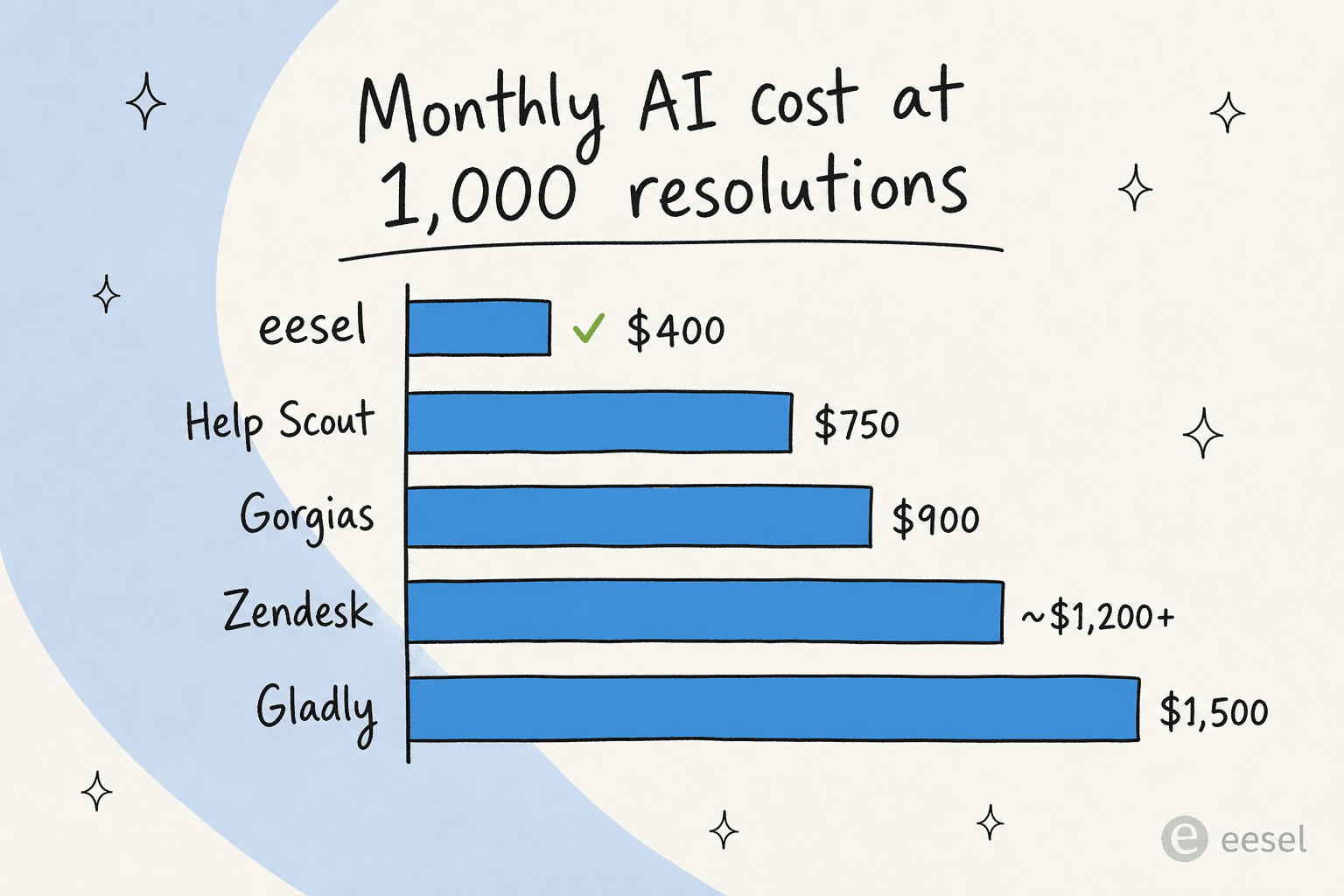
And the dimension that quietly decides the bill is the AI billing model. Per-resolution rates range from $0.40 (eesel, per ticket) all the way up to $1.50 (Gladly) for what is broadly the same job. At 1,000 resolutions a month, that's the difference between a $400 bill and a $1,500 one.
For most readers who landed here because the Zendesk AI bill got out of hand, the cleanest move is the one that doesn't require a migration at all. More options live in our best AI helpdesk software and Zendesk competitors guides.
Try eesel AI on your Zendesk
If the thing pushing you to look elsewhere is Zendesk's AI pricing and setup pain, eesel AI is the lowest-friction fix: it installs as a native AI Agent inside your existing Zendesk in under 30 minutes, learns from your past tickets and help center automatically, and bills a flat $0.40 per ticket with a spend cap, so there are no per-resolution surprises.
The part we'd actually point you to: you can simulate the agent on your historical tickets before it ever replies to a customer, so you see your real resolution rate and fix knowledge gaps up front instead of finding out in production. Start free with $50 of usage and no credit card, or book a demo to see it on your own data.
Frequently Asked Questions

Share this article

Article by
Alicia Kirana Utomo
Kira is a writer at eesel AI with a Computer Science background and over a year of hands-on experience evaluating AI-powered customer service tools. She focuses on breaking down how helpdesk platforms and AI agents actually work so that support teams can make better buying decisions.