The 8 best Zendesk competitors and alternatives in 2026


Last edited June 13, 2026
Table of Contents
Why teams leave Zendesk in the first place
Let's be fair to Zendesk first, because the warts only matter in context. Zendesk is a genuinely strong platform: it was named a 2025 Gartner Magic Quadrant Leader for the CRM Customer Engagement Center, it carries a 4.3/5 average across 6,837 G2 reviews, and its marketplace lists over 1,800 apps. If you want a mature, omnichannel ticketing core that scales to enterprise, it earns its reputation.
So why the steady stream of people searching for an exit? Three reasons keep coming up.
The AI pricing is the headline complaint. Zendesk's AI bills per "automated resolution" on top of your per-agent plan. Only a conversation the LLM verifies as resolved draws from your allowance, which is fairer than the old "silence for 72 hours counts" model, but the per-resolution charges still stack fast. Third-party teardowns put overage at $1.20 to $1.50 per resolution, and there is no soft cap: your only cost control is to pause AI entirely. On Reddit, the sentiment is blunt:
"ARs are a rip off, and it's a rushed product to get into the AI hype."
r/Zendesk user, quoted in our Zendesk pricing research
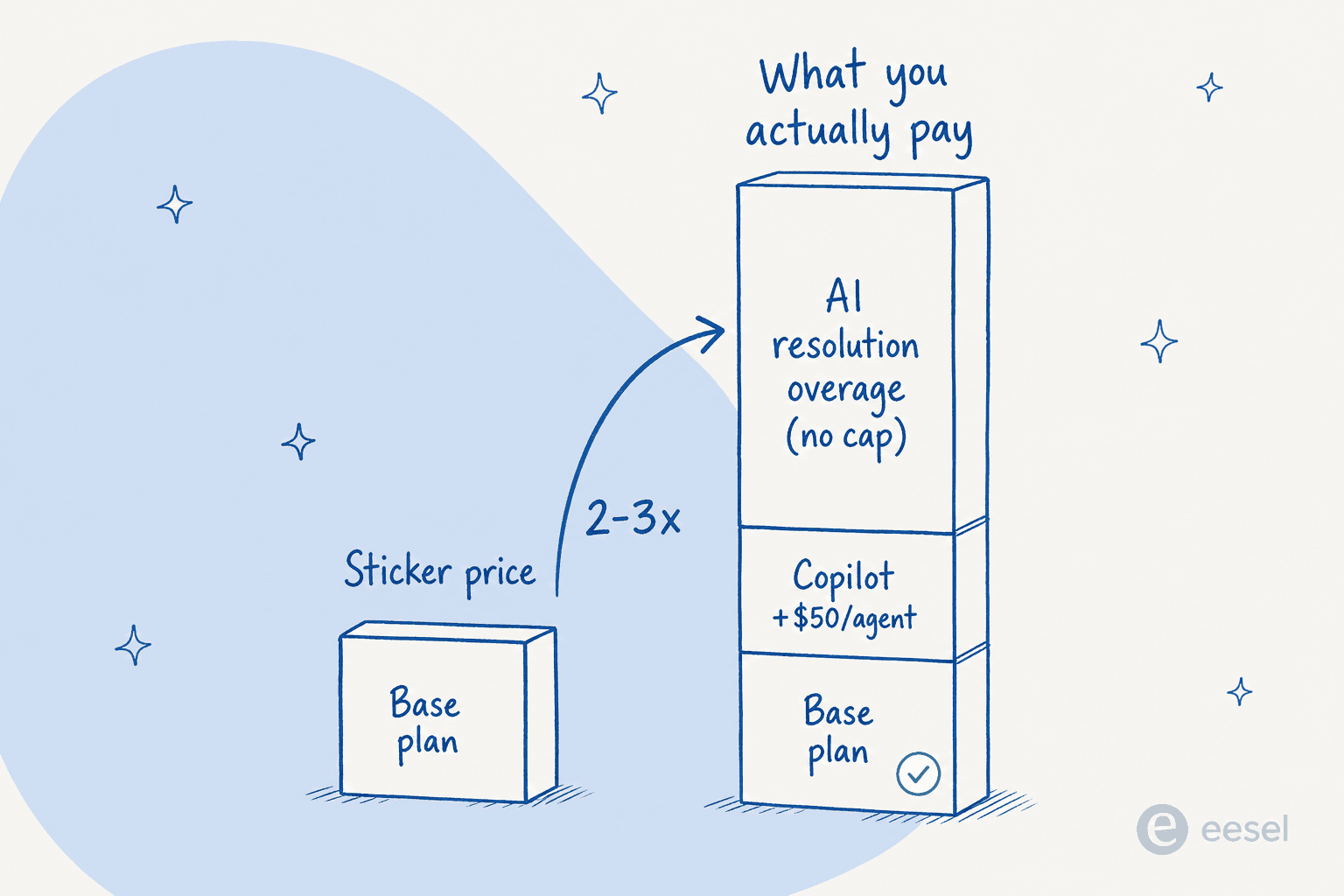
The costs compound. Copilot, Zendesk's agent-side AI, is a $50/agent/month add-on below the Enterprise tier. Stack the base plan, Copilot, and automated-resolution overage together and the AI-related spend can easily reach 2 to 3 times the base subscription for a team with real automation volume.
The AI layer is heavy to run. Reviewers repeatedly describe configuring AI Agents, Copilot, and Intelligent Triage as "burdensome", and one Zendesk-run poll at its own 2025 conference found only about 10% of AI agents built in the prior six months were still in use. That points to abandonment, not adoption.
None of this makes Zendesk a bad product. It makes it a product worth pressure-testing against the alternatives, especially if AI automation is the thing you actually came for. If that's the core issue, our Zendesk AI alternatives guide goes deeper on the AI-first options specifically.
How we picked these Zendesk competitors
We weighed every tool on the dimensions that actually decide a switch, not just a feature checklist:
- Total cost, not sticker price. What you pay once AI usage, add-ons, and seats are included.
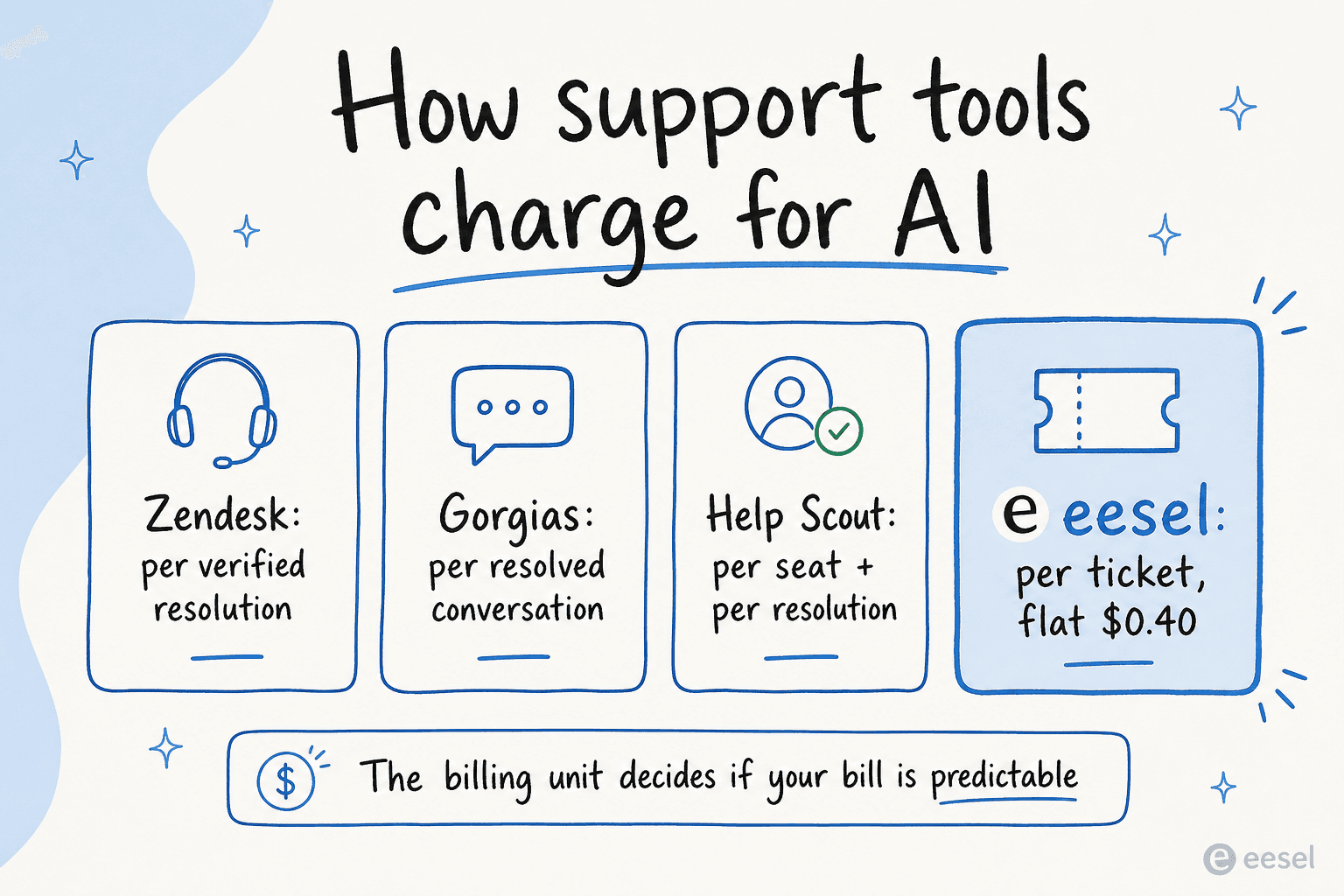
- AI billing model. Per seat, per resolution, per conversation, or per ticket. This single choice decides whether your bill is predictable.
- Channel and ecosystem fit. Shopify, CRM, email, voice, social.
- Setup effort and time to value. How fast a real team gets live.
- What real users say. Verifiable G2, Capterra, and Reddit signal, not marketing copy.
Zendesk competitors at a glance
| Tool | Best for | Starting price | AI billing model | Free tier | G2 rating | Standout |
|---|---|---|---|---|---|---|
| eesel AI | AI on top of your current helpdesk | $0.40 per ticket | Per ticket, flat | $50 credit, no card | n/a | Simulate on past tickets before go-live |
| Freshdesk | Affordable omnichannel ticketing | $19/agent/mo | Per AI session | 1-2 agents, 6 months | 4.4/5 | Fast setup, broad channels |
| Zoho Desk | Budget and Zoho ecosystem | $7-14/agent/mo | Token allowance | Free, 3 users | 4.5/5 (Gartner) | Half the cost of Zendesk |
| Help Scout | Small, human support teams | $25/user/mo | $0.75 per resolution | Free, 5 users | 4.4/5 | Email-style simplicity |
| Gorgias | Shopify e-commerce brands | $10/mo (50 tickets) | $0.90-1.00 per conversation | 7-day trial | 4.6/5 | Native Shopify actions |
| HubSpot Service Hub | Teams inside a CRM | $7/seat/mo | ~$0.45 per resolution (credits) | Free, 2 users | n/a | One CRM view across teams |
| Front | Collaborative shared inbox | $25/seat/mo | From $0.05 per conversation | 14-day trial | 4.7/5 | Team collaboration on email |
| Gladly | Premium DTC and retail | ~$180/seat/mo | $1.50 per resolution | 30-day trial | 4.7/5 | Ticketless, customer-centric model |
Prices are per the vendors' public pricing pages as of June 2026; AI usage is billed separately on most platforms. G2 figures are aggregate ratings from each product's G2 page.
Now the detail, starting with the option that doesn't ask you to migrate at all.
1. eesel AI
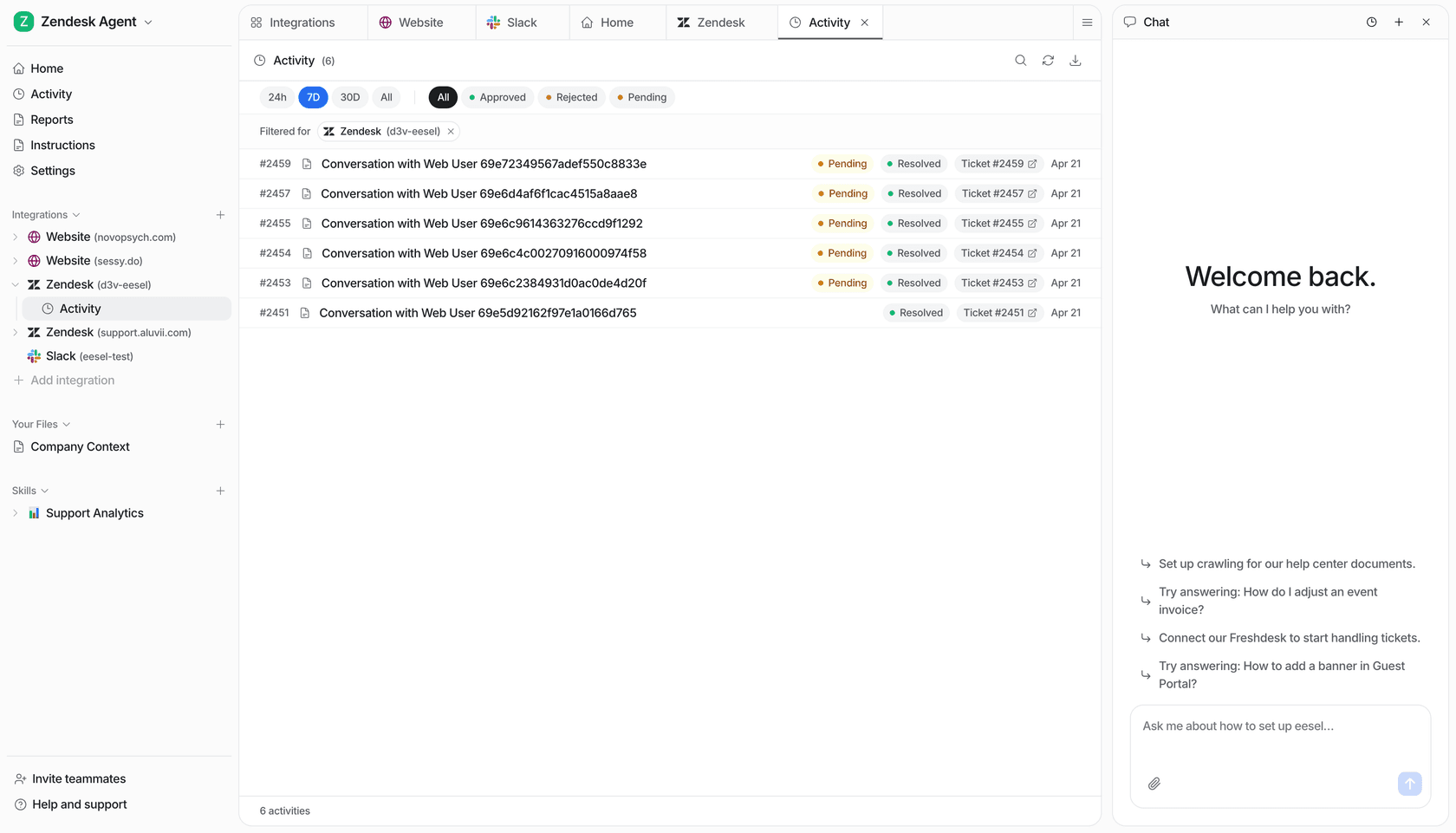
Most "Zendesk competitors" lists assume you want to rip out your helpdesk. eesel AI takes the opposite bet: keep the helpdesk you already have, and replace the part that's actually frustrating you, the AI. It deploys autonomous AI agents directly inside Zendesk (and Freshdesk, Slack, email, Shopify, and 100+ other tools), where they read tickets, draft and send replies, update fields, and escalate the edge cases.
Best for: teams who like their helpdesk but want better, more predictable AI without a migration.
The differentiator that earns it the top slot is the simulation mode. Before an eesel agent touches a live customer, you run it against thousands of your own historical tickets and see exactly how it would have replied and what it would have resolved. That removes the leap of faith that makes most AI rollouts stall. Setup is fast too: eesel reports onboarding in under 30 minutes from your existing help center, past tickets, and macros, with 85%+ tier-1 resolution out of the box across 80+ languages. There's also knowledge-gap detection that flags topics your docs don't cover and drafts new articles to fill them.
Pros
- Runs inside your existing helpdesk, so there's no new interface for agents to learn.
- Flat $0.40-per-ticket pricing with no per-seat or per-resolution games, and a hard spend cap.
- Simulation on past tickets de-risks the rollout before go-live.
Cons
- It's an AI layer, not a standalone ticketing system, so you still need a helpdesk underneath.
- Tasks that go wrong are still billed, since the AI work was done.
- The Enterprise plan carries a $1,000/month platform fee on top of usage.
Pricing: usage-based per task. A regular support ticket or chat is $0.40, dashboard questions are free, and there are no seat fees, platform fees on self-serve, or monthly minimums. The free trial gives you $50 of usage with no card, a $250 default monthly cap protects you from surprises, and committing to $300+/month saves 25%. See the full pricing breakdown.
That billing model is the whole point. While Zendesk meters per verified resolution and Help Scout adds a per-resolution fee on top of seats, eesel charges a flat rate per ticket regardless of how many back-and-forth messages it takes. One customer put the result plainly:
"In the first month, eesel is resolving 73% of our tier 1 requests. eesel offers easy Zendesk implementation and setup. Our team implemented and achieved results quickly during our 7-day trial."
Kim Simpson, Gridwise, on the eesel Zendesk integration page
Our take: if your real complaint with Zendesk is the AI (its cost, its setup, or its results), eesel is the lowest-friction fix because you don't change anything else. If you need to replace the ticketing core itself, keep reading, the next seven are full platforms.
2. Freshdesk
Freshdesk, by Freshworks, is the most direct like-for-like Zendesk alternative: omnichannel ticketing across email, chat, messaging, and phone, with a built-in AI suite called Freddy. It's trusted by 74,000+ businesses including Klarna and PepsiCo, and it tends to win on price and time-to-value at the entry level.
Best for: SMB-to-mid-market teams who want Zendesk-style breadth at a lower starting price.
Freddy comes in two flavors. Freddy AI Agent is the autonomous resolver, with 50+ prebuilt agentic workflows and a no-code studio, claiming up to 80% query resolution. Freddy AI Copilot is the agent-side assistant for reply suggestions, summaries, and live translation. The omnichannel routing by sentiment, skill, and workload is genuinely strong, and there's a deep Shopify integration for order data inside tickets.
Pros
- Lower entry price than Zendesk with comparable omnichannel breadth.
- Fast setup and a real free tier for tiny teams.
- Scales cleanly from a startup to enterprise.
Cons
- Freddy AI Agent is session-priced ($49 per 100 sessions after a 500-session allowance on Pro/Enterprise), which gets expensive at scale.
- The best AI is gated to higher tiers.
- Community reports say the AI breaks on complex tickets.
That last point is worth quoting, because it's the recurring theme with bundled helpdesk AI:
"We tested an ai integration in freshdesk and had almost the exact same experience. it worked for very simple tickets but anything slightly complex got misclassified. agents ended up spending more time fixing errors than before."
r/AiAutomations comment

Pricing: Growth $19, Pro $55, Enterprise $89 per agent/month billed annually, with 1-2 agents free for six months. Freddy AI is billed separately by session. Our Freshdesk AI pricing guide has the full math.
Our take: the strongest straight swap for Zendesk if your priority is cost-per-agent and omnichannel coverage. Just price out Freddy sessions before you commit, and if the bundled AI underwhelms, note that you can run eesel on Freshdesk the same way you would on Zendesk.
3. Zoho Desk
If budget is the deciding factor, Zoho Desk is the default answer. It's a full omnichannel help desk and self-service center, part of the broader Zoho suite, and it lands at roughly half of Zendesk for comparable features. It's used by 125,000+ businesses and rates 4.5/5 across 2,403 Gartner Peer Insights ratings.
Best for: cost-conscious teams, especially anyone already inside the Zoho ecosystem.
Its standout is Blueprint, a drag-and-drop process-automation engine that enforces step-by-step resolution flows. The AI assistant, Zia, handles self-service, in-ticket assist, auto-tagging, and sentiment analysis, with a Zia Answer Bot for KB-grounded chat in 29 languages. The honest community read is that Zia is the weakest part of the package:
"Zoho Desk offers almost everything that Zendesk does at like half the cost."
r/SaaS thread on helpdesk software
Pros
- Excellent value, roughly half of Zendesk for similar breadth.
- Strong automation via Blueprint and SLAs.
- Deep integration with the rest of Zoho.
Cons
- Zia is widely seen as underwhelming next to dedicated AI agents.
- A steep learning curve and a UI some reviewers call cluttered.
- The most useful AI features are gated to the Enterprise tier.
Pricing: Free Forever for 3 users, then Express ($7-9), Standard ($14-20), Professional ($23-35), and Enterprise ($40-50) per agent/month. Even at the top tier it undercuts Zendesk's Suite Professional substantially.
Our take: the best pick if price is the brief and you don't need best-in-class AI. If you love the cost but want stronger automation, pairing Zoho Desk with a dedicated AI layer gets you both. Our Zoho Desk research digs into where Zia falls short.
4. Help Scout
Help Scout is the anti-Zendesk for teams who think full ticketing is overkill. It combines a shared inbox that feels like email, a Docs knowledge base, the embeddable Beacon widget, and a layer of AI features, all wrapped in a UX you can onboard in under an hour. It's used by 12,000+ companies and scores well on ease of use.
Best for: small and growing teams who want human, relationship-driven support without ticketing overhead.
The shared inbox does the heavy lifting: collision detection, private notes, assignments, and saved replies, all in a clean email-style thread. On the AI side, AI Answers is an autonomous customer-facing agent (around 73% resolution, 50+ languages), and the Inbox Assistant adds AI drafts, summaries, and tone edits for your team.
Pros
- Clean, email-like UX with sub-hour onboarding.
- Genuinely great for small or low-volume teams.
- A real free tier and a fast path to value.
Cons
- Lacks the advanced features and customization of heavier platforms (the top G2 con).
- AI Answers is $0.75 per resolution on top of seat costs, which adds up fast (around +$750/month at 1,000 resolutions).
- Its pricing-model whiplash burned trust.
That last point is the one Help Scout users still bring up:
"HelpScout changed back to user-based pricing. Guess too many people cancelled including me... Helpscout lost all trust with this flip-flopping on pricing."
r/SaaS comment
Pricing: Free for 5 users, then Standard $25, Plus $45, and Pro $75 per user/month billed annually. AI Answers is an add-on at $0.75 per resolution. See the full Help Scout pricing breakdown.
Our take: a lovely, simple alternative if you're a small team that values tone over ticketing machinery. Just watch the per-resolution AI fee stacking on top of seats, and know you'll likely outgrow it if you scale into complex, high-volume support.
5. Gorgias
Gorgias is the Zendesk alternative built specifically for Shopify stores. It's Shopify's only Premier CX Partner, powers around 40% of top Shopify brands, and serves 17,000+ merchants. Where Zendesk treats e-commerce as one of many verticals, Gorgias treats it as the whole point.
Best for: Shopify and e-commerce brands where a large share of tickets need direct store actions.
The Shopify integration is the moat: order management, multi-store support, revenue attribution, and the ability to issue refunds, edit orders, and cancel subscriptions without leaving the ticket. Its AI Agent splits into a pre-sale Shopping Assistant and a post-sale Support Agent that handles returns, refunds, and discount generation. Chat Campaigns add proactive, behavior-triggered messages. For the full feature set, see our Gorgias for Shopify guide.
Pros
- Best-in-class Shopify context in every ticket.
- The AI Agent meaningfully cuts repetitive order-status volume.
- Clean handling of Instagram, Facebook, and TikTok DMs.
Cons
- Roughly 3x Zendesk's cost for comparable volume is the #1 objection.
- Volume-based pricing creeps up quickly as you scale.
- Hard to justify for small teams unless e-commerce actions dominate your queue.
A Reddit veteran framed the decision better than any spec sheet:
"40%+ tickets need Shopify actions, I'd lean Gorgias. Mostly conversational support, Zendesk is fine."
Pricing: by ticket volume with unlimited users: Starter $10 (50 tickets), Basic $60 (300), Pro $360 (2,000), Advanced $900 (5,000), then custom Enterprise. The AI Agent is an add-on at $0.90-1.00 per resolved conversation. Our Gorgias pricing breakdown has the worked examples.
Our take: the obvious pick if you're a Shopify brand and store actions dominate your tickets. If they don't, you're paying an e-commerce premium for features you won't use, and a general helpdesk plus an AI agent will be cheaper. Either way, compare it against the field in our best Gorgias alternatives roundup.
6. HubSpot Service Hub
HubSpot Service Hub is less a pure helpdesk and more a support layer bolted onto HubSpot's Smart CRM, sharing one customer record across Marketing, Sales, and Service. If your company already runs on HubSpot, that unified view is a real advantage that Zendesk can't match.
Best for: teams already in (or moving into) the HubSpot ecosystem who want support tied to one CRM view.
The AI layer is Breeze. The Breeze Customer Agent is an autonomous 24/7 agent across chat, email, voice, and social that cites your content and can take actions on Professional and Enterprise. The Breeze Assistant for thread summaries and reply drafts is included on every edition, and a beta Knowledge Base Agent turns resolved tickets into self-service articles.
Pros
- One CRM context across every team, no data silos.
- Breeze ticket summaries and the KB feedback loop are genuinely useful.
- A low $7 entry point on Starter.
Cons
- Pricing is the loudest complaint, with the Starter-to-Professional jump quoted around $17,500/year.
- AI-credit billing causes bill shock with no usable spend cap.
- Breeze quality is mixed and data-dependent.
The credit-billing pain is worth hearing directly:
"The system churns through credits and you cannot set a maximum number of credits below your recent utilization... I find this very deceptive and unethical."
r/hubspot thread on AI-credit usage
Pricing: Free for 2 users, then Starter $7-20, Professional $90-100 (with $1,500 onboarding), and Enterprise $150 per seat/month, plus AI credits. The Breeze Customer Agent costs about $0.45 per resolved conversation via credits. We compare the alternatives in our HubSpot Service Hub AI alternatives guide.
Our take: a strong choice if and only if you're committed to HubSpot's ecosystem. The unified CRM view is the draw; the credit-based AI billing and steep tier jumps are the catch. Outside the HubSpot world, a dedicated helpdesk is usually simpler and cheaper.
7. Front
Front blends a shared email inbox with helpdesk and ticketing, built around team collaboration rather than rigid queues. It explicitly positions against "AI for simple support" and is used by 9,300+ companies. It carries one of the highest ratings in this list at 4.7/5 across 2,466 G2 reviews.
Best for: teams with complex, cross-departmental customer operations who want a collaborative feel over a ticketing system.
The shared inbox is the core: comments, assignments, and internal discussion happen on the message itself, with no CC-and-forward chaos. Front AI adds Autopilot (an omnichannel agent claiming up to 70% resolution), Copilot for agent assist, plus Smart QA and Smart CSAT. A user summed up the positioning cleanly:
"Front feels like a 'supercharged shared inbox' whereas Zendesk is a proper ticketing system built for customer support from the ground up."
r/CustomerSuccess thread on Zendesk vs Front
Pros
- Excellent team collaboration on shared email.
- Easy setup and responsive support.
- 160+ integrations and no-code workflows.
Cons
- Pricing is the dominant complaint, "extremely overpriced" with paid AI add-ons stacked on top.
- The newer UI is polarizing, with some calling it unusable.
- Some users see the AI as bloat.
Pricing: Starter $25 (up to 10 seats, single channel), Professional $65, and Enterprise $105 per seat/month billed annually. AI is extra: Autopilot from $0.05/conversation, Copilot $20/seat, Smart QA $20/seat, Smart CSAT $10/seat. For the inbox angle specifically, see our Front vs Hiver comparison.
Our take: a great fit if collaboration across teams matters more to you than structured ticketing, and you can stomach the add-on-heavy pricing. If you want Front's collaborative inbox but smarter, cheaper automation, an AI agent layer can sit on top rather than buying every Front AI module.
8. Gladly
Gladly is the premium, ticketless option. Instead of discrete tickets, it organizes support as a single lifelong conversation per customer, and brands itself as "the only AI built for LTV". Its customer list (TUMI, Ulta, UGG, Nordstrom) tells you the target market, and it scores 4.7/5 across 1,112 G2 reviews.
Best for: DTC, retail, and consumer brands who want a premium, relationship-first platform optimized for lifetime value.
The Sidekick AI agent resolves end-to-end and takes real actions like cancellations, returns, and price adjustments, with a configurable persona, and even works over voice. The unified 360-degree profile keeps every conversation, order, and preference in one thread, which is the whole pitch: no duplicate tickets for the same customer.
Pros
- A genuinely unified customer view that kills duplicate threads.
- Strong personalization from stored 360-degree profiles.
- Broad channel coverage (voice, email, SMS, chat) in one place.
Cons
- Consistently flagged as expensive with an inflexible per-seat model.
- Reporting is fragmented, the #1 complaint, with manual Excel pulls.
- A dense interface and steep learning curve.
The cost is the recurring theme, even from fans:
"To be quite frank, gladly is very expensive. The per-user cost may be very expensive to a mid-sized company and they lack a flexible plan."
Gladly review on G2

Pricing: platform pricing is sales-gated; secondary sources cite the Hero plan around $180/seat/month (10-seat minimum), billed annually. There's a Shopify App Store plan with a 30-day free trial and a $250/month spending cap as a smaller on-ramp. Our Gladly AI overview covers the model in detail.
Our take: the right call for premium consumer brands where lifetime value justifies the spend and the ticketless model fits. Teams that need formal SLAs, queues, and routing, or a tighter budget, will find it both pricey and a poor structural fit.
So which Zendesk competitor should you choose?
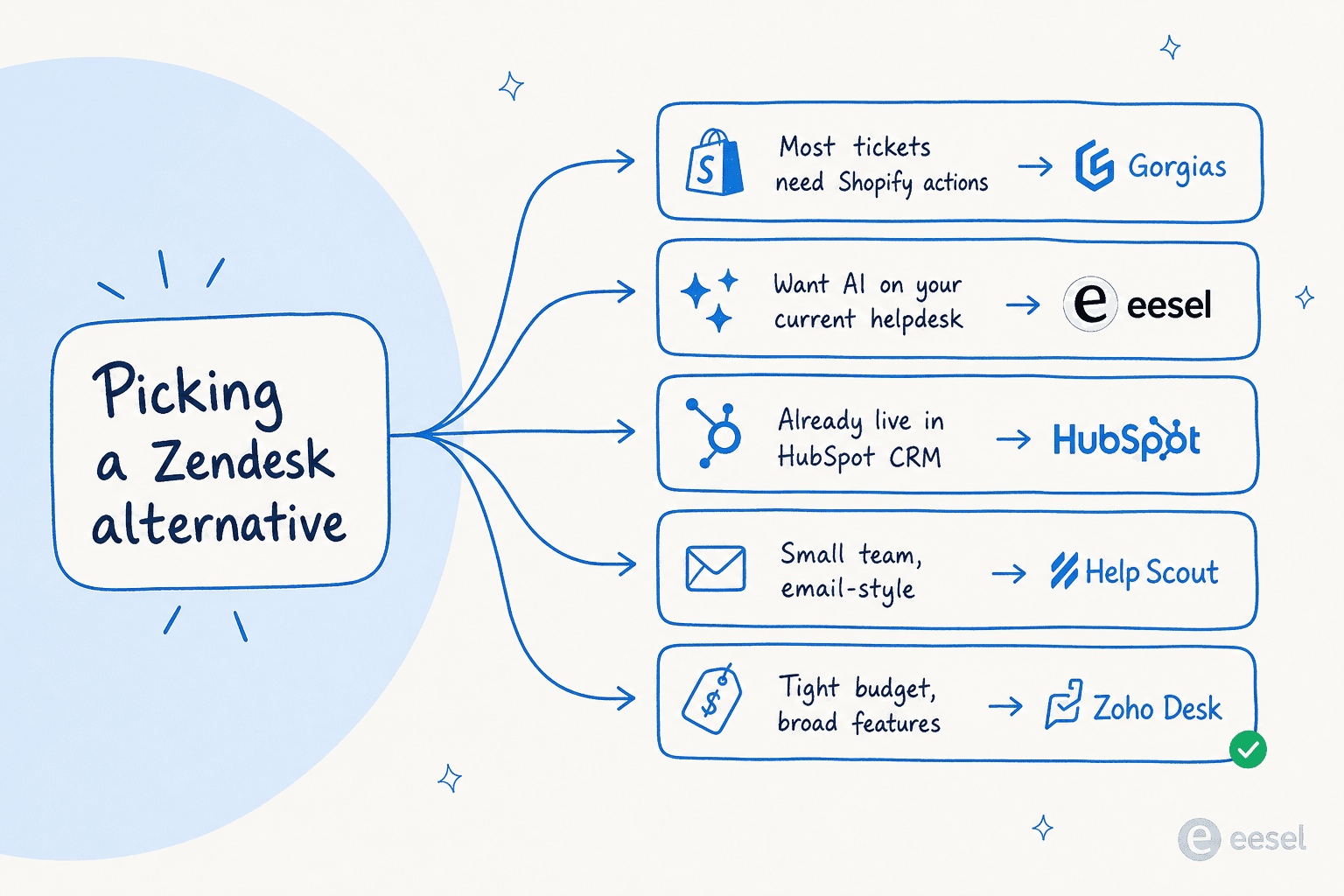
After all eight, the honest pattern is that the "best" alternative depends on one question: what's actually broken about Zendesk for you?
- If it's the budget, Zoho Desk at half the cost is the cleanest swap.
- If it's Shopify, Gorgias is purpose-built, as long as store actions dominate your queue.
- If it's complexity, Help Scout strips support back to a smart shared inbox.
- If it's your CRM, HubSpot Service Hub keeps everything in one record.
- If it's the AI, which it usually is, you don't have to migrate at all. An AI layer like eesel sits on top of Zendesk (or Freshdesk, or your shared inbox), charges a flat rate per ticket, and lets you prove the results on past tickets before you trust it live.
That last path is the one most "Zendesk competitors" lists miss, because they assume the only fix is a full rip-and-replace. Often it isn't.
Try eesel AI on your existing helpdesk
If the real reason you're shopping Zendesk competitors is the AI, eesel AI is the fastest way to fix it without a migration. It plugs into Zendesk, Freshdesk, and 100+ tools, drafts and sends replies while respecting your existing triggers and SLAs, and you can simulate it on thousands of past tickets to see the resolution rate before going live. The pricing is flat per ticket with a hard spend cap, so there's no per-resolution surprise at the end of the month. You can start free with $50 of usage and no credit card, or book a demo to see it run on your own data.
Frequently Asked Questions

Share this article

Article by
Alicia Kirana Utomo
Kira is a writer at eesel AI with a Computer Science background and over a year of hands-on experience evaluating AI-powered customer service tools. She focuses on breaking down how helpdesk platforms and AI agents actually work so that support teams can make better buying decisions.