Ada CX pricing explained: What you'll really pay in 2025


Last edited May 8, 2026

Disclosure: This article is published by eesel AI, a competitor of Ada. We encourage you to read Ada's own materials for their perspective.
Trying to figure out how much an AI customer service platform actually costs can be genuinely frustrating. You're ready to compare your options, but you keep running into the same wall: a "Contact Sales" button. It makes it nearly impossible to budget or even tell if a tool is in the right ballpark for your company.
Ada CX is one of the biggest names out there, a platform that some of the world's largest companies rely on. But it's also a clear example of this pricing mystery. If you're trying to get a straight answer on Ada CX pricing, you're not alone.
This guide walks through what Ada's pricing model actually looks like based on Ada's own published materials, what risks the structure creates, and how a more transparent alternative works in practice.
Understanding the Ada CX platform
Founded in 2016, Ada is a no-code platform built to help large companies automate their customer service. Think of it as an enterprise-level chatbot builder that handles the repetitive, easy-to-answer questions that clog up a support team's inbox.
Ada's ACX platform centers on a patent-pending Unified Reasoning Engine that powers omnichannel agents across 8+ channels: voice, chat, email, WhatsApp, SMS, Instagram, in-app messaging, and custom deployments. Connections to major help desks like Zendesk and CRMs like Salesforce are supported out of the box. You'll typically see Ada used by larger businesses in retail, travel, and fintech - industries that need to scale front-line support without expanding headcount. Ada says it has 550+ AI agents deployed globally, powering over 6.4 billion interactions across 350+ customers.
A full breakdown of Ada CX pricing
Here's the direct answer: Ada does not publish its pricing. You won't find plan tiers, starting figures, or contract terms anywhere on their website.
What Ada says about its pricing
If you go to Ada's pricing page, you won't find a pricing page in the traditional sense. What you'll find is a form to book a demo and get a custom quote from their sales team. Ada also states directly on that page: "We are a great fit for companies with at least 300,000 annual customer service conversations." That threshold is the only public signal about who Ada is designed for.
Interestingly, Ada published a blog post explaining the difference between "resolution-based" and "conversation-based" pricing models - arguing that the latter is more transparent. Their own model is still quote-based, which leaves prospective buyers without a clear picture of costs until they're deep in a sales conversation. Some third-party review sites mention "Generative" and "Scripted" plan names, but what those cost is not disclosed by Ada.
What's publicly known about Ada CX pricing
Because Ada keeps pricing off its website, there are no official figures to share. Ada's pricing is not publicly disclosed.
What we do know from Ada's own materials:
| Signal | Source |
|---|---|
| Pricing model | Quote-based, not publicly disclosed |
| Minimum volume to qualify | 300,000 annual conversations (Ada pricing page) |
| Contract structure | Enterprise contracts negotiated through sales |
| Free trial | Not available |
| Self-serve signup | Not available |
On G2, where Ada holds a 4.6/5 rating from admin users, one reviewer captured the frustration well: "Pricing is a big one...once a user is engaged in a playbook process they're sometimes 'stuck' in it." The combination of sales-only pricing and high switching costs is a recurring friction point for buyers comparing Ada to alternatives.
The hidden risks of the Ada CX pricing model
The absence of public pricing is one part of the equation. The structure of Ada's billing model also carries a few risks worth thinking through before you commit, especially if your team is growing.
Unpredictable costs: the penalty for success
Most large AI platforms, Ada included, base their pricing on usage - whether that's the number of conversations or "resolutions." This creates a counterintuitive problem: the better your AI performs, the more you pay.
Imagine your AI agent has a strong month and resolves twice as many customer issues as usual. That's a win for your team and your customers. But with a usage-based model, it also means a larger bill. You're penalized for success, which makes budget forecasting very difficult. For teams that need to demonstrate a predictable return on investment, this kind of volatility is a real concern.
The challenge of validating "resolutions"
When a vendor charges per "resolution," the definition of that word matters a great deal. Did the AI actually solve the customer's problem, or did the customer get frustrated and abandon the conversation?
This is often called the "containment trap" - a customer leaving a chat unresolved can get counted as a successful resolution. That gray area means support managers end up auditing chat logs just to confirm their invoices are accurate, adding overhead that doesn't show up in any sales demo.
The risk of a large upfront commitment
Platforms like Ada are built for enterprises, and that typically comes with a formal setup process and a locked-in annual contract. You're often committing to a significant investment before you've had a chance to see how the AI performs with your actual customer questions.
It's a substantial leap of faith - dedicating a large portion of your budget without real data on whether the tool will deliver the return you're expecting.
A more transparent alternative to Ada CX pricing: How eesel AI works
If unpredictable costs and long-term contracts give you pause, there's a different approach worth considering.
Transparent and predictable pricing you can see right now
At eesel.ai, pricing is public and task-based - so you know exactly what you'll pay before talking to anyone. Rather than a vague per-resolution fee that shifts as your volume grows, eesel charges per AI task completed.
| Task type | Rate |
|---|---|
| Helpdesk task (standard AI reply or action) | $0.40 per task |
| Complex task (multi-step workflow, agent action) | $4.00 per task |
| Enterprise | From $1,000/month |
Your costs follow what you actually use, not a bundled commitment negotiated before you've tested anything. There are no minimum conversation volume requirements to qualify.
Test with confidence using simulation mode
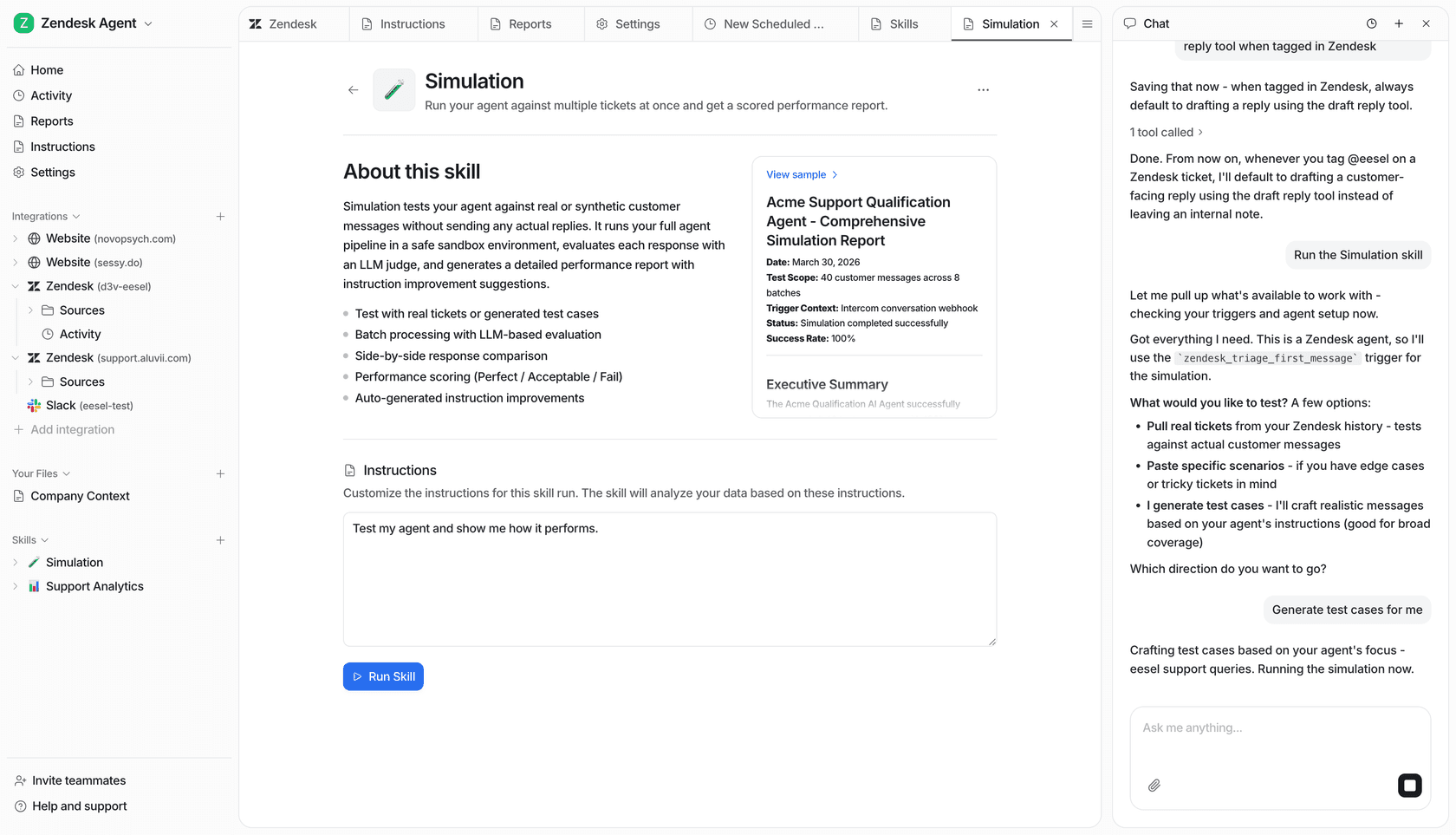
eesel AI is built to let you prove value before you commit. Rather than signing a contract based on a polished sales demo, you can run a simulation on thousands of your own historical support tickets in a safe environment. You can see exactly how the AI would have responded, what percentage of tickets it could have resolved, and what your potential cost savings look like - before you spend anything on a live agent.
Go live in minutes, not months
While enterprise platforms like Ada can take weeks or months to set up, eesel AI is designed to be fully self-serve. You can connect your help desk, like Zendesk or Freshdesk, with a single click and have a working AI agent running in minutes - no sales conversation required.
Choosing the right pricing model for growth
Ada CX is a capable platform for large companies with high conversation volume and the budget to match. But its opaque, usage-based pricing creates real risk for growing teams. When you're investing in AI support, you need a pricing model that aligns with your goals - one that rewards efficiency rather than billing you more when the AI has a good month.
For modern teams, pricing transparency isn't a nice-to-have; it's what makes sustainable growth possible. The best AI platform is one that makes its costs legible upfront, so you're making a decision based on data rather than a sales pitch.
Start automating your support with confidence
If you're ready for a powerful AI solution without the guesswork, give eesel AI a try. You can see exactly your automation potential and what your ROI will look like.
Run a free, no-risk simulation on your own tickets today.
Frequently asked questions

Share this article

Article by
Kenneth Pangan
Writer and marketer for over ten years, Kenneth Pangan splits his time between history, politics, and art with plenty of interruptions from his dogs demanding attention.