ServiceNow license types and costs 2026: ITSM, CSM, ITOM pricing explained


Last edited May 7, 2026

Disclosure: This article is published by eesel AI, a competitor of ServiceNow. We encourage you to read ServiceNow's own materials for their perspective.
ServiceNow is one of the most widely deployed platforms for enterprise IT management. 85% of the Fortune 500 use it (source), and its workflow capabilities span everything from incident resolution to employee onboarding to security operations. But if you've tried to figure out what it actually costs, you've probably hit a wall. ServiceNow does not publish dollar pricing on any public-facing page, which makes it genuinely difficult to budget for or compare against alternatives before entering a sales process.
That's what this guide is for. We'll walk through the license types ServiceNow offers, what drives the cost up, and what to budget for beyond the license itself. Every dollar amount in this article is attributed to a named third-party analyst, not to ServiceNow directly, because ServiceNow does not publish pricing.
What is ServiceNow?
At its core, ServiceNow is a cloud platform for managing enterprise digital workflows. While its products now span IT Service Management (ITSM), IT Operations Management (ITOM), customer service, HR, and security, the company's roots are in ITSM. It positions itself as "the AI control tower for business reinvention" (source), running "95 billion workflows" across its customer base. Think of it as an integrated platform designed to consolidate disparate business systems into a single data model and workflow layer.
Understanding the total cost of owning ServiceNow
When a ServiceNow quote finally arrives, that number is only one part of the picture. The real cost of ownership accumulates before, during, and long after go-live.
Costs before implementation
Before signing anything, most organizations spend on planning. ServiceNow implementations typically begin with paid consultation, either directly from ServiceNow or through a certified partner, to map existing workflows, define requirements, and scope the project. That process also consumes significant internal team time before any configuration work begins.
Implementation costs
Going live is where the upfront investment concentrates. Setup fees cover the technical configuration of the platform. Connecting it to existing tools, via Integration Hub or Workflow Data Fabric, typically requires either in-house developers or external implementation partners. Data migration from legacy systems is its own distinct project phase. And because the platform carries a well-documented learning curve ("Learning Curve (72)" and "Expensive (60)" are the top complaint tags across 1,270 G2 reviews), training budget matters too.
Ongoing costs
Once deployed, the license fee is an annual recurring cost. On top of it, organizations typically pay for annual maintenance and, separately, any add-on features they want. This is especially relevant for Now Assist, ServiceNow's generative AI product line: it is sold per-product (Now Assist for ITSM, for CSM, for HRSD, and so on), and may require being on a higher base tier before the add-on is available to purchase at all. Pricing is not publicly listed — contact ServiceNow for a quote at servicenow.com/lpgp/pricing.html.
For teams looking at a faster on-ramp, eesel AI takes a different approach. It connects to existing helpdesks with no migration, no consultant engagement, and no multi-month setup, and its task-based pricing charges $0.40 per resolved support task rather than per seat or per product tier.
A breakdown of ServiceNow license types and cost
ServiceNow's pricing structure has two main axes: who uses the platform and which product package they're on.
Role-based user types
ServiceNow's licensing differentiates users by what they do on the platform. Third-party consultancies describe three broad role categories (ServiceNow does not publish per-role dollar figures on any public page; all current pricing requires a quote via servicenow.com/lpgp/pricing.html):
| License Type | User Role and Access | Cost tier |
|---|---|---|
| Requester | End users who submit tickets or search the knowledge base | No additional charge |
| Business Stakeholder | Managers who approve requests or review dashboards and reports | Paid (lower tier) |
| Fulfiller (ITIL User) | IT staff, agents, and developers who actively resolve tickets | Paid (highest tier) |
| Unrestricted User | A pooled model where any active user can access as needed | Paid (volume-based) |
Third-party analysis consistently identifies the Fulfiller license as the meaningful cost driver: the access level your IT operations team cannot work without.
ITSM product packages
ServiceNow organizes ITSM pricing tiers into three named packages:
ITSM Foundation is framed as "AI agents and skills that accelerate IT service delivery with task-based, always-on support" (source). It includes service catalog and request management, incident management, asset management and CMDB, Virtual Agent, Workflow Data Fabric, Now Assist Foundation, and Moveworks for ITSM Foundation.
ITSM Advanced is described as "agentic workflows that automate complex IT processes, working side by side with your team" (source). It adds major incident management, on-call management, change management, problem management, AI Voice Agents, Process Mining (10,000 records per year), and Now Assist Advanced.
ITSM Prime, marked as recommended on the pricing page, is positioned as "AI Specialists that independently manage IT workflows, make decisions, and drive results" (source). It adds the L1 AI Specialist, ITSM AI Agents, an AI Agent for Digital End-User Experience, DevOps Change Velocity, Digital Product Release, and Process Mining expanding to 15,000 records per year.
All three tiers terminate in a "Get Custom Quote" CTA. Pricing is not publicly listed — contact ServiceNow for a quote at servicenow.com/lpgp/pricing.html.
What analysts estimate about pricing
ServiceNow does not publish dollar amounts. Third-party consultancies have published estimates based on contract disclosures and customer interviews. These are not ServiceNow's published prices and should be treated as external benchmarks only:
- Unthread and RedressCompliance estimate ITSM Fulfiller licenses in the $70-$200 per user per month range.
- Third-party consultancies estimate that Now Assist adds roughly 25-60% on top of the base license, depending on the tier and number of products licensed.
- Advanced modules like ITOM or SecOps are estimated by Rezolve.ai to push Fulfiller costs into the $150-$250 per user per month range.
These ranges help explain why smaller organizations often struggle to justify the investment. As one G2 reviewer put it directly: "Pricing is another concern, since the platform is relatively expensive and the ROI tends to be clearer for larger organizations than for smaller teams."
Contrast this with eesel AI's pricing: $0.40 per regular support task, no per-seat fees, and all core products (AI Agent, Copilot, and Triage) included in one usage-based model.
Practical challenges with ServiceNow's licensing model
Beyond the pricing structure itself, several patterns in how ServiceNow licensing works in practice are worth understanding before committing.
Over-provisioning licenses
ServiceNow contracts are typically multi-year and structured around fixed license counts. Organizations often commit to more Fulfiller licenses than they end up using in year one, sometimes because requirements aren't fully scoped before signing, and sometimes because rollout takes longer than planned. Once signed, reducing the license count mid-contract is rarely simple. The result is that some organizations pay for licenses that see limited use during the contract period. There is no straightforward way to trial your actual usage needs on a small scale before locking into a volume commitment.
Platform migration
Bringing ServiceNow in as your primary ITSM system means moving ticket history, SLAs, workflows, and integrations off whatever platform you're running today. The ITSM product page positions this consolidation as a core value proposition: "With one platform and one data model, ITSM unifies tools, systems, and data." (source) ServiceNow's own Workflow Data Fabric supports connecting to external systems alongside ServiceNow, and the company frames this as fast integration rather than wholesale displacement. But buying ITSM as your primary ticketing system still means migrating away from systems like Zendesk, Freshdesk, or Jira Service Management. That migration is a project in its own right.
The road to AI automation
Now Assist is ServiceNow's generative AI layer, and it is substantive. AI agents on the platform draw on "knowledge articles, historical incidents and cases, CIs from the CMDB, and information from other systems accessed with Workflow Data Fabric." The L1 Service Desk AI Specialist in Prime "autonomously diagnoses and resolves common IT support requests end-to-end" using historical incident data and enterprise knowledge bases. But as one G2 reviewer put it: "The AI and intelligence features are promising as well, but they can feel limited unless they are properly configured and licensed." Accessing those features requires both the right tier and, in most cases, a separate add-on purchase on top of that. Getting to working AI automation involves the same implementation cycle as the base platform; it's not a toggle you turn on after go-live.
A modern alternative for ITSM automation
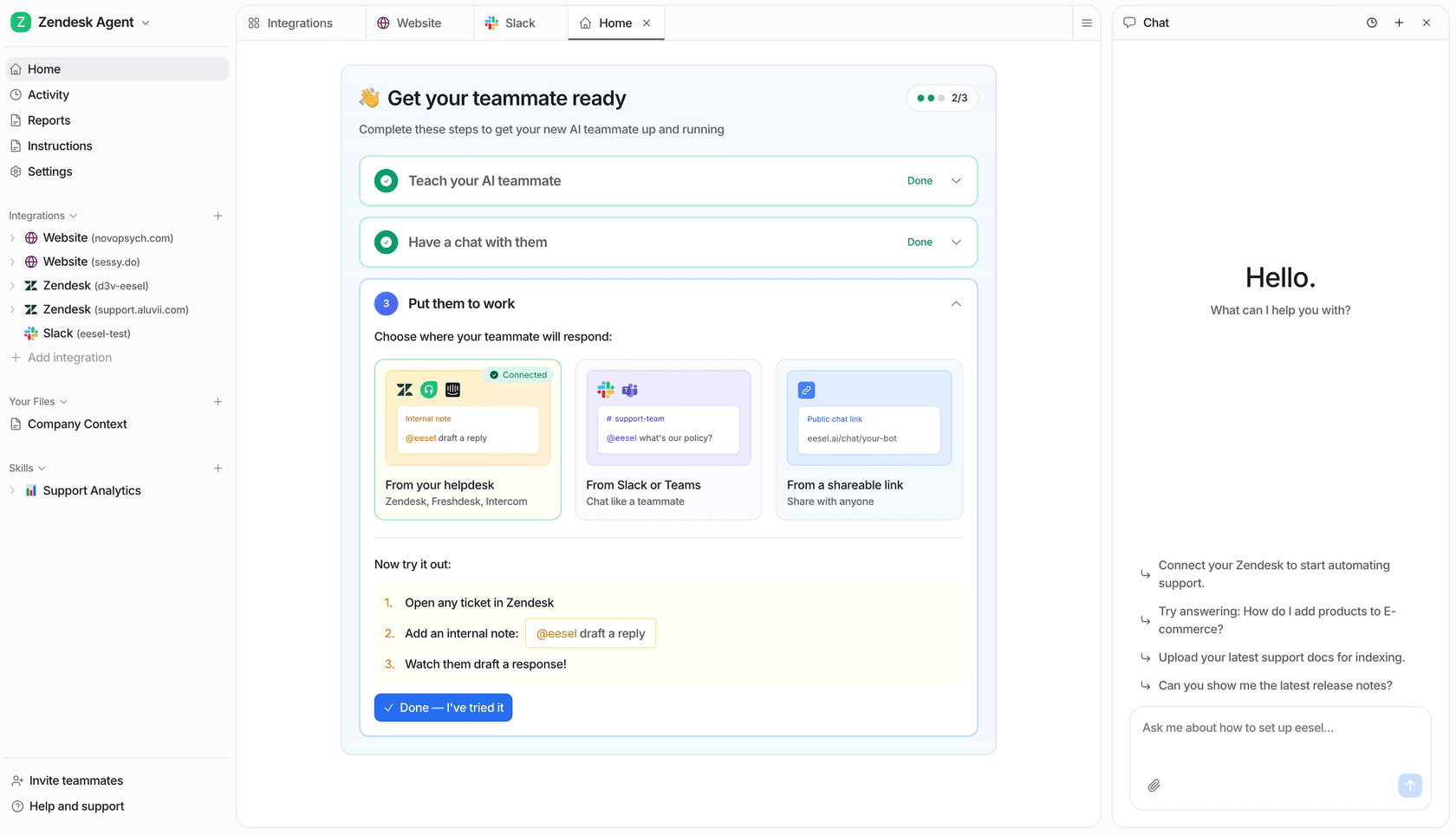
For years, the assumption was that enterprise-grade ITSM automation required an enterprise-scale platform commitment. That assumption is worth revisiting. eesel AI is built for teams that need AI-powered support automation without the implementation overhead of a traditional enterprise platform.
It works on a few straightforward ideas:
- Self-serve setup. Sign up, connect your existing helpdesk, and start training your AI agent with no sales call required. It works alongside tools your team already uses, so there is no migration project involved. See the full integration list.
- You control scope. Decide exactly what to automate. Start with your most common Tier 1 tickets and pass everything else to your human agents. Test everything in a sandbox environment before it reaches a real customer.
- Task-based pricing. eesel AI's pricing is usage-based: $0.40 per regular task, $4.00 per heavy task. No per-seat fees, no different rates for different user types, no separate charge to unlock AI features. You can start on a monthly plan and cancel anytime.
What's the verdict on ServiceNow license types and cost?
ServiceNow is a genuinely capable platform. For large organizations managing complex, multi-department workflows, its all-in-one approach can justify the investment. 85% of the Fortune 500 use it (source), and customer outcomes like "92% improvement in MTTR for high-priority incidents" at Fonterra and "87% increase in self-service rate" at Griffith University (source) show what the platform can do when properly implemented.
But all that capability comes with a pricing process that is opaque by design. Pricing is not publicly listed — contact ServiceNow for a quote at servicenow.com/lpgp/pricing.html. The full cost of ownership extends well beyond the license fee, and getting to working AI automation requires clearing several adoption hurdles in sequence. For teams that want AI for customer support automation without that level of commitment, newer tools are worth evaluating on their own terms.
Ready to see what AI support automation looks like without the enterprise overhead? Try free and be up and running in minutes.
Frequently asked questions

Share this article

Article by
Stevia Putri
Stevia Putri is a marketing generalist at eesel AI, where she helps turn powerful AI tools into stories that resonate. She's driven by curiosity, clarity, and the human side of technology.