Salesforce pricing 2026: License costs by edition and add-on


Last edited October 5, 2025
Let's be honest, everyone knows Salesforce is the big kahuna in the CRM world. If you're in sales or support, it's pretty much impossible to have not considered it. But then comes the moment of truth: you land on their pricing page. Suddenly, you're trying to make sense of different editions, endless add-ons, and a credit system that feels intentionally confusing.
It's the kind of experience that has you Googling “Why is Salesforce so expensive?” at 2 AM.

Look, there's no denying Salesforce is a beast of a platform. But that power comes with a notoriously complicated price tag. This guide is your translator. We're going to cut through the jargon, lay out the real costs for Sales and Service Cloud, and tackle the wild new pricing for their AI tools. By the end, you'll have a much clearer picture of what you'd actually be paying for.
Understanding the core Salesforce pricing models
On the surface, the Salesforce pricing model seems straightforward. It's a classic per-user, per-month subscription, though you'll almost always be asked to pay for the whole year upfront. Easy, right? Well, not exactly. The real trick is in the "editions."
Think of it like this: you're buying a car. The sticker price for the base model looks great, but that version doesn't even come with air conditioning or power windows. If you want the features you actually need to have a comfortable ride, you're suddenly looking at a much higher price point. That's Salesforce in a nutshell.
Let's break down the main plans for Sales Cloud and Service Cloud, since those are the tools most support and sales teams are looking at.
Sales Cloud and Service Cloud Salesforce pricing tiers
Sales Cloud is all about managing your sales pipeline, while Service Cloud is built for your customer support crew. They have similar pricing tiers, but the features inside are geared for different jobs. Here’s a quick look at how they compare.
| Edition | Price (per user/month, billed annually) | Key Features & Limitations | Ideal For |
|---|---|---|---|
| Starter Suite | $25 | Basic lead, contact, & case management. Includes limited email marketing & sales flows. No API access or deep customization. | Small businesses or teams just starting with a CRM and needing an all-in-one solution. |
| Professional | $100 | Everything in Starter, plus sales forecasting, quoting, greater customization, process automation, and AppExchange access. | Growing teams that need more automation, flexibility, and integration capabilities. |
| Enterprise | $175 | Everything in Professional, plus advanced workflow automation, approval processes, and more extensive API access. | Mid-sized to large businesses with complex sales or service operations requiring deep customization. |
| Unlimited | $325 | Everything in Enterprise, plus 24/7 support, developer sandboxes, and access to premier success plans and additional AI features. | Large enterprises with extensive needs for scalability, support, and advanced development tools. |
So, what's the real story here? That $25 Starter Suite looks tempting, but for most businesses, it’s just a foot in the door. It’s priced to get you signed up, but as soon as your team starts to grow and you realize you need to connect to other apps or automate simple tasks, you're stuck. The moment you need that, you're forced to jump all the way to the Professional plan at $100 per user. That’s a 4x price hike, and it's usually where people start to feel the sticker shock.
The hidden costs of Salesforce pricing: Beyond the license fee
The price on the website is just the tip of the iceberg. The number that really matters is the Total Cost of Ownership (TCO), and with Salesforce, that number is almost always way higher than you expect. These are the "gotchas" that pop up after you've already signed the contract.
Getting it set up. Salesforce isn’t something you just turn on and start using. You’ll likely need to hire expensive certified consultants to get it configured for how your team actually works.
The "must-have" add-ons. Want to see your data in a useful way? That’s an extra license for their analytics tool. Need to connect it to your other systems? You might have to pay for an integration platform. Many of the features they show off in demos don't come included in the core package.
Support that actually helps. The standard support can be slow. If you need a fast response when things go wrong (and they will), you'll have to upgrade to a premium support plan. They often charge for this as a percentage of your total license cost, so it's a hefty, recurring fee.
Paying for storage. You get a set amount of data storage, but it’s surprisingly easy to blow past that limit as your company grows. And when you do, the overage fees start to pile up.
Training your team. Salesforce is powerful, but it's not intuitive. You'll need to budget for training to get your team up to speed, otherwise, you're paying for a fancy tool that no one knows how to use properly.
The new frontier: Salesforce pricing for AI and Agentforce
Now we get to the really fun part: AI. Salesforce is all-in on AI with tools like Agentforce, promising to automate tasks and boost your team's productivity. The technology is impressive, but it comes with a brand-new pricing model that can make budgeting a total nightmare. They're moving away from the predictable monthly subscriptions we're all used to and into the murky waters of consumption-based pricing.
How Salesforce pricing for Agentforce works: Credits, conversations, and commitments
Instead of paying a set price per agent, you pay for what you use. While that sounds flexible, it makes your monthly bill about as predictable as the weather. It's a real headache for anyone trying to stick to a budget.
Here’s a simplified look at how it works:
-
Paying per action: The AI costs money every time it does something. This could be a flat fee per conversation it handles (think $2 a pop) or a system of "Flex Credits." With credits, every little action, like looking up an order status or sending a reply, eats up a few credits.
-
Choosing your poison: You can pay as you go, which is the most expensive option. Or, you can get a discount by committing to a certain amount of usage upfront. This is great if you have a crystal ball and know exactly how many customer inquiries you'll get next quarter.
Pro tip
Trying to forecast your costs on a model like this is a guessing game. One simple customer ticket might only use a few AI actions. A more complex one could trigger a dozen or more. If your ticket volume spikes one month, your AI bill could go right through the roof. It’s a perfect recipe for a nasty surprise when the invoice arrives.
The challenge of complex, unpredictable Salesforce pricing for AI
This pricing model isn't just confusing; it can be a real problem for a growing business. It’s less about the cost itself and more about the complete lack of predictability.
Imagine being a support manager trying to explain your budget to the finance team. How can you possibly forecast your monthly spend when it's tied to things you can't control, like how many customers have issues or how complicated their problems are? This kind of uncertainty can make you afraid to automate more of your workflow. You might have a great idea to save your team time, but you hesitate because you have no idea if it will triple your Salesforce bill.
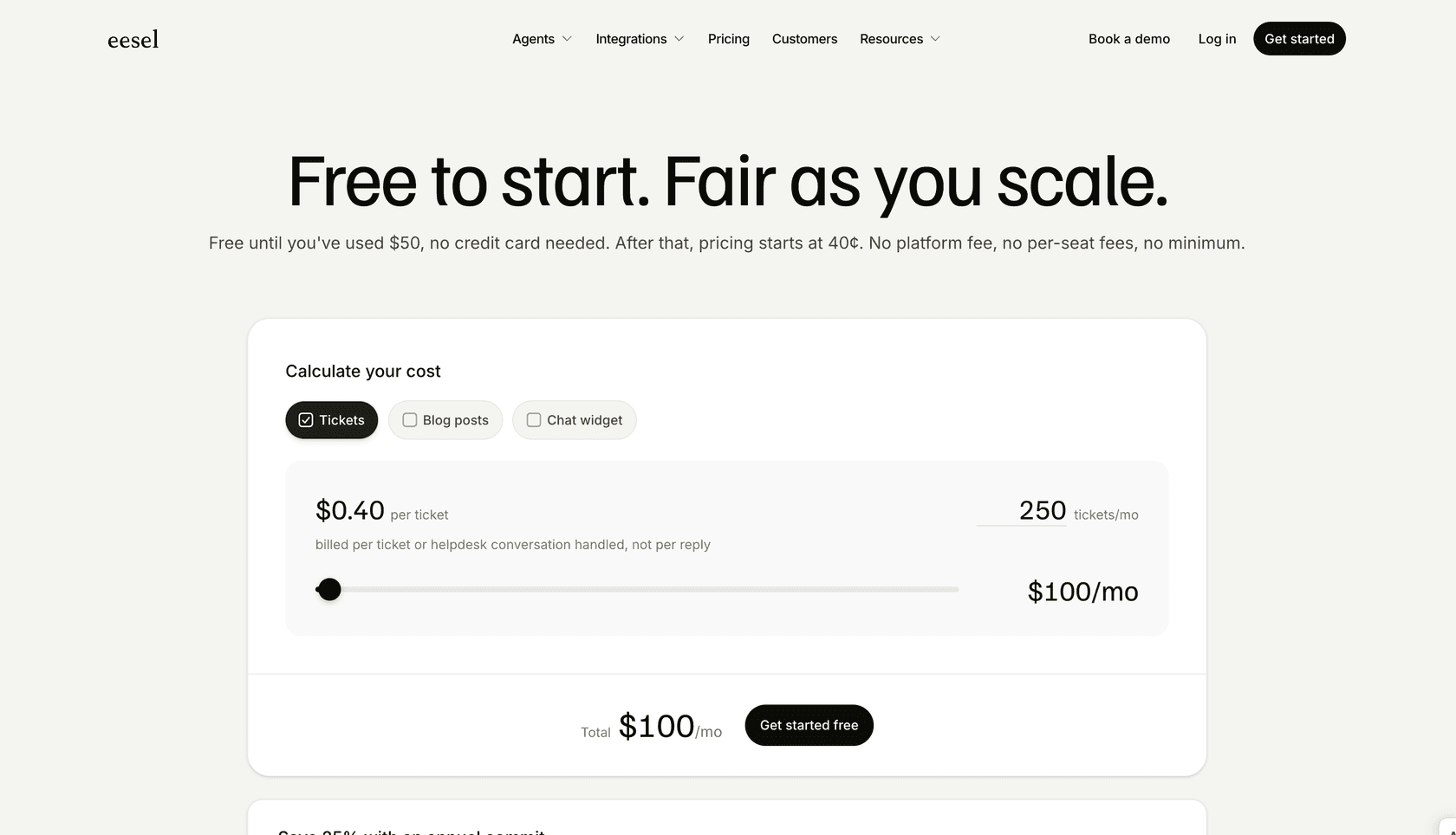
It’s a different story with platforms built on a simpler philosophy. For example, eesel AI has straightforward, predictable pricing. You pay for a set number of AI interactions per month, so you always know what your bill will be. No confusing credits, no per-action fees. This lets you automate to your heart's content without worrying that a busy month will blow up your budget. Plus, the plans are month-to-month, so you're not locked into a massive annual contract.
Simplifying your support stack to avoid complex Salesforce pricing
Salesforce is a great CRM, but its "one-stop-shop" approach can easily lead to a bloated, expensive system. They want you to run your entire business inside their world, but that often means you get locked in and end up paying for a bunch of features you never touch.
The smarter, more modern way to build your tech stack is to pick the best tool for each job. You use the help desk you love, the internal chat that works for your team, and the document storage you already have. Then, you connect them all together.
The "all-in-one" Salesforce pricing trap vs. a flexible, integrated approach
Sure, having everything from one company sounds convenient. But that convenience usually means you're making compromises. You get a whole suite of tools, but maybe only one or two of them are actually great. The rest are just… okay. And you're stuck with that one vendor, so if a better, more innovative tool comes out, you're out of luck.
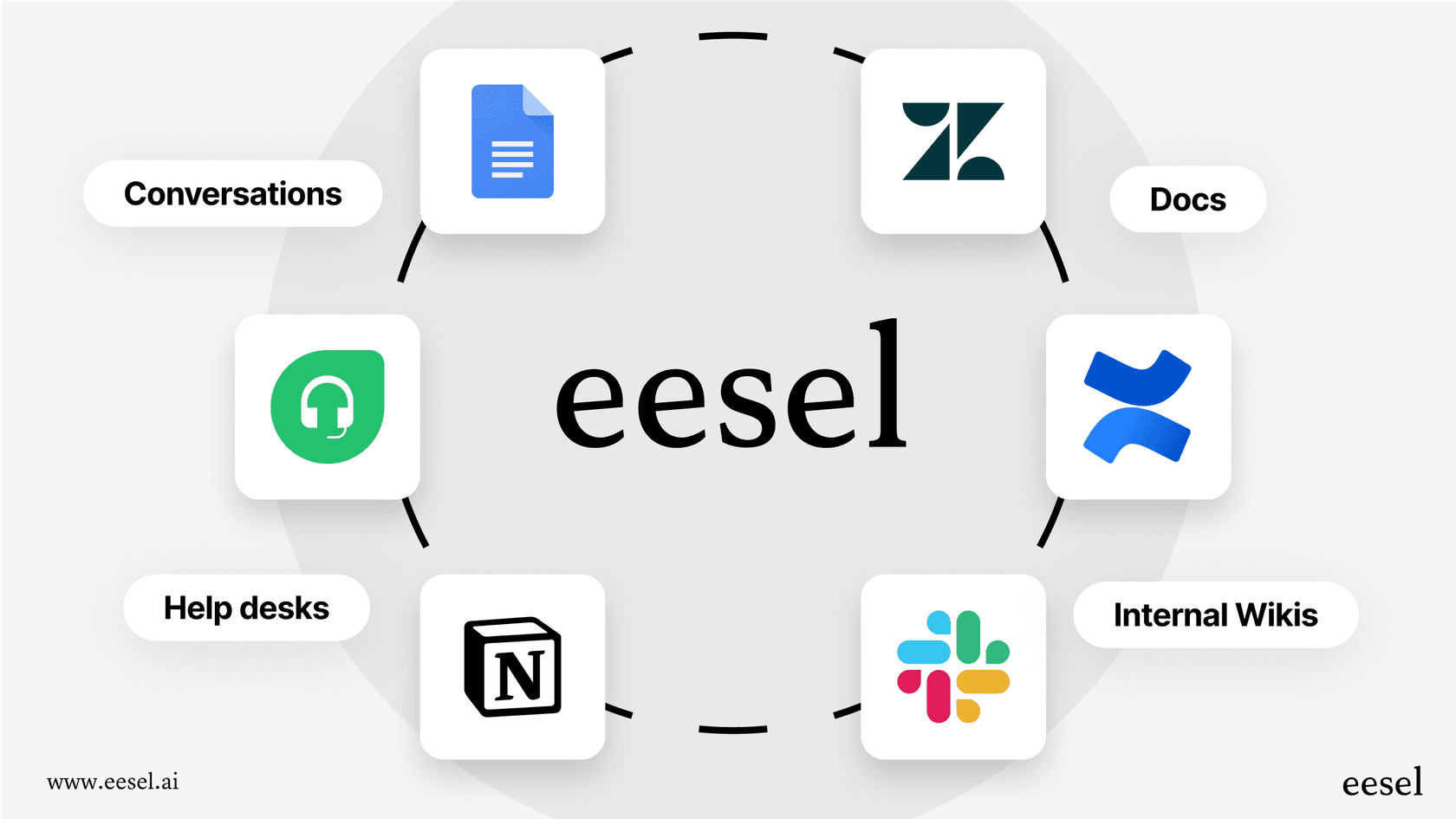
A more flexible approach lets you build a setup that's perfect for your team. You can stick with your favorite help desk and just add a specialized AI tool that’s amazing at automation. Instead of being strong-armed into using Agentforce, you could use a tool like eesel AI that just plugs into the systems you already have. It's built to be self-serve, so you can get it running in minutes without a massive "rip and replace" project. Just connect it to your help desk like Zendesk or Freshdesk, your company chat in Slack, and your knowledge bases in Confluence or Google Docs. Suddenly, you have powerful AI that works with the tools your team already relies on every day.
Making the right Salesforce pricing choice for your budget and team
Salesforce is a monster of a platform, there's no question about it. But its pricing is a confusing labyrinth of tiers, hidden fees, and add-ons that can make your final bill look nothing like the initial quote. And now, with their new consumption-based AI pricing, that bill has become almost impossible to predict.
Before you commit to that annual contract, take a step back. Really map out what your team needs, add up all the potential hidden costs, and ask yourself if you truly need a massive, all-in-one system. Often, a more targeted and flexible tool can give you exactly what you need for automation without the baggage.
If you want to bring powerful AI to your support team without the confusing pricing and months-long setup, take a look at a dedicated AI platform. A tool like eesel AI gives you a simple, powerful, and predictably priced way to automate your work. And since it plugs right into your existing tools, you can be up and running in minutes, not months.
Frequently asked questions

Share this article

Article by
Kenneth Pangan
Writer and marketer for over ten years, Kenneth Pangan splits his time between history, politics, and art with plenty of interruptions from his dogs demanding attention.