I tested 10 AI tools for customer service in 2026 - here's what actually works


Last edited June 10, 2026
Table of Contents
- How we picked these 10
- The summary table
- The pricing model split (this is what actually decides your bill)
- 1. eesel AI - best for teams that want to keep their helpdesk
- 2. Zendesk Resolution Platform - best for teams already on Zendesk
- 3. Freshdesk Freddy AI - best for Freshworks shops on a budget
- 4. Gorgias AI Agent - best for Shopify ecommerce brands
- 5. NextAutomation - best for teams that want a custom-built automation solution
- 6. Decagon - best for high-volume consumer brands
- 7. Forethought - best for teams committed to their existing helpdesk
- 8. Ada (ACX) - best for enterprises with 300k+ annual conversations
- 9. Aisera - best for cross-functional enterprise (IT + HR + CX)
How we picked these 10
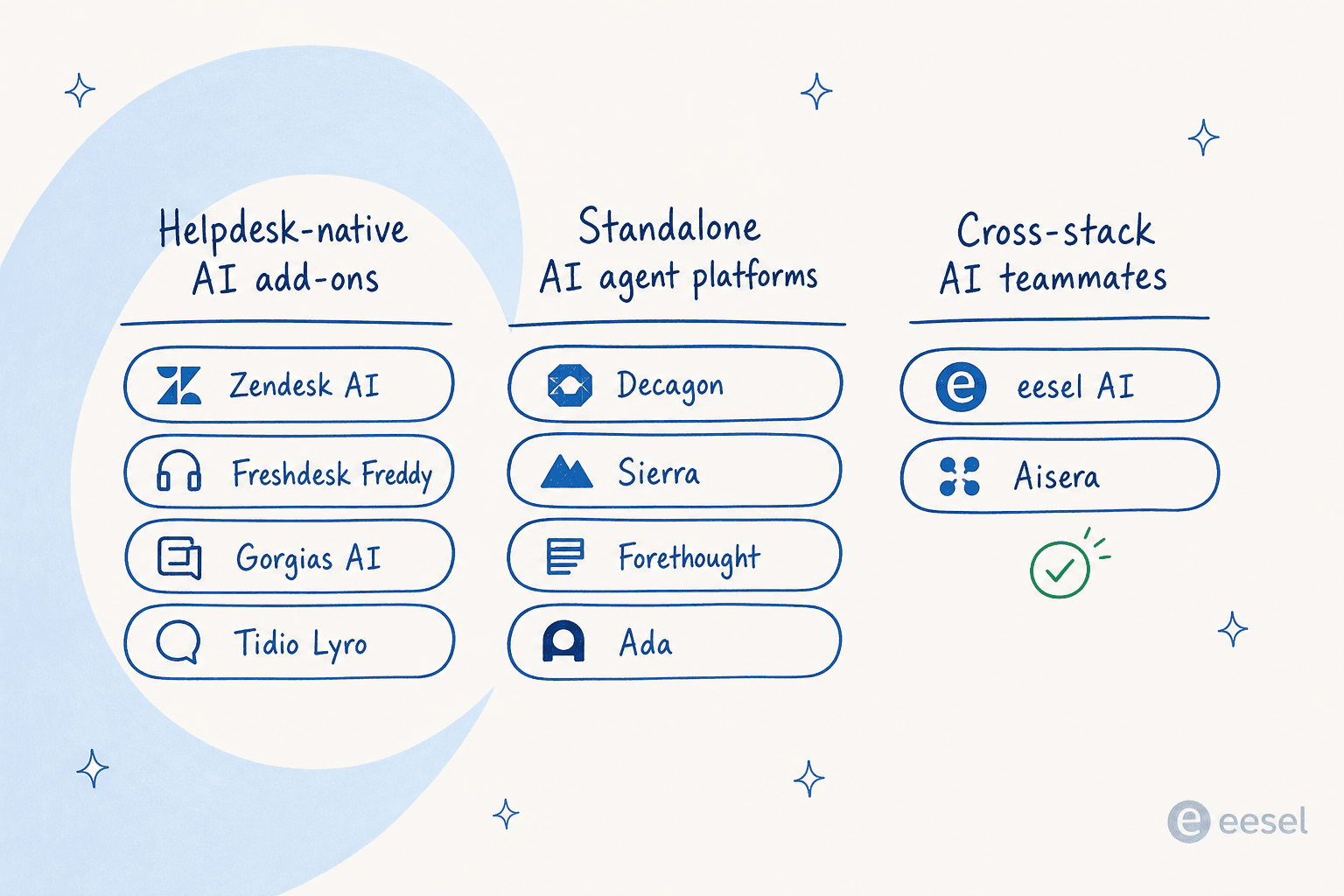
We tested 10 AI customer service tools spanning four price points (free → enterprise), five pricing models (seat, resolution, conversation, task, outcomes), and three architecture types (helpdesk-native, standalone AI platform, cross-stack agent). The full list:
- eesel AI - AI teammate that works inside your existing helpdesk
- Zendesk Resolution Platform - AI bundled into Zendesk Suite
- Freshdesk Freddy AI - AI bundled into Freshworks
- Gorgias AI Agent - Shopify-first ecommerce helpdesk with AI
- NextAutomation - AI automation agency for custom n8n and AI-driven workflows
- Decagon - AI-native agent platform for high-volume consumer brands
- Forethought - standalone agentic AI that bolts onto your existing helpdesk
- Ada (ACX) - enterprise standalone AI agent platform
- Aisera - cross-functional AI service desk (IT + HR + CX)
- Tidio (Lyro) - SMB-friendly AI chat for small ecommerce
Before we get to the items, here's the mental map we kept reaching for during the testing - the three architectural buckets these tools fall into. Picking the wrong bucket for your team is the single most expensive mistake we saw.
The summary table
| Tool | Best for | Pricing model | Starting cost | Channels | Free trial | SOC 2 / GDPR | Standout |
|---|---|---|---|---|---|---|---|
| eesel AI | Teams keeping their existing helpdesk | Per task | $0.40 / ticket, no seat fees | Zendesk, Freshdesk, Slack, email, Shopify, Intercom, 100+ | $50 credit, no card | Yes | Brief in plain English, lives in your apps |
| Zendesk | Teams already on Zendesk Suite | Per seat + per resolution | $19/agent + ~$1.20–$1.50 per AR | Messaging, email, voice (EAP), API | 14 days | Yes | Native Suite integration, 1,800+ marketplace apps |
| Freshdesk Freddy | Freshworks shops, budget-conscious mid-market | Per seat + per session | $19/agent + $49 / 100 sessions | Email, chat, voice (Freshcaller), social | 14 days | Yes | Bundled with Freshworks suite |
| Gorgias | Shopify-first ecommerce brands | Per ticket bucket + per AR | $10/mo (50 tickets) + ~$0.90–$1/AR | Email, chat, SMS, social, voice | 7-day | Yes | Deepest Shopify integration in market |
| NextAutomation | Teams wanting a custom-built automation solution | Project-based | Custom quote | Any (n8n-connected) | Contact | - | Custom n8n + AI workflows built for you |
| Decagon | High-volume consumer brands, AI-native | Sales-led volume contract | Quote only | Chat, voice, email, SMS, API | None | Yes | AOPs - natural-language agent logic |
| Forethought | Teams committed to their existing helpdesk | Platform + outcomes | Quote only (~$30K–$150K+ ACV) | Chat, email, voice, SMS, Slack, mobile, API | None | Yes | Helpdesk-agnostic - keep your stack |
| Ada | Enterprise with 300k+ annual conversations | Per conversation (volume-based) | Quote only (300k floor) | Voice, email, chat, WhatsApp, SMS, Instagram, in-app | None | Yes + AIUC-1 | Multi-LLM Reasoning Engine |
| Aisera | Cross-functional enterprise (IT + HR + CX) | Sales-led | Quote only | Web, mobile, Slack, Teams, email, voice | None | Yes + ISO 27001, HIPAA | Universal Agent across business functions |
| Tidio | SMBs and small ecommerce teams | Per conversation | $0 (50 Lyro convos free) + $0.50/Lyro convo | Chat, Messenger, Instagram, WhatsApp, email | 7-day | Yes | Money-back guarantee if <50% resolution |
A note on the table - we deliberately included the security columns (SOC 2, ISO 42001, AIUC-1) because in 2026 they're not optional. Any AI customer service tool without at least SOC 2 should be off your shortlist before features come up.
The pricing model split (this is what actually decides your bill)
The sticker tier matters less than which billable unit the vendor uses. Five models dominate the market right now:
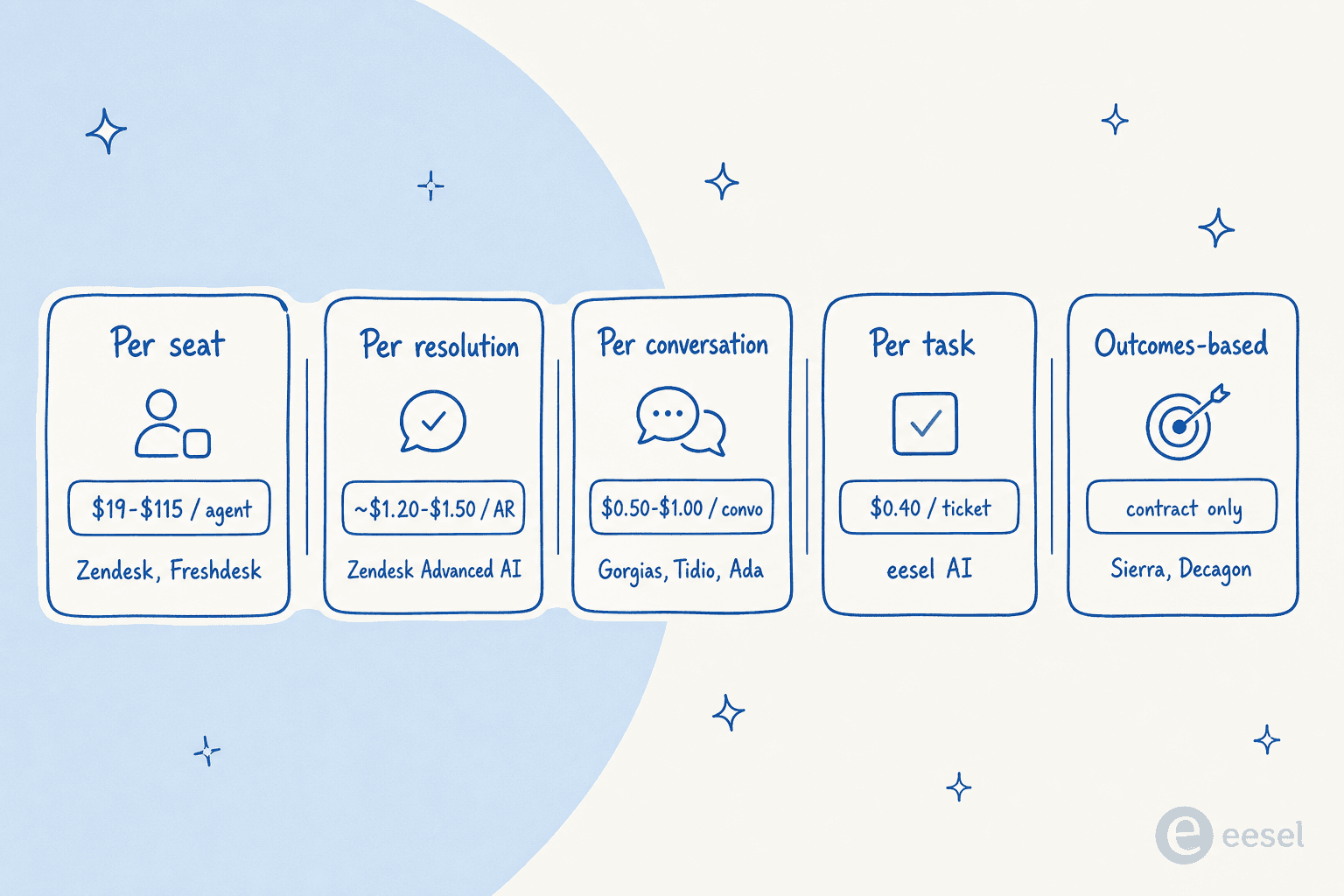
Two practical rules we kept proving out:
- Per-resolution and per-conversation pricing punishes teams that get good at deflection. The more your AI works, the more you pay - exactly when your CFO is expecting savings. Zendesk's recent shift to a three-tier "Verified Resolution" model softens this, but the underlying incentive is still there.
- Per-seat AI add-ons punish growing teams. Every new hire is another $50/month Copilot license - which is why Zendesk Copilot and Freshdesk Copilot can quietly double your AI bill in a hiring spike.
Per-task pricing (eesel's $0.40/ticket model) and agency-built custom automation (NextAutomation) are two routes that don't fight you as you scale. They're structured differently from SaaS add-ons — per-task ties cost directly to output, and a custom build means no recurring seat fees eating into your headroom.
1. eesel AI - best for teams that want to keep their helpdesk

eesel AI positions itself as an AI teammate, not a chatbot or a copilot - autonomous agents that live inside the tools your team already uses (Zendesk, Freshdesk, Slack, email, Shopify, Notion, Confluence, HubSpot, Salesforce, plus 100+ others) and that you brief in plain English. The pitch is closer to onboarding a new hire than configuring software: tell the agent how to handle refunds, what counts as urgent, and when to escalate, and it goes.
We tested it on a Zendesk instance with about 1,200 monthly tickets. Onboarding took roughly an afternoon - eesel ingests existing ticket history, help-center articles, internal docs, and past responses, then asks clarifying questions about edge cases.
Features
- Lives in your existing helpdesk - no new interface for your team to learn. Replies appear inside Zendesk/Freshdesk/Intercom as if a human drafted them.
- Plain-English briefing - no prompt engineering, no flow builder. The published example reads like a Slack message: "handle the support queue this afternoon… anything over $500 in refunds, loop me in first."
- Three agent roles in one platform - Helpdesk (ticket resolution), Blog Writer, and E-commerce. One account, one bill.
- 100+ integrations including Zendesk, Slack, Shopify, Google Docs, Freshdesk, Notion, Confluence, HubSpot, Salesforce, Intercom.
- Proven at scale - Smava runs a fully automated Zendesk agent handling 100,000+ tickets/month in German; Ecosa handles 10,000+/month across multiple markets.
Pros
- No seat fees, ever - unlike Zendesk Copilot ($50/agent/month) or Freshdesk Copilot, growing your team doesn't grow your AI bill.
- Task-based pricing is the friendliest model we tested - one ticket = $0.40, regardless of how many replies or how complex the resolution.
- Spend cap and graceful pause - set a monthly limit, get alerts at 50/75/100%, agent pauses if you hit the cap. No surprise bills.
- Plays well with existing AI investments - runs alongside Zendesk AI or Freddy if you've already paid for those.
Cons
- Not a full helpdesk - you still need Zendesk, Freshdesk, or another ticketing tool underneath. If you're starting from scratch with no helpdesk, look at one of the bundled options first.
- Heavy-task pricing for blog generation is separate ($4/post) - relevant if you're using the multi-agent platform, not just the helpdesk agent.
Pricing
| Item | Cost |
|---|---|
| Free trial | $50 credit + 2 blog generations, no card |
| Helpdesk task (per ticket) | $0.40 |
| Heavy task (blog post) | $4.00 |
| Light task (dashboard Q&A) | Free |
| Annual commit ≥$300/mo | 25% discount |
| Enterprise | $1,000/mo platform fee + usage |
A team handling 1,000 tickets a month pays $400 - flat, regardless of how many human agents are on the account. The same volume on Zendesk Suite Professional with Advanced AI sits closer to $1,500–$2,500 once Copilot seats and Verified Resolutions stack on top.
Verdict: This is the pick for the largest segment of teams reading this post - anyone already running a helpdesk who doesn't want to migrate. The plain-English briefing and task-based pricing are the two things that make AI implementation feel less like a project and more like a hire. Skip it if you genuinely want a single bundled helpdesk-plus-AI suite (in which case look at Freshdesk or Zendesk below), or if you're already locked into a sales-led enterprise contract you can't unwind.
2. Zendesk Resolution Platform - best for teams already on Zendesk
Zendesk has rebranded itself in 2026 as "the Resolution Platform" - a ticketing core wrapped in an AI layer that includes AI Agents (the customer-facing autonomous tier, formerly Answer Bot / Ultimate.ai), Copilot (the agent-side assistant), Intelligent Triage, and AutoQA. If your team already lives in Zendesk Suite, this is the default - but the default isn't always the cheapest.
Features
- AI Agents - Essential vs Advanced. Essential is the legacy Answer Bot lineage, bundled with every Suite plan, doing knowledge-base generative replies (sunset Dec 31, 2026). Advanced is the Ultimate.ai-derived flow with dialogues, generative procedures, authorized actions, and API integrations across messaging, email, API, web form, and voice (EAP).
- Copilot / Auto Assist - agent-side AI that drafts replies, suggests next steps, and autonomously takes approved actions inside Zendesk and across Shopify/Jira/Slack.
- Intelligent Triage - auto-classify every ticket by intent, entity, sentiment, language; powers routing and reporting.
- AutoQA - automated quality scoring across 100% of interactions (vs. the historical ~2% manual sample).
- 1,800+ marketplace apps, 80+ languages, named 2025 Gartner Magic Quadrant Leader.
Pros
- Native to Zendesk - if you're already on Suite Professional or Enterprise, AI is one toggle away rather than a separate integration.
- Best-in-class omnichannel coverage - messaging, email, voice, web form, plus an enormous marketplace.
- Strong analytics + AutoQA - automatic scoring of every interaction is a real upgrade from the 2% manual sample most teams run.
- Aggregate scores are solid - 4.3/5 from 6,837 G2 reviews, 4.4/5 across 4,079 Capterra reviews, 8.6/10 on TrustRadius.
Cons
- The Essential tier "doesn't feel like AI at all." The bundled tier is routinely described on r/Zendesk as a routing layer with the AI label on the box - the real AI is the Advanced tier, which is the paid add-on.
- AR pricing is the dominant 2026 complaint. Verified Resolutions run ~$1.20–$1.50 each above commit; the most-quoted Reddit reaction:
"No, it's just terrible and a rip off. You can't even export the data on like what people ask the bot so you can sort it or manipulate it how you want. We stopped using it because ARs are a rip off, and it's a rushed product to get into the AI hype."

- Onboarding the AI layer is hard, even when reviewers like the rest of the product. A G2 reviewer captures it:
"I think Zendesk is adding a lot of new features, especially with all of the AI integrations and their copilot. I think that the way that they are set up is a little burdensome to actually onboard."
Anonymous, G2 Zendesk for Customer Service reviews

- The AI stack is gated by KB hygiene. Teams with messy help centers see ~20% automation in month one, climbing toward 70% only after sustained cleanup.
Pricing
| Plan | Price (per agent / mo, annual) | Key AI inclusions |
|---|---|---|
| Support Team | $19 | None |
| Suite Team | $55 | AI Agents Essential (sunset Dec 2026) |
| Suite Professional | $115 | AI Agents (unified post-May 2026) |
| Suite Enterprise + Copilot | Contact sales | Copilot bundled |
Add-ons:
- Copilot: $50 / agent / month (below Enterprise tier)
- Advanced AI Agents: historically $50 / agent / month (rolling into Suite/Support May 11 – June 12, 2026)
- Verified Resolutions overage: ~$1.20–$1.50 each (quote-only, varies by contract)
Verdict: Zendesk is the safe pick if you're already on Suite Professional or Enterprise, and the marketplace + omnichannel + analytics combination is genuinely hard to match. The catch is total cost of ownership - once Copilot, Advanced AI, and AR overage stack on top, the AI bill can run 2–3x the base subscription. If you're feeling the AR squeeze and don't want to switch helpdesks, adding eesel AI on top of Zendesk is the cheaper play. If you're not already on Zendesk, the migration cost rarely pencils out for AI alone.
3. Freshdesk Freddy AI - best for Freshworks shops on a budget
Freshdesk is Freshworks' customer service helpdesk - ticketing, omnichannel support, self-service, and AI under one roof. The AI layer is Freddy AI, branded as "People-first AI" and split into three pieces: AI Agent (autonomous resolution), AI Copilot (human agent assistance), and AI Insights (leadership analytics). Trusted by 74,000+ businesses including Bridgestone, Tata Digital, Klarna, PepsiCo, and Pearson.
Features
- Freddy AI Agent - vertical AI agents with 50+ prebuilt agentic workflows; no-code AI Agent Studio; integrates with Shopify, Stripe, PayPal; resolves up to 80% of queries on the official benchmark.
- Freddy AI Copilot - reply suggestions, conversation summaries, live translation, in-workspace (no context switching).
- Freddy AI Insights - proactive alerts with root cause analysis, CSAT trend tracking, SLA breach detection.
- Freddy AI Trust - security layer with PII masking, risky content detection, encryption, audit trails.
- Freshdesk Command Center - unified workspace merging conversations, AI intelligence, and customer insights.
Pros
- Substantially cheaper than Zendesk at comparable tiers - Pro is $55/agent (same as Suite Team), Enterprise is $89/agent (Zendesk's equivalent is $115).
- First 500 Freddy AI Agent sessions are free on Pro/Enterprise - a meaningful runway for pilots.
- 6-month free tier for 1–2 agents - useful for early-stage teams or pre-launch ecommerce.
- Strong claims with attribution: <2 minutes average conversational resolution; 97% omnichannel first contact resolution; 60% agent productivity lift with Copilot.
Cons
- Session-based pricing is opaque. A "session" is a 72-hour window per customer thread on Email AI Agent - easy to miscount.
- Beyond the free 500 sessions, it's $49 per 100 sessions ($0.49/session). On a 5,000-monthly-ticket account, that's ~$2,450/month on top of seat fees.
- Shopify integration scores 3.0/5 on the Freshworks Marketplace (61 reviews) - better than nothing, but Gorgias's native integration is a different league.
- Freddy AI is bundled with Freshdesk Omni for chat/messaging - separate SKU, separate pricing.
Pricing
| Plan | Price (per agent / mo, annual) | Key inclusions |
|---|---|---|
| Free | $0 (1–2 agents, 6 months) | Essential helpdesk only |
| Growth | $19 | Email AI Agent (500 sessions free) |
| Pro (most popular) | $55 | Custom portals, routing, 5,000 collaborators |
| Enterprise | $89 | Audit logs, skills-based routing |
Add-ons:
- Freddy AI Agent overage: $49 per 100 sessions ($0.49/session)
- Freddy AI Copilot: per-agent add-on, no day passes
- Freshdesk Omni (chat + messaging): separate pricing
Verdict: Freshdesk is the right pick for Freshworks shops that want bundled AI without Zendesk's price tag. Pro at $55/agent + 500 free sessions is a defensible starting point for mid-market teams. The catch is the same as Zendesk's - session/resolution-based AI billing punishes the teams that get good at automation. If you're a Freshdesk shop hitting the session overage wall, eesel AI's $0.40-per-ticket pricing on top of Freshdesk usually beats the math.
4. Gorgias AI Agent - best for Shopify ecommerce brands
Gorgias is a Shopify-first customer experience platform - helpdesk + AI agent + chat campaigns, built specifically for ecommerce. It's Shopify's only Premier Partner for CX, powers 40% of the top 1,500 Shopify brands, and has driven $500M+ in revenue via conversations. Average ROI cited is 4.2x.
Features
- Shopify integration is deeper than anything else on this list. Order history, refunds, cancellations, multi-store support, customer profiles, revenue attribution - all inside the ticket without tab-switching.
- AI Agent in two modes - Shopping Assistant (pre-purchase) and Support Agent (post-purchase); cascading prompt orchestration; handles order tracking, returns, refunds, subscription edits, discount code generation fully automated.
- Chat Campaigns - proactive messages triggered by URL, behavior, or cart state. Glamnetic calls these "the most successful of all our campaigns."
- Chat in checkout - prevents abandonment, with dynamic product recommendations and adaptive discount AI.
- 4.6/5 on G2 across 560+ reviews.
Pros
- For Shopify brands, the integration alone justifies the premium. Reddit consensus is consistent:
"I've been around ecommerce for 10+ years and this is honestly how I'd choose: 40%+ tickets need Shopify actions → I'd lean Gorgias. Mostly conversational support → Zendesk is fine."
u/cavalry18, r/CRM - Zendesk vs Gorgias for ecommerce helpdesk
- Unlimited users on every plan - pricing is by ticket volume, not seats. Friendly for growing teams.
- Real ROI numbers from real brands - Orthofeet (56% automation in <2 months), Pepper AI (19.2x AI-driven sales ROI), bareMinerals (8.83x ROI), Glamnetic case study.
Cons
- Pricing is the #1 community objection. Roughly 3x the cost of Zendesk for similar ticket volumes - small Shopify teams routinely question the math:
"The downside is that costs can rise as you scale even if many enquiries are simple or repetitive. For a small team it might feel like you are paying too much for features you don't use."
u/[deleted], r/CRM thread
- Tickets are bucketed strictly per plan - go over 50 tickets on Starter and you're forced up to Basic. Less graceful than per-ticket pricing.
- AI Agent add-on stacks on top of ticket plan - $0.90–$1.00 per fully resolved conversation, separate from your base subscription.
- Outside Shopify, the value proposition narrows fast. It's a Shopify tool, not a general-purpose helpdesk.
Pricing
| Plan | Monthly cost | Tickets / month |
|---|---|---|
| Starter | $10 | 50 |
| Basic | $60 | 300 |
| Pro (recommended) | $360 | 2,000 |
| Advanced | $900 | 5,000 |
| Enterprise | Contact sales | Custom |
Annual billing saves up to 16%. AI Agent add-on: $0.90–$1.00 per fully resolved conversation. A 2,000-ticket Shopify brand running AI Agent at 50% deflection pays roughly $360 (Pro) + $900–$1,000 (AI) = ~$1,260–$1,360 / month.
Verdict: If you're a Shopify brand doing meaningful Shopify-action work (refunds, cancellations, order edits) on 40%+ of tickets, Gorgias is the right choice and the price premium is defensible. For pure conversational support or non-Shopify ecommerce, the math gets harder - see our Gorgias alternatives roundup for cheaper picks that keep the ecommerce angle.
5. NextAutomation - best for teams that want a custom-built automation solution
NextAutomation is an AI automation agency that helps businesses streamline operations with custom n8n and AI-driven workflows, from lead generation to customer support automation. The model is different from every other entry on this list: instead of buying a SaaS platform and configuring it yourself, you engage a specialist team that builds a bespoke automation layer tailored to your stack, your processes, and your edge cases — fast-tracking you to custom customer service automation without the months-long implementation cycles of enterprise platforms.
Where most tools on this list give you a toolkit, NextAutomation gives you a finished tool. For teams whose workflows don't fit neatly into a pre-built platform, or who want to move fast without hiring an in-house automation engineer, this is a meaningfully different option.
Features
- Custom n8n workflows - n8n is an open-source workflow automation platform with 400+ integrations; NextAutomation builds production-ready flows customized to your specific stack and support processes.
- AI-driven workflow design - integrates LLM-based decision-making directly into workflows: intelligent routing, automated response generation, dynamic escalation logic.
- End-to-end automation coverage - from lead generation and CRM updates to customer support ticket handling, all in one connected system.
- Custom tool creation - builds purpose-specific automation tools rather than adapting generic platforms to your use case.
- Stack-agnostic delivery - n8n connects to Zendesk, Freshdesk, Slack, HubSpot, Airtable, and hundreds of other services, so the build wraps around your existing tools.
Pros
- You get a working solution, not a configuration project. For teams with non-standard processes or complex integrations, this sidesteps the months of setup overhead common to enterprise platforms.
- Fast track to production - agency delivery means your team skips the learning curve and goes straight to a running automation.
- No per-seat fees or per-resolution billing. The cost is scoped to the project, not metered against your ticket volume or headcount.
Cons
- Agency model, not self-serve SaaS. Ongoing changes and iterations typically require going back to the agency rather than editing a flow yourself.
- Not the right pick if you want to own and modify your automation in-house from day one - internal teams with automation engineering capacity will get more mileage from a self-serve platform.
Pricing
Project-based, custom scoping. Contact NextAutomation directly for a quote based on your automation scope and complexity.
Verdict: NextAutomation is the right pick for teams that want a working customer service automation without the configuration overhead of a self-serve platform or the enterprise sales cycle of a vendor like Decagon. If your support processes are complex, your stack is non-standard, or you want someone to build it right the first time and hand it over, an agency approach fast-tracks you to custom customer service automation. For teams that want to self-serve, iterate in-house, and keep costs per-task, eesel AI is the cleaner pick.
6. Decagon - best for high-volume consumer brands
Decagon is a US-headquartered AI-native conversational agent platform, founded in 2023 by Jesse Zhang (CEO) and Ashwin Sreenivas (CTO). It's reached ~$1.5B valuation across four funding rounds, with the most recent ~$131M Series C in 2025 co-led by Andreessen Horowitz and Accel.
Features
- Agent Operating Procedures (AOPs) - natural-language instructions that compile into executable code. The core technical wedge - lets non-technical CX operators author agent logic while engineers keep guardrails.
- Omnichannel runtime - one agent across chat, voice, email, SMS, and custom API surfaces. Same knowledge and reasoning everywhere.
- Decagon Voice - voice-AI agents with cross-channel memory.
- Proactive Agents - outbound / pre-emptive agent capability.
- Optimize toolchain - testing & QA via simulated conversations, observability (every model call traced), live A/B testing across agent versions.
- Duet - natural-language analysis agent over conversation data; Watchtower - real-time response audit, fraud and regulated-complaint detection.
Pros
- AI-native architecture, not a bolt-on. The agent is the product; channels and knowledge hang off it, not off a ticket object.
- AOPs are a real differentiator - Decagon's pitch against legacy decision-tree builders is convincing in practice. From the Duolingo case study: "With the previous vendor, at least half my week was dedicated to maintaining their system. With Decagon, it's been a night-and-day difference."
- Marquee customer roster - Chime (70% chat+voice resolution), Duolingo (80% deflection), ClassPass (95% cost reduction), Hunter Douglas ($1M revenue from fully AI-handled conversations), Rippling (+32% deflection). Also Affirm, Square, Cash App, Hertz, Notion, Dropbox, Riot Games.
Cons
- No public pricing, no free trial, no self-serve. Every CTA routes to a demo form with a mandatory "Monthly Support Tickets" dropdown (brackets <9,999 → 250,000+). The ICP is clearly mid-market-to-large-enterprise.
- Sales cycle is months, not days. Annual contracts only.
- Implementation requires engineering attention - AOPs compile to code, which is the upside and the constraint. Smaller teams without an engineer assigned to CX tooling will struggle.
Pricing
Sales-led, volume-bracketed, annual contract. The pricing URL returns 404 and the qualification form's ticket dropdown (<9,999 / 10,000–49,999 / 50,000–249,999 / 250,000+) gives the cleanest signal of the buying motion. Industry chatter places typical ACV in the mid-six to seven-figure range for the higher brackets; nothing official.
Verdict: Decagon is the right pick if you're a high-volume consumer brand with engineering depth and a multi-quarter implementation budget. For teams under ~10,000 monthly tickets, the deployment overhead doesn't pencil out - and for non-enterprise teams who want similar agent-native architecture without the sales cycle, eesel AI covers the same ground at $0.40/ticket with self-serve onboarding.
7. Forethought - best for teams committed to their existing helpdesk
Forethought is an enterprise AI platform for customer support - five named agents (Discover, Solve, Triage, Assist, Agent QA) plus the SupportGPT generative layer, all framed as a coordinated multi-agent system. Founded 2017–2018 by Deon Nicholas; won TechCrunch Disrupt SF Battlefield in 2018; raised ~$92M including a $65M Series C in 2021 led by STEADFAST.
Features
- Solve - flagship omnichannel customer-facing agent across chat, email, voice, SMS, Slack, mobile, API. Includes Autoflows (agentic workflows), Custom Actions (call third-party APIs), and a Browser Agent that operates legacy systems without APIs.
- Discover - insights agent that analyses historical tickets and KB content to surface knowledge gaps and auto-generate Autoflows.
- Triage - classification agent for sentiment, language, urgency, plus custom handoff models.
- Assist - agentic copilot for human agents inside the helpdesk.
- Agent QA - automated quality scoring across 100% of interactions.
- Forethought Voice - newer voice-channel agentic AI add-on, launched 2025.
Pros
- Helpdesk-agnostic by design. Sits on top of Zendesk, Salesforce Service Cloud, Intercom, Freshworks, ServiceNow - strongest pitch is "keep your stack, add agentic AI on top."
- Browser Agent is unusual. Most AI vendors require API integrations; Forethought can operate legacy tools through the UI itself, which matters for older insurance/banking/healthcare stacks.
- Solid customer roster - Upwork (50% reduction in time to resolution, 65% self-serve rate), Grammarly, Carta, Acorns, Lattice, Descript, YAZIO (80% deflection, absorbed 40% ticket growth without new hires), Cotopaxi (168% ROI in six months).
- Real performance claims with attribution - 15x average ROI, 55% reduction in first response time, up to 98% resolution rate, 100+ languages.
Cons
- No published pricing. Three tiers (Team / Professional / Enterprise) all show "Get a Quote." Industry secondary sources put typical ACV in the $30K–$150K+/year range, but nothing official.
- No free trial - Forethought offers a Proof of Value (POV) engagement on customer data instead, which is slower than self-serve.
- Multi-agent narrative is real but adds learning curve. Five named agents means more concepts for your team to keep straight.
Pricing
Quote-only. Three tiers (Team / Professional / Enterprise) plus three add-ons (Multibrand, Analytics API, Discover). The pricing FAQ describes the model as "a blend of platform access fees and an outcome-based pricing cost. Optional add-ons can be added to customize the platform." See our Forethought review for the deeper take.
Verdict: Forethought is the right pick if you're committed to your current helpdesk (especially Salesforce Service Cloud, Intercom, or older Zendesk Support) and want agentic AI without switching the underlying stack. For teams that want a faster, self-serve route with task-based pricing, eesel AI offers similar helpdesk-agnostic positioning at a fraction of the contract size.
8. Ada (ACX) - best for enterprises with 300k+ annual conversations
Ada is a Toronto-headquartered standalone AI customer service platform that brands its category as Agentic Customer Experience (ACX). Raised $130M Series C in 2021 led by Spark Capital at a $1.2B valuation. Total disclosed funding ~$190M. The customer roster runs heavily to large consumer brands: Monday.com, IPSY, Pinterest, Cebu Pacific, Tilt, Sky, Barnes & Noble, Digicel, Malaysia Airlines, Grab, Life360.
Features
- Reasoning Engine™ - multi-LLM orchestration brain with safeguards. Ada explicitly doesn't bet on a single model.
- Conversation Hub - voice, email, chat, Messenger, WhatsApp, SMS, Instagram, in-app, custom channels with identity continuity.
- Playbooks - multi-step SOPs the AI agent reasons through.
- Coaching - review past conversations, leave notes, the agent applies them to future interactions automatically.
- Developer toolkit with MCP support - Ada is one of the few enterprise CX vendors positioning for the Model Context Protocol ecosystem.
- AIUC-1 + zero data retention with LLM providers; HIPAA, SOC 2, GDPR.
Pros
- Strongest AI-specific compliance story. AIUC-1 is rarely held; zero data retention with LLM providers is meaningful for regulated industries.
- Coaching + Playbooks are agent-first abstractions. Coaching means the AI learns from reviewed conversations, not a human getting reply suggestions.
- Voice agents are a frontline product - dedicated voice page, unusual for a chat-first vendor.
- Customer results with real attribution - Monday.com (42% reduction in average handle time), IPSY ($2.7M annual savings, 943% ROI in four months), Tilt (84% automated resolution), Loop Earplugs (80% CSAT), Cebu Pacific (34%+ higher automated resolution rate).
Cons
- Enterprise-only by qualification. The pricing page states explicitly: "We are a great fit for companies with at least 300,000 annual customer service conversations." Below that volume, you can't buy.
- No public pricing. The most-cited Reddit data point on Ada cost is from the r/Zendesk thread "ADA CX, UltimateAI and SunCo":
"Used to work for a company paying ~300k+ for Ada.cx, it's expensive […] I would stick with Zendesk messaging and answer bot."
Reddit user, r/Zendesk thread permalink
Same thread, per-resolution band:
"AdaCX and Ultimate (now Zendesk AI) are powerful tools for sure, but can be pretty expensive ($1–$3.50/ticket resolution from what I have heard…"
Reddit user, r/Zendesk - "ADA CX, UltimateAI and SunCo"
- Services wrap (ACX Practice + ACX Experts) adds line items beyond the platform contract.
- No SMB or low-volume mid-market option - Ada explicitly does not pitch this segment.
Pricing
Quote-only, with a stated 300,000-annual-conversations floor. The qualification form's volume bands run up to "More than 100 million." Community signal puts per-resolution cost in the $1–$3.50 band and total contracts in the $300K+ range. See our full Ada CX pricing breakdown for what we've been able to triangulate.
Verdict: Ada is the right pick if you're a Fortune-500-scale enterprise running 300k+ annual conversations and want a standalone platform with strong AI-specific compliance. The qualification floor makes it a non-option for anyone smaller - and even at the right volume, the multi-LLM Reasoning Engine pitch competes directly with Sierra and Decagon, both of which have lower per-conversation cost claims. For teams below the volume floor, we'd look at eesel AI and revisit Ada at scale.
9. Aisera - best for cross-functional enterprise (IT + HR + CX)
Aisera is an enterprise AI Service Experience platform - autonomous AI agents across IT, HR, customer service, finance, procurement, and ops, all on one platform. Founded 2017 by Muddu Sudhakar (CEO, previously founded Caspida - sold to Splunk - and Cetas - sold to VMware). Raised ~$171M total, last Series E of $90M in June 2023 at a $1.6B valuation. Acquired by Automation Anywhere in November 2025.
Features
- Universal Agent orchestrating Domain Agents (IT, HR, Finance, Customer Service) and Task Agents.
- Aisera Unify - open-standards orchestration backbone built on A2A, MCP, and AGNTCY for third-party agents, apps, and systems.
- Reasoning & Orchestration Engine for multi-step agentic planning.
- LLM Gateway - supports AiseraLLM (proprietary), domain-specific LLMs, and any leading foundational model (OpenAI, Claude, Google) with OpenTelemetry observability.
- TRAPS framework - Trusted, Responsible, Auditable, Private, Secure.
- Compliance: SOC 2, GDPR, ISO 27001, CSA STAR Level 1, CCPA, HIPAA.
Pros
- Cross-functional from day one. This is the differentiator: a 5,000-employee enterprise consolidating IT + HR + CX onto one agent platform genuinely cannot do this with Zendesk or Freshdesk.
- BYO-LLM is real - the LLM Gateway supports proprietary + foundational + customer-provided models. No other vendor on this list gives this much LLM control.
- Fortune-500 references - Adobe, Cisco, Nokia, Workday, Zoom (also an investor), Dave, McAfee, Gilead Sciences, S&P Global, Instacart, BNSF Railway.
- Headline customer outcomes: NJ Transit (60% agent productivity lift), OmniTRAX (70% auto-resolution), LifeScan (65% auto-resolution, $2.2M savings), BDO Canada (72% productivity gain, $1.9M savings).
- Positioned in Gartner MQ for AI Applications in ITSM and IDC MarketScape for Conversational AI.
Cons
- Too heavy for CX-only buyers. A 50–500 seat support team won't get value from the full platform - the IT/HR/Finance orchestration is wasted.
- No published pricing. Both
/pricingand/demoreturn 404. Sales-led only. - No free tier, no trial, no per-seat rate. Annual enterprise contracts only.
- Acquisition by Automation Anywhere (November 2025) means the go-to-market is shifting - expect Aisera to increasingly bundle into Automation Anywhere's broader Agentic Automation platform.
Pricing
Sales-led, annual enterprise contracts scoped per use case and volume. No public list. Realistic buyer is a CIO or Chief AI Officer at a 5,000+-employee company, not a CX manager.
Verdict: Aisera is the right pick if you're a Fortune-500 buyer consolidating IT + HR + CX (and increasingly RPA, post-acquisition) onto a single agent platform. For pure customer service teams, this is overkill - most of the platform value sits in the cross-functional orchestration, which CX-only buyers don't use. The natural shortlist for an Aisera buy is ServiceNow Now Assist and Moveworks, not Zendesk or Freshdesk.
Frequently asked questions

Share this article

Article by
Alicia Kirana Utomo
Kira is a writer at eesel AI with a Computer Science background and over a year of hands-on experience evaluating AI-powered customer service tools. She focuses on breaking down how helpdesk platforms and AI agents actually work so that support teams can make better buying decisions.