AI customer service for logistics: how to stop drowning in WISMO tickets


Last edited June 18, 2026

Why logistics support is different
Working on eesel's customer support team, I've talked to dozens of logistics and 3PL teams about their support setup. The honest summary: their ticket queue looks nothing like a typical SaaS company's.
A SaaS support team mostly fields "how do I do X?" questions - documentation gaps, configuration questions, the occasional billing dispute. These are answerable from a knowledge base. A well-tuned AI customer service chatbot handles 60-70% of them cleanly.
Logistics is structurally different. The majority of questions are operational status queries that need live data:
- "Has my container cleared customs?"
- "Why was my delivery attempted and failed?"
- "What's my current stock level for SKU X?"
- "My shipment shows 'in transit' for five days - is something wrong?"
None of those are answerable from a static help center. They require a live lookup against a carrier API, WMS, or TMS. That's the fundamental reason AI for customer service in logistics is harder to get right than in most other industries - and why the integration setup matters far more than the AI layer itself.
There's also a volume problem that's unique to the sector. Logistics support doesn't spike on product launches. It spikes on peak season, weather events, port congestion, carrier network outages. A storm system over a major hub can generate 10x normal tracking-query volume in 24 hours. Staffing to that peak is expensive and slow; AI is the only cost-effective answer for high-volume ticket periods like these.
What's actually flooding your queue
LateShipment.com research puts WISMO queries at around 35% of all ecommerce inbound support volume - and that's a conservative figure for logistics operations where tracking is the core product. Combined with delivery exceptions and inventory queries, more than half the average logistics support queue is resolvable by AI customer service automation today.
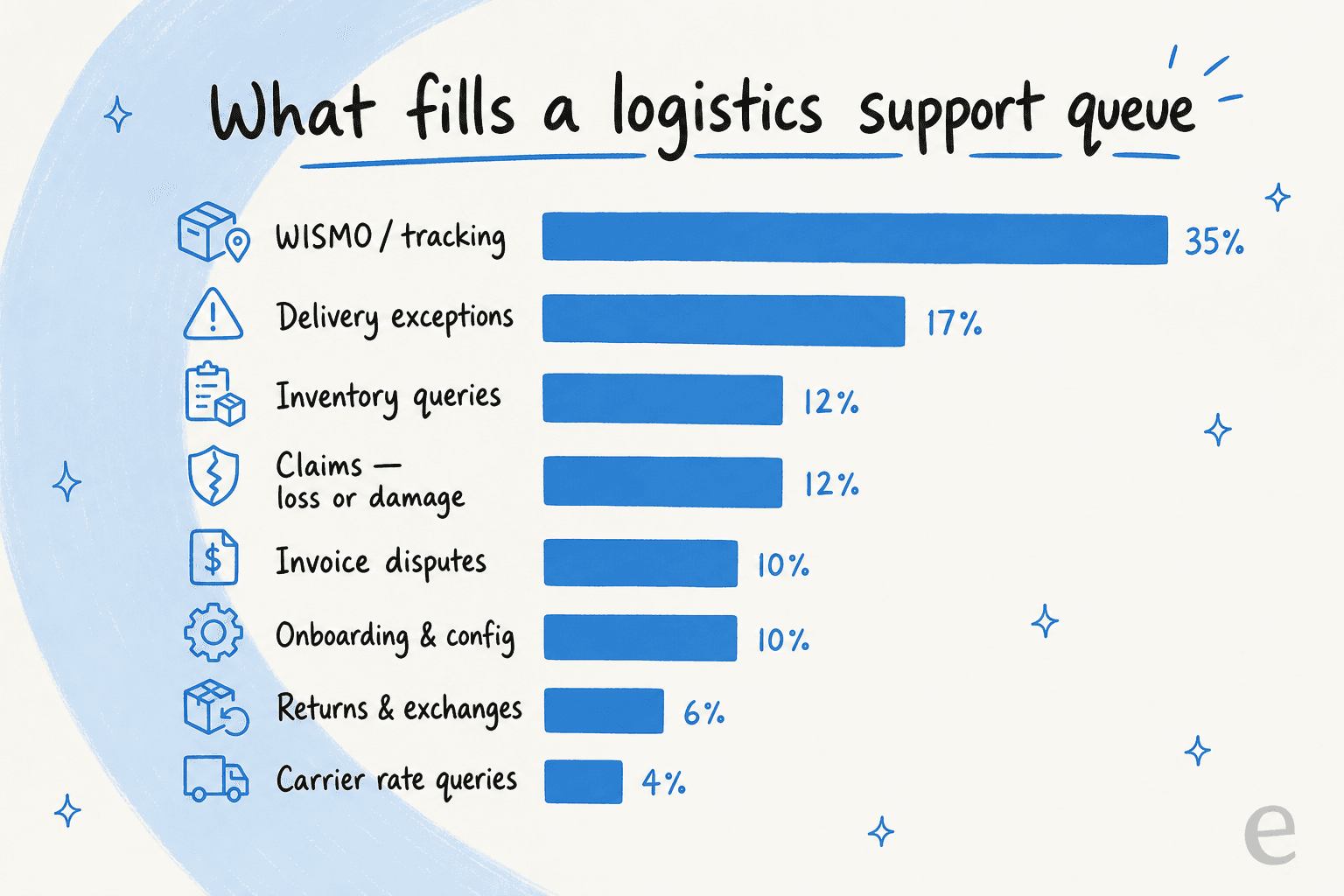
Here's the full breakdown, sourced from carrier, 3PL, and WMS data:
| Ticket category | Estimated share | AI-resolvable? |
|---|---|---|
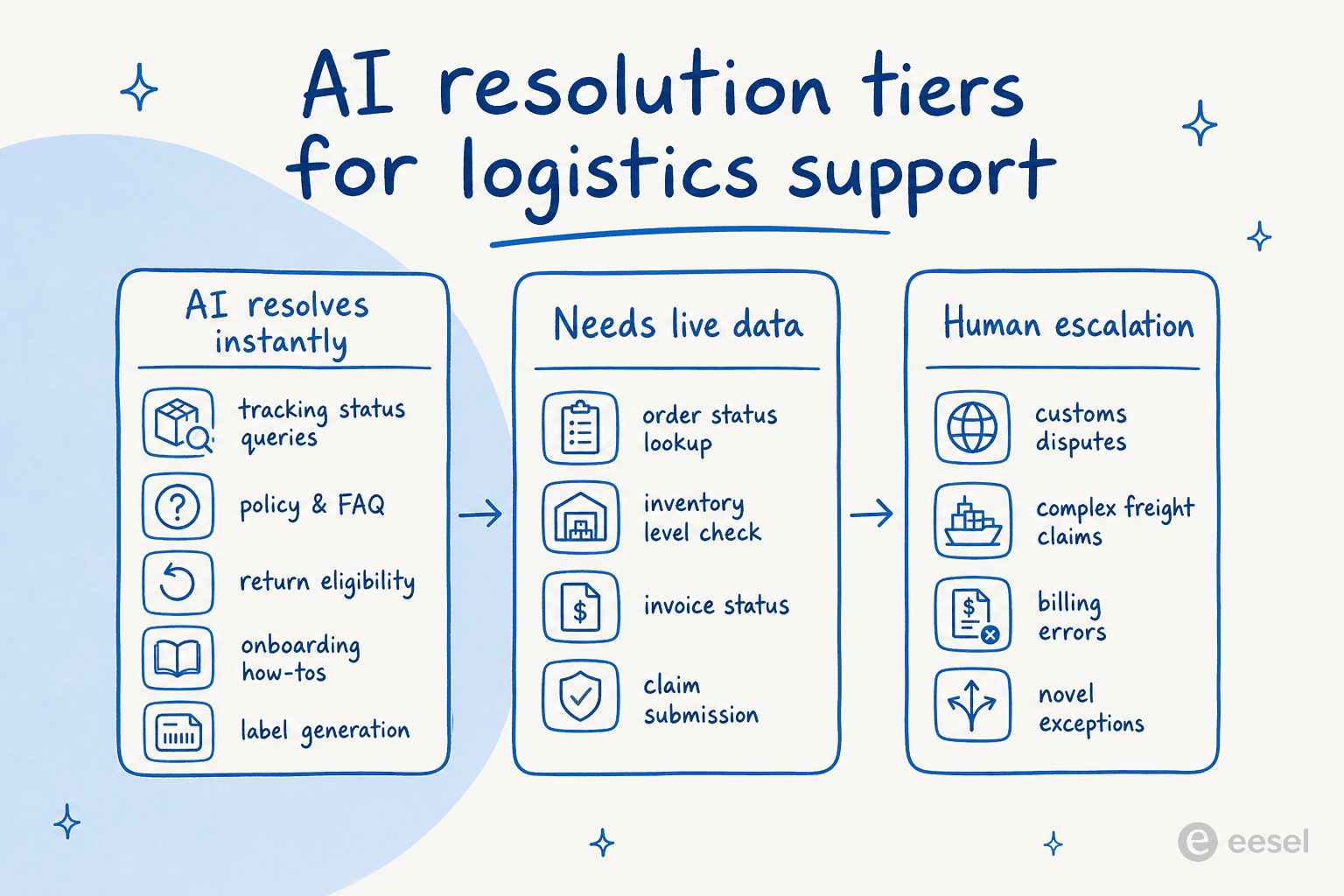
| WISMO / shipment tracking | 30-40% | Yes - with carrier API integration |
| Delivery exceptions (failed, delayed, lost) | 15-20% | Partial - triage yes, complex cases no |
| Inventory & stock queries (3PLs) | 10-15% | Yes - with WMS integration |
| Claims - loss, damage, late delivery | 10-15% | Partial - initiation yes, disputes no |
| Invoice & billing | 8-12% | Partial - status lookup yes, disputes no |
| Onboarding & configuration | 8-12% | Yes - from docs and past tickets |
| Returns & exchanges | 5-10% | Yes - eligibility check + label generation |
| Carrier & rate queries | 3-5% | Yes - from knowledge base |
Two conclusions stand out. First, the top three categories alone account for 55-75% of total volume, and all three are automatable to some degree. Second, partial automation is still valuable. If AI handles only 60% of delivery exception queries, that's still real agent time freed up for the complex 40%.
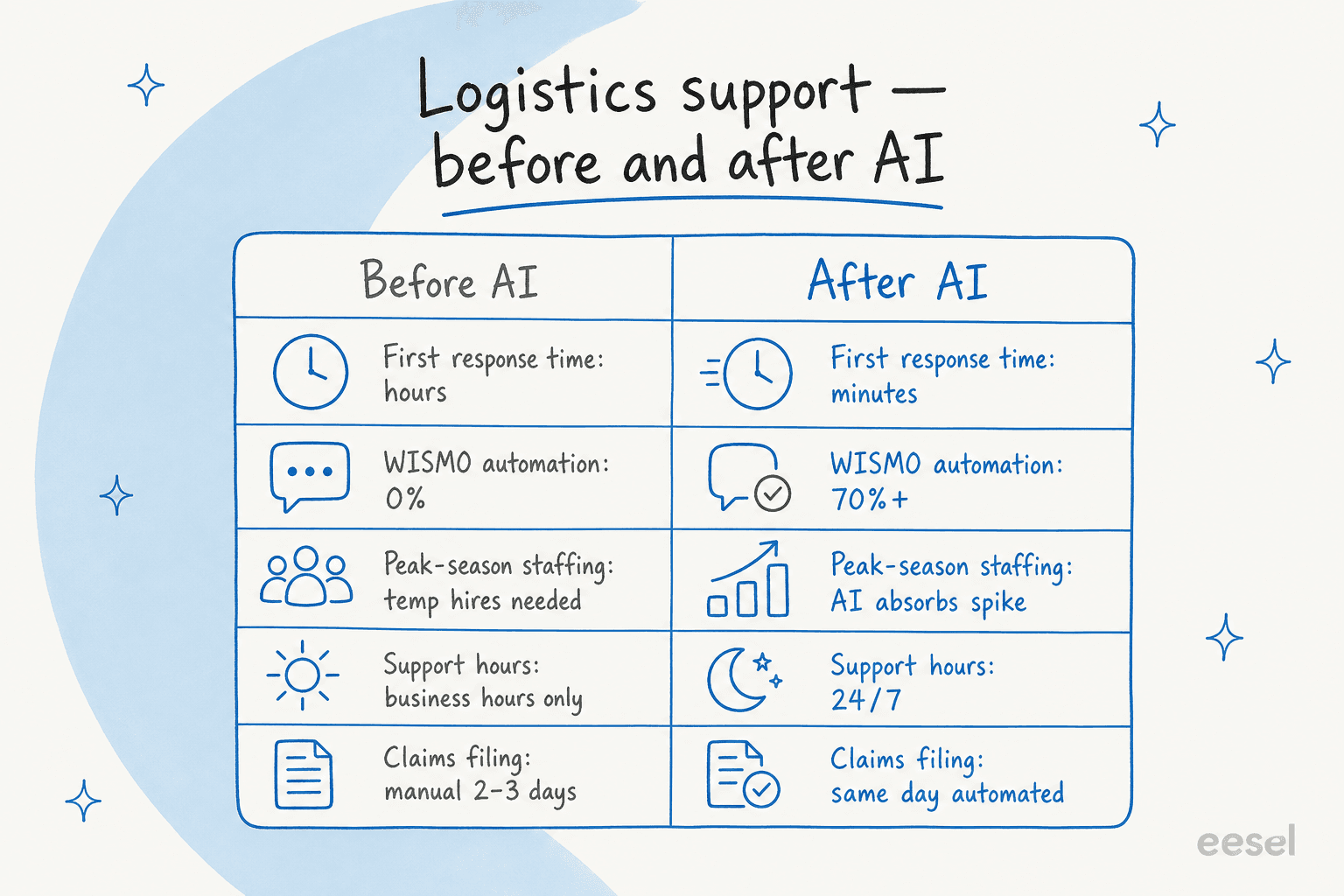
I'd also note - and this is something I see regularly on our own team - that customer service KPIs for logistics operations tend to look dramatically different pre- and post-AI. First response time compresses from hours to minutes. Resolution rates on the categories above climb well above 50% within the first month.
The integration gap most AI tools miss
Here's where a lot of logistics teams get burned. They deploy a general-purpose AI chatbot, it works well for FAQ questions, and they wonder why it's not touching their WISMO volume.
The answer is almost always the same. A knowledge base AI can't answer "where is my shipment?" because the shipment's location isn't in the knowledge base. It changes every 15 minutes. Answering it requires a live API call to the carrier.
This is the integration map for logistics AI support:
Must-have for core deflection:
- Carrier tracking APIs (FedEx, UPS, DHL, Australia Post, etc.) - without these, WISMO is unresolvable
- OMS / WMS integration - required for inventory and order lookup at 3PLs
- Helpdesk platform - where the AI actually operates
High-value for full resolution:
- Returns management system - automates return eligibility checks and label generation
- Carrier claims API - handles claim initiation for losses and damages
- Billing / invoicing system - answers invoice status queries
Contextual knowledge (usually covered by default):
- Help center and knowledge base - for policy, process, and how-tos
- Internal SOPs and runbooks - for operator-facing queries at WMS vendors
- Past ticket history - trains the AI on how your team handles edge cases
The good news: a helpdesk AI like eesel covers the contextual knowledge layer well out of the box, connecting to your help center, Google Docs, Notion, Confluence, Salesforce, and past tickets. The live data integrations are the layer that requires configuration specific to your stack - but once in place, your first contact resolution rate climbs fast.
Five AI use cases that actually move the needle
Tracking query automation
The highest-ROI application in logistics AI customer service. LateShipment.com research shows brands using proactive delivery notifications - an automated form of tracking coverage - see up to 72% fewer delivery-related support contacts. Fully automated WISMO resolution eliminates the category rather than just reducing it.
The practical setup: AI integrated with your carrier APIs answers tracking questions in real time, in any of 80+ languages, 24 hours a day. Peak season doesn't break you; the AI absorbs the spike without additional staffing.
Delivery exception handling
When a shipment gets delayed or a delivery attempt fails, two things need to happen quickly: the customer needs to know, and the resolution path needs to be clear. AI handles both - it detects the exception, sends the proactive notification, and presents options (re-delivery scheduling, pickup point redirect, claim initiation) before the customer ever contacts support.
Sendcloud's support automation reports 8x faster claims resolution and 3x faster first response time for lost, damaged, or delayed parcel queries after automating this workflow. For teams that process high parcel volumes, those numbers translate directly into headcount savings and agent productivity gains.
Chatbots handling order status, returns, and shipping have become standard at high-volume carriers for exactly this reason. The technology works; the differentiator is how well it integrates with the specific carriers your operation uses.
Inventory visibility for 3PLs
For 3PLs, an AI connected to the WMS can instantly answer "how much stock do I have?", "has my container been received?", and "what are my slow-moving SKUs this month?" without agent intervention. Before self-serve portals and AI, small 3PL teams spent hours weekly pulling and emailing manual spreadsheet reports to clients - that's now a query the AI resolves in seconds.
CartonCloud, one of the leading WMS platforms in the 3PL space, runs their support team on eesel. Their Service Desk Lead Eddie Stephens put it this way:
"It is getting us to the right articles really quickly and easily, as well as curating well-formed responses with consistent, on-brand tone, still keeping our own style and still keeping that human touch."
Eddie Stephens, Service Desk Lead, CartonCloud
Their deployment spans 717 knowledge items across Salesforce and Slack - the kind of multi-source setup that used to require significant agent time to navigate manually.
Returns self-service
AI-driven returns flows that offer an exchange option before showing the refund path retain roughly 40% of would-be refunds as exchange revenue, per LateShipment.com. For logistics companies processing high e-commerce return volumes, that conversion matters. Return eligibility checks, label generation, and warehouse routing are all automatable - and a well-configured AI for refund requests handles them without agent involvement.
24/7 coverage across time zones
International logistics doesn't stop at 5pm. A freight forwarder in Singapore serves customers across Asia, Europe, and the US. A last-mile carrier in Australia has clients across all major time zones. An AI helpdesk provides round-the-clock tier-1 coverage at no additional staffing cost - not reduced-hours coverage, genuinely 24/7.
This matters most during the hours when your team is asleep. A customs clearance query arriving at 2am on a Sunday still gets an accurate triage answer rather than sitting in queue until Monday morning.
What to look for in an AI tool for logistics support
Not all AI customer service tools are built to handle the logistics use case. Here's what separates a tool that helps from one that adds noise:
Knowledge base coverage is the baseline. Any decent AI for ticketing systems reads your help center and answers policy questions. That's table stakes. The meaningful differentiation starts with what else it can connect to.
Live data integration is the real differentiator. Ask specifically: does this tool support custom API calls to carrier tracking endpoints? Can it query our WMS for live inventory data? If the answer is no, be honest about what fraction of your ticket volume it will actually handle. Without those integrations, you're covering roughly 30-40% of your queue, not 70%.
Confidence-based routing protects you. Logistics support gets it wrong expensively. A confident-but-wrong answer about a shipment's location, or an incorrect claim status, creates bigger problems than the original query. A good AI routes low-confidence queries to humans with full context rather than sending a plausible-sounding guess. AI escalation shouldn't be an afterthought, and measuring your AI containment rate is how you know whether the routing thresholds are set correctly.
Multilingual support is non-negotiable. International logistics means international customers. An AI that handles English but routes Spanish, Mandarin, or Portuguese customers to a human agent hasn't solved the problem. Look for 80+ language coverage with automatic detection - the AI should answer in the customer's language without any configuration per language.
Test before you go live. The most dangerous AI failure mode is a tool that answers with confidence and answers wrong. The best tools let you run the AI against your historical ticket sample before it touches live customers - checking coverage by topic, finding gaps, filling them, and re-running before flipping the switch. This is how you avoid the peak-season horror story of a bot sending incorrect tracking information to 500 customers at once.
The post about AI customer service for fintech covers a similar compliance-first approach worth borrowing - logistics has its own version of "can't afford to be wrong" in claims and customs handling.
Try eesel
I use eesel as part of my daily work on eesel's own support team, so I'll say this directly: the setup that makes the biggest difference is training on real past tickets, not just the help center. When the AI sees how your team has actually handled delivery exception queries, return disputes, and onboarding edge cases - in the language and tone your customers use - the response quality is noticeably better than a clean knowledge-base-only deployment.

eesel connects to the helpdesks logistics teams actually run: Zendesk, Freshdesk, Gorgias, Front, HubSpot, and more. On the knowledge side, it reads your help center, Confluence, Notion, Google Docs, SharePoint, Salesforce, and past ticket history. Setup takes under an hour; meaningful deflection appears within the first week.
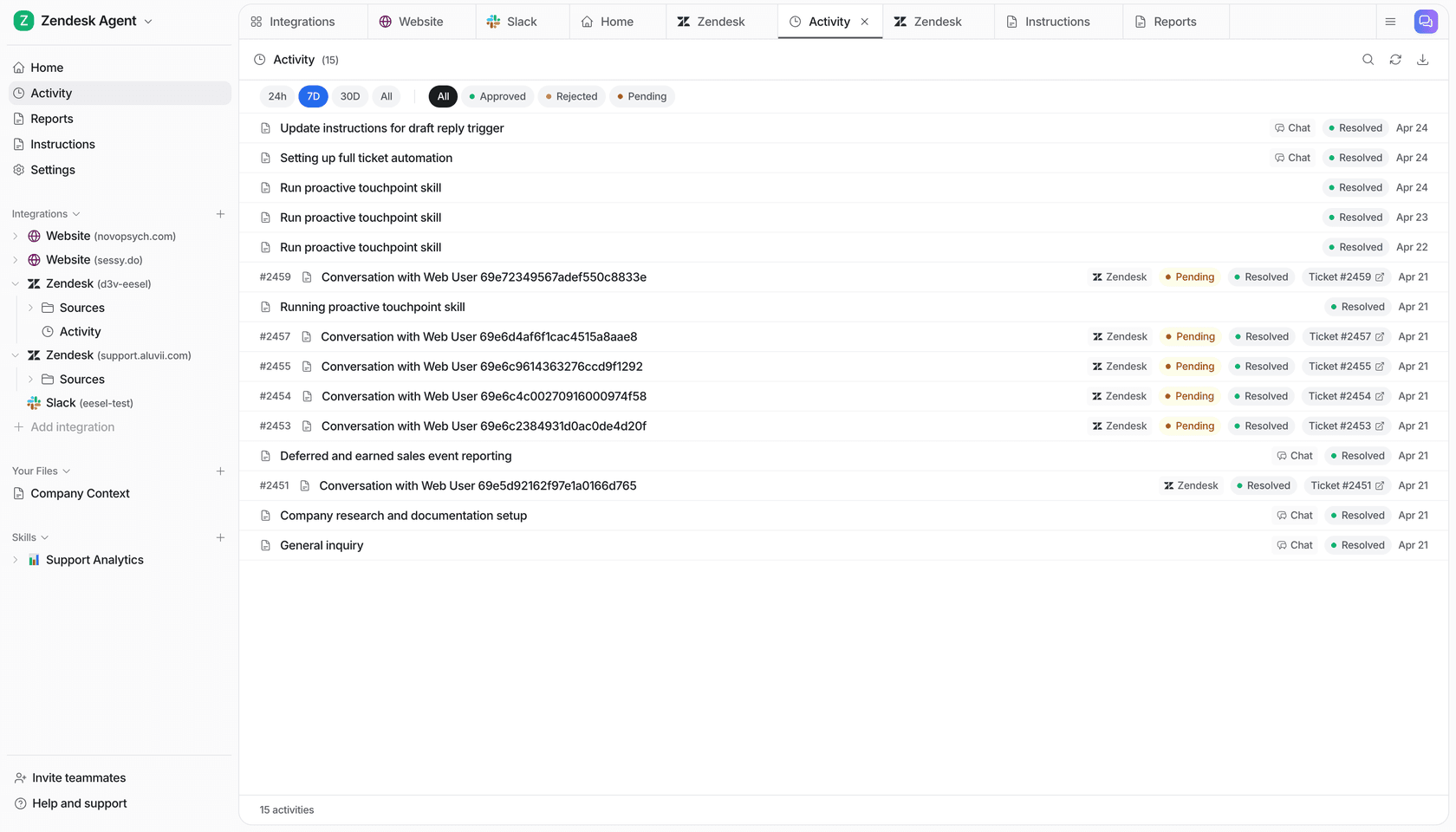
Gridwise - a gig-economy driver analytics platform in the transportation space - deployed eesel on Zendesk and saw 73% of tier-1 requests resolved in the first month, with results showing up within a 7-day trial. The eesel reports dashboard lets you see exactly which categories the AI is covering, where it's escalating, and where knowledge gaps exist.
Pricing starts at $0.40 per resolved ticket, no platform fee, no seat costs, and a $50 free trial. For a logistics operation handling 2,000 tier-1 tickets per month, full AI resolution runs to roughly $800/month - with 24/7 coverage and no additional headcount required. Try eesel and see what your resolution rate looks like after seven days.
Frequently Asked Questions

Share this article

Article by
Riellvriany Indriawan
Riell is a designer and writer at eesel AI with about two years of experience researching CX platforms, AI chatbots, and helpdesk software. She combines her design background with a sharp eye for how these tools actually look and feel in practice — making her comparisons unusually visual and user-focused.