
| Observation data Epoch J2000 Equinox J2000 | |
|---|---|
| Constellation | Eridanus |
| Right ascension | 04h 40m 26.51159s[1] |
| Declination | −19° 40′ 17.3723″[1] |
| Apparent magnitude (V) | 4.32[2] |
| Characteristics | |
| Evolutionary stage | asymptotic giant branch[3] |
| Spectral type | M3/4 III[4] |
| U−B color index | +1.80[5] |
| B−V color index | 1.599±0.021[2] |
| Variable type | SRb[6] |
| Astrometry | |
| Radial velocity (Rv) | −32.9±0.8[2] km/s |
| Proper motion (μ) | RA: +29.13[7] mas/yr Dec.: −96.42[7] mas/yr |
| Parallax (π) | 8.2063±0.2709 mas[1] |
| Distance | 400 ± 10 ly (122 ± 4 pc) |
| Absolute magnitude (MV) | −0.93[2] |
| Details | |
| Mass | 3.95[8] M☉ |
| Radius | 69+12 −6[1] R☉ |
| Luminosity | 2,239[8] L☉ |
| Surface gravity (log g) | 1.98[9] cgs |
| Temperature | 3,500[8] K |
| Metallicity [Fe/H] | 0.00[8] dex |
| Other designations | |
| DM Eridani, BD−19°988, GC 5695, HD 29755, HIP 21763, HR 1496, SAO 149818, WDS J04404-1940[10] | |
| Database references | |
| SIMBAD | data |


54 Eridani is a suspected astrometric binary[11] star system located around 400 light years from the Sun in the barely equatorial-southern constellation of Eridanus. It is visible to the naked eye as a faint, reddish hued star with a baseline apparent visual magnitude of 4.32.[2] The object is moving closer to the Earth with a heliocentric radial velocity of −33 km/s.[2]

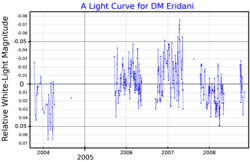
The variability of 54 Eridani was announced by Benjamin Apthorp Gould in his Uranometria Argentina, published in 1879.[13] But it was not given its variable star designation, DM Eridani, until nearly 100 years later, in 1973.[14] The visible component is an aging red giant star, currently on the asymptotic giant branch,[3] with a stellar classification of M3/4 III.[4] It is a semiregular variable star of subtype SRb, ranging in magnitude from 4.28 down to 4.36.[6] The star has pulsation periods of 18.8 and 45.5 days, each with an amplitude of 0.019 in magnitude.[12] With the hydrogen and helium at its core exhausted, the star has expanded to around 69 times the Sun's radius and it is radiating 1,021 times the luminosity of the Sun from its swollen photosphere at an effective temperature of 3,915 K.[1]
It was the second-brightest star in the obsolete constellation of Sceptrum Brandenburgicum after 53 Eridani.
References
[edit]- ^ a b c d e Brown, A. G. A.; et al. (Gaia collaboration) (August 2018). "Gaia Data Release 2: Summary of the contents and survey properties". Astronomy & Astrophysics. 616. A1. arXiv:1804.09365. Bibcode:2018A&A...616A...1G. doi:10.1051/0004-6361/201833051. Gaia DR2 record for this source at VizieR.
- ^ a b c d e f Anderson, E.; Francis, Ch. (2012), "XHIP: An extended hipparcos compilation", Astronomy Letters, 38 (5): 331, arXiv:1108.4971, Bibcode:2012AstL...38..331A, doi:10.1134/S1063773712050015, S2CID 119257644.
- ^ a b Eggen, Olin J. (July 1992), "Asymptotic giant branch stars near the sun", Astronomical Journal, 104 (1): 275–313, Bibcode:1992AJ....104..275E, doi:10.1086/116239.
- ^ a b Houk, Nancy; Smith-Moore, M. (1978), Michigan catalogue of two-dimensional spectral types for the HD stars, vol. 4, Ann Arbor: Dept. of Astronomy, University of Michigan, Bibcode:1988mcts.book.....H.
- ^ Mermilliod, J.-C. (1986). "Compilation of Eggen's UBV data, transformed to UBV (unpublished)". Catalogue of Eggen's UBV Data. Bibcode:1986EgUBV........0M.
- ^ a b Samus, N. N.; et al. (2017), "General Catalogue of Variable Stars", Astronomy Reports, 5.1, 61 (1): 80–88, Bibcode:2017ARep...61...80S, doi:10.1134/S1063772917010085, S2CID 125853869.
- ^ a b Van Leeuwen, F. (2007), "Validation of the new Hipparcos reduction", Astronomy and Astrophysics, 474 (2): 653–664, arXiv:0708.1752, Bibcode:2007A&A...474..653V, doi:10.1051/0004-6361:20078357, S2CID 18759600.
- ^ a b c d Charbonnel, C.; Lagarde, N.; Jasniewicz, G.; North, P. L.; Shetrone, M.; Krugler Hollek, J.; Smith, V. V.; Smiljanic, R.; Palacios, A.; Ottoni, G. (2020). "Lithium in red giant stars: Constraining non-standard mixing with large surveys in the Gaia era". Astronomy and Astrophysics. 633: A34. arXiv:1910.12732. Bibcode:2020A&A...633A..34C. doi:10.1051/0004-6361/201936360.
- ^ Khalatyan, A.; Anders, F.; Chiappini, C.; Queiroz, A. B. A.; Nepal, S.; Dal Ponte, M.; Jordi, C.; Guiglion, G.; Valentini, M.; Torralba Elipe, G.; Steinmetz, M.; Pantaleoni-González, M.; Malhotra, S.; Jiménez-Arranz, Ó.; Enke, H.; Casamiquela, L.; Ardèvol, J. (2024). "Transferring spectroscopic stellar labels to 217 million Gaia DR3 XP stars with SHBoost". Astronomy and Astrophysics. 691: A98. arXiv:2407.06963. Bibcode:2024A&A...691A..98K. doi:10.1051/0004-6361/202451427.
- ^ "54 Eri". SIMBAD. Centre de données astronomiques de Strasbourg. Retrieved 2019-05-28.
- ^ Eggleton, P. P.; Tokovinin, A. A. (September 2008), "A catalogue of multiplicity among bright stellar systems", Monthly Notices of the Royal Astronomical Society, 389 (2): 869–879, arXiv:0806.2878, Bibcode:2008MNRAS.389..869E, doi:10.1111/j.1365-2966.2008.13596.x, S2CID 14878976.
- ^ a b Tabur, V.; et al. (December 2009), "Long-term photometry and periods for 261 nearby pulsating M giants", Monthly Notices of the Royal Astronomical Society, 400 (4): 1945–1961, arXiv:0908.3228, Bibcode:2009MNRAS.400.1945T, doi:10.1111/j.1365-2966.2009.15588.x, S2CID 15358380.
- ^ Gould, Benjamin Apthorp (1879). "Uranometria Argentina: Brightness and position of every fixed star, down to the seventh magnitude, within one hundred degrees of the South Pole; with atlas". Resultados del Observatorio Nacional Argentino. 1: 162, 273. Bibcode:1879RNAO....1....1G.
- ^ Kukarkin, B. V.; Kholopov, P. N.; Kukarkina, N. P.; Perova, N. B. (October 1973). "59th Name-List of Variable Stars" (PDF). Information Bulletin on Variable Stars. 834 (1–22): 1. Bibcode:1973IBVS..834....1K. Retrieved 8 December 2024.
