

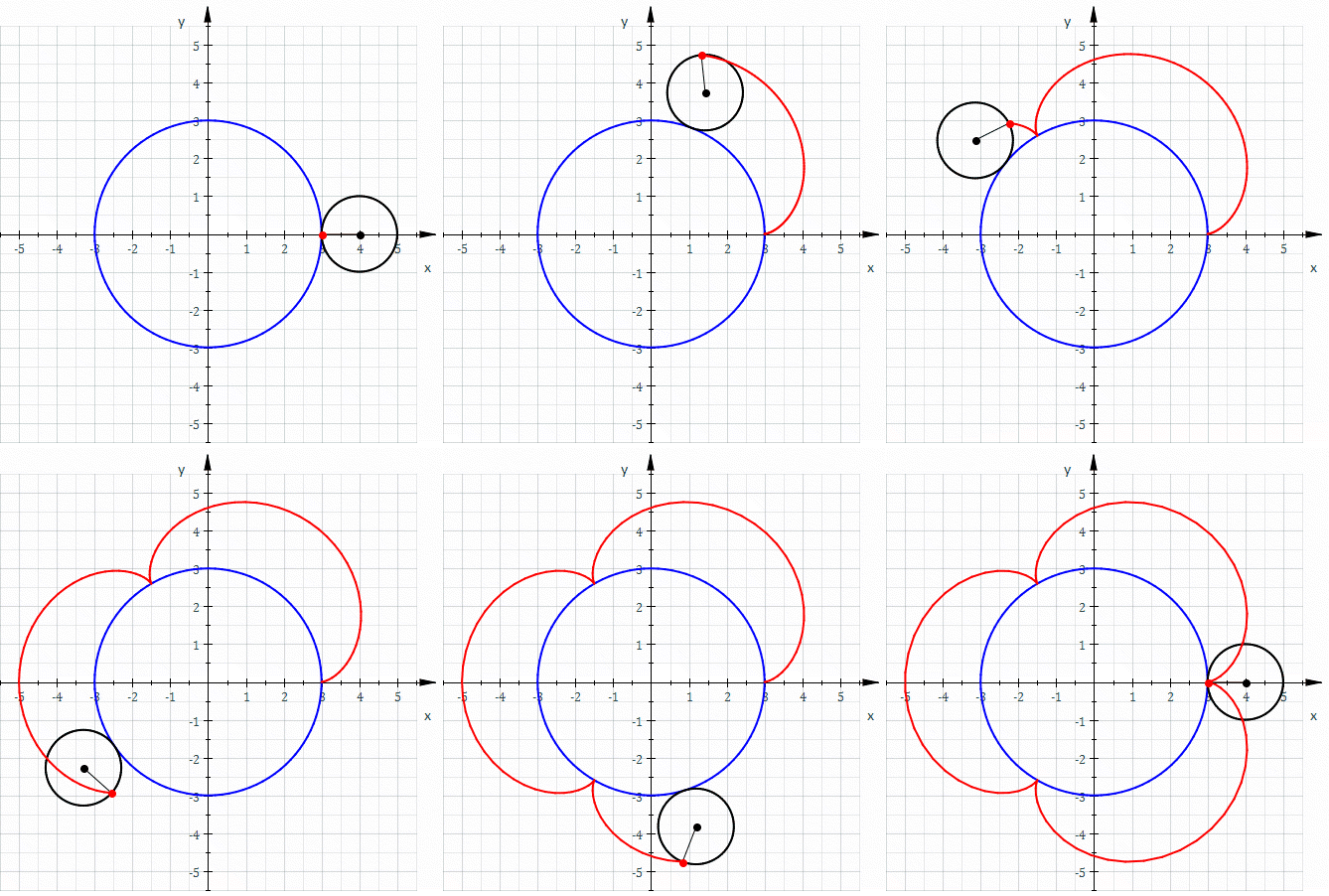
In geometry, an epicycloid (also called hypercycloid)[1] is a plane curve produced by tracing the path of a chosen point on the circumference of a circle—called an epicycle—which rolls without slipping around a fixed circle. It is a particular kind of roulette.
An epicycloid with a minor radius (R2) of 0 is a circle. This is a degenerate form.
Equations
[edit]If the rolling circle has radius 👁 {\displaystyle r}
, and the fixed circle has radius 👁 {\displaystyle R=kr}
, then the parametric equations for the curve can be given by either:
or:
This can be written in a more concise form using complex numbers as[2]
where
- the angle 👁 {\displaystyle \theta \in [0,2\pi ],}
- the rolling circle has radius 👁 {\displaystyle r}
, and - the fixed circle has radius 👁 {\displaystyle kr}
.
Area and arc length
[edit]Assuming the initial point lies on the larger circle, when 👁 {\displaystyle k}
is a positive integer, the area 👁 {\displaystyle A}
and arc length 👁 {\displaystyle s}
of this epicycloid are
It means that the epicycloid is 👁 {\displaystyle {\frac {(k+1)(k+2)}{k^{2}}}}
larger in area than the original stationary circle.
If 👁 {\displaystyle k}
is a positive integer, then the curve is closed, and has k cusps (i.e., sharp corners).
If 👁 {\displaystyle k}
is a rational number, say 👁 {\displaystyle k=p/q}
expressed as irreducible fraction, then the curve has 👁 {\displaystyle p}
cusps.
| To close the curve and |
| complete the 1st repeating pattern : |
| θ = 0 to q rotations |
| α = 0 to p rotations |
| total rotations of outer rolling circle = p + q rotations |
Count the animation rotations to see p and q
If 👁 {\displaystyle k}
is an irrational number, then the curve never closes, and forms a dense subset of the space between the larger circle and a circle of radius 👁 {\displaystyle R+2r}
.
The distance 👁 {\displaystyle {\overline {OP}}}
from the origin to the point 👁 {\displaystyle p}
on the small circle varies up and down as
where
- 👁 {\displaystyle R}
= radius of large circle and - 👁 {\displaystyle 2r}
= diameter of small circle .
- Epicycloid examples
-
k = 1; a cardioid
-
k = 2; a nephroid
-
k = 3; a trefoiloid
-
k = 4; a quatrefoiloid
-
k = 2.1 = 21/10
-
k = 3.8 = 19/5
-
k = 5.5 = 11/2
-
k = 7.2 = 36/5


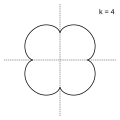

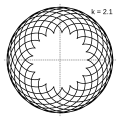


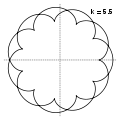


The epicycloid is a special kind of epitrochoid.
An epicycle with one cusp is a cardioid, two cusps is a nephroid.
An epicycloid and its evolute are similar.[3]
Proof
[edit]

Assuming that the position of 👁 {\displaystyle p}
is what has to be solved, 👁 {\displaystyle \alpha }
is the angle from the tangential point to the moving point 👁 {\displaystyle p}
, and 👁 {\displaystyle \theta }
is the angle from the starting point to the tangential point.
Since there is no sliding between the two cycles, then
By the definition of angle (which is the rate arc over radius), then
and
From these two conditions, the following identity is obtained
By calculating, the relation between 👁 {\displaystyle \alpha }
and 👁 {\displaystyle \theta }
is obtained, which is
From the figure, the position of the point 👁 {\displaystyle p}
on the small circle is clearly visible.
- 👁 {\displaystyle x=\left(R+r\right)\cos \theta -r\cos \left(\theta +\alpha \right)=\left(R+r\right)\cos \theta -r\cos \left({\frac {R+r}{r}}\theta \right)}
- 👁 {\displaystyle y=\left(R+r\right)\sin \theta -r\sin \left(\theta +\alpha \right)=\left(R+r\right)\sin \theta -r\sin \left({\frac {R+r}{r}}\theta \right)}
See also
[edit]

- List of periodic functions
- Cycloid
- Cyclogon
- Deferent and epicycle
- Epicyclic gearing
- Epitrochoid
- Hypocycloid
- Hypotrochoid
- Multibrot set
- Roulette (curve)
- Spirograph
References
[edit]- J. Dennis Lawrence (1972). A catalog of special plane curves. Dover Publications. pp. 161, 168–170, 175. ISBN 978-0-486-60288-2.
External links
[edit]- Weisstein, Eric W. "Epicycloid". MathWorld.
- "Epicycloid" by Michael Ford, The Wolfram Demonstrations Project, 2007
- O'Connor, John J.; Robertson, Edmund F., "Epicycloid", MacTutor History of Mathematics Archive, University of St Andrews
- Animation of Epicycloids, Pericycloids and Hypocycloids
- Spirograph -- GeoFun
- Historical note on the application of the epicycloid to the form of Gear Teeth