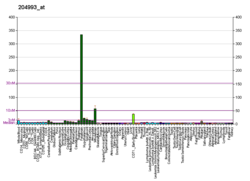
Protein-coding gene in the species Homo sapiens
Guanine nucleotide-binding protein G(z) subunit alpha is a protein that in humans is encoded by the GNAZ gene.[5][6]
The protein encoded by this gene is a member of a G protein subfamily that mediates signal transduction in pertussis toxin-insensitive systems. This encoded protein may play a role in maintaining the ionic balance of perilymphatic and endolymphatic cochlear fluids.[6]
GNAZ has been shown to interact with EYA2,[7] RGS20[8][9] and RGS19.[7][10]
- ^ a b c GRCh38: Ensembl release 89: ENSG00000128266 – Ensembl, May 2017
- ^ a b c GRCm38: Ensembl release 89: ENSMUSG00000040009 – Ensembl, May 2017
- ^ "Human PubMed Reference:". National Center for Biotechnology Information, U.S. National Library of Medicine.
- ^ "Mouse PubMed Reference:". National Center for Biotechnology Information, U.S. National Library of Medicine.
- ^ Matsuoka M, Itoh H, Kaziro Y (September 1990). "Characterization of the human gene for Gx alpha, a pertussis toxin-insensitive regulatory GTP-binding protein". J. Biol. Chem. 265 (22): 13215–20. doi:10.1016/S0021-9258(19)38287-0. PMID 2115889.
- ^ a b "Entrez Gene: GNAZ guanine nucleotide binding protein (G protein), alpha z polypeptide".
- ^ a b Fan X, Brass LF, Poncz M, Spitz F, Maire P, Manning DR (October 2000). "The alpha subunits of Gz and Gi interact with the eyes absent transcription cofactor Eya2, preventing its interaction with the six class of homeodomain-containing proteins". J. Biol. Chem. 275 (41): 32129–34. doi:10.1074/jbc.M004577200. PMID 10906137.
- ^ Nagahama M, Usui S, Shinohara T, Yamaguchi T, Tani K, Tagaya M (December 2002). "Inactivation of Galpha(z) causes disassembly of the Golgi apparatus". J. Cell Sci. 115 (Pt 23): 4483–93. doi:10.1242/jcs.00093. PMID 12414994. S2CID 37993828.
- ^ Glick JL, Meigs TE, Miron A, Casey PJ (October 1998). "RGSZ1, a Gz-selective regulator of G protein signaling whose action is sensitive to the phosphorylation state of Gzalpha". J. Biol. Chem. 273 (40): 26008–13. doi:10.1074/jbc.273.40.26008. PMID 9748279.
- ^ De Vries L, Elenko E, Hubler L, Jones TL, Farquhar MG (December 1996). "GAIP is membrane-anchored by palmitoylation and interacts with the activated (GTP-bound) form of G alpha i subunits". Proc. Natl. Acad. Sci. U.S.A. 93 (26): 15203–8. Bibcode:1996PNAS...9315203D. doi:10.1073/pnas.93.26.15203. PMC 26381. PMID 8986788.
- Wilkie TM, Gilbert DJ, Olsen AS, Chen XN, Amatruda TT, Korenberg JR, Trask BJ, de Jong P, Reed RR, Simon MI (1992). "Evolution of the mammalian G protein alpha subunit multigene family". Nat. Genet. 1 (2): 85–91. doi:10.1038/ng0592-85. PMID 1302014. S2CID 31888533.
- Jiang M, Pandey S, Tran VT, Fong HK (1991). "Guanine nucleotide-binding regulatory proteins in retinal pigment epithelial cells". Proc. Natl. Acad. Sci. U.S.A. 88 (9): 3907–11. Bibcode:1991PNAS...88.3907J. doi:10.1073/pnas.88.9.3907. PMC 51562. PMID 1902575.
- Gagnon AW, Manning DR, Catani L, Gewirtz A, Poncz M, Brass LF (1991). "Identification of Gz alpha as a pertussis toxin-insensitive G protein in human platelets and megakaryocytes". Blood. 78 (5): 1247–53. doi:10.1182/blood.V78.5.1247.1247. PMID 1908722.
- Hinton DR, Blanks JC, Fong HK, Casey PJ, Hildebrandt E, Simons MI (1990). "Novel localization of a G protein, Gz-alpha, in neurons of brain and retina". J. Neurosci. 10 (8): 2763–70. doi:10.1523/JNEUROSCI.10-08-02763.1990. PMC 6570268. PMID 2117645.
- Mumby SM, Heukeroth RO, Gordon JI, Gilman AG (1990). "G-protein alpha-subunit expression, myristoylation, and membrane association in COS cells". Proc. Natl. Acad. Sci. U.S.A. 87 (2): 728–32. Bibcode:1990PNAS...87..728M. doi:10.1073/pnas.87.2.728. PMC 53339. PMID 2153964.
- Matsuoka M, Itoh H, Kozasa T, Kaziro Y (1988). "Sequence analysis of cDNA and genomic DNA for a putative pertussis toxin-insensitive guanine nucleotide-binding regulatory protein alpha subunit". Proc. Natl. Acad. Sci. U.S.A. 85 (15): 5384–8. Bibcode:1988PNAS...85.5384M. doi:10.1073/pnas.85.15.5384. PMC 281761. PMID 2456569.
- Blatt C, Eversole-Cire P, Cohn VH, Zollman S, Fournier RE, Mohandas LT, Nesbitt M, Lugo T, Jones DT, Reed RR (1988). "Chromosomal localization of genes encoding guanine nucleotide-binding protein subunits in mouse and human". Proc. Natl. Acad. Sci. U.S.A. 85 (20): 7642–6. Bibcode:1988PNAS...85.7642B. doi:10.1073/pnas.85.20.7642. PMC 282248. PMID 2902634.
- Fong HK, Yoshimoto KK, Eversole-Cire P, Simon MI (1988). "Identification of a GTP-binding protein alpha subunit that lacks an apparent ADP-ribosylation site for pertussis toxin". Proc. Natl. Acad. Sci. U.S.A. 85 (9): 3066–70. Bibcode:1988PNAS...85.3066F. doi:10.1073/pnas.85.9.3066. PMC 280144. PMID 3129724.
- Fields TA, Casey PJ (1995). "Phosphorylation of Gz alpha by protein kinase C blocks interaction with the beta gamma complex". J. Biol. Chem. 270 (39): 23119–25. doi:10.1074/jbc.270.39.23119. PMID 7559455.
- Lounsbury KM, Schlegel B, Poncz M, Brass LF, Manning DR (1993). "Analysis of Gz alpha by site-directed mutagenesis. Sites and specificity of protein kinase C-dependent phosphorylation". J. Biol. Chem. 268 (5): 3494–8. doi:10.1016/S0021-9258(18)53721-2. PMID 8429024.
- Linder ME, Middleton P, Hepler JR, Taussig R, Gilman AG, Mumby SM (1993). "Lipid modifications of G proteins: alpha subunits are palmitoylated". Proc. Natl. Acad. Sci. U.S.A. 90 (8): 3675–9. Bibcode:1993PNAS...90.3675L. doi:10.1073/pnas.90.8.3675. PMC 46364. PMID 8475115.
- Hunt TW, Fields TA, Casey PJ, Peralta EG (1996). "RGS10 is a selective activator of G alpha i GTPase activity". Nature. 383 (6596): 175–7. Bibcode:1996Natur.383..175H. doi:10.1038/383175a0. PMID 8774883. S2CID 4318445.
- Magovcevic I, Khetarpal U, Bieber FR, Morton CC (1995). "GNAZ in human fetal cochlea: expression, localization, and potential role in inner ear function". Hear. Res. 90 (1–2): 55–64. doi:10.1016/0378-5955(95)00146-8. PMID 8975005. S2CID 4762404.
- De Vries L, Elenko E, Hubler L, Jones TL, Farquhar MG (1996). "GAIP is membrane-anchored by palmitoylation and interacts with the activated (GTP-bound) form of G alpha i subunits". Proc. Natl. Acad. Sci. U.S.A. 93 (26): 15203–8. Bibcode:1996PNAS...9315203D. doi:10.1073/pnas.93.26.15203. PMC 26381. PMID 8986788.
- Ho MK, Wong YH (1997). "Functional role of amino-terminal serine16 and serine27 of G alphaZ in receptor and effector coupling". J. Neurochem. 68 (6): 2514–22. doi:10.1046/j.1471-4159.1997.68062514.x. PMID 9166747.
- Sidhu A, Kimura K, Uh M, White BH, Patel S (1998). "Multiple coupling of human D5 dopamine receptors to guanine nucleotide binding proteins Gs and Gz". J. Neurochem. 70 (6): 2459–67. doi:10.1046/j.1471-4159.1998.70062459.x. PMID 9603210. S2CID 35877239.
- Lin P, Le-Niculescu H, Hofmeister R, McCaffery JM, Jin M, Hennemann H, McQuistan T, De Vries L, Farquhar MG (1998). "The mammalian calcium-binding protein, nucleobindin (CALNUC), is a Golgi resident protein". J. Cell Biol. 141 (7): 1515–27. doi:10.1083/jcb.141.7.1515. PMC 2132997. PMID 9647645.
- Glick JL, Meigs TE, Miron A, Casey PJ (1998). "RGSZ1, a Gz-selective regulator of G protein signaling whose action is sensitive to the phosphorylation state of Gzalpha". J. Biol. Chem. 273 (40): 26008–13. doi:10.1074/jbc.273.40.26008. PMID 9748279.