

Jakarta | |
|---|---|
| Special Region of Jakarta Daerah Khusus Jakarta | |
| Nicknames: | |
| Motto(s): | |
| 👁 Map Interactive map of Jakarta | |
Location In Indonesia Location in Asia | |
| Coordinates: 6°11′S 106°50′E / 6.18°S 106.83°E / -6.18; 106.83 | |
| Country | 👁 Image Indonesia |
| Region | Java |
| Metropolitan area | Jabodetabek |
| Administrative section | |
| First settled | 400 BC (Buni pottery culture) |
| First mentioned | 358 AD (Tugu inscription) |
| Foundation | 22 June 1527; 498 years ago (1527-06-22)[2] |
| Establishment | 30 May 1619; 406 years ago (1619-05-30)[3] |
| City status | 4 March 1621; 405 years ago (1621-03-04)[2] |
| Province status | 28 August 1961; 64 years ago (1961-08-28)[2] |
| Capital | Central Jakarta (de facto)[a] |
| Government | |
| • Type | Special administrative region |
| • Body | Special Region of Jakarta Provincial Government |
| • Governor | Pramono Anung (PDI-P) |
| • Vice Governor | Rano Karno |
| • Legislature | Jakarta Regional House of Representatives (DPRD) |
| Area | |
| 662 km2 (256 sq mi) | |
| • Urban | 3,546 km2 (1,369 sq mi) |
| • Metro | 7,076.31 km2 (2,732.18 sq mi) |
| • Rank | 38th in Indonesia |
| Elevation | 8 m (26 ft) |
| Population (mid 2025)[4] | |
| 10,677,975 | |
| • Rank | 6th province in Indonesia 1st city in Indonesia |
| • Density | 16,100/km2 (41,800/sq mi) |
| • Urban | 35,386,000 |
| • Urban density | 9,979/km2 (25,850/sq mi) |
| • Metro | 32,594,159 |
| • Metro density | 4,606.10/km2 (11,929.7/sq mi) |
| Demonym | Jakartan |
| GDP (Nominal, 2023) | |
| • Special region | |
| • Per capita | |
| • Metro | |
| Time zone | UTC+07:00 (WIB) |
| Postal codes |
|
| Area code | +62 21 |
| ISO 3166 code | ID-JK |
| Vehicle registration | B |
| HDI (2024) | 👁 Increase 0.850[9] (1st) – very high |
| Website | www.jakarta.go.id 👁 Edit this at Wikidata |


.jpg)

_Fatahillah_Square_(2025)_-_img_03.jpg)




.jpg)
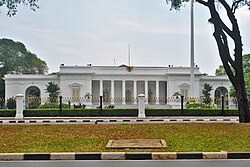


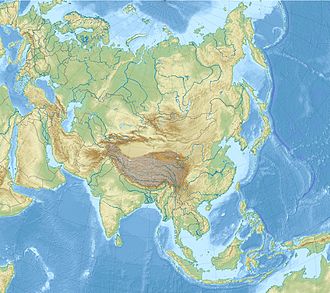


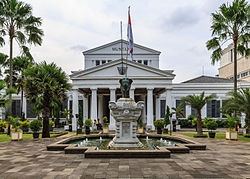
Jakarta,[b] officially the Special Region of Jakarta, previously called the Special Capital Region of Jakarta,[c] is the de facto capital and largest city of Indonesia and an autonomous region with administrative status equivalent to a province. Located on the northwest coast of Java, the world’s most populous island, the city borders the provinces of West Java and Banten and faces the Java Sea to the north. Although Jakarta covers about 662 square kilometres (256 square miles), the wider Jakarta metropolitan area—commonly known as Greater Jakarta—is one of the largest urban agglomerations in the world. The city serves as Indonesia’s political, economic, and cultural centre and hosts numerous national institutions, corporate headquarters, and the secretariat of the Association of Southeast Asian Nations (ASEAN).
The area that is now Jakarta has been inhabited since at least the early centuries of the Common Era and was historically associated with the port of Sunda Kelapa, which served the Sunda Kingdom. In 1527, the settlement was renamed Jayakarta, following its capture by forces of the Demak Sultanate. The Dutch East India Company (VOC) later seized the city in 1619 and rebuilt it as Batavia, which became the centre of VOC power, and later of Dutch colonial rule in Indonesia for more than three centuries. After the Japanese occupation during the Second World War and Indonesia’s declaration of independence in 1945, the city adopted the name Jakarta and became the capital of the newly independent republic.
Classified as an alpha world city, Jakarta is Indonesia’s principal financial and commercial hub, and plays a central role in the country’s economy and regional trade across Southeast Asia. The city hosts the headquarters of major Indonesian corporations, financial institutions, and the Indonesia Stock Exchange, and has developed into a major centre for business, media, and international diplomacy. Rapid urbanisation since the mid-20th century has transformed Jakarta into a vast metropolitan region, attracting migrants from across the Indonesian archipelago and contributing to its position as the country’s most populous city and one of the largest urban economies in the region.
Jakarta is a highly diverse city with no single dominant ethnic group. Its population includes large communities of Javanese, Betawi, Sundanese, Chinese Indonesians, and migrants from many other regions of Indonesia. Indonesian is the official language and the primary means of communication, while Betawi culture reflects the historical blending of local, Chinese, Arab, and European influences that developed during the colonial period. As Indonesia’s capital and largest metropolis, Jakarta struggles with urban challenges including traffic congestion, air pollution, flooding, and land subsidence, issues that have contributed to the national government’s decision to relocate Indonesia’s future capital to Nusantara in East Kalimantan.
Etymology
[edit]The area that is now Jakarta has been known by several names throughout its history. The earliest references appear in the Tugu inscription from the Tarumanagara kingdom in the 5th century, while later sources associate the early settlement with the name Sundapura.[10] In subsequent centuries, the harbour settlement became known as Sunda Kelapa, serving as the principal port of the Sunda Kingdom on the north coast of western Java.[11]
The name Jayakarta was introduced in the 16th century.[12] It derives from the Sanskrit words (Devanagari: जयकर्त), namely जय jaya (victory),[13] and कृत krta (accomplished or acquired),[14] meaning “complete victory” or “victorious deed.” Early European accounts recorded the name in forms such as Jacatra or Jacarta.[15] The name reflected political changes in the region during this period and remained in use until the early 17th century.[11]
In 1619, the Dutch East India Company (VOC) renamed the city Batavia, after the Batavi, a Germanic tribe regarded by the Dutch as their ancestors.[11] The name remained in official use for more than three centuries during the Dutch colonial period. During the Japanese occupation in the Second World War, the city was briefly renamed (Japanese: ジャカルタ特別市, romanized: Jakaruta Tokubetsu-shi, lit. 'Jakarta Special Municipality'),[16] after which the Indonesian form Jakarta became the official name following Indonesian independence.[16]
History
[edit]Early settlements and Sunda Kelapa
[edit]

The area that now forms Jakarta has been inhabited since prehistoric times. Archaeological evidence from the Buni culture, which flourished on the north coast of western Java between roughly 400 BC and 100 AD,[17] indicates early settlements in the region. By the 5th century, the area had become part of the Sundanese kingdom of Tarumanagara, one of the earliest Hindu kingdoms in the archipelago.[11][17] The Tugu inscription, discovered in present-day North Jakarta and dated to the mid 5th century,[18] records hydraulic projects undertaken by King Purnawarman, including irrigation and river management works along the Candrabhaga and Gomati rivers near the kingdom’s capital.[18]
Following the decline of Tarumanagara, the region became part of the Kingdom of Sunda.[19] From the early medieval period to the early 13th century, ports in the Sunda/western Java region were integrated into regional maritime networks. Chinese sources such as the Chu-fan-chi describe Sunda as part of the San-fo-tsi (the Srivijaya maritime empire) sphere and note the quality of Sunda pepper.[20] By the 16th century, Sunda Kelapa had become the principal commercial port of the Sunda Kingdom and was connected to wider Asian trade networks.[11][21]
European involvement in the region began in the early 16th century when Portuguese ships from Malacca arrived in 1513 while searching for new spice routes.[22] In 1522, the Sunda Kingdom concluded an alliance with Portugal,[23] granting permission for the construction of a trading post to counter the growing power of the Demak Sultanate in central Java. The arrangement was short-lived. In 1527, forces from Demak led by the military commander Fatahillah captured Sunda Kelapa and expelled the Portuguese.[23][24] The port was renamed Jayakarta and later became a possession of the Banten Sultanate, developing into a significant regional trading centre.[23]
Batavia under Dutch rule
[edit]
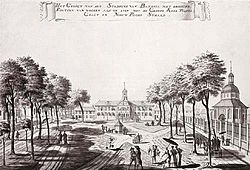
Conflict surrounding Prince Jayawikarta's Jayakarta, involving the Dutch East India Company (VOC), the English, and the Banten Sultanate, ultimately enabled the Dutch to seize control of the city.[25] In May 1619, Dutch forces under Jan Pieterszoon Coen returned with reinforcements, defeated the English in the confrontation around Jayakarta, and overran and destroyed the city.[26] The Dutch subsequently established a fortified colonial city on the site and renamed it Batavia,[26] which became the centre of VOC operations.[27]
Batavia developed into a major trading hub within the Dutch colonial empire.[28] Commercial activity attracted migrants from across Asia, including Chinese, Arab, and other trading communities.[28] Rapid population growth, however, also produced social tensions.[29] In 1740, a revolt by Chinese residents led to a violent suppression in which thousands were killed,[30] after which Chinese inhabitants were relocated to the Glodok district outside the city walls.[31] Over time, Batavia continued to expand as trade increased[32] and new immigrant communities settled in the city.[28]
During the 19th and early 20th centuries, the city expanded southward as epidemics and overcrowding in the old port district encouraged new residential developments further inland.[33] Urban planning projects created new districts such as Menteng, developed in the 1910s as a planned residential suburb,[34] while Kebayoran Baru became one of the last major residential areas constructed during the late colonial period.[31][35] Dutch colonial rule ended in March 1942 when Japanese forces captured the city during the Second World War and renamed it Jakarta (Jakarta Special City (ジャカルタ特別市, Jakaruta tokubetsu-shi)), marking the beginning of a new phase in the city’s history.[36]
Jakarta in independent Indonesia
[edit]
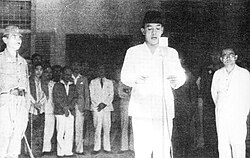
Following the end of the Second World War, Indonesian nationalists proclaimed independence on 17 August 1945.[37][38][39] In the following month, the city administration was reorganised under Indonesian leadership as the Jakarta City National Administration (Pemerintah Nasional Kota Jakarta).[40] During the Indonesian National Revolution, republican leaders withdrew from Jakarta after British troops entered the city and established their temporary capital in Yogyakarta.[41] After the Netherlands recognised Indonesian sovereignty in December 1949, Jakarta resumed its role as the national capital in 1950.[31]
During Sukarno's presidency, Jakarta was reshaped into the symbolic showcase of the new Indonesian nation. Preparations for the 1962 Asian Games, part of Sukarno's broader programme of nation-building and international representation, prompted major urban development projects in the city. These included the National Monument, the Hotel Indonesia complex, new shopping centres, and major boulevards such as the MH Thamrin-Sudirman street.[42] Sukarno envisioned Jakarta as a modern international city representing Indonesia’s independence and national identity.[43]
Political tensions reached a turning point in October 1965 when an attempted coup resulted in the killing of six senior army generals, triggering a nationwide anti-communist purge that killed hundreds of thousands of people,[44] and marking the beginning of Suharto's New Order. In 1964, Jakarta was legally designated a Special Capital Region (Daerah Khusus Ibukota, DKI) with administrative status equivalent to a province.[45] During the governorship of Ali Sadikin (1966–1977), the city underwent major urban reforms,[46] including infrastructure improvements, the expansion of hospitals and schools, and cultural development programmes,[47] although large-scale redevelopment projects also displaced many low-income and informal settlements.[48][49][50]
Jakarta continued to expand rapidly during the late 20th and early 21st centuries. Foreign investment during the late New Order period fuelled a major real estate boom,[51] although this growth was interrupted by the 1997 Asian financial crisis,[52] which caused political unrest and riots in 1998 that led to the resignation of President Suharto.[53][54] In the period that followed, Jakarta remained the centre of Indonesia’s political life and reforms,[55] including the introduction of direct gubernatorial elections in 2007.[56] The city has also experienced sporadic terrorist attacks since the early 2000s.[57] More recently, the Indonesian government announced plans to relocate the national capital to Nusantara,[58] although Jakarta continues to function as the country’s primary economic centre.[59][60]
Geography
[edit].jpg)

Jakarta covers 662 square kilometres (256 sq mi),[61] making it the smallest province in Indonesia by land area. However, the wider Jakarta metropolitan area covers about 6,392 square kilometres (2,468 sq mi) and extends into the neighbouring provinces of West Java and Banten.[61] The metropolitan area includes the regencies of Bekasi, Tangerang, and Bogor, as well as the cities of Bogor, Depok, Bekasi, Tangerang, and South Tangerang.[61]
The city lies on the northwestern coast of Java at the mouth of the Ciliwung River on the Jakarta Bay,[36] an inlet of the Java Sea. The northern part consists largely of low-lying coastal plains, some areas of which are below sea level and therefore prone to flooding, while the southern part is relatively higher.[62] Administratively, Jakarta also includes the Thousand Islands archipelago located in the Jakarta Bay to the north of the mainland city.[36]
Jakarta is situated on a flat alluvial plain with an average elevation of about 5 metres (16 feet) to 8 metres (26 feet) above sea level. Historically, Jakarta included extensive swampy areas,[36] and parts of its northern coastal zone have been developed on reclaimed land.[63][64] Thirteen rivers flow through Jakarta from the Puncak highlands in the south towards the Java Sea, including the Ciliwung, Angke, Sunter, and Grogol rivers.[65] These waterways, combined with heavy seasonal rainfall and drainage challenges, contribute to the city’s recurring flooding problems.[66]
Jakarta is also grappling with environmental challenges related to land subsidence and water management. Parts of the city—particularly in northern coastal areas—have been sinking by several centimetres per year, largely due to excessive groundwater extraction and rapid urban development.[67] Flood control projects and coastal protection measures, including sea wall systems in the Jakarta Bay, have been developed to mitigate these risks.[68][69] Air pollution and water pollution, especially in Jakarta’s rivers, are major environmental problems in the city.[70][71]
Climate
[edit]

Jakarta has a tropical monsoon climate (Köppen: Am). It has a long wet season from October to May and a relatively drier season from June to September, although rainfall occurs year-round. The heaviest precipitation typically occurs between December and March, when the average monthly rainfall is more than 150 millimetres, while July and August are usually the driest months.[72][73]
Seasonal weather patterns contribute to recurring flooding in Jakarta. During the wet season, monsoon-related atmospheric circulation over western Java can intensify rainfall and increase river discharge into the city.[70][74] Combined with Jakarta’s low-lying topography, inadequate drainage, and dense urban development, these conditions contribute to recurrent floods.[70][72]
Temperatures in Jakarta remain consistently warm throughout the year. Mean daily maximum temperatures are generally around 30 °C (86.0 °F) to 32 °C (89.6 °F), and mean daily minimum temperatures around 24 °C (75.2 °F) to 25 °C (77.0 °F), while average monthly temperatures vary only slightly, at roughly 27 °C (80.6 °F).[73] Recorded extremes range from about 18.9 °C (66.0 °F) to 37.9 °C (100.2 °F).
| Climate data for downtown Jakarta (Kemayoran) (1991–2020 normals, extremes 1924–present) | |||||||||||||
|---|---|---|---|---|---|---|---|---|---|---|---|---|---|
| Month | Jan | Feb | Mar | Apr | May | Jun | Jul | Aug | Sep | Oct | Nov | Dec | Year |
| Record high °C (°F) | 36.9 (98.4) |
35.8 (96.4) |
36.0 (96.8) |
35.9 (96.6) |
36.1 (97.0) |
36.3 (97.3) |
35.6 (96.1) |
35.6 (96.1) |
37.1 (98.8) |
37.9 (100.2) |
37.1 (98.8) |
36.7 (98.1) |
37.9 (100.2) |
| Mean daily maximum °C (°F) | 31.0 (87.8) |
30.8 (87.4) |
32.1 (89.8) |
32.8 (91.0) |
33.2 (91.8) |
32.9 (91.2) |
32.7 (90.9) |
33.0 (91.4) |
33.4 (92.1) |
33.4 (92.1) |
32.8 (91.0) |
32.0 (89.6) |
32.5 (90.5) |
| Daily mean °C (°F) | 27.5 (81.5) |
27.3 (81.1) |
28.0 (82.4) |
28.4 (83.1) |
28.7 (83.7) |
28.4 (83.1) |
28.2 (82.8) |
28.3 (82.9) |
28.6 (83.5) |
28.8 (83.8) |
28.4 (83.1) |
28.0 (82.4) |
28.2 (82.8) |
| Mean daily minimum °C (°F) | 25.2 (77.4) |
25.2 (77.4) |
25.5 (77.9) |
25.6 (78.1) |
25.8 (78.4) |
25.5 (77.9) |
25.3 (77.5) |
25.3 (77.5) |
25.5 (77.9) |
25.6 (78.1) |
25.6 (78.1) |
25.5 (77.9) |
25.5 (77.9) |
| Record low °C (°F) | 20.6 (69.1) |
20.6 (69.1) |
20.6 (69.1) |
20.6 (69.1) |
21.1 (70.0) |
19.4 (66.9) |
19.4 (66.9) |
19.4 (66.9) |
18.9 (66.0) |
20.6 (69.1) |
20.0 (68.0) |
19.4 (66.9) |
18.9 (66.0) |
| Average precipitation mm (inches) | 373.3 (14.70) |
381.4 (15.02) |
210.4 (8.28) |
164.1 (6.46) |
103.2 (4.06) |
80.4 (3.17) |
77.7 (3.06) |
51.5 (2.03) |
61.0 (2.40) |
112.2 (4.42) |
134.8 (5.31) |
183.3 (7.22) |
1,933.3 (76.11) |
| Average precipitation days (≥ 1.0 mm) | 17.5 | 17.9 | 14.1 | 11.5 | 8.2 | 6.2 | 4.8 | 3.3 | 4.0 | 7.4 | 10.4 | 12.8 | 118.1 |
| Average relative humidity (%) | 85 | 85 | 83 | 82 | 82 | 81 | 78 | 76 | 75 | 77 | 81 | 82 | 81 |
| Mean monthly sunshine hours | 139.5 | 138.3 | 189.1 | 216.0 | 220.1 | 219.0 | 229.4 | 235.6 | 225.0 | 207.7 | 180.0 | 148.8 | 2,348.5 |
| Mean daily sunshine hours | 4.5 | 5.2 | 6.1 | 7.2 | 7.1 | 7.3 | 7.4 | 7.6 | 7.5 | 6.7 | 6.0 | 4.8 | 6.5 |
| Source 1: World Meteorological Organization[75] | |||||||||||||
| Source 2: Sistema de Clasificación Bioclimática Mundial,[76] Danish Meteorological Institute (humidity),[77] Deutscher Wetterdienst (daily sun 1889–1921)[78] | |||||||||||||
| Climate data for Jakarta | |||||||||||||
|---|---|---|---|---|---|---|---|---|---|---|---|---|---|
| Month | Jan | Feb | Mar | Apr | May | Jun | Jul | Aug | Sep | Oct | Nov | Dec | Year |
| Average sea temperature °C (°F) | 28.0 (82.0) |
28.0 (82.0) |
29.0 (84.0) |
30.0 (86.0) |
30.0 (86.0) |
29.0 (84.0) |
29.0 (84.0) |
29.0 (84.0) |
29.0 (84.0) |
29.0 (84.0) |
29.0 (84.0) |
29.0 (84.0) |
29.0 (84.0) |
| Mean daily daylight hours | 12.0 | 12.0 | 12.0 | 12.0 | 12.0 | 12.0 | 12.0 | 12.0 | 12.0 | 12.0 | 12.0 | 12.0 | 12.0 |
| Average Ultraviolet index | 13 | 13 | 13 | 13 | 11 | 10 | 10 | 12 | 13 | 13 | 13 | 13 | 12 |
| Source: Weather Atlas[79] | |||||||||||||
Cityscape
[edit]

Jakarta’s cityscape reflects successive phases of the city’s development and its role as Indonesia’s political and economic centre. The urban landscape combines colonial-era districts and buildings, post-independence monumental architecture, later high-rise development, and public squares and parks. Much of the capital’s symbolic architecture and axial planning dates from the mid-twentieth century, when Sukarno sought to remake Jakarta as the monumental capital of a newly independent nation.
Several prominent landmarks and monuments were constructed or planned during this period. The most recognisable symbol of the city is the National Monument (Monas), a 132-metre-tall (433-foot) obelisk located in the centre of Merdeka Square. Other notable landmarks include the Istiqlal mosque, Jakarta Cathedral, and the historic Batavia Stadhuis in Jakarta Old Town. Monumental statues and memorials commemorating Indonesian history and national heroes are also prominent features of the city, including the Tugu Tani monument, the Dirgantara Monument, and statues honouring figures such as Diponegoro and Kartini.[80]
Jakarta’s modern skyline has continued to evolve with rapid urban development and the construction of high-rise buildings in its central business districts. Structures such as the Autograph Tower, the tallest building in Indonesia, illustrate the city’s contemporary architectural growth. Alongside these developments, Jakarta also contains numerous parks, squares, and public spaces that form important parts of the urban environment and provide recreational areas for residents.
Architecture
[edit]
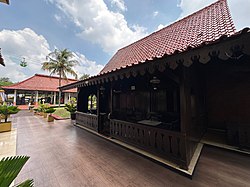
Jakarta contains architecturally significant buildings that represent a wide range of historical and cultural influences. Betawi vernacular architecture in the city incorporates elements from Malay, Arab, Chinese, and Dutch traditions.[81] Traditional Betawi houses, associated with the indigenous Betawi community, illustrate this combination of influences.[81] These houses are typically constructed using nangka wood (Artocarpus heterophyllus) and commonly consist of three main rooms.[citation needed] Their roof forms often resemble the traditional Javanese joglo,[81] while features such as wide eaves, large openings, and open layouts are well suited to the tropical climate.[82] The number of officially registered cultural heritage buildings in Jakarta has increased in recent decades as preservation efforts have expanded.[83]
Many historic structures date from the Dutch colonial era, when Batavia served as the centre of VOC operations.[84] In broad terms, colonial architecture in Jakarta can be grouped into the VOC-era phase, a 19th-century transitional / Indies Empire phase associated with the move to Weltevreden (present-day Central Jakarta), and a late-colonial modern phase in the early 20th century.[33] These buildings include residences, churches, government offices, and commercial structures, many of which remain concentrated in Jakarta Old Town and the former colonial centre of Weltevreden.[85] Architects associated with this built environment include J.C. Schultze, who worked on prominent early 19th-century buildings in Weltevreden,[33][86] and Eduard Cuypers, whose office designed major early 20th-century commercial and banking buildings in Batavia, including the former Javasche Bank (present-day Bank Indonesia Museum).[87]
During the early 20th century, architectural styles in Batavia shifted toward modernist currents, including rationalist, New Indies, and Art Deco influences.[88] The Menteng district, developed in the 1910s as a planned residential suburb, represented one of the earliest attempts to create a modern and healthy residential environment for the middle class. Houses in the area were designed with features suited to the tropical climate, including large windows, open ventilation, and overhanging eaves.[89]
Post-independence architecture in Jakarta reflected the political and cultural priorities of nation-building. Major infrastructure projects were constructed, particularly during the Sukarno era, including the National Monument and the Senayan Sports Stadium, as well as a network of arterial roads that helped reshape the city’s urban landscape.[90] The national parliament building, with its distinctive hyperbolic roof, illustrates modernist architectural influences associated with mid-20th-century international design.[91] In the 21st century, Jakarta has experienced a rapid urban construction boom, particularly in the Golden Triangle central business district,[92] alongside the rise of skyscrapers.[93]
Parks and public spaces
[edit]

Public parks and green open spaces are an important but limited component of Jakarta’s urban landscape. Based on provincial government data for 2023, green open space (ruang terbuka hijau, RTH) covered about 5.18% of the city's total area, far below the minimum proportion of 30% required by law.[95] To expand access to public space, the city has created hundreds of child-friendly integrated public spaces (ruang publik terpadu ramah anak, RPTRA), with more than 300 such facilities operating since 2015.[96] In addition to parks, reservoirs and lakes—numbering more than 200 in the wider metropolitan area—serve multiple functions, including water supply and flood control.[97]
One of the most prominent public spaces in the city is Merdeka Square (Medan Merdeka) in Central Jakarta, a nearly one-square-kilometre open field surrounding the National Monument (Monas). The area originated as the colonial Koningsplein in Weltevreden and is now often a site of the city's public and political life.[85][98] Another important historical square is the Buffalo Square (Lapangan Banteng), located near Istiqlal Mosque and Jakarta Cathedral. The site served ceremonial functions during the colonial period and now features the West Irian Liberation Monument.[99]
Jakarta also contains numerous urban parks distributed across the city. Suropati Park in Menteng is known for its landscaped gardens and sculptures created by artists from ASEAN countries, while nearby Menteng Park and Ayodya Park provide recreational spaces in central residential districts.[100] Parks such as Tebet Park, Langsat Park, and Tugu Tani Park serve as important neighbourhood green spaces.[101] More recent developments include Kalijodo Park in North Jakarta, opened in 2017 with recreational facilities including a skateboard park.[102]
Several larger recreational and environmental areas are also located within the city. Ragunan Zoo in South Jakarta is one of the oldest zoos in the world and one of the largest urban parks in the city.[94] Other natural areas include the Muara Angke Wildlife Sanctuary and the Angke Kapuk Nature Tourism Park in North Jakarta.[103] Cultural and recreational complexes such as Taman Mini Indonesia Indah, which features pavilions representing Indonesia’s provinces, also function as major public attractions and green spaces.[104] The UI Forest is a significant ecological area at the edge of Jakarta that supports documented plant and animal biodiversity and serves as an educational forest, green open space, and water-absorption area.[105]
Demographics
[edit]

Jakarta’s population growth has been strongly shaped by migration from other parts of Indonesia. As the country’s political and economic centre, the city attracts residents seeking employment, education, and business opportunities.[106] Scholarly summaries of the national 1961 census found that only 51% of Jakarta residents had been born in the city,[107] while the remainder were migrants from other parts of Indonesia.
| Year | Pop. | ±% |
|---|---|---|
| 1945 | 600,000 | — |
| 1950 | 1,800,000 | +200.0% |
| 1960 | 2,678,740 | +48.8% |
| 1970 | 3,915,406 | +46.2% |
| 1980 | 6,700,000 | +71.1% |
| 1990 | 8,174,756 | +22.0% |
| 2000 | 8,389,759 | +2.6% |
| 2010 | 9,625,579 | +14.7% |
| 2020 | 10,562,088 | +9.7% |
| Note: Census figures cover the actual and projected populations of the largest Asian urban agglomerations.[108] According to the Indonesia Central Bureau of Statistics, 23 per cent of urban residents live in poverty. With a population of 7.9 million in 1985, Jakarta accounted for 19 per cent of the total Indonesia urban population.[109] Source: [110] | ||
In 2025, Jakarta had around 11 million inhabitants according to the city’s official statistics,[111] while the United Nations put its population at nearly 42 million.[112] Growth accelerated in the late 20th and early 21st centuries, with the city’s population rising from about 6.7 million in 1980 to 10 million in 2018; over the same period, the wider Jakarta metropolitan area grew from roughly 11.4 million to 34 million.[113] The city’s annual population growth rate averaged about 1.14% between 1980 and 2020,[citation needed] and the population density stands at about 16,129 people per square kilometre according to early 2026 data.[114]
Ethnicity
[edit]Jakarta is ethnically diverse and has no single majority ethnic group. According to tabulations from the 2010 Indonesian census, Javanese formed the largest ethnic group in the city, followed by Betawi, Sundanese, Chinese, and Batak; Minangkabau, Malays, Madurese, and other groups were also represented.[115]
The Betawi (Orang Betawi), who are widely regarded as Jakarta’s indigenous people, developed during the colonial period from the diverse populations of Batavia. They are described by scholars as a creole or mixed-origin community formed through long processes of interaction among peoples from across the Indonesian archipelago and wider Asia, including groups brought to Batavia as slaves, labourers, soldiers, and settlers.[116][117] Over time, Betawi culture incorporated influences from many groups, including Chinese, Arab, and European communities.[118] Many Betawi communities historically lived in areas on the fringes of the colonial city, and today Betawi populations are distributed throughout the Jakarta metropolitan area.[119][25] Because Betawi identity emerged through mixture, migration, and intermarriage, it is often described in the literature as socially and culturally heterogeneous.[25]
Jakarta has also long had a significant Chinese population. Their communities traditionally lived in older urban districts such as Glodok, and parts of Senen and Pluit,[120] and today the Chinese Indonesian population in Indonesia remains primarily concentrated in Jakarta.[121] Smaller but historically established communities of Indians have also lived in Jakarta for centuries,[122] many of them historically associated with the Pasar Baru district, sometimes referred to as the city's "Little India."[123]
Migration from other regions of Indonesia has significantly shaped Jakarta’s modern demographics. Large communities of Batak, Minangkabau, and Malay migrants from Sumatra live in the city. Toba Batak constitute the largest Batak subgroup in Jakarta,[124][125] while Minangkabau migrants have historically been prominent in trade and professional occupations within the city.[126][127]
Language
[edit]

Indonesian is the official and dominant language of Jakarta and is widely used in government, education, and public life.[128][129] English is also prominent in some international and upper-middle-class settings,[130] especially in parts of South Jakarta and in expatriate-oriented environments.[131][132] Many residents continue to use ethnic or heritage languages in family and community settings. The Betawi language, associated with the indigenous Betawi community, is a Malay-based creole that developed through centuries-long interaction among different cultural groups in Batavia/Jakarta.[133] Over time, many Betawi expressions and phrases have entered colloquial Indonesian and are widely used as part of Jakarta’s urban slang.[134]
Chinese Indonesians in Jakarta today mainly speak Indonesian and English,[121] although older generations may also speak Chinese dialects such as Hokkien and other varieties depending on their family background. Migration from Chinese communities in other parts of Indonesia has also introduced dialects such as Hakka and Hokkien into the city’s Chinese community. The latter is commonly spoken among residents with roots in North Sumatra, while the former is often associated with communities originating from West Kalimantan.[135]
Other regional languages are also spoken by migrant communities in Jakarta. Minangkabau migrants continue to use the Minangkabau language alongside Indonesian in family and community settings, and Toba Batak is likewise maintained by some Batak residents in everyday communication.[136][137] Sundanese, from the surrounding region of West Java, is also spoken in parts of East Jakarta; one study found it still spoken in Pondok Ranggon and linked that community to earlier migration from Jatinegara Kaum,[138] while another describes Sundanese-speaking descendants in Jatinegara Kaum itself.[139]
Education
[edit]

Jakarta is a major centre of higher education in Indonesia, with a dense concentration of public and private institutions in the capital region. The University of Indonesia (UI), one of Indonesia’s oldest and largest public universities, operates campuses in Salemba, Central Jakarta, and in nearby Depok.[140] Other public universities located in the city include Syarif Hidayatullah State Islamic University Jakarta and the State University of Jakarta (UNJ).
The city is also home to many private universities and colleges. Major institutions include Trisakti University, Atma Jaya Catholic University of Indonesia, Bina Nusantara University, and several others. Vocational higher education institutions, such as Jakarta State Polytechnic, also operate in the city. Modern higher education in Jakarta can be traced in part to colonial medical training in Batavia beginning in 1851, which later developed into STOVIA (School tot Opleiding van Indische Artsen).[141] Students in Jakarta commonly live in dormitories, boarding houses (kost), or other rented accommodation while studying.[142]
For primary and secondary education, Jakarta offers a wide range of public and private schools, including bilingual and international institutions. Several international schools operate in the Jakarta metropolitan area, such as the Jakarta Intercultural School, Australian Independent School, GMIS Jakarta, and the French School Jakarta, among others.
Religion
[edit]- Islam (83.8%)
- Protestantism (8.56%)
- Roman catholic (3.89%)
- Buddhism (3.46%)
- Hinduism, Confucianism, and others (0.75%)
Religion plays an important role in Jakarta’s social life, and the city is religiously diverse. Official 2024 data from Indonesia’s Ministry of Religious Affairs show that Islam is by far the largest religion in the city, followed by Protestantism, Catholicism, Buddhism, Hinduism, and Confucianism, with a very small number recorded under "other" categories.[143]
Islamic religious and educational institutions are widespread in Jakarta. The city has extensive Islamic schooling under the Ministry of Religious Affairs, including madrasas, while pesantren remain important nationally; most pesantren in Indonesia are affiliated with traditionalist organisation Nahdlatul Ulama (NU).[144] Modernist Islamic organisations such as Muhammadiyah also run major educational and social-welfare networks that serve urban communities, including in Jakarta.[145][146] Several major Islamic organisations, including the NU, Muhammadiyah, the Indonesian Ulema Council (MUI), and the Indonesia Institute of Islamic Dawah, maintain headquarters in Jakarta.
Christian communities form the second-largest religious bloc in Jakarta. The Roman Catholic Archdiocese of Jakarta is a metropolitan archdiocese whose ecclesiastical province includes the dioceses of Bandung and Bogor,[147] while Protestant churches are widely represented across the city.[148] Jakarta also has significant Buddhist communities, many of them historically associated with Chinese Indonesian populations. Scholarship on Chinese Indonesians observes strong links to Mahāyāna and Tridharma, while contemporary studies of Indonesian Buddhism and state Buddhist institutions show the presence of Theravāda.[149] Smaller religious communities include Hindus—mainly of Balinese and Indian origin—as well as Sikh and Baháʼí communities.[150][151]
Economy
[edit]- Service (75.9%)
- Manufacturing (12.3%)
- Other Industrial (11.7%)
- Agriculture (0.08%)
As Indonesia’s capital and largest city, Jakarta is the country’s principal economic, financial, and business centre, and one of Southeast Asia’s major business hubs. Indonesia is the largest economy in Southeast Asia by GDP, and Jakarta plays a central role in national economic activity.[153] In 2024, the city’s nominal gross regional product was estimated at Rp 3,679.36 trillion (about 16% of Indonesia’s GDP), while its nominal GDP per capita was estimated at Rp 344,35 million in the same year.[154]


Jakarta’s economy is heavily service-oriented. Official Statistics Indonesia (BPS) data for the city show that wholesale and retail trade is the largest single contributor to the city’s GRDP, while financial and business services also account for substantial shares.[155] Other important sectors include manufacturing industries such as electronics, automotive production, chemicals, mechanical engineering, and biomedical industries. Finance, ownership and business services form the largest contributor to Jakarta’s economy, followed by trade, hospitality, and manufacturing.[citation needed]
The city hosts the headquarters of many major Indonesian corporations and financial institutions. Bank Indonesia and the Indonesia Stock Exchange are located in Jakarta, and numerous state-owned enterprises—including Pertamina and PLN—maintain their head offices in the city. Large Indonesian conglomerates such as Salim Group and CT Corp are also headquartered there. Jakarta has become an important cloud and digital-infrastructure hub, with Google Cloud operating a Jakarta cloud region and Alibaba Cloud running data centres in the city.[156]
Economic growth and investment have contributed to Jakarta’s rapid urban development. In 2024, the city's economy grew by 4.9%,[154] while total investment realisation reached Rp 241.9 trillion in the same year.[157] Jakarta also hosts the headquarters of several of Indonesia’s largest listed companies, including firms that appear in the Forbes Global 2000 and Fortune 500,[158][159] and the city is the country’s leading startup ecosystem.[160]
Jakarta’s economic landscape also reflects its role as Indonesia’s principal commercial centre. Modern shopping malls and traditional markets form an important part of the urban retail economy,[161][162] while the tourism sector contributes to municipal revenue through business travel, conventions, and domestic tourism.[163] Rising demand and limited land supply have intensified housing-affordability pressures in Jakarta,[164] while proximity to the central business district and major urban amenities is associated with higher land and property values.[165]
Shopping
[edit]

Jakarta is one of Southeast Asia’s major retail centres, with an extensive network of shopping malls and traditional markets. Recent market reports place total retail stock in Jakarta at roughly 4.8–4.9 million square metres,[166] with large concentrations in South Jakarta and in CBD and prime commercial areas. Major shopping centres are concentrated in commercial districts such as Central Jakarta, where large complexes including Sarinah, Grand Indonesia and Plaza Senayan serve as prominent retail and entertainment hubs.[161]
Alongside modern malls, Jakarta maintains a large network of traditional markets (pasar), which continue to play an important role in the city’s everyday retail economy.[162] Prominent traditional market areas include Tanah Abang, known for textiles and garments; Pasar Baru, known for textiles, shoes, and clothing;[167] and Glodok, a long-standing trading district noted for its market culture and culinary activity.[168] Some markets are known for specialised goods, including antiques along Jalan Surabaya and gemstones sold at Rawabening.[169][170]
Tourism
[edit].jpg)

Although Jakarta is not Indonesia’s leading leisure destination, it functions as one of the country’s main international gateways and remains an important urban tourism centre.[171] As such, the city serves as a transit point for many visitors continuing to other destinations across the archipelago.[172] In 2023, Jakarta recorded about 1.9 million foreign tourist arrivals, while domestic tourism was far larger in volume, reaching tens of millions of trips in 2025 quarterly statistics.[173]
International tourism rankings have identified Jakarta as a rapidly growing destination.[174] The city government has sought to expand tourism through the development of meetings, incentives, conferences and exhibitions (MICE) tourism,[175][176] as well as through cultural festivals and large international events. The tourism sector contributes to Jakarta’s economy and municipal revenue, reflecting the city’s role as Indonesia’s principal commercial and transportation hub.[163]
Culture
[edit]

As the capital and largest city of Indonesia, Jakarta is a major centre of cultural exchange and diversity. The city’s population includes people from across the Indonesian archipelago, making its cultural life a mixture of traditions, languages, and customs originating from many regions of the country. Although the Betawi people are regarded as Jakarta’s indigenous community, the city’s culture has been shaped by successive waves of migration and interaction among different ethnic groups. Javanese form the largest ethnic group in the capital, followed by Betawi and Sundanese communities, alongside numerous other groups from throughout Indonesia. This diversity is reflected in Jakarta’s arts, festivals, media, cuisine, and sporting life.
Arts and festivals
[edit]

Jakarta’s artistic and cultural life is closely linked to Betawi culture, the traditional culture of the city’s indigenous community. Betawi culture developed through centuries of interaction among Malay, Sundanese, Javanese, Chinese, Arab, Indian, and European influences, producing distinctive traditions in language, music, cuisine, and ceremonial practices. Chinese cultural influence is particularly visible in Betawi festivals, wedding traditions, and culinary customs.
Efforts to preserve and promote Betawi arts and traditions are reflected in several community festivals held in different parts of the city,[177][178][179] including the Jalan Jaksa Festival, Condet Festival, and Lebaran Betawi. Cultural traditions are also maintained through local celebrations such as the Sedekah Bumi Keramat Ganceng Festival in Pondok Ranggon.[180] These events often feature traditional music, dance performances, and exhibitions of Betawi cultural heritage.
Jakarta has numerous venues for performing arts and cultural exhibitions. Major centres include the Taman Ismail Marzuki arts complex in Cikini, Gedung Kesenian Jakarta near Pasar Baru, and Aula Simfonia Jakarta in Kemayoran.[181][182] Other venues such as Balai Sarbini, Bentara Budaya Jakarta, and Pasar Seni Ancol also host concerts, exhibitions, and performances.[183][184][185] Traditional Indonesian performing arts, including wayang and gamelan-based performances, continue to be staged in the city, including at venues such as Wayang Orang Bharata.[186]
Jakarta also hosts numerous cultural festivals and exhibitions throughout the year, including Jakarta Fashion Week,[187] the Jakarta Fashion & Food Festival,[188] the Jakarta Fair,[189] the Jakarta International Film Festival,[190] Indonesia Comic Con,[191] Art Jakarta,[192] and the annual Jakarta International Java Jazz Festival.[193] The city's cultural landscape is also shaped by international cultural centres such as the Institut Français d'Indonésie,[194] Goethe-Institut,[195] the Japan Foundation,[196] the British Council,[197] and Erasmus Huis,[198] which organise language, arts, film, exhibition, and educational programmes.
Cuisine
[edit]

Jakarta’s culinary culture reflects the city’s long history as a trading port and meeting point of diverse communities. The city’s traditional local cuisine is Betawi cuisine, which developed through cultural acculturation in Batavia/Jakarta and incorporates influences commonly identified in the literature as Chinese, Arab, Indian, Portuguese, Dutch/European, as well as other Indonesian traditions.[199] One of the best-known Betawi dishes is soto betawi, a rich soup made with beef and offal cooked in a spiced broth of coconut milk or cow’s milk.[200] Other traditional dishes include ketoprak, rujak, and Betawi-style gado-gado.
Jakarta is also strongly associated with street food and informal food vending. Food travelling vendors and small roadside eateries (warung) serve a wide variety of dishes throughout the city, ranging from common Indonesian foods such as nasi goreng (fried rice), sate (skewered meats), and bakso (meatballs) to snacks such as bakpau (Chinese bun) and siomay (fish dumplings). Culinary traditions from other Indonesian regions are also strongly represented; for example, Padang restaurants serving Minangkabau cuisine[201] and warteg (short for warung tegal) food stalls offering inexpensive home-style meals are widespread in Jakarta.[202]
Several districts of the city are known for their concentrations of street food stalls, restaurants, and cafés, including areas such as Sabang Street and Blok M.[203][204] Chinese culinary traditions are especially prominent in parts of West Jakarta, particularly around Glodok and Mangga Besar, while the Blok M area has developed a reputation for Japanese restaurants and nightlife venues.[205] The city government has also established organised food courts such as Lenggang Jakarta and Thamrin 10, which provide spaces for small vendors and street-food traders.[206][207]
Jakarta’s dining scene ranges from modest street vendors to upscale restaurants and international chains.[208] Local restaurant brands such as Bakmi GM and Sederhana operate alongside global fast-food outlets in shopping centres across the city.[209] Owing to Jakarta’s cosmopolitan population, restaurants serving international cuisines—including Chinese, Japanese, Korean, Indian, Turkish, Middle Eastern, American, European, and other Asian cuisines—are widely available throughout the capital.
Sports
[edit]


Jakarta has hosted numerous major international sporting events and serves as one of Indonesia’s principal centres for sport. The city hosted the 1962 Asian Games,[210] and co-hosted the 2018 Asian Games with Palembang.[211] It has also hosted the Southeast Asian Games several times, including in 1979, 1987, 1997, and 2011. Major football tournaments have taken place in the city as well; the Gelora Bung Karno Stadium was one of the venues for the 2007 AFC Asian Cup, hosting group-stage matches as well as the quarter-final and final.[212] Following the success of the 2018 Asian Games, Jakarta submitted a bid to host the 2032 Summer Olympics,[213] although the Games were ultimately awarded to Brisbane.[214]
The city contains several large sporting venues and complexes. The Gelora Bung Karno Sports Complex in Senayan is Jakarta’s main sporting hub, comprising facilities for football, athletics, aquatic sports, tennis, and indoor arena sports. Other major venues include the Jakarta International Stadium, a retractable-roof football stadium opened in 2022,[215] the Jakarta International Velodrome in Rawamangun, and the Jakarta International Equestrian Park in Pulomas, both of which were developed or renovated for the 2018 Asian Games.[216] Indoor arenas such as the BritAma Arena and facilities in Kelapa Gading are also used for national basketball competitions and other sporting events.
Football is widely regarded as Jakarta’s most popular sport. The city’s best-known professional club is Persija, which has competed in Indonesia’s top-flight football league, while Persitara is another Jakarta club that has played in the country’s lower divisions.[217] Jakarta also hosts large-scale sporting events such as the Jakarta Marathon, established in 2013 and recognised by international athletics organisations,[218] and regularly attracts thousands of participants from many countries.[219]
In addition to professional sports, recreational and community sporting activities are common in the city. One well-known example is the Jakarta Car-Free Day that began in the 2000s. It was formally established as a weekly public activity in 2012 and typically features mass exercise, cycling, community performances, children’s activities, public services, and small-business stalls.[220] Jakarta has also hosted international motorsport events, including the Formula E Jakarta ePrix, first held in 2022 at the Jakarta International e-Prix Circuit in Ancol, North Jakarta.[221]
Media and entertainment
[edit]

Jakarta has long functioned as a principal hub of Indonesia’s media industry. Indonesia’s mainstream media sector is highly concentrated in a small number of large national groups,[222] and many leading print, broadcast, and digital news organisations are headquartered in Jakarta.[223] Several national newspapers are based in the city, including Kompas and Media Indonesia, while local newspapers such as Pos Kota and Warta Kota focus primarily on news and events within the capital.[223] A number of specialised publications are also produced in Jakarta, including business newspapers such as Bisnis Indonesia and Investor Daily, as well as the sports newspaper Super Ball.
Jakarta is also home to foreign-language newspapers serving national and transnational readerships. English-language publications include The Jakarta Post and the online news outlet The Jakarta Globe. Chinese-language newspapers such as Harian Indonesia (印尼星洲日报), and Guoji Ribao (国际日报) circulate among the Indonesian Chinese community,[224] while the Japanese-language newspaper The Daily Jakarta Shimbun (じゃかるた新聞) serves Japanese readers in Indonesia.[225]
Radio broadcasting remains an important part of Jakarta’s media landscape. Dozens of stations operate in the metropolitan area, including both public and private networks. National radio networks based in Jakarta include Prambors FM, Hard Rock FM, and Delta FM, while public broadcasting services are provided by Radio Republik Indonesia (RRI).[226] Local stations such as Gen FM and Radio Elshinta also broadcast from the city.
Jakarta is likewise the headquarters of Indonesia’s public television broadcaster TVRI and several private national television networks, including Metro TV, tvOne, Kompas TV, and RCTI. The city also has local television stations such as TVRI Jakarta, JakTV, and Elshinta TV. In recent years, Indonesia has transitioned from analogue broadcasting to digital television using the DVB-T2 standard as part of a nationwide digital migration programme.[227]
Government and politics
[edit]

Jakarta has a special administrative status equivalent to that of a province within Indonesia.[45] The provincial government is led by a directly elected governor and vice governor, while legislative authority is exercised by the Jakarta Regional People's Representative Council (Dewan Perwakilan Rakyat Daerah, DPRD DKI Jakarta), whose members are elected through provincial elections.[228] The governor’s office and provincial administrative headquarters are located at the Jakarta City Hall (Balai Kota DKI Jakarta), on Jalan Medan Merdeka Selatan in Central Jakarta, immediately south of Merdeka Square.[229]
The provincial administration oversees five administrative cities (kota administrasi)—Central Jakarta, West Jakarta, South Jakarta, East Jakarta, and North Jakarta—and one administrative regency, the Thousand Islands (Kepulauan Seribu).[230] Each administrative city is headed by a mayor (walikota) and the regency by a regent (bupati); unlike heads of autonomous municipalities elsewhere in Indonesia, these officials are appointed by the governor rather than directly elected.[231] These administrative units are further divided into districts (kecamatan).
At the national level, Jakarta is represented in the People’s Representative Council (Dewan Perwakilan Rakyat, DPR). For the most recent election in 2024, the province was allocated 21 DPR seats across three electoral districts: Jakarta I (East Jakarta), Jakarta II (Central Jakarta, South Jakarta, and overseas voters), and Jakarta III (North Jakarta, West Jakarta, and the Thousand Islands).[232] Like all Indonesian provinces, Jakarta also sends four representatives to the Regional Representative Council (Dewan Perwakilan Daerah, DPD), the upper chamber of parliament.[233]
The provincial government has promoted digital governance initiatives, including the Jakarta Smart City (JSC) programme, launched in 2014 to improve urban management through data integration, online services, and mobile applications aimed at enhancing public services, mobility, environmental monitoring, and civic participation.[234][235]
Public safety
[edit].jpg)

Policing in Jakarta is primarily handled by the Greater Jakarta Metropolitan Regional Police (Polda Metro Jaya), whose jurisdiction covers Jakarta and several surrounding municipalities in the metropolitan region. It is headed by a regional police chief (Kapolda Metro Jaya) holding the rank of Inspector General of Police, a two-star rank.[236]
The Indonesian Army also maintains a regional command in Jakarta, the Jayakarta Military Regional Command (Kodam Jaya), headed by the area's commander called the Pangdam Jaya, who holds the rank of Major General.[237] As part of the Army’s territorial command structure, Kodam Jaya is responsible for regional military organisation and the defence and security of the Jakarta metropolitan area,[237] while the army may support civilian authorities under the legal framework governing military operations other than war and assistance tasks.[238][239]
Municipal finances
[edit]Jakarta’s provincial revenue is derived primarily from locally generated income (pendapatan asli daerah, PAD), while transfers from the national government remain an important secondary source.[240][241] PAD is dominated by regional taxes, notably vehicle ownership tax and vehicle transfer fees.[240] Despite its substantial fiscal resources, the provincial administration often records under-execution and year-end balances, partly due to delays in procurement and other administrative processes.[242][243]
Public expenditure prioritises sectors such as education, healthcare, transportation and congestion management, flood control, environmental and spatial management, and social services.[241][244] Jakarta’s regional budget has generally increased in recent years.[245][246]
Administrative divisions
[edit]

Jakarta is divided into five administrative cities (Kota Administratif) and one administrative regency (Kabupaten Administratif), each headed by a mayor or regent.[230] Unlike other Indonesian municipalities, these administrative divisions do not have their own local legislatures and remain directly subordinate to the provincial government of Jakarta.[231] Each administrative city is further divided into districts (Kecamatan).[230]
The five administrative cities are Central Jakarta, West Jakarta, South Jakarta, East Jakarta, and North Jakarta, while the Thousand Islands (Kepulauan Seribu) form the province’s sole administrative regency.[36] Central Jakarta is the smallest administrative city by area and serves as the political and administrative core of the capital; it contains major landmarks including the National Monument (Monas), Istiqlal Mosque, Jakarta Cathedral, and several national museums.[247][248]
West Jakarta contains part of Jakarta Old Town, an area of 17th- and 18th-century colonial heritage that includes buildings such as Toko Merah and illustrates the area’s multicultural urban history,[249] including Chinese influence; the municipality also has substantial MSME activity.[250] South Jakarta includes Kebayoran Baru, originally planned as a satellite city in the 1950s, which has since developed into one of the capital’s most important commercial and affluent residential districts;[251] parts of South Jakarta also fall within the Golden Triangle central business district.
East Jakarta contains major industrial areas, notably the Pulogadung industrial estate,[252] and includes Taman Mini Indonesia Indah and Halim Perdanakusuma Airport. North Jakarta lies along the Jakarta Bay on the Java Sea and contains the Port of Tanjung Priok, Indonesia’s busiest seaport,[253][254] as well as the Ancol Dreamland recreation complex. The Thousand Islands regency comprises roughly 110 small islands stretching north of Jakarta into the Java Sea and is known for marine tourism and recreation, including snorkeling, diving, and island getaways.[36][255]
| Name of City or Regency |
Area in km2 |
Pop'n 2010 census[256] |
Pop'n 2020 census[257] |
Pop'n mid 2025 estimate[258] |
Pop'n density (per km2) in mid 2025 |
HDI [259] 2021 estimates |
|---|---|---|---|---|---|---|
| South Jakarta | 144.942 | 2,062,232 | 2,226,812 | 2,219,225 | 15,311 | 0.849 (Very High) |
| East Jakarta | 185.538 | 2,693,896 | 3,037,139 | 3,085,058 | 16,628 | 0.829 (Very High) |
| Central Jakarta | 47.565 | 902,973 | 1,056,896 | 1,038,396 | 21,831 | 0.815 (Very High) |
| West Jakarta | 124.970 | 2,281,945 | 2,434,511 | 2,487,199 | 19,902 | 0.817 (Very High) |
| North Jakarta | 147.212 | 1,645,659 | 1,778,981 | 1,819,009 | 12,356 | 0.805 (Very High) |
| Thousand Islands | 10.725 | 21,082 | 27,749 | 29,088 | 2,712 | 0.721 (High) |
Infrastructure
[edit]Jakarta’s infrastructure reflects the scale and complexity of a rapidly growing metropolitan region. Urban expansion and population growth have driven substantial development across several sections, including transportation networks, healthcare services, and water supply systems, while also placing sustained pressure on capacity, accessibility, and long-term sustainability. As a low-lying coastal city, Jakarta’s infrastructure is shaped not only by development demands but also by geographic and environmental constraints.
Transportation has historically been dominated by road networks and private vehicle use, but recent years have seen the expansion and integration of public transport systems. Healthcare is delivered through a mix of public and private providers under Indonesia’s national health insurance framework, which has enabled near-universal coverage while facing ongoing demand pressures. The water supply system has undergone institutional restructuring in recent years, with a shift toward greater public control, although access to piped water remains uneven and many residents continue to rely on groundwater sources.
Transportation
[edit].jpg)


Transportation in Jakarta has been shaped by road development and a strong preference for private vehicle use,[260] but policies since 2017 have increasingly shifted toward expanding and integrating public transportation and improving overall urban mobility.[261] Jakarta received the 2021 Sustainable Transport Award for efforts to integrate its public transport system,[261][262] but transport infrastructure in the wider metropolitan region continues to face pressure from congestion, rapid motorisation, and population growth.[263]
Road transport is dominant, and Jakarta is served by an extensive toll-road system that includes the Jakarta Inner and Outer Ring Roads, and major radial expressways such as the Jagorawi, Jakarta–Cikampek, and the Jakarta–Tangerang toll roads.[264] Traffic congestion has long remained a significant problem, and Jakarta has used measures such as the odd-even license-plate restriction system to curb private-car use on selected roads;[265] the policy was originally introduced as an interim measure while the city prepared electronic road pricing (ERP), which remains under regulatory development as of December 2024.[266]
Jakarta’s public transport network expanded significantly during the 2010s and early 2020s and now includes several mass-transit systems serving the wider metropolitan area, including the TransJakarta bus rapid transit system, the Jakarta MRT and LRT, the KRL Commuterline suburban railway, and the Soekarno–Hatta Airport Rail Link.[261][267] Transit-oriented and intermodal integration projects such as the Dukuh Atas hub have been developed to improve transfers between different modes of transport.[268][261] By the early 2020s, public transport service coverage in Jakarta had reached about 86%.[269]
Jakarta is served by several major transport hubs. Soekarno–Hatta International Airport is the principal airport serving the Jakarta metropolitan area, while Halim Perdanakusuma Airport in East Jakarta handles a smaller volume of domestic and other secondary air services.[270] The city’s principal seaport is Tanjung Priok, Indonesia’s busiest port and the main maritime gateway to the capital. Smaller ports also remain important, including Muara Angke that serves ferry and boat services to the Thousand Islands,[271] and Sunda Kelapa that supports inter-island shipping.[272]
Healthcare
[edit]
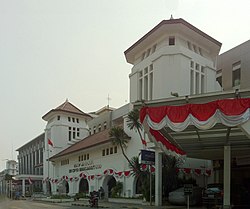
Jakarta has an extensive healthcare system consisting of public and private facilities. In late 2012, then Governor Joko Widodo introduced the Kartu Jakarta Sehat (Healthy Jakarta Card, KJS), a Jakarta-level programme intended to expand access to medical care, especially through public health facilities.[273][274] On 1 January 2014, Indonesia launched the nationwide universal health insurance system Jaminan Kesehatan Nasional (JKN), administered by the Social Security Agency on Health (BPJS Kesehatan);[275] earlier public schemes were merged into the national system, and Jakarta's local healthcare programme subsequently operated within this broader framework.[276] Recent official documents indicate that Jakarta's universal health coverage had reached about 98.5% in 2023.[277]
Public healthcare in Jakarta includes major government-run and military hospitals such as Dr. Cipto Mangunkusumo Hospital and Gatot Soebroto Army Hospital, alongside district hospitals and community health centres (puskesmas).[278] Public hospitals play a central referral role, but high demand can contribute to overcrowding and long waiting times; one 2023 study at a referral hospital in Jakarta found that prolonged emergency-department stays were common and associated with worse outcomes.[279]
Private hospitals and clinics are also an important part of Jakarta's healthcare system. Indonesia's health sector has become more open to foreign and private investment over the past decade, and regional investment reports note active foreign direct investment in Indonesian healthcare services.[280] Some hospitals are run by public, military, nonprofit, or religious bodies, while many others belong to major private groups such as Siloam Hospitals and Mitra Keluarga.
Water supply
[edit]Jakarta’s piped-water system was long operated through a concession model in which the public utility PAM Jaya retained ownership of the underlying assets while private operators were responsible for service delivery in different parts of the city;[281] since early 2023, however, PAM Jaya has again become the primary operator of the city’s piped-water system.[282][283] Under the concession era, which began in February 1998, two private operators served different parts of the capital: PALYJA in the western part of Jakarta and Aetra in the eastern part,[283] while PAM Jaya functioned as the public asset holder and contract counterpart.[281]
A large share of Jakarta’s raw water supply comes through the West Tarum Canal system, a roughly 70-kilometre canal carrying water from the Jatiluhur reservoir system on the Citarum River toward Jakarta.[284] The concession system itself was negotiated in the late 1990s with joint ventures involving the international water companies Lyonnaise des Eaux (later Suez) and Thames Water;[285] over time, these foreign stakes were sold and the operators’ ownership shifted to other investors before the concession era ended in 2023.[286] In the early years, the concession system underperformed against ambitious service-expansion targets amid the Asian financial crisis in 1997, tariff disputes, and repeated contract renegotiations. Tariff freezes and delayed tariff adjustments constrained cost recovery and were cited as factors limiting planned investment and network expansion.[281][287][288]
Access to piped water in Jakarta improved during the concession era, but remained uneven and disputed. According to concession-era and regulatory figures, coverage in the western service area rose substantially from about 32% in 1998 to roughly 50% in 2005, while in the eastern service area access increased from about 57% to around 67% in the same period.[289] However, independent studies and survey-based estimates have often suggested much lower effective household access. One academic study noted unofficial estimates that only about 25% of Jakarta’s true population was being served in the mid-2000s.[290] More recent studies indicate that network access remains incomplete; one 2022 study reported piped-water coverage of about 64% in Jakarta.[291]
Many residents without piped water rely on groundwater self-supply.[292] Studies of Jakarta and urban Indonesia note that self-supply remains dominant in many areas, but over-extraction and contamination are common, and groundwater quality problems have worsened inequalities in access both within and beyond the piped network.[293] Groundwater in Jakarta is frequently saline in coastal areas and contaminated in both shallow and deeper systems. Longstanding hydro-geological work found seawater intrusion in northern and central Jakarta and widespread contamination of shallow groundwater,[293] while a 2017 statement by the Geological Agency of the Ministry of Energy and Mineral Resources said that around 80% of groundwater in the Jakarta groundwater basin did not meet national drinking-water standards and described the city as facing a clean-water crisis.[294][295]
International relations
[edit]As Indonesia’s capital, Jakarta is one of Southeast Asia’s principal diplomatic centres. In addition to hosting a large concentration of foreign embassies, the city is home to the ASEAN Headquarters, which is based in Jakarta, and to the permanent missions of ASEAN member states and dialogue partners to ASEAN.[153] This institutional concentration makes Jakarta an important venue for regional diplomacy, economic coordination, and ASEAN-related meetings.[153]
Jakarta also engages in international city networks concerned with climate policy, smart-city governance, and urban cooperation. The city has been a member of the C40 Cities network since 2006[296] and is part of the ASEAN Smart Cities Network;[297] it also participated in the Asian Network of Major Cities 21, an earlier inter-city forum that was active until 2014. Through these networks, Jakarta cooperates with other cities on issues such as climate resilience, environmental policy, and urban development.
Twin towns – sister cities
[edit]Jakarta signed sister city agreements with other cities, including Casablanca. To promote friendship between the two cities, the main avenue famous for its shopping and business centres was named after Jakarta's Moroccan sister city. No streets in Casablanca is named after Jakarta. However, the Moroccan capital city of Rabat has an avenue named after Sukarno, Indonesia's first president, to commemorate his visit in 1960 and as a token of friendship.[298]
Jakarta's sister cities are:[299]
- Bangkok, Thailand
- Beijing, China
- Berlin, Germany
- Casablanca, Morocco
- East Jerusalem, Palestine
- Hanoi, Vietnam
- Islamabad, Pakistan
- Istanbul, Turkey
- Jeddah, Saudi Arabia
- Kyiv, Ukraine
- Los Angeles, United States
- Maputo, Mozambique
- Mumbai, India[300]
- Moscow, Russia
- Pyongyang, North Korea
- Seoul, South Korea
- Shanghai, China
- Tokyo, Japan
Jakarta also has established a partnership with Rotterdam, especially on integrated urban water management, including capacity-building and knowledge exchange.[301] This cooperation is mainly because both cities are dealing with similar problems; they lie in low-lying flat plains and are prone to flooding. Additionally, they have both implemented drainage systems involving canals, dams and pumps vital for both cities for below-sea-level areas.
In addition to its sister cities, Jakarta cooperates with:[299]
- Arkansas, United States
- Budapest, Hungary
- New South Wales, Australia
- New York, United States[302]
- Paris, France
- Rotterdam, Netherlands
Notable people
[edit]See also
[edit]


.svg)

- Betawi people
- Climate change in Indonesia
- Greater Jakarta
- List of tallest buildings in Jakarta
- Outline of Jakarta
- Transport in Jakarta
Notes
[edit]- ^ Jakarta is a special region comprising five Kota Administrasi (administrative cities/municipalities) and one Kabupaten Administrasi (administrative regency). It has no de jure capital, but many governmental buildings are located in Central Jakarta.
- ^ Formerly spelled as Djakarta, and formerly known as Batavia until 1949 (/dʒəˈkɑːrtə/ ⓘ juh-KAR-tuh; Indonesian pronunciation: [dʒaˈkarta] ⓘ), Betawi: Jakarta, Jakartè
- ^ Indonesian: Daerah Khusus Ibukota Jakarta; DKI Jakarta
References
[edit]- ^ "A Day in J-Town". Jetstar Magazine. April 2012. Archived from the original on 1 August 2013. Retrieved 2 January 2013.
- ^ a b c "Provinsi – Kementerian Dalam Negeri – Republik Indonesia" [Province – Ministry of Home Affairs – Republic of Indonesia] (in Indonesian). Ministry of Home Affairs. Archived from the original on 19 February 2013. Retrieved 14 August 2019.
- ^ Ricklefs, M. C. (2001). A History of Modern Indonesia since c.1200 (3rd ed.). Palgrave Macmillan. p. 35. ISBN 9780804744805.
- ^ Badan Pusat Statistik 2025, DKI Jakarta, 27 February 2026 (Katalog 1102001.31).
- ^ "Demographia World Urban Areas" (PDF) (19th annual ed.). August 2023. Retrieved 4 June 2024.
- ^ "Basis Data Pusat Pengemangan Kawasan Perkotaan" [Urban area development centre database]. perkotaan.bpiw.pu.go.id. Archived from the original on 6 February 2020. Retrieved 31 August 2020.
- ^ Badan Pusat Statistik (2024). "Produk Domestik Regional Bruto (Milyar Rupiah), 2022–2023" (in Indonesian). Jakarta: Badan Pusat Statistik.
- ^ Badan Pusat Statistik (2024). "[Seri 2010] Produk Domestik Regional Bruto Per Kapita (Ribu Rupiah), 2022–2023" (in Indonesian). Jakarta: Badan Pusat Statistik.
- ^ "Indeks Pembangunan Manusia 2024" (in Indonesian). Statistics Indonesia. 2024. Retrieved 15 November 2024.
- ^ Hasna, S.; et al. (July 2024). "Construction of kota tua as cultural heritage area on @kotatua.Jkt". ASPIRATION Journal. 5 (1). ASPIKOM Jakarta: 32–51. doi:10.56353/aspiration.v5i1.63.
- ^ a b c d e Gultom, A. (23 February 2017). "Kalapa–Jacatra–Batavia–Jakarta: An old city that never gets old". Journal of Archaeology and Fine Arts in Southeast Asia. 2. SEAMEO Regional Centre for Archaeology and Fine Arts (SPAFA): 1–27. doi:10.26721/spafajournal.v2i0.173.
- ^ Abeyasekere, S. (1987). Jakarta: A History. Oxford; New York: Oxford University Press.
- ^ "jaya". Sanskrit Dictionary. Archived from the original on 31 July 2017. Retrieved 11 June 2017.
- ^ "krta". Sanskrit Dictionary. Archived from the original on 31 July 2017. Retrieved 11 June 2017.
- ^ Cortesão 1990, pp. 172.
- ^ a b "The capital's 'childhood' names". The Jakarta Post. Archived from the original on 28 January 2019. Retrieved 28 January 2019.
- ^ a b "Batujaya Temple complex listed as national cultural heritage". The Jakarta Post. Archived from the original on 24 April 2019. Retrieved 24 April 2019.
- ^ a b Noorduyn, J.; Verstappen, H. Th. (1972). "Purnavarman's river-works near Tugu". Journal of the Humanities and Social Sciences of Southeast Asia. 128 (2–3). Koninklijke Brill NV: 298–307. doi:10.1163/22134379-90002752.
- ^ Manguin, P-Y; Indradjaja, A. (2011). "The Batujaya Site: New Evidence of Early Indian Influence in West Java". Early Interactions between South and Southeast Asia: Reflections on Cross-Cultural Exchange. Singapore: ISEAS–Yusof Ishak Institute.
- ^ Zhao, Rukuo (1911). Chau Ju-kua: His Work on the Chinese and Arab Trade in the Twelfth and Thirteenth Centuries, Entitled Chu-fan-chi. Translated by Hirth, F.; Rockhill, W. W. St. Petersburg: Print Office of the Imperial Academy of Sciences.
- ^ Maulana, W. I.; et al. (2024). "Maritime Activities of the Demak Sultanate: Shipping and Trade Route in the Nusantara Network (1478-1546)". Journal of Al-Tamaddun. 19 (1). Universiti Malaya: 261–272. doi:10.22452/JAT.vol19no1.19.
- ^ Cortesão 1990, pp. XXV.
- ^ a b c Reid, Anthony (2010). "Islam in Southeast Asia and the Indian Ocean Littoral, 1500-1800: Expansion, Polarization, Synthesis". The New Cambridge History of Islam, Vol. 3: The Eastern Islamic World, Eleventh to Eighteenth Centuries. Cambridge University Press. p. 433. hdl:1885/18044. ISBN 978-1-10-745697-6.
- ^ Pratama, A.Y.; et al. (26 December 2022). "The Origin of Plural Society in Jakarta". Proceedings of the 2nd International Conference on Social Knowledge Sciences and Education (ICSKSE 2022). Advances in Social Science, Education and Humanities Research. Vol. 696. Dublin: Atlantis Press. pp. 27–32. doi:10.2991/978-2-494069-63-3_4. ISBN 978-2-494069-62-6.
- ^ a b c Knörr, J. (2014). Creole Identity in Postcolonial Indonesia. Berghahn Books. pp. 46, 124. doi:10.3167/9781782382683. ISBN 978-1-78238-268-3.
- ^ a b Blussé, L. (2023). "Setting the Stage: Dutch trade and the Chinese Diaspora". A Colonial Tragedy: The Chinese Massacre at Batavia, 1740. Leiden University Press. pp. 15–28.
- ^ Bentley, Jerry H.; Subrahmanyam, S.; Wiesner-Hanks, Merry E., eds. (2015). "Crossroads region: Southeast Asia". The Cambridge World History, Volume 6: The Construction of a Global World, 1400–1800 CE, Part 1. Cambridge University Press. doi:10.1017/CBO9781139194594. ISBN 978-1-13919-459-4.
- ^ a b c Shimada, R. (2019). "Southeast Asia and International Trade: Continuity and Change in Historical Perspective". In Sugihara, K.; Otsuka, K. (eds.). Paths to the Emerging State in Asia and Africa. Springer Chapter Link. pp. 55–71.
- ^ Zhang, L. (2025). Beyond the Archival Grain: An Archival-Practice Inquiry into the Internal Diversity of the Chinese Population and its relationship with Inter-group interaction in Dutch East Indies Colonial Possessions Between the 17th and the 19th Century (Thesis). University of Chicago.
- ^ Blussé, L. (2023). A Colonial Tragedy: The Chinese Massacre at Batavia, 1740. Leiden University Press.
- ^ a b c Witton 2003, pp. 138–39.
- ^ Nas & Grijns 2000, p. 145.
- ^ a b c Passchier, C. (2007). Colonial Architecture in Indonesia. Leiden: KITLV Press.
- ^ Alwi, N.M. (2018). Culture and Identity in Public Green Spaces: Story of Suropati and Menteng Park in Central Jakarta, Indonesia. The IAFOR International Conference on Sustainability, Energy & the Environment – Hawaii 2018 Official Conference Proceedings. The International Academic Forum (IAFOR).
- ^ Fahmi, E. (8 April 2021). "Planning Approach of Kebayoran New City of Jakarta: Background and Lessons Learned". Journal of Regional and City Planning Asia. 32 (1): 56–70. doi:10.5614/jpwk.2021.32.1.4.
- ^ a b c d e f Martinez, R.; Masron, I.N. (November 2020). "Jakarta: A city of cities". Cities. 106 102868. doi:10.1016/j.cities.2020.102868. PMID 32863521.
- ^ Ricklefs 2001, p. 262, 268.
- ^ van Mook, H.J. (1949). "Indonesia". Royal Institute of International Affairs. 25 (3): 274–285. doi:10.2307/3016666. JSTOR 3016666.
- ^ Bidien, C. (5 December 1945). "Independence the Issue". Far Eastern Survey. 14 (24): 345–348. doi:10.2307/3023219. JSTOR 3023219.
- ^ Fadhilah, N.; Abdurakhman (2021), The jakarta government 1947-1950: Revolution and nationalism of the people, Dissecting History and Problematizing the Past in Indonesia, Nova Science Publishers, Inc, ISBN 978-1-53619-399-2
- ^ Purwanto, B.; et al., eds. (2023). Revolutionary Worlds. Translated by Hanafi, T. Amsterdam University Press. p. 47. doi:10.5117/9789463727587. ISBN 978-9-04855-686-1.
- ^ Padawangi, R. (April 2014). Counter-Hegemonic Spaces of Hope? Constructing the Public City in Jakarta and Singapore (Report). ARI Working Paper. Singapore: National University of Singapore.
- ^ Prasetyo, T.; Danisworo, M. (2015). "Global Cities in a Local Context: The Case of Indonesia's Urban Development". Global Interchanges: Resurgence of the Skyscraper City. CTBUH 2015 New York Conference. Council on Tall Buildings and Urban Habitat.
- ^ Cribb, Robert (August 2002). "Unresolved Problems in the Indonesian Killings of 1965–1966". Asian Survey. 42 (4): 550–563. doi:10.1525/as.2002.42.4.550.; "Indonesia massacres: Declassified US files shed new light". BBC. 17 October 2017. Archived from the original on 30 October 2017. Retrieved 19 September 2018.
- ^ a b Suryoputri, S.A.; Diamantina, A. (7 July 2023). "The Existence of DKI Jakarta's Special Status as the Capital of Indonesia after the Ratification of the State Capital Law". International Journal of Social Science and Human Research. 6 (7): 4346–4350. doi:10.47191/ijsshr/v6-i7-61.
- ^ Douglass 1989, pp. 211–38; Douglass 1992, pp. 9–32
- ^ Ellisa, E.; Putri, F.N. (March 2020). The Intervention of Art and Culture to Recapture the Livable Inner-Urban District. International Conference on Watershed Management and Coastal Conservation. Cebu, Philippines.
- ^ Turner 1997, p. 315.
- ^ Simone, A. (2014). Jakarta: Drawing the City Near. Minneapolis: University of Minnesota Press. p. 37.
- ^ Irawaty, D.T. (2018). Jakarta's Kampungs: Their History and Contested Future (Thesis). University of California.
- ^ Sajor 2003, pp. 713–42.
- ^ Delhaise, P.F. (1998). Asia in Crisis: The Implosion of the Banking and Finance Systems. Willey. p. 123. ISBN 978-0-471-83450-2.
- ^ Vickers 2013, pp. 209–212.
- ^ Pincus, J.; Ramli, R. (November 1998). "Indonesia: from showcase to basket case". Cambridge Journal of Economics. 22 (6): 723–734. doi:10.1093/cje/22.6.723.
- ^ Friend 2003, p. ?.
- ^ "Jakarta holds historic election". BBC News. 8 August 2007. Archived from the original on 1 January 2016. Retrieved 8 August 2007.
- ^ Hwang, Julie Chernov (September 2012). Terrorism in Perspective: An Assessment of 'Jihad Project' Trends in Indonesia (Report). JSTOR resrep06463. ProQuest 1716947838.
- ^ Ammar, M.A.; et al. (June 2026). "Building a sustainable future for Indonesia's new capital, the Nusantara capital city (IKN)". Sustainable Futures. 11 101718. Bibcode:2026SusFu..1101718A. doi:10.1016/j.sftr.2026.101718.
- ^ Suroyo, Gayatri; Jefriando, Maikel (29 August 2019). "Indonesia pledges $40 billion to modernise Jakarta ahead of new capital – minister". Reuters. Archived from the original on 1 April 2026. Retrieved 17 May 2024.
- ^ "President Jokowi Signs Law on Special Regional Province of Jakarta". Office of Assistant to Deputy Cabinet Secretary for State Documents & Translation. 30 April 2024. Archived from the original on 14 June 2024. Retrieved 18 September 2025.
- ^ a b c JABODETABEK Urban Transportation Policy Integration Phase 2 (Report). Tokyo: Japan International Cooperation Agency. 2012.
- ^ Lou, P.; et al. (9 November 2021). "Exploring sustainable solutions for the water environment in Chinese and Southeast Asian cities". Ambio. 51 (5): 1199–1218. doi:10.1007/s13280-021-01654-3. PMC 8931166. PMID 34751934.
- ^ Murray et al. 2014, pp. 267–72.
- ^ Zoysa, R.S.; et al. (20 August 2025). "Afterlives of reclamation: coastal privatization, distanced dispossession, and more-than-human calcifications in Jakarta Bay". Maritime Studies. 24 (56). doi:10.1007/s40152-025-00443-y.
- ^ Koto, J.; et al. (8 October 2018). "Study on the Phenomenon of Flood Characteristic in DKI Jakarta". Journal of Ocean, Mechanical and Aerospace -science and Engineering-. 51. International Society of Ocean, Mechanical and Aerospace Scientists and Engineers: 19–30. doi:10.36842/jomase.v51i1.43.
- ^ Padawangi, R.; Douglass, M. (3 September 2015). "Water, Water Everywhere: Toward Participatory Solutions to Chronic Urban Flooding in Jakarta". Pacific Affairs. 88 (3). Routledge: 517–550. doi:10.5509/2015883517.
- ^ Mei Lin, Mayuri (12 August 2018). "Jakarta, the fastest-sinking city in the world". BBC News. Archived from the original on 30 April 2019. Retrieved 30 March 2023.
- ^ Kusuma, Adriana Nina (9 October 2014). "Indonesia Holds Groundbreaking Ceremony for Giant Sea Wall". The Jakarta Globe. Archived from the original on 1 August 2015. Retrieved 28 August 2017.
- ^ Hendrix, Esmeralda. "Dutch to study new dike for Jakarta Bay". The Jakarta Post. Archived from the original on 18 January 2012. Retrieved 27 July 2011.
- ^ a b c Luo, P.; et al. (11 July 2019). "Water Quality Trend Assessment in Jakarta: A Rapidly Growing Asian Megacity". PLOS ONE. 14 (7): e0219009. Bibcode:2019PLoSO..1419009L. doi:10.1371/journal.pone.0219009. PMID 31295261.
{{cite journal}}: CS1 maint: article number as page number (link) - ^ Syuhada, G.; et al. (7 February 2023). "Impacts of Air Pollution on Health and Cost of Illness in Jakarta, Indonesia". International Journal of Environmental Research and Public Health. 20 (4) 2916. doi:10.3390/ijerph20042916. PMID 36833612.
- ^ a b Maheng, D.; et al. (30 December 2023). "Changing Urban Temperature and Rainfall Patterns in Jakarta: A Comprehensive Historical Analysis". Sustainability. 16 (1): 350. Bibcode:2023Sust...16..350M. doi:10.3390/su16010350.
- ^ a b "World Weather Information Service". Retrieved 27 March 2026.
- ^ Lubis, S.; et al. (7 November 2022). "Record-Breaking Precipitation in Indonesia's Capital of Jakarta in Early January 2020 Linked to the Northerly Surge, Equatorial Waves, and MJO". Geophysical Research Letters. 49 (22) e2022GL101513. Bibcode:2022GeoRL..4901513L. doi:10.1029/2022GL101513.
- ^ "World Meteorological Organization Climate Normals for 1991–2020". World Meteorological Organization Climatological Standard Normals (1991–2020). National Oceanic and Atmospheric Administration. Archived from the original on 19 October 2023. Retrieved 19 October 2023.
- ^ "Indonesia – Halim Perdanakus". Centro de Investigaciones Fitosociológicas. Archived from the original on 14 June 2021. Retrieved 26 June 2016.
- ^ "Stations Number 96745" (PDF). Ministry of Energy, Utilities and Climate. Archived from the original (PDF) on 16 January 2013. Retrieved 26 June 2016.
- ^ "Klimatafel von Jakarta (Stadt, Obs.), West-Java / Indonesien" (PDF). Baseline climate means (1961–1990) from stations all over the world (in German). Deutscher Wetterdienst. Retrieved 10 November 2024.
- ^ "Jakarta, Indonesia – Monthly weather forecast and Climate data". Weather Atlas. Archived from the original on 9 February 2019. Retrieved 8 February 2019.
- ^ Silver 2007, p. 101.
- ^ a b c Lakawa, A.R.; et al. (August 2015). "The Relationship between Language and Architecture: A Case Study of Betawi Cultural Village at Setu Babakan, South Jakarta, Indonesia". International Journal of Humanities and Social Science. 5 (8): 84–101.
- ^ Hidayat, M.S.; Suhendar, R. (August 2018). The Assessment of Building Envelope Performance of Vernacular Architecture in Betawi House. IOP Conference Series: Materials Science and Engineering. Vol. 453. Purpose-Led Publishing. p. 012053. doi:10.1088/1757-899X/453/1/012053.
- ^ "Number of cultural heritage buildings in Jakarta increased". The Jakarta Post. Archived from the original on 20 February 2018. Retrieved 20 February 2018.
- ^ Kehoe, M.L. (2015). "Dutch Batavia: Exposing the Hierarchy of the Dutch Colonial City". Journal of Historians of Netherlandish Art. 7 (1). doi:10.5092/jhna.2015.7.1.3.
- ^ a b Ellisa, E. (1 July 2018). "The Recreational Landscape of Weltevreden Since Indonesian Colonization". Journal of Urban Culture Research. 17: 12–30. doi:10.58837/CHULA.JUCR.17.1.4.
- ^ Purnama, I.Y. (31 May 2020). "Interior Restoration A.A Maramis Building Ministry of Finance of Indonesia: Developing Interior Concepts with the Principles of Cultural Heritage Restoration". International Review of Humanities Studies. 5 (3). doi:10.7454/irhs.v5i1.241.
- ^ Passchier, C. The Quest for the Ultimate Architecture.
- ^ Santosa, A. (13 July 2004). "A Review of the Emergence of Indonesian Modern Interior Design". Dimensi Interior. 1 (1): 16–28. doi:10.9744/interior.1.1.pp.16-28 (inactive 1 April 2026).
{{cite journal}}: CS1 maint: DOI inactive as of April 2026 (link) - ^ Wilson, W. (11 July 2012). "Building on the Past". The Jakarta Post. Archived from the original on 5 March 2016.
- ^ Sopandi, S. (2017). "Modern Indonesian Architecture: A Cultural Discourse". Docomomo Journal (57): 20–29. doi:10.52200/57.A.KQFG8KIO.
- ^ Lucius, C.R.; et al. (22 August 2024). "A Study on Indonesian Sociopolitical Design Objects within the Framework of Gesamtkunstwerk". Southeast Asian Studies. 13 (2). Center for Southeast Asian Studies: 287–310. doi:10.20495/seas.13.2_287.
- ^ Jakarta Rise#20: Path Towards Top 20 Global City (Report). Regional Development Planning Agency DKI Jakarta Province. 2025. p. 35.
- ^ Puspitasari, A.W.; Kwon, J. (2017). "The Influence of Tall Buildings to the Modern Urban Landscape of Jakarta City". Proceedings of the UIA 2017 Seoul World Architects Congress. Seoul.
- ^ a b Ramdani, F. (12 April 2024). "A Very High-Resolution Urban Green Space from the Fusion of Microsatellite, SAR, and MSI Images". Remote Sensing. 16 (8). MDPI: 1366. Bibcode:2024RemS...16.1366R. doi:10.3390/rs16081366.
- ^ Kusumaningtyas, P.I.N. (2024). "Availability of green open space in Jakarta using GIS analysis". Spatial Planning & Management Science. 1 (2). Institute for Advanced Science, Social, and Sustainable Future: 96–104.
- ^ Saragih, V.; et al. (2024). Exploring the inclusivity of Jakarta's child-friendly integrated public spaces (RPTRA) through qualitative analysis of Google Map reviews. IOP Conference Series: Earth and Environmental Science. Vol. 1394. Semarang: IOP Publishing Ltd. p. 012025. doi:10.1088/1755-1315/1394/1/012025.
- ^ Sulastri; Akhdiana, I. (2021). Seasonal variation of water quality of three urban small lakes in West Java, Indonesia. IOP Conference Series: Earth and Environmental Science. Vol. 1036. IOP Publishing Ltd. p. 012113. doi:10.1088/1755-1315/1036/1/012113.
- ^ Sarwindaningrum, I. (16 April 2019). "Sharing the Spirit of Freedom at Medan Merdeka" (in Indonesian). Kompas. Archived from the original on 1 April 2026. Retrieved 26 March 2026.
- ^ "Lapangan Banteng gets facelift". The Jakarta Post. Archived from the original on 6 August 2018. Retrieved 6 August 2018.
- ^ "Travel: Must-visit public parks in the capital". The Jakarta Post. Archived from the original on 21 March 2015. Retrieved 21 March 2015.
- ^ "City allocates Rp 140 billion to revamp five parks". The Jakarta Post. Archived from the original on 9 January 2019. Retrieved 9 January 2019.
- ^ Adyatama, Egi (5 March 2017). "Kalijodo Park Expected to be New Tourism Icon in Indonesia". Archived from the original on 31 March 2017. Retrieved 30 March 2017.
- ^ Widodo, Wahyu Setyo. "Taman Wisata Alam Angke Kapuk, Permata di Utara Jakarta". detikTravel. Archived from the original on 25 November 2020. Retrieved 4 December 2020.
- ^ Evan, V. "Fantasy of a perfect Indonesia: Growing up with TMII". The Jakarta Post. Archived from the original on 8 June 2021. Retrieved 8 June 2021.
- ^ Widodo, S.; et al. (2019). Snake Diversity at Universitas Indonesia's Urban Forest. IOP Conference Series: Materials Science and Engineering. Vol. 546. IOP Publishing Ltd. p. 022035. doi:10.1088/1757-899X/546/2/022035.
- ^ Mulyana, W. (February 2012). Decent Work in Jakarta: An Integrated Approach (Report). ILO Asia-Pacific Working Paper Series. Bangkok: ILO Regional Office for Asia and the Pacific. p. 21. ISBN 9789221260448.
- ^ Cybriwsky & Ford 2001, pp. 202–13.
- ^ Ginsburg, Koppel & McGee 1991, p. 71.
- ^ Harpham & Tanner 1995, p. 71.
- ^ "Hasil Sensus Penduduk 2020" (PDF) (in Indonesian). Statistics Indonesia. 21 January 2021. p. 9. Archived (PDF) from the original on 22 January 2021. Retrieved 21 January 2021.
- ^ "Understanding the Difference in Jakarta Population Data: UN Data vs. Population and Civil Registration Office Data" (in Indonesian). Jakarta Population and Civil Registration Office. 27 November 2025. Archived from the original on 29 March 2026. Retrieved 29 March 2026.
- ^ World Urbanization Prospects 2025. Department of Economic and Social Affairs - Population Division (Report). New York: United Nations.
- ^ Rustiadi, E.; et al. (April 2021). "Impact of continuous Jakarta megacity urban expansion on the formation of the Jakarta-Bandung conurbation over the rice farm regions". Cities. 111 103000. doi:10.1016/j.cities.2020.103000.
- ^ "Jakarta, the Most Densely Populated Province in Indonesia in Early 2026" (in Indonesian). Katadata. 13 March 2026. Archived from the original on 1 April 2026. Retrieved 29 March 2026.
- ^ Citizenship, Ethnicity, Religion, and Language of the Indonesian Population: Results of the 2010 Population Census (in Indonesian). Jakarta: Indonesia Statistics. 23 May 2012. ISBN 978-979-064-417-5. Retrieved 29 March 2026.
- ^ Knörr 2007, p. 263.
- ^ Knörr, J. (July 2005). Orang Betawi: Construction and Transformation of a Creole Notion of Jakartan Identity. 4th International Symposium of the journal Antropologi Indonesia. Depok.
- ^ Sáenz, Embrick & Rodriguez 2015, p. ?.
- ^ Iyer 2001, p. 23.
- ^ Wira, N.N. (28 September 2019). "Looking closely at Chinese community in Jakarta". ANTARA News. Archived from the original on 2 October 2019. Retrieved 30 March 2026.
- ^ a b Yuliana, V.; Yanti (August 2023). "Language Attitudes, Shift, and Maintenance: A Case Study of Jakartan Chinese Indonesians". Linguistik Indonesia. 41 (2): 241–262. doi:10.26499/li.v41i2.517.
- ^ Singh, B. (April 2022). "Role of Diaspora in India-Indonesia Relations". International Journal of Humanities and Social Science Invention. 2 (4): 49–52. doi:10.35629/7722-1104034952 (inactive 1 April 2026).
{{cite journal}}: CS1 maint: DOI inactive as of April 2026 (link) - ^ Wira, N.N. (5 April 2016). "Explore these 5 spots in Pasar Baru, Jakarta's 'Little India'". The Jakarta Post. Archived from the original on 8 December 2016. Retrieved 29 March 2026.
- ^ Reid 2010, p. 170. sfn error: multiple targets (2×): CITEREFReid2010 (help)
- ^ Hirata, S. Kinship and Identity of the Toba Batak in the Multi-ethnic City of Jakarta (Thesis). Center for Southeast Asian Studies, Kyoto University.
- ^ Board of Editors, Contributions to Southeast Asian Ethnography, 1987
- ^ Naim 1971, p. 115-131.
- ^ Chapter XV, Article 36 of the 1945 Constitution.
- ^ "The 1945 Constitution of the Republic of Indonesia" (PDF). International Labour Organization. Archived (PDF) from the original on 11 October 2017. Retrieved 11 October 2017.
- ^ Tanu, D. (19 October 2018). "Becoming 'International': The Cultural Reproduction of the Local Elite at an International School in Indonesia". South East Asia Research. 22 (4). doi:10.5367/sear.2014.0236.
- ^ Jimmi, J.; Davistasya, R.E. (2019). "Code-mixing in Language Style of South Jakarta Community Indonesia". Journal of English Education and Applied Linguistics. 8 (2): 193. doi:10.24127/pj.v8i2.2219.
- ^ Rusdy, B.C.; Sunarti, L. (28 July 2025). "The Establishment of Jakarta International School in Indonesia as a Reflection of Globalisation Through Education". International Review of Humanities Studies. 10 (2). University of Indonesia. doi:10.7454/irhs.v10i2.1411.
- ^ Siregar, I.; Hamzah, N.H.B. (2024). "Effectiveness of the Language Preservation Model in the Betawi Community". Eurasian Journal of Applied Linguistics. 10 (2): 274–281. doi:10.32601/ejal.10223 (inactive 1 April 2026).
{{cite journal}}: CS1 maint: DOI inactive as of April 2026 (link) - ^ Sneddon, J.N. (2006). Colloquial Jakartan Indonesian. Pacific Linguistics, Australian National University. ISBN 0858835711.
- ^ Setijadi, C. (12 September 2016). "'A Beautiful Bridge': Chinese Indonesian Associations, Social Capital and Strategic Identification in a New Era of China-Indonesia Relations". Journal of Contemporary China. 25 (102). Routledge: 822–835. doi:10.1080/10670564.2016.1184895.
- ^ Hastuti, E.; Oswari, T. (25 March 2020). The Influence of Effort on the Minangkabau Language Maintenance in Jakarta. Proceedings of the 4th International Conference on Arts Language and Culture (ICALC 2019). Advances in Social Science, Education and Humanities Research. Vol. 421. Atlantis Press.
- ^ Simanjuntak, M.B.; et al. (15 November 2022). Local Wisdom's Value of Toba Bataknese Language for Daily Communication in Jakarta. Proceedings of the International Conference on Communication, Policy and Social Science (InCCluSi 2022). Advances in Social Science, Education and Humanities Research. Vol. 682. Atlantis Press. pp. 109–116. doi:10.2991/978-2-494069-07-7_141 (inactive 1 April 2026).
{{cite conference}}: CS1 maint: DOI inactive as of April 2026 (link) - ^ Lauder, Multamia R.M.T.; Lauder, Allan F. (2017). Language Change and Endangerment in West Java: Recent Dialectology Research. International Seminar on Sociolinguistics and Dialectology: Changes and Development of Language in Social Life. University of Indonesia.
- ^ Kurniawati, W. (1996). "Sundanese Language in Jatinegara Kaum and Settlement of Prince Achmad Djaketra's Descendants". Berkala Arkeologi (in Indonesian). 16 (1): 49–57. doi:10.30883/jba.v16i1.746.
- ^ "History of University of Jakarta". University of Indonesia. Archived from the original on 15 August 2024. Retrieved 30 March 2026.
- ^ Pols, H. (8 April 2024). "The expansion of medical education in the Dutch East Indies and the formation of the Indonesian medical profession". Medical History. 68 (2). Cambridge University Press: 162–182. doi:10.1017/mdh.2024.11. PMID 38586988.
- ^ Wulandari, Diah Wasis; Mori, S. (May 2014). "Characteristics of the Spatial Structure of Kosts Private Rental Housing: A Case Study of the Urban Settlement of Jakarta, Indonesia". Journal of Asian Architecture and Building Engineering. 13 (2): 309–316. doi:10.3130/jaabe.13.309.
- ^ a b "Jumlah Penduduk Menurut Agama" (in Indonesian). Ministry of Religious Affairs. 2024. Archived from the original on 4 February 2026. Retrieved 30 March 2026.
- ^ Azzahra, N.F. (2020). Effects of the Pesantren Law on Indonesia's Education System: A Projection (working paper). EconStor. p. 8. hdl:10419/249432.
- ^ Porter 2002, p. 39.
- ^ Hamami, T.; Nuryana, Z. (7 December 2022). "A holistic–integrative approach of the Muhammadiyah education system in Indonesia". HTS Teologiese Studies-Theological Studies. 78 (4). AOSIS Publishing. doi:10.4102/hts.v78i4.7607.
- ^ "Archdiocese of Jakarta". UCA News. Archived from the original on 13 June 2024. Retrieved 30 March 2026.
- ^ Ali-Fauzi, I.; et al. (March 2011). Lindsey, T.; Crouch, M. (eds.). Disputed Churches in Jakarta (Report). Translated by Lunnon, R. Melbourne Law School. p. 25.
- ^ Suprajitno, S. (2019). "Various Petals of the Lotus: The Identities of the Chinese Buddhists in Indonesia". Archiv orientální - Journal of African and Asian Studies (87): 333–384.
- ^ Handayani, L. (April 2025). "Development of the Sikh Community in Jakarta: History and Social Dynamics". Hanifiya: Jurnal Studi Agama-Agama. 8: 129–138. doi:10.15575/hanifiya.v8i1.43926.
- ^ "Bahá'í International Community". 21 April 2015. Archived from the original on 3 October 2018. Retrieved 2 October 2018.
- ^ "Provinsi DKI Jakarta Dalam Angka 2022". Statistics Indonesia. Retrieved 22 September 2023.
- ^ a b c Salmande, Ali (14 June 2024). "What does Indonesia's new capital mean for Jakarta and the ASEAN headquarters?". Indonesia at Melbourne. Archived from the original on 15 August 2025. Retrieved 1 April 2026.
- ^ a b "Jakarta's Economic Growth in the Fourth Quarter of 2024". Statistics Indonesia - DKI Jakarta Province. 5 February 2025. Retrieved 30 March 2026.
- ^ "Distribution of GRDP at Current Prices by Business Sector (Percent), 2024". Statistics Indonesia - DKI Jakarta Province. Retrieved 30 March 2026.
- ^ "Google expands Jakarta cloud region in Indonesia". Data Center Dynamics. 16 May 2025. Archived from the original on 15 November 2025. Retrieved 30 March 2026.
- ^ "The Jakarta Investment Realization Recap 2024". Jakarta Investment Centre. 5 March 2025. Archived from the original on 8 December 2025. Retrieved 31 March 2026.
- ^ "12 Indonesian Companies Earn Spots on Forbes' Global 2000 List for 2025". 17 June 2025. Archived from the original on 23 July 2025. Retrieved 30 March 2026.
- ^ "Indonesia Returns to the Fortune Global 500, But Is That Really the Win We Think It Is?". Career Candour. Archived from the original on 15 December 2025. Retrieved 31 March 2026.
- ^ "The Startup Ecosystem of Jakarta". Startup Blink. Archived from the original on 1 April 2026. Retrieved 31 March 2026.
- ^ a b "Jakartans and malls, a misconstrued love affair?". The Jakarta Post. 27 January 2020. Retrieved 31 March 2026.
- ^ a b Utari, R.; et al. (2024). "Policy analysis of sustainable traditional market management". Community Service for Sustainable Community Journal. 1 (1). University of Indonesia: 12–22. doi:10.61511/csjsc.v1i1.2024.702.
- ^ a b Albab, F.N.U.; et al. (June 2024). "Study of the Relationship between Per Capita Income and the Number of Indonesian Tourists in Receiving Entertainment Tax Revenue (Case Study in 5 Cities of DKI Jakarta)". Digital Business: Future Business Trends. 15 (2). Bandung Institute of Technology: 153–157. doi:10.59651/dibus (inactive 1 April 2026).
{{cite journal}}: CS1 maint: DOI inactive as of April 2026 (link) - ^ Manahampi, S.J.; Yudhistira, M.H. (12 January 2026). "Impacts of Spatial Intensity Policies on Jakarta Property Prices". Indonesian Journal of Economics and Development. 26 (1). Universitas Indonesia. doi:10.7454/jepi.v26i1.1748 (inactive 1 April 2026).
{{cite journal}}: CS1 maint: DOI inactive as of April 2026 (link) - ^ Ibrahim, M.K. (28 January 2026). "Land Value Capture Potential of Jakarta's LRT: Early Post-Operational Evidence from Residential Property Prices in TOD Zones". International Journal of Technology. 17 (1): 219. doi:10.14716/ijtech.v17i1.8024.
- ^ Indonesia - Jakarta - Retail 4Q24 (PDF) (Report). Cushman & Wakefield. 2024. Archived (PDF) from the original on 1 April 2026. Retrieved 31 March 2026.
- ^ "Bargain Shopping in Metropolitan Jakarta". Indonesia Travel. Archived from the original on 1 April 2026. Retrieved 31 March 2026.
- ^ Budianto, V.; et al. (1 December 2023). "An evaluation of the alleys of Glodok and its market culture". Journal of Architectural Engineering. 8 (3). Bandung Institute of Technology: 395–404. doi:10.30822/arteks.v8i3.2547.
- ^ "Jakpost guide to Jl. Surabaya". The Jakarta Post. 15 July 2017. Archived from the original on 17 July 2017. Retrieved 31 March 2026.
- ^ "Jakarta gems center shines amidst traditional markets". The Jakarta Post. 13 April 2010. Archived from the original on 1 April 2026. Retrieved 31 March 2026.
- ^ Setiawan, C.; et al. (2 July 2021). "Friendly Locals and Clean Streets?—Evaluating Jakarta's Destination Brand Image". Sustainability. 13 (13). Bandung Institute of Technology: 7434. Bibcode:2021Sust...13.7434S. doi:10.3390/su13137434.
- ^ Srihadi, T.F.; et al. (July 2016). "Segmentation of the tourism market for Jakarta: Classification of foreign visitors' lifestyle typologies". Tourism Management Perspectives. 19: 32–39. doi:10.1016/j.tmp.2016.03.005.
- ^ "Growth of Tourism in DKI Jakarta Province, March 2025". Statistics Indonesia - DKI Jakarta Province. Retrieved 31 March 2026.
- ^ "Jakarta in World's Top Ten Fastest Growing Tourism Cities". Indonesia Travel. Archived from the original on 1 April 2026. Retrieved 31 March 2026.
- ^ "Ministry holds national convention to develop MICE tourism". The Jakarta Post. Archived from the original on 2 August 2017. Retrieved 16 June 2017.
- ^ "Jakarta Investment Festival (Summit) - Thematic #1 Discussion - Transforming Jakarta into a MICE Tourism Hub". Jakarta Investment Centre. 30 September 2024. Archived from the original on 4 August 2025. Retrieved 31 March 2026.
- ^ "Lebaran Betawi: An event to maintain bonds and traditions". The Jakarta Post. Archived from the original on 27 July 2019. Retrieved 27 July 2019.
- ^ "Festival Condet 2019, Upaya untuk Lestarikan Budaya Betawi". Kompas. Archived from the original on 27 July 2019. Retrieved 27 July 2019.
- ^ Knörr 2007
- ^ "Festival Ganceng 2025 Resmi Dibuka, Wali Kota Jaktim Ajak Generasi Muda Lestarikan Tradisi". sinpo.id (in Indonesian). Sinpo. 14 June 2025. Retrieved 2 September 2025.
- ^ "What it takes to create Jakarta's world-class arts center". The Jakarta Post. 11 April 2020. Archived from the original on 25 December 2022. Retrieved 31 March 2026.
- ^ "Weekly 5: Five city venues for performing arts, music". The Jakarta Post. 3 October 2014. Archived from the original on 11 November 2016. Retrieved 31 March 2026.
- ^ "Balai Sarbini: Home". Balai Sarbini (in Indonesian). Retrieved 31 March 2026.
- ^ "Bentara Budaya Jakarta". ASEF Culture360 (in Indonesian). 5 July 2011. Retrieved 31 March 2026.
- ^ "ReKreasi di Pasar Seni". Ancol (in Indonesian). Retrieved 31 March 2026.
- ^ "'Wayang Orang Bharata' strives to preserve traditional culture". The Jakarta Post. 1 July 2016. Archived from the original on 2 July 2016. Retrieved 31 March 2026.
- ^ "Jakarta Fashion Week". Jakarta Fashion Week. Retrieved 31 March 2026.
- ^ "4 Ways to Enjoy the Jakarta Fashion and Food Festival". Indonesia Travel. Ministry of Tourism, Republic of Indonesia. Retrieved 31 March 2026.
- ^ "Tips for Visiting Jakarta Fair Kemayoran 2025". Jakarta Smart City. 26 June 2025. Retrieved 31 March 2026.
- ^ "Turning Year for the Jakarta International Film Festival". ASEF Culture360. Retrieved 31 March 2026.
- ^ "Indonesia Comic Con 2026". JETRO. 12 February 2026. Retrieved 31 March 2026.
- ^ "Art Jakarta 2025". Ocula. Retrieved 31 March 2026.
- ^ "Java Jazz Festival 2026 - About Us". Jakarta International Java Jazz Festival. Retrieved 31 March 2026.
- ^ "Institut français Indonésie". Institut français Indonésie (in Indonesian). Retrieved 31 March 2026.
- ^ "Goethe-InstitutIndonesien". Goethe-Institut. Retrieved 31 March 2026.
- ^ "The Japan Foundation, Jakarta". The Japan Foundation. Retrieved 31 March 2026.
- ^ "British Council Indonesia". British Council. Retrieved 31 March 2026.
- ^ "Erasmus Huis". Netherlands and You. Retrieved 31 March 2026.
- ^ Kartika, D.I.; Kartika, Y. (2022). The Spice Route from Arabic, Europe and China to Jayakarta toward Batavian Cuisine: Revitalization of Batavian Local Wisdom Values through Batavian Culinary Gastronomy. Proceedings of the 9th Asbam International Conference (Archeology, History, & Culture In The Nature of Malay) (ASBAM 2021). Atlantis Press. pp. 225–236.
- ^ Yudhistira, B.; Fatmawati, A. (26 August 2020). "Diversity of Indonesian soto". International Journal of Ethnic Foods. 7 (27) 27. doi:10.1186/s42779-020-00067-z.
- ^ Mardatillah, A. (22 September 2020). "The enterprise culture heritage of Minangkabau cuisine, West Sumatra of Indonesia as a source of sustainable competitive advantage". Journal of Ethnic Foods. 7 (34) 34. doi:10.1186/s42779-020-00059-z.
- ^ Tampubolon, L.H. (2020). Warung Tegal: Business Unit based on Ethnicity. Proceedings of the 2nd International Conference on Inclusive Business in the Changing World (ICIB 2019). SCITEPRESS. pp. 263–267. doi:10.5220/0008430102630267.
- ^ Wira, Simon Ni Nyoman. "Jakpost guide to Jl. Sabang". The Jakarta Post. Archived from the original on 9 August 2017. Retrieved 9 August 2017.
- ^ "The legendary eateries you must visit in Blok M". The Jakarta Post. 13 December 2015. Archived from the original on 9 August 2017. Retrieved 9 August 2017.
- ^ Figge, Katrin. "A Trip to Melawai's Little Tokyo in Jakarta". Jakarta Globe. Archived from the original on 12 August 2017. Retrieved 10 December 2017.
- ^ Prakoso, Johanes Randy (29 June 2015). "Lenggang Jakarta, a New Hangout Spot at Monas". detik.com. Archived from the original on 24 July 2016.
- ^ "Better space for cheap food". The Jakarta Post. Archived from the original on 24 April 2020. Retrieved 8 March 2020.
- ^ Tanjung, Intan (7 January 2016). "Where to go for a drink and to dress up to impress". The Jakarta Post. Archived from the original on 10 December 2017. Retrieved 10 December 2017.
- ^ "Superhot fried chicken eats into KFC's dominance in Indonesia". Nikkei Asian Review. Archived from the original on 23 May 2018. Retrieved 23 May 2018.
- ^ Hanna 1962, pp. 193–203.
- ^ "Why Palembang and Jakarta Were Chosen to Host the 2018 Asian Games" (in Indonesian). Republika Online. 30 September 2014. Archived from the original on 1 April 2026. Retrieved 31 March 2026.
- ^ "Asian Cup venue: Gelora Bungkarno Stadium". ABC News. 3 July 2007. Archived from the original on 29 October 2016. Retrieved 29 October 2016.
- ^ "2032 Olympics: Indonesia to bid for Games, president Joko Widodo announces". BBC. 1 September 2018. Archived from the original on 10 July 2021. Retrieved 19 February 2019.
- ^ Graham Dunbar (21 July 2021). "Brisbane picked to host 2032 Olympics without a rival bid". AP News. Archived from the original on 22 November 2025. Retrieved 26 February 2021.
- ^ "Indonesia: Jakarta International Stadium inaugurated!". Stadium DB. 27 July 2022. Archived from the original on 27 July 2022. Retrieved 31 March 2026.
- ^ "Jakpost guide to Asian Games 2018". The Jakarta Post. 4 August 2018. Archived from the original on 30 August 2018. Retrieved 4 August 2018.
- ^ "With Only 13 Teams in Liga 3, Jakarta PSSI Seeks More Clubs" (in Indonesian). Bola. 24 July 2024. Archived from the original on 13 August 2024. Retrieved 31 March 2026.
- ^ "IAAF Approves Jakarta Marathon's Route". Tempo. 28 October 2013. Archived from the original on 7 July 2019. Retrieved 7 July 2019.
- ^ "Over 31,000 runners join 2025 Jakarta International Marathon". Tempo. 29 June 2025. Archived from the original on 11 October 2025. Retrieved 31 March 2026.
- ^ Azhar, R. (11 July 2019). "Jakarta Car Free Day: Exercise and Socialise". Now Jakarta. Archived from the original on 16 February 2026. Retrieved 31 March 2026.
- ^ "Last year in Jakarta..." ABB FIA Formula E World Championship. 1 June 2023. Archived from the original on 1 June 2023. Retrieved 31 March 2026.
- ^ Nugroho, Y.; et al. (2012). Mapping the Landscape of the Media Industry in Contemporary Indonesia (Report). Engaging Media, Empowering Society: Assessing Media Policy and Governance in Indonesia through the Lens of Citizens’ Rights. Jakarta: Centre for Innovation Policy and Governance.
- ^ a b "Perusahaan Pers". Press Council (in Indonesian). Retrieved 31 March 2026.
- ^ Suryadinata, L. (2023). The Orientation of Chinese Newspapers in Indonesia in Recent Years (Report). Trends in Southeast Asia. ISEAS – Yusof Ishak Institute.
- ^ "'Jakarta Shimbun' a bridge to Indonesia". The Jakarta Post. 30 November 2009. Archived from the original on 8 October 2012. Retrieved 31 March 2026.
- ^ Allan (6 September 2023). Mosita (ed.). "The Founding History of Radio Republik Indonesia (RRI)". Radio Republik Indonesia. Archived from the original on 1 April 2026. Retrieved 31 March 2026.
- ^ Sjuchro, D.W.; et al. (30 March 2023). "Implementation of the analog switch off towards digital broadcast Jawa Pos". ProTVF. 7 (1): 82–96. doi:10.24198/ptvf.v7i1.42012.
- ^ "Law of the Republic of Indonesia Number 29 of 2007 concerning the Governance of the Special Capital Region of Jakarta as the Capital of the Unitary State of the Republic of Indonesia". Ministry of Finance Legal Documentation and Information Network (in Indonesian). Archived from the original on 1 April 2026. Retrieved 31 March 2026.
- ^ "Provincial Government Office Address". Official Portal of the Province of DKI Jakarta (in Indonesian). 19 June 2023. Retrieved 31 March 2026.
- ^ a b c DKI Jakarta Province Voluntary Local Review 2021 (PDF) (Report). Provincial Government of DKI Jakarta. 2021. p. 2. Archived (PDF) from the original on 5 June 2023. Retrieved 31 March 2026.
- ^ a b Sapii, R.B.S.; et al. (2025). "Regulation of the Appointment and Dismissal of Mayors/Regents by the Governor: Before and After the Enactment of the Special Region of Jakarta Law". Journal of the Association of Constitutional Law and Administrative Law Lecturers (JAPHTN-HAN) (in Indonesian). 4 (2): 85–104. doi:10.55292/japhtnhan.v4i2.193.
- ^ "Decision of the General Elections Commission Number 1206 of 2024 concerning the Determination of Elected Members of the House of Representatives in the 2024 General Election" (PDF). Legal Documentation and Information Network (JDIH) of the General Elections Commission of the Republic of Indonesia (in Indonesian). 25 August 2024. Archived (PDF) from the original on 1 April 2026. Retrieved 31 March 2026.
- ^ "Law Number 17 of 2014 concerning the People's Consultative Assembly, the House of Representatives, the Regional Representative Council, and the Regional People's Representative Councils" (PDF). The House of Representatives of the Republic of Indonesia (in Indonesian). Archived (PDF) from the original on 1 April 2022. Retrieved 31 March 2026.
- ^ "Jakarta Smart City". Official Portal of the Province of DKI Jakarta (in Indonesian). 2 August 2023. Retrieved 31 March 2026.
- ^ "Four years on, Ahok's 'Smart City' legacy lives on". The Jakarta Post. Archived from the original on 14 January 2019. Retrieved 14 January 2019.
- ^ "Regional Police of DKI Jakarta". Official Portal of the Indonesian National Police Public Relations Division (in Indonesian). Retrieved 31 March 2026.
- ^ a b Faizi, L. (30 April 2024). "A Look at the History of Kodam Jaya, Now Led by Major General Mohamad Hasan" (in Indonesian). Sindo News. Archived from the original on 18 August 2025. Retrieved 31 March 2026.
- ^ Darwanto, H. "Military Operations Other Than War" (PDF). Ministry of Defense of the Republic of Indonesia (in Indonesian). Archived (PDF) from the original on 1 June 2020. Retrieved 31 March 2026.
- ^ "Regulation of the Minister of Defense Number 35 of 2011 concerning Military Assistance by the Indonesian National Armed Forces to Regional Governments" (PDF). Ministry of Defense of the Republic of Indonesia (in Indonesian). Archived (PDF) from the original on 28 June 2017. Retrieved 31 March 2026.
- ^ a b "DKI Jakarta Provincial Government 2024 Financial Statements (Audited)" (PDF). Official Portal of the Province of DKI Jakarta (in Indonesian). Archived (PDF) from the original on 1 April 2026. Retrieved 31 March 2026.
- ^ a b "Jakarta's 2023 Regional Budget of Rp83.7 Trillion Focuses on Three Priority Programs" (PDF). Indonesia’s Audit Board Representative Office for DKI Jakarta (in Indonesian). Archived (PDF) from the original on 31 May 2023. Retrieved 31 March 2026.
- ^ "Jakarta's 2024 Budget Realization: Local Revenue (PAD) Exceeds Target" (PDF). Indonesia’s Audit Board Representative Office for DKI Jakarta (in Indonesian). Archived (PDF) from the original on 1 April 2026. Retrieved 31 March 2026.
- ^ "'Procurement failures' to blame for budget surplus". The Jakarta Post. 4 May 2012. Archived from the original on 28 May 2012. Retrieved 31 March 2026.
- ^ "APBD 2023". SMART APBD DKI Jakarta (in Indonesian). Archived from the original on 4 August 2024. Retrieved 31 March 2026.
- ^ "DKI Jakarta's 2024 Draft Budget Agreed at Rp81.7 Trillion" (PDF). Indonesia’s Audit Board Representative Office for DKI Jakarta (in Indonesian). Archived (PDF) from the original on 1 April 2026. Retrieved 31 March 2026.
- ^ "DPRD DKI Jakarta Approves 2025 Budget Worth Rp91.34 Trillion" (PDF). Indonesia’s Audit Board Representative Office for DKI Jakarta (in Indonesian). Archived (PDF) from the original on 1 April 2026. Retrieved 31 March 2026.
- ^ "Total Area by Regency/City". Statistics Indonesia - DKI Jakarta Province (in Indonesian). Retrieved 31 March 2026.
- ^ "National Museum Collections & Cultural Heritage". Indonesia Travel. Archived from the original on 1 April 2026. Retrieved 31 March 2026.
- ^ Revitalizing Cultural Heritage (PDF) (Report). UCLG Learning. 2017. Archived (PDF) from the original on 15 March 2022. Retrieved 31 March 2026.
- ^ Prawesti, E.M.; et al. (February 2023). Analysis of the Effect of Jakpreneur Program Implementation on Improving MSMEs Financial Performance. Proceedings of the 2023 14th International Conference on E-Education, E-Business, E-Management and E-Learning. Shenzhen, China. pp. 243–250. doi:10.1145/3588243.3588282.
- ^ Ratriananda, R.; Herlily (2021). "Second-wave gentrification and quasi-public space in Kebayoran Baru". IOP Conference Series: Earth and Environmental Science. 673 (1): 012044. Bibcode:2021E&ES..673a2044R. doi:10.1088/1755-1315/673/1/012044.
{{cite journal}}: CS1 maint: article number as page number (link) - ^ Anggraini, S.; et al. (May 2015). Estimated The Reasonable Land Price in Industrial Estate: Case Study of an Pulogadung Industrial Estate in Jakarta. From the Wisdom of the Ages to the Challenges of the Modern World. Sofia.
- ^ Santoso, M. Iman; Suroso, Djoko Santoso Abi; Fitriyanto, Muhammad S.; Suroso, Muhammad S. P. A.; Krumme, Klaus; Melkonyan-Gottschalk, Ani; Noche, Bernd (2023). "Conceptual Design of Sustainable Governance by VIDEL (Virtual Dashboard of Environmentally Logistics-Port-City): A Case Study of Jakarta and Tanjung-Priok Port". Environmental Governance in Indonesia. Environment & Policy. Vol. 61. pp. 487–506. doi:10.1007/978-3-031-15904-6_25. ISBN 978-3-031-15903-9.
- ^ Suprata, F; Natalia, C; Sugioko, A (April 2020). "Analysing the cause of idle time in loading and unloading operation at Indonesian international port container terminal: Port of Tanjung Priok case study". IOP Conference Series: Materials Science and Engineering. 847 (1) 012090. Bibcode:2020MS&E..847a2090S. doi:10.1088/1757-899X/847/1/012090.
- ^ "10 Islands to Plunge into in Jakarta's Thousand Islands". Indonesia Travel. Archived from the original on 1 April 2026. Retrieved 31 March 2026.
- ^ Biro Pusat Statistik, Jakarta, 2011.
- ^ Badan Pusat Statistik, Jakarta, 2021.
- ^ Badan Pusat Statistik, Jakarta, 27 February 2026, Kota Subussalam Dalam Angka 2026 (Katalog-BPS 1102001.1175)
- ^ "Human Development Indices by Province, 2020–2021 (New Method)" (in Indonesian). Archived from the original on 27 January 2021. Retrieved 3 July 2022.
- ^ OECD Economic Surveys: Indonesia 2024 (PDF) (Report). OECD. 2024. p. 114, 123. Archived (PDF) from the original on 9 February 2026. Retrieved 1 April 2026.
- ^ a b c d "Lessons Learned from Jakarta's Journey to Integrated and Resilient Transport Systems". Institute for Transportation and Development Policy. 18 November 2021. Retrieved 1 April 2026.
- ^ "Jakarta wins global 2021 Sustainable Transport Award for integrated public transportation". The Jakarta Post. Archived from the original on 25 March 2022. Retrieved 31 October 2020.
- ^ Indonesia Mass Transit Project (PDF) (Report). World Bank. 29 April 2022. p. 10. Archived (PDF) from the original on 5 January 2023. Retrieved 1 April 2026.
- ^ "Toll Road Concession Business". PT Jasa Marga (Persero) Tbk (in Indonesian). Archived from the original on 11 December 2025. Retrieved 1 April 2026.
- ^ "'Even-Odd' Set to Replace 3-in-1 on Jakarta Roads". Jakarta Globe. 5 April 2016. Archived from the original on 1 April 2026. Retrieved 1 April 2026.
- ^ Nemesis, Carlos (December 2024). "Jakarta's Traffic Management Strategies Set A Standard for Indonesia" (PDF). Sustainable Transport Magazine. Institute for Transportation and Development Policy. p. 32. Archived (PDF) from the original on 27 September 2025. Retrieved 1 April 2026.
- ^ Jakarta Deep Dive (PDF) (Report). Transformative Urban Mobility Initiative. 2024. Archived (PDF) from the original on 11 June 2024. Retrieved 1 April 2026.
- ^ Simorangkir, E. (5 November 2023). "Transit-Oriented Development Innovations in Dukuh Atas". Jakarta Smart City. Archived from the original on 23 January 2025. Retrieved 1 April 2026.
- ^ Hardi, A.Z.; Murad, A.A. (2023). "Spatial Analysis of Accessibility for Public Transportation: A Case Study in Jakarta Bus Rapid Transit System (Transjakarta), Indonesia". Journal of Computer Science. 19 (10): 1190–1202. doi:10.3844/jcssp.2023.1190.1202.
- ^ "At Halim military airbase, defense comes after business". The Jakarta Post. 11 July 2016. Archived from the original on 12 July 2016. Retrieved 1 April 2026.
- ^ "Want Vacation? Here are Boat Fares to Seribu Islands". Berita Jakarta. 23 December 2022. Archived from the original on 23 December 2022. Retrieved 1 April 2026.
- ^ Widiati, S. (16 June 2023). "Sunda Kelapa and the Birth of Jakarta". Now Jakarta. Archived from the original on 8 December 2025. Retrieved 1 April 2026.
- ^ "Jokowi set to launch 'Jakarta Health Card'". The Jakarta Post. 10 November 2012. Archived from the original on 8 January 2013. Retrieved 1 April 2026.
- ^ Pisani, E. (2017). "Indonesia's road to universal health coverage: a political journey". Health Policy and Planning. 32 (2): 267–276. doi:10.1093/heapol/czw120. PMC 5400042. PMID 28207049.
- ^ Teguh, D.; et al. (2015). Expanding Universal Health Coverage in the Presence of Informality in Indonesia (Report). LPEM FEB UI.
- ^ Fossati, D. (2017). "From Periphery to Centre: Local Government and the Emergence of Universal Healthcare in Indonesia". Contemporary Southeast Asia.
- ^ Jakarta Rise#20: Path Towards Top 20 Global City (Report). Regional Development Planning Agency DKI Jakarta Province. 2025. p. 19.
- ^ Mahendradhata, Y.; et al. (10 March 2017). "The Republic of Indonesia health system review". Health Systems in Transition. 7 (1). hdl:10665/254716.
- ^ Habib, H.; Sudaryo, M.K. (13 September 2023). "Association Between the Emergency Department Length of Stay and In-Hospital Mortality: A Retrospective Cohort Study". Open Access Emergency Medicine. 15: 313–323. doi:10.2147/OAEM.S415971. PMC 10505382. PMID 37724246.
- ^ ASEAN Investment Report 2019: FDI in Services – Focus on Health Care (Report). ASEAN Secretariat and UNCTAD. 2020. p. 212.
- ^ a b c "Drinking Water Supply, Jakarta, Indonesia". Public-Private Partnership Resource Center, World Bank. Archived from the original on 1 April 2026. Retrieved 1 April 2026.
- ^ Tobing, A.G.L. (1 February 2023). "PAM Jaya Starts 100% Independent Operations Today". Berita Jakarta. Archived from the original on 7 August 2024. Retrieved 1 April 2026.
- ^ a b Valette, Hugo (2024). "Analysing the Evolution of Water Governance Models in Indonesia Through the Economies of Worth Framework". Water Alternatives. 17 (1). Retrieved 1 April 2026.
- ^ Hadipuro, W.; et al. (24 November 2014). "Market Triumphalism in Water Governance: A Study of the Indonesian West Tarum Canal Water Allocation". International Journal of Water. 8 (4) 65793: 368–380. Bibcode:2014IJWat...8..368H. doi:10.1504/IJW.2014.065793.
- ^ Indonesia Support to National Urban Water Supply (Report). World Bank. 2024.
- ^ Weghmann, V. (April 2018). The Sale of Palyja and Aetra, the Two Companies that Supply Drinking Water in Jakarta (Report). Public Services International. p. 1.
- ^ West Jakarta Water Supply Development Project: Extended Annual Review Report (Report). Asian Development Bank. September 2013.
- ^ West Jakarta Water Supply Development Project (Report). Asian Development Bank. August 2007.
- ^ Marin, P. (2009). Public-Private Partnerships for Urban Water Utilities: A Review of Experiences in Developing Countries. Washington, DC: World Bank. p. 57. ISBN 978-0-8213-7956-1.
- ^ Bakker, K.; et al. (2008). "Governance Failure: Rethinking the Institutional Dimensions of Urban Water Supply to Poor Households". World Development. 36 (10): 1891–1915. doi:10.1016/j.worlddev.2007.09.015.
- ^ Taftazani, R.; et al. (11 October 2022). "Spatial Analysis of Groundwater Abstraction and Land Subsidence for Planning the Piped Water Supply in Jakarta, Indonesia". Water. 14 (20) 3197. Bibcode:2022Water..14.3197T. doi:10.3390/w14203197.
- ^ Priadi, C.R.; et al. (March 2024). "Policy and regulatory context for self-supplied drinking water services in two cities in Indonesia: Priorities for managing risks". Environmental Development. 49 100940. Bibcode:2024EnvDe..4900940P. doi:10.1016/j.envdev.2023.100940.
- ^ a b Kooy, M.; Walter, C.T.; Prabaharyaka, I. (March 2018). "Inclusive development of urban water services in Jakarta: The role of groundwater". Habitat International. 73: 109–118. Bibcode:2018HabI...73..109K. doi:10.1016/j.habitatint.2016.10.006.
- ^ Schmidt, G.; Sukardi (1993). "Possibilities for groundwater development for the city of Jakarta". Natural Resources and Development.
- ^ "Geological Agency: Jakarta Experiencing Clean Water Crisis". Ministry of Energy and Mineral Resources of Indonesia (in Indonesian). 9 June 2017. Archived from the original on 1 April 2026. Retrieved 1 April 2026.
- ^ "Jakarta, Indonesia". C40 Cities. Retrieved 1 April 2026.
- ^ "ASEAN Smart Cities Network". ASEAN. Retrieved 1 April 2026.
- ^ Anjaiah, Veeramalla (30 July 2009). "Morocco seeks to boost business ties with RI: Envoy". The Jakarta Post. Archived from the original on 14 November 2017. Retrieved 14 June 2013.
- ^ a b "21 State Capitals Working with Sister City with Jakarta". Berita Jakarta. 13 February 2019. Archived from the original on 21 July 2021. Retrieved 17 January 2022.
- ^ "BMC plans 'sister city square' to celebrate Mumbai's bond with its 15 sister cities". Hindustan Times. 6 March 2022. Archived from the original on 3 December 2022. Retrieved 2 December 2022.
- ^ "Jakarta and Rotterdam strengthen ties on urban water management". Neso Indonesia. 16 September 2014. Archived from the original on 7 August 2016.
- ^ "NYC's Partner Cities". The City of New York. Archived from the original on 14 August 2013. Retrieved 26 March 2015.
Bibliography
[edit]- Adya, Afandri (2022). Minangkabau In A Nutshell [Minangkabau In A Nutshell] (Cet. 1 ed.). Bukunesia Publisher. ISBN 978-623-88007-3-5. Archived from the original on 5 November 2022. Retrieved 5 November 2022.
- Ayatrohaédi (2005). Sundakala: cuplikan sejarah Sunda berdasarkan naskah-naskah "Panitia Wangsakerta" Cirebon [Sundakala: A snippet of Sundanese history based on the manuscripts of "Panitia Wangsakerta" Cirebon] (in Indonesian). Pustaka Jaya. ISBN 978-979-419-330-3. Archived from the original on 28 October 2021. Retrieved 28 October 2021.
- Bakker, K.; Kooy, M.; Shofiani, N.E.; Martijn, E. J. (2008). "Governance Failure: Rethinking the Institutional Dimensions of Urban Water Supply to Poor Households". World Development. 36 (10): 1891–1915. doi:10.1016/j.worlddev.2007.09.015.
- Baskoro, Bra (2010). Wisata kota Jalan Jaksa : sebuah kajian sosiologi pariwisata [Street tourism, city tourism: A study of the sociology of tourism] (Cet. 1 ed.). Penerbit Koekoesan. ISBN 978-979-1442-31-2. Archived from the original on 29 August 2022. Retrieved 27 April 2021.
- Bishop, Ryan; Phillips, John; Yeo, Wei Wei (2003). Postcolonial Urbanism: Southeast Asian Cities and Global Processes. Psychology Press. ISBN 978-0-415-93250-9. Archived from the original on 16 November 2021. Retrieved 16 November 2021.
- Britnell, Mark (2015). In Search of the Perfect Health System. London: Palgrave. ISBN 978-1-137-49661-4. Archived from the original on 29 August 2022. Retrieved 27 April 2021.
- Bunge, Frederica M.; Vreeland, Nena (1983). Indonesia: A Country Study. U.S. Government Printing Office. Archived from the original on 28 October 2021. Retrieved 28 October 2021.
- Corfield, Justin (2013). "Sister Cities". Historical Dictionary of Pyongyang. London: Anthem Press. p. 196. ISBN 978-0-85728-234-7. Archived from the original on 30 March 2019. Retrieved 16 November 2021.
- Douglass, M. (1992). "The Political Economy of Urban Poverty and Environmental Management in Asia: Access, Empowerment, and Community-based Alternatives". Environment and Urbanization. 4 (2): 9–32. Bibcode:1992EnUrb...4....9D. doi:10.1177/095624789200400203.
- Cortesão, Armando, ed. (1944). The Suma Oriental of Tome Pires 1512-1515. London: Hakluyt Society.
- Cybriwsky, Roman; Ford, Larry R. (2001). "City profile". Cities. 18 (3): 199–210. doi:10.1016/S0264-2751(01)00004-X.
- Douglass, M. (1989). "The Environmental Sustainability of Development. Coordination, Incentives and Political Will in Land Use Planning for the Jakarta Metropolis". Third World Planning Review. 11 (2): 211. doi:10.3828/twpr.11.2.44113540kqt27180.
- Friend, Theodore (2003). Indonesian Destinies. Harvard University Press. ISBN 978-0-674-01137-3. Archived from the original on 29 June 2016. Retrieved 28 October 2021.
- Ginsburg, Norton Sydney; Koppel, Bruce; McGee, T. G. (1991). "The Extended Metropolis: Implications for Urban Management". In Cheema, G. Shabbir (ed.). The Extended Metropolis: Settlement Transition in Asia. Honolulu: University of Hawaii Press. ISBN 0-585-30143-3. Archived from the original on 16 November 2021. Retrieved 16 November 2021.
- Hanna, Willard A. (1962). "The Politics of Sport. Indonesia as the Host to the "Fourth Asian Games"". American University. Southeast Asia Series. 10 (19). Archived from the original on 16 November 2021. Retrieved 16 November 2021.
- Harpham, Trudy; Tanner, Marcel (1995). Urban health in developing countries : progress and prospects. London: Earthscan. ISBN 1-85383-285-5. Archived from the original on 16 November 2021. Retrieved 16 November 2021.
- Hartmann, Wolf D.; Maennig, Wolfgang; Wang, Run (2017). Chinas neue Seidenstraße Kooperation statt Isolation [China's New Silk Road Cooperation instead of isolation] (in German) (1 ed.). Frankfurt am Main. ISBN 978-3-95601-224-2. Archived from the original on 28 October 2021. Retrieved 28 October 2021.
{{cite book}}: CS1 maint: location missing publisher (link) - Hellman, Jorgen; Thynell, Marie; Voorst, Roanne van (2018). Jakarta: Claiming spaces and rights in the city. Routledge. ISBN 978-1-351-62044-4. Archived from the original on 29 August 2022. Retrieved 27 April 2021.
- Hermanto, Zarida (1998). Perubahan pemanfaatan tanah di Jabotabek : studi perbandingan dengan Gerbangkertosusila [Land use change in Jabotabek: A comparative study with Gerbangkertosusila]. Jakarta: Indonesian Institute of Sciences. ISBN 979-9165-04-0. Archived from the original on 28 October 2021. Retrieved 28 October 2021.
- Henderson, John William (1970). Area Handbook for Indonesia. Vol. 550. Washington, D.C.: U.S. Government Printing Office. Archived from the original on 28 October 2021. Retrieved 28 October 2021.
- Hernig, Marcus (2018). Die Renaissance der Seidenstraße: Der Weg des chinesischen Drachens ins Herz Europas [The Renaissance of the Silk Road: The Chinese Dragon's Way to the Heart of Europe] (in German). FinanzBuch Verlag. ISBN 978-3-96092-253-7. Archived from the original on 28 October 2021. Retrieved 28 October 2021.
- Heuken, Adolf (1999). Sumber-sumber asli sejarah Jakarta, Jilid I: Dokumen-dokumen sejarah Jakarta sampai dengan akhir abad ke-16 [Original sources of Jakarta's history, Volume I: Historical documents of Jakarta up to the end of the 16th century]. Vol. 1. Cipta Loka Caraka.
- Iyer, Alessandra (2001). Indonesian Performing Arts: Tradition and Transition. Harwood Academic Pub. Archived from the original on 28 October 2021. Retrieved 28 October 2021.
- Kampen, Nicolaas Godfried (1831). Geschiedenis der Nederlanders buiten Europa [History of the Dutch outside Europe] (in Dutch). Vol. 1. Haarlem: De Erven François Bohn. Archived from the original on 28 October 2021. Retrieved 28 October 2021.
- Knörr, Jacqueline (2007). Kreolität und postkoloniale Gesellschaft: Integration und Differenzierung in Jakarta [Creole and Post-Colonial Society: Integration and Differentiation in Jakarta] (in German). Campus Verlag. ISBN 978-3-593-38344-6. Archived from the original on 28 October 2021. Retrieved 28 October 2021.
- Knörr, Jacqueline (2014). Creole Identity in Postcolonial Indonesia. Vol. 9. Berghahn Books. doi:10.2307/j.ctt9qcwb1. ISBN 978-1-78238-268-3. JSTOR j.ctt9qcwb1. Archived from the original on 25 March 2022. Retrieved 28 October 2021.
- Kusno, Abidin (2000). Behind the Postcolonial: Architecture, Urban Space and Political Cultures. New York City: Routledge. ISBN 978-0-415-23615-7. Archived from the original on 28 October 2021. Retrieved 28 October 2021.
- Merrillees, Scott (2015). Jakarta: Portraits of a Capital 1950–1980. Jakarta: Equinox Publishing. ISBN 9786028397308. Archived from the original on 30 March 2021. Retrieved 12 November 2020.
- Murray, N.J.; Clemens, R.S.; Phinn, S.R.; Possingham, H.P.; Fuller, R.A. (2014). "Tracking the rapid loss of tidal wetlands in the Yellow Sea" (PDF). Frontiers in Ecology and the Environment. 12 (5): 267–272. Bibcode:2014FrEE...12..267M. doi:10.1890/130260. Archived (PDF) from the original on 7 December 2021. Retrieved 5 August 2021.
- Nas, Peter J.M.; Grijns, Kees (2000). Jakarta-Batavia: Socio-cultural Essays. Leiden: KITLV Press. ISBN 90-6718-139-0. Archived from the original on 2 February 2020. Retrieved 28 October 2021.
- Naim, Mochtar (1971). "Merantau: Causes and Effects of Minangkabau Voluntary Migration". Merantau. ISEAS Publishing. pp. 1–15. doi:10.1355/9789814380164-002. ISBN 978-981-4380-16-4. Archived from the original on 28 October 2021. Retrieved 28 October 2021.
- Porter, Donald James (2002). Managing politics and Islam in Indonesia. London. ISBN 0-7007-1736-6. Archived from the original on 16 November 2021. Retrieved 16 November 2021.
{{cite book}}: CS1 maint: location missing publisher (link) - Reid, Anthony (2010). Imperial Alchemy: Nationalism and Political Identity in Southeast Asia. Cambridge University Press. ISBN 978-0-521-87237-9. Archived from the original on 16 November 2021. Retrieved 16 November 2021.
- Ricklefs, M. C. (1981). A History of Modern Indonesia. London: Macmillan Education UK. doi:10.1007/978-1-349-16645-9. ISBN 978-0-333-24380-0. Archived from the original on 28 October 2021. Retrieved 28 October 2021.
- Sajor, Edsel E. (2003). "Globalization and the Urban Property Boom in Metro Cebu, Philippines". Development and Change. 34 (4): 713–742. doi:10.1111/1467-7660.00325.
- Sáenz, Rogelio; Embrick, David G.; Rodriguez, Nestor P. (2015). The International Handbook of the Demography of Race and Ethnicity. Dordrecht. ISBN 978-90-481-8891-8.
{{cite book}}: CS1 maint: location missing publisher (link) - Schoppert, P.; Damais, S. (1997). Java Style. Paris: Didier Millet. ISBN 978-962-593-232-3. Archived from the original on 28 October 2021. Retrieved 28 October 2021.
- Silver, Christopher (2007). Planning the Megacity: Jakarta in the Twentieth Century. Planning, History and Environment. Routledge. ISBN 978-1-135-99122-7. Archived from the original on 17 April 2021. Retrieved 12 November 2020.
- Soekmono, R. (1973). Pengantar Sejarah Kebudayaan Indonesia 2, 2nd ed [Introduction to Indonesian Cultural History 2] (2 ed.). Yogyakarta: Penerbit Kanisius.
- Suryadinata, Leo; Arifin, Evi Nurvidya; Ananta, Aris (2003). Indonesia's Population: Ethnicity and Religion in a Changing Political Landscape. Institute of Southeast Asian Studies. ISBN 978-981-230-212-0. Archived from the original on 25 August 2021. Retrieved 28 October 2021.
- Teeuwen, Dirk (2010). "From horsepower to electrification: Tramways in Batavia-Jakarta 1869–1962" (PDF). Rendez-vous Batavia. Indonesia-Dutch Colonial Heritage. Archived from the original (PDF) on 5 July 2016. Retrieved 22 April 2017.
- Torchia, Christopher; Djuhari, Lely (2007). Indonesian Idioms and Expressions: Colloquial Indonesian at Work. Tuttle Publishing. ISBN 978-1-4629-1650-4. Archived from the original on 28 October 2021. Retrieved 28 October 2021.
- Turner, Peter (1997). Java (1st ed.). Melbourne: Lonely Planet. ISBN 978-0-86442-314-6. Archived from the original on 28 October 2021. Retrieved 28 October 2021.
- Waworoentoe, Willem Johan (2013). "Jakarta". Encyclopædia Britannica. Archived from the original on 14 November 2016. Retrieved 28 October 2021.
- Witton, Patrick (2003). Indonesia. Melbourne: Lonely Planet Publications. ISBN 978-1-74059-154-6. Archived from the original on 27 April 2021. Retrieved 27 April 2021.
- Zahorka, Herwig (2007). The Sunda Kingdoms of West Java. Yayasan Cipta Loka Caraka. Archived from the original on 28 October 2021. Retrieved 28 October 2021.
Further reading
[edit]- Fleming, Tom (28 April 2021). Indonesia: Jakarta (PDF) (Report). Cultural Cities Profile East Asia. Jakarta: British Council Indonesia. Archived (PDF) from the original on 17 July 2024. Retrieved 7 April 2025.
- Ring, Trudy (1994). Schellinger, Paul E.; Salkin, Robert M. (eds.). International Dictionary of Historic Places: Asia and Oceania. Vol. 5. Chicago: Fitzroy Dearborn Publishers. ISBN 1-884964-05-2.
External links
[edit]- Official website
- Jakarta Archived 16 November 2021 at the Wayback Machine (official travel website)
- 👁 Image
Geographic data related to Jakarta at OpenStreetMap





- Pages using gadget WikiMiniAtlas
- Pages using the Phonos extension
- Pages including recorded pronunciations
- Pages with Indonesian IPA
- Articles containing Indonesian-language text
- CS1 Indonesian-language sources (id)
- Harv and Sfn no-target errors
- CS1 maint: article number as page number
- CS1 German-language sources (de)
- CS1 maint: DOI inactive as of April 2026
- Harv and Sfn multiple-target errors
- Articles with short description
- Short description is different from Wikidata
- Wikipedia indefinitely move-protected pages
- Wikipedia pending changes protected pages
- Use British English from February 2025
- All Wikipedia articles written in British English
- Use dmy dates from February 2025
- Pages using multiple image with auto scaled images
- Articles containing Sanskrit-language text
- Pages using infobox settlement with possible motto list
- Coordinates on Wikidata
- Articles containing Japanese-language text
- Articles containing Dutch-language text
- All articles with unsourced statements
- Articles with unsourced statements from April 2026
- CS1 maint: location missing publisher
- CS1 Dutch-language sources (nl)
- Official website different in Wikidata and Wikipedia
- Webarchive template wayback links
- Pages using Sister project links with hidden wikidata
- Pages using the Kartographer extension