| Kalimantsia | |
|---|---|
| 👁 Image | |
| Kalimantsia bulgarica, Asenovgrad Paleontological Museum | |
| 👁 Image | |
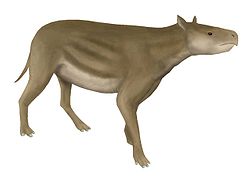
| Life restoration of Kalimantsia bulgarica | |
| Scientific classification 👁 Edit this classification | |
| Kingdom: | Animalia |
| Phylum: | Chordata |
| Class: | Mammalia |
| Order: | Perissodactyla |
| Family: | †Chalicotheriidae |
| Subfamily: | †Chalicotheriinae |
| Genus: | † Geraads, Spassov & Kovachev, 2001 |
| Species: | †K. bulgarica
|
| Binomial name | |
| †Kalimantsia bulgarica Geraads, Spassov & Kovachev, 2001
| |


Kalimantsia is an extinct chalicothere from the Miocene of Bulgaria, Europe. It contains one species, Kalimantsia bulgarica.
Description
[edit]Kalimantsia is named for the area in which it was discovered in 2001 by Geraads, Spassov, and Kovachev. The habitat would have been quite open and the remains of Kalimantsia are accompanied by those of horses, early deer, and various carnivorous mammals. Kalimantsia has a shorter muzzle than the horse-like shapes of the rest of the chalicotheres. The teeth of Kalimantsia are long and low, and well adapted for eating leaves.[1]
Size
[edit]- 3 m (10 ft.)[1]
Lifestyle
[edit]See also
[edit]

- Tylocephalonyx - Another genus of chalicothere that also has a domed head.
References
[edit]- ^ a b c Dixon, Dougal (2008). World Encyclopedia of Dinosaurs & Prehistoric Creatures. New York: Lorenz Books. pp. 453. ISBN 978-0-7548-1730-7.