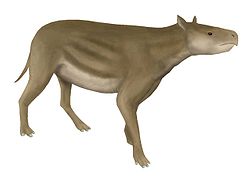
| Nestoritherium | |
|---|---|
| 👁 Image | |
| Skull of N. linxiaense, National Natural History Museum of China | |
| Scientific classification 👁 Edit this classification | |
| Kingdom: | Animalia |
| Phylum: | Chordata |
| Class: | Mammalia |
| Order: | Perissodactyla |
| Family: | †Chalicotheriidae |
| Subfamily: | †Chalicotheriinae |
| Genus: | † Kaup, 1859 |
| Type species | |
| †Nestoritherium sivalense (Falconer & Cautley, 1837)
| |
| Species [1] | |
| |


Nestoritherium is an extinct genus of chalicothere; it has been dated to have lived from the late Miocene to the Early Pleistocene (11.6–0.781 mya).[2][3][4] This range makes Nestoritherium one of the most recently dated chalicotheres. It has been found in fossil sites in Indonesia, Myanmar and China.[4][5]
The genus Nestoritherium was erected by German paleontologist Johann Jakob Kaup in 1859 for the species then known as Chalicotherium sivalense,[6] itself named in 1843 by Falconer and Cautley from early Pleistocene material from India.[1] The shortened faced and brachyodont dentition suggests it belongs to the subfamily Chalicotheriinae.[7]
Nestoritherium fuguense was named from partial lower jaw and palate material from Miocene beds in Fugu County, China in 2014.[1]
Material consisting of a fragmentary upper and lower molar recovered from the (early Pleistocene) Irrawaddy Formation in Myanmar has been referred to the genus Nestoritherium.[8] A femur of possible chalicothere origin was recovered from Pliocene deposits in Yenangyaung in 1897.[9]
References
[edit]- ^ a b c Xue, Xiang-Xu; Deng, Tao; Coombs, Margery; Zhang, Yun-Xiang (2014). "New chalicothere materials from the Late Miocene of Fugu, Shaanxi, China". Vertebrata PalAsiatica. 52: 401–426.
- ^ "A NEW SPECIES OF CHALICOTHERIINAE (PERISSODACTYLA,MAMMALIA) FROM THE LATE MIOCENE IN THE LINXIA BASIN OF GANSU,CHINA--《Vertebrata PalAsiatica》2012年01期". en.cnki.com.cn. Archived from the original on 2016-04-27. Retrieved 2016-04-19.
- ^ "New Chalicothere Species Found From the Late Miocene of the Linxia Basin of Gansu, China----Institute of Vertebrate Paleontology and Paleoanthropology, Chinese Academy of Sciences". english.ivpp.cas.cn. Retrieved 2016-04-19.
- ^ a b "Fossilworks: Nestoritherium". fossilworks.org. Retrieved 17 December 2021.
- ^ Vos, John de (December 2007). "VERTEBRATE RECORDS | Mid-Pleistocene of Southern Asia". Encyclopedia of Quaternary Science. pp. 3232–3249. doi:10.1016/B0-44-452747-8/00256-8. ISBN 978-0-444-52747-9 – via Elsevier.
- ^ Colbert, E. H. (1935). "The Proper Use of the Generic Name Nestoritherium". Journal of Mammalogy. 16 (3): 233–234. doi:10.1093/jmammal/16.3.233.
- ^ "New Chalicothere Species Found From the Late Miocene of the Linxia Basin of Gansu, China". Chinese Academy of Sciences. 2012.
- ^ Tsubamoto, Takehisa; Zin-Maung-Maung-Thein; ThaungHtike; Egi, Naoko; Chit-Sein; Maung-Maung; Takai, Masanaru (2006). "Discovery of chalicothere and Dorcabune from the upper part (lower Pleistocene) of the Irrawaddy Formation, Myanmar" (PDF). Asian Paleoprimatology. 4: 137–142.
- ^ Hooijer, Dirk Albert (1951). "A Femur of a (?) Chalicothere from the Pliocene of Upper Burma". Journal of Mammalogy. 32 (4): 467–468. doi:10.1093/jmammal/32.4.467.