
(Redirected from Nasu Mountains)
This article needs additional citations for verification. Please help improve this article by adding citations to reliable sources. Unsourced material may be challenged and removed. Find sources: "Mount Nasu" – news · newspapers · books · scholar · JSTOR (February 2022) (Learn how and when to remove this message) |


| Mount Nasu | |
|---|---|
| 那須岳 | |
| 👁 Image Nasu Mountains | |
| Highest point | |
| Peak | Sanbonyari Peak |
| Elevation | 1,916.9 m (6,289 ft)[1] |
| Prominence | 1,009 m (3,310 ft)[2] |
| Listing | Mountains of Japan, Ribu |
| Coordinates | 37°09′N 139°57′E / 37.150°N 139.950°E / 37.150; 139.950 |
| Naming | |
| Language of name | Japanese |
| Geography | |
On the border of Nasushiohara and Nasu of Tochigi Prefecture, Nishigō, Nishishirakawa of Fukushima Prefecture, Japan | |
| Parent range | Ōu Mountains |
| Geology | |
| Mountain type | Complex volcano |
| Volcanic arc | Northeastern Japan Arc |
| Last eruption | November 1963[3] |


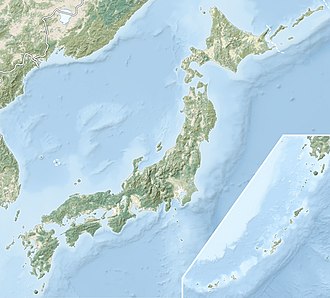

Mount Nasu (那須岳, Nasu-dake) is a group of complex volcanoes located in the northeast part of Nikkō National Park, Japan. The tallest peak is Sanbonyari Peak at a height of 1,916.9 m (6,289 ft). Mount Nasu is one of the 100 Famous Japanese Mountains.
Major peaks
[edit]Mount Nasu has the following major peaks:
- Sanbonyari Peak – 1916.9 m
- Chausu Peak – 1915 m
- Asahi Peak – 1896 m
- Minamigatsusan – 1776 m
- Kuro-oya Peak – 1589 m
These peaks are known collectively as Nasu Five Peaks (那須5岳, Nasu-Go-Take).
Climate
[edit]| Climate data for Mount Nasu (1991−2020 normals, extremes 1976−present) | |||||||||||||
|---|---|---|---|---|---|---|---|---|---|---|---|---|---|
| Month | Jan | Feb | Mar | Apr | May | Jun | Jul | Aug | Sep | Oct | Nov | Dec | Year |
| Record high °C (°F) | 12.7 (54.9) |
16.8 (62.2) |
21.1 (70.0) |
26.8 (80.2) |
29.6 (85.3) |
30.3 (86.5) |
31.8 (89.2) |
32.2 (90.0) |
29.5 (85.1) |
24.6 (76.3) |
20.0 (68.0) |
17.4 (63.3) |
32.2 (90.0) |
| Mean daily maximum °C (°F) | 1.9 (35.4) |
2.7 (36.9) |
6.8 (44.2) |
13.0 (55.4) |
18.2 (64.8) |
20.7 (69.3) |
24.3 (75.7) |
25.4 (77.7) |
21.4 (70.5) |
16.1 (61.0) |
10.9 (51.6) |
5.1 (41.2) |
13.9 (57.0) |
| Daily mean °C (°F) | −1.7 (28.9) |
−1.3 (29.7) |
2.0 (35.6) |
7.8 (46.0) |
13.0 (55.4) |
16.4 (61.5) |
20.2 (68.4) |
21.0 (69.8) |
17.3 (63.1) |
11.8 (53.2) |
6.4 (43.5) |
1.1 (34.0) |
9.5 (49.1) |
| Mean daily minimum °C (°F) | −5.3 (22.5) |
−5.3 (22.5) |
−2.4 (27.7) |
2.6 (36.7) |
7.7 (45.9) |
12.3 (54.1) |
16.7 (62.1) |
17.5 (63.5) |
13.8 (56.8) |
7.7 (45.9) |
2.0 (35.6) |
−2.6 (27.3) |
5.4 (41.7) |
| Record low °C (°F) | −11.7 (10.9) |
−12.1 (10.2) |
−10.4 (13.3) |
−6.0 (21.2) |
−2.3 (27.9) |
3.6 (38.5) |
8.7 (47.7) |
8.9 (48.0) |
3.2 (37.8) |
−1.2 (29.8) |
−6.1 (21.0) |
−10.2 (13.6) |
−12.1 (10.2) |
| Average precipitation mm (inches) | 52.6 (2.07) |
42.8 (1.69) |
101.6 (4.00) |
139.6 (5.50) |
180.8 (7.12) |
220.5 (8.68) |
305.7 (12.04) |
303.9 (11.96) |
305.3 (12.02) |
212.6 (8.37) |
89.2 (3.51) |
60.1 (2.37) |
2,014.7 (79.33) |
| Average snowfall cm (inches) | 103 (41) |
79 (31) |
45 (18) |
7 (2.8) |
0 (0) |
0 (0) |
0 (0) |
0 (0) |
0 (0) |
0 (0) |
4 (1.6) |
55 (22) |
293 (116.4) |
| Average precipitation days (≥ 1.0 mm) | 9.1 | 8.3 | 10.4 | 11.3 | 12.1 | 15.9 | 18.3 | 17.0 | 14.8 | 11.5 | 8.3 | 9.1 | 146.1 |
| Average snowy days (≥ 1 cm) | 11.5 | 8.8 | 5.5 | 0.6 | 0 | 0 | 0 | 0 | 0 | 0 | 0.4 | 5.9 | 32.7 |
| Mean monthly sunshine hours | 131.0 | 129.0 | 156.4 | 170.4 | 169.1 | 108.8 | 98.7 | 115.3 | 98.9 | 115.1 | 130.1 | 132.6 | 1,555.2 |
| Source 1: JMA[4] | |||||||||||||
| Source 2: JMA[5] | |||||||||||||
Eruption
[edit]It is estimated that Mount Nasu started erupting 600 thousand years ago. The eruption started from the north end of the mountain range, at Kashi-Asahi Peak. Only Chausu Peak is active today.
Access
[edit]- Nasu Sancho Station of Nasu Ropeway
- Sandogoya Onsen Bus Stop of Kanto Transportation
Gallery
[edit]-
Chausu lava dome and Asahi Peak
-
Chausu lava dome and fumes
-
Asahi Peak
-
West view from Sanbonyari Peak
-
Sanbonyari Peak and snow in summer
-
At the Sanbonyari Peak
-
Topographic map
-
To Asahi Peak


References
[edit]- ^ "Topographic map of Mount Nasu". opentopomap.org. Retrieved 2023-06-12.
- ^ "Japanese Archipelago - World Ribus". worldribus.org. Retrieved 2025-08-30.
- ^ "Nasudake". Global Volcanism Program. Smithsonian Institution. Retrieved 2021-06-24.
- ^ 観測史上1~10位の値(年間を通じての値). JMA. Retrieved February 18, 2022.
- ^ 気象庁 / 平年値(年・月ごとの値). JMA. Retrieved February 18, 2022.
External links
[edit]

Wikimedia Commons has media related to Mount Nasu.
- Nasudake – Japan Meteorological Agency (in Japanese)
- "Nasudake: National catalogue of the active volcanoes in Japan" (PDF). – Japan Meteorological Agency
- Nasudake – Geological Survey of Japan

Hidden categories:
- Pages using gadget WikiMiniAtlas
- CS1 uses Japanese-language script (ja)
- Articles with short description
- Short description is different from Wikidata
- Articles needing additional references from February 2022
- All articles needing additional references
- Coordinates on Wikidata
- Pages using infobox mountain with language parameter
- Articles containing Japanese-language text
- Commons category link is on Wikidata
- Articles with Japanese-language sources (ja)