
Oulu
Uleåborg (Swedish) | |
|---|---|
City | |
| Oulun kaupunki Uleåborgs stad City of Oulu | |
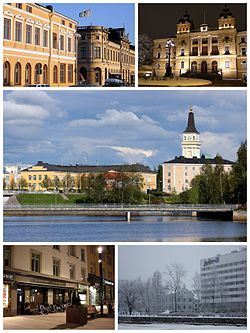
| 👁 From top, left to right: Rantakatu in downtown Oulu; Oulu City Hall; Lyseo Upper Secondary School and the Oulu Cathedral; Shops along Kirkkokatu; Radisson Blu Hotel along Ojakatu From top, left to right: Rantakatu in downtown Oulu; Oulu City Hall; Lyseo Upper Secondary School and the Oulu Cathedral; Shops along Kirkkokatu; Radisson Blu Hotel along Ojakatu | |
|
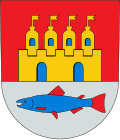
👁 Flag of Oulu Flag 👁 Coat of arms of Oulu Coat of arms | |
| Nicknames: | |
| 👁 Location of Oulu in Finland Location of Oulu in Finland | |
Interactive map of Oulu | |
| Coordinates: 65°00′51″N 25°28′19″E / 65.01417°N 25.47194°E / 65.01417; 25.47194 | |
| Country | 👁 Image Finland |
| Region | North Ostrobothnia |
| Sub-region | Oulu sub-region |
| Charter | April 8, 1605; 420 years ago (1605-04-08) |
| Government | |
| • City manager | Ari Alatossava |
| Area (2018-01-01)[3] | |
• City | 3,817.52 km2 (1,473.95 sq mi) |
| • Land | 2,972.44 km2 (1,147.67 sq mi) |
| • Water | 103.2 km2 (39.8 sq mi) |
| • Urban | 187.1 km2 (72.2 sq mi) |
| • Rank | 17th largest in Finland |
| Population (2025-12-31)[4] | |
• City | 217,556 |
| • Rank | 5th largest in Finland |
| • Density | 73.19/km2 (189.6/sq mi) |
| • Urban | 208 939[5] |
| • Urban density | 915.8/km2 (2,372/sq mi) |
| Demonym | oululainen (Finnish) |
| Population by native language | |
| • Finnish | 92.8% (official) |
| • Swedish | 0.2% |
| • Sami | 0.1% |
| • Others | 6.9% |
| Population by age | |
| • 0 to 14 | 17.4% |
| • 15 to 64 | 66% |
| • 65 or older | 16.6% |
| Time zone | UTC+02:00 (EET) |
| • Summer (DST) | UTC+03:00 (EEST) |
| Website | www.ouka.fi 👁 Edit this at Wikidata |





Oulu (/ˈoʊluː/ OH-loo,[9][10] Finnish: [ˈou̯lu] ⓘ; Swedish: Uleåborg [ʉːlɛɔˈbɔrj] ⓘ) is a major port city in Finland and the regional capital of North Ostrobothnia. It is located on the north-western coast of the country at the mouth of the River Oulu. The population of Oulu is approximately 218,000, while the sub-region has a population of approximately 266,000. It is the 5th most populous municipality in Finland, and the fourth most populous urban area in the country. Oulu is also the most populous city in Northern Finland.
Oulu's neighbouring municipalities are: Hailuoto, Ii, Kempele, Liminka, Lumijoki, Muhos, Pudasjärvi, Tyrnävä and Utajärvi. Oulu is the third northernmost city in the world with a population of over 100,000, after Murmansk and Norilsk in Russia.
Due to its large population and geopolitical, economic and cultural-historical position, Oulu has been called the "capital of Northern Finland".[1] Oulu is also considered one of Europe's "living labs", where residents experiment with new technologies (such as NFC tags and ubi-screens) on a community-wide scale.[11] Although only in the top 2% of universities,[12] the University of Oulu is regionally renowned in the field of information technology.[13][14][15] Oulu has also been very successful in recent city image surveys; in a study published by the Finnish Economic Survey in 2008, Oulu received the best image rating among large cities in the country, including ratings from respondents in all provinces.[16] In the 2023 T-Media survey, Oulu was tied with Kuopio as the second most attractive city in Finland, while Tampere was ranked first.[17] In 2025, Oulu had the cleanest air quality among all European cities according to European Environment Agency (EEA).[18]
Once known for wood tar and salmon,[19] Oulu has become a major high-tech centre, particularly in IT and wellness technology.[20] In 2024, Oulu placed third in the European Commission’s Capital of Innovation Awards (iCapital) in the Rising Innovative Cities category.[21] Other important industries include wood processing, chemicals, pharmaceuticals, paper and steel.[22]
Oulu has been selected as the European Capital of Culture for 2026[23][24][25][26] together with Trenčín, Slovakia.
Etymology
[edit]The city is named after the river Oulujoki, which originates in the lake Oulujärvi. There have been a number of other theories for the origin of the name Oulu. One possible source is a word in the Sami language meaning 'flood water', but there are other suggestions. At minimum, the structure of the word requires that, if originally given by speakers of a Uralic language, the name must be a derivative. In all likelihood, it also predates Finnish settlement and is thus a loanword from one of the now-extinct Saami languages once spoken in the area.
The most probable theory is that the name derives from the Finnish dialectal word oulu, meaning "floodwater", which is related to e.g. Southern Sami åulo, meaning "melted snow", åulot meaning "thaw" (of unknown ultimate origin). Two other word families have also been speculated to be related. The first is seen in the Northern Savo dialectal word uula and its Sami counterpart oalli, both meaning "river channel". The second is the Uralic root reconstructed as *uwa, meaning "river bed" (reflected as vuo in modern Finnish, also in derivatives such as vuolas "heavy-flowing"). To either of these roots, some Sami variety would have to be assumed having added further derivational suffixes.[27]
History
[edit]

Oulu is situated by the Gulf of Bothnia, at the mouth of river Oulujoki, which was an official trading centre.[28]
Following the Treaty of Nöteborg in 1323, the status of Oulu was disputed in its ownership, as both the Novgorod Republic and the Kingdom of Sweden held much influence. In 1345, the Swedish annexed territory up to the Kemi River for the Diocese of Turku. In 1375, the Novgorodians built a defensive castle which was later captured by the Swedish forces in 1377.[29]
The 1400s were characterized by Russian raids in the region, during these raids captured people would be killed and/or taken back to the region of Russia.[30] In 1531, the city was granted permission to act as a trading post.[29] In 1590, the Oulu Castle was built by the Swedes and in 1595, the Treaty of Teusina firmly established Sweden's control over Oulu.
The city was founded on 8 April 1605 by King Charles IX of Sweden, and granted city privileges in 1610.[31] In 1765, Oulu received township rights granting them to trade outside of Sweden.[32] Oulu was the capital of the Province of Oulu from 1776 to 2009.
In 1822, a major fire destroyed much of the city, especially the city centre as most of the city was made from wood.[33] The architect Carl Ludvig Engel, chiefly known for the neoclassical (empire style) buildings around Helsinki Senate Square, was enlisted to provide the plan for its rebuilding. With minor changes, this plan remains the basis for the layout of Oulu's town center. The Oulu Cathedral was built in 1832 to his designs, with the spire being finished in 1844. During the Åland War, part of the Crimean War, Oulu's harbour was raided by the British fleet, who destroyed ships and burned tar houses,[34] leading to international criticism.[citation needed]
The city was the site of the Battle of Oulu on 3 February 1918 between the Whites and the Reds during the Finnish Civil War.[35]
Geography
[edit]

Oulu is located in northern Finland, a considerable distance from the other major cities in the country. It is located 607 kilometres (377 mi) north of the capital city Helsinki. Mainland Finland's northernmost and southernmost points are roughly equidistant from Oulu.
Oulu's coast sits at the Bothnian Bay (Perämeri in Finnish) and the Swedish mainland is about 180 km directly west across the Bothnian Bay. From the center of Oulu in the direction of Oulunsalo, there is Kempeleenlahti [fi], a smaller but wide, meadow-belted bay,[36] and part of it has been listed as a nature conservation area.[37] The nearby island Hailuoto is just off the coast, 53 kilometres (33 mi) away in the Bothnian Bay. Along the coast to the southwest, about 75 kilometres (47 mi) of Oulu is Raahe (Brahestad), known for its historic wooden town, and, further to the southwest, about 130 kilometres (81 mi) of Oulu is Kalajoki, known for its popular sandy beaches.
Subdivisions
[edit]

Oulu is divided into 106 city districts. The largest of these are Haukipudas, Oulunsalo, Kaakkuri, Ritaharju, Tuira, and Kello [fi].
The municipality of Ylikiiminki was merged with the city of Oulu on 1 January 2009. Oulu and the municipalities of Haukipudas, Kiiminki, Oulunsalo, and Yli-Ii were merged on 1 January 2013.[38]
Climate
[edit]Oulu has a subarctic climate (Köppen: Dfc, Trewartha Eolo), bordering a humid continental climate (Köppen: Dfb, Trewartha Dclo). It is the largest Finnish city entirely in this climatic zone as well as one of the largest such in the world. The typical features are cold and snowy winters with short and mild summers.[39][40] Average annual temperature is 3.3 °C (37.9 °F). The average annual precipitation is 477 mm (18.78 in) falling 105 days per year, mostly in late summer and fall.[citation needed] The warmest temperature ever recorded in Oulu was 33.3 °C (91.9 °F) in July 1957,[41] while the coldest temperature on record was −41.5 °C (−42.7 °F) in February 1966.[42]
Due to Oulu's far northern location, and its frequent overcast skies, it only sees on average 15 minutes of sunshine per day in December. During the winter solstice days only last 3 hours and 34 minutes with the sun rising 1.9 degrees over the horizon. On the other hand, during the summer solstice days last 22 hours and 3 minutes, with the sun dipping 1 degree below the horizon. This gives Oulu white nights during the summer.[43]
| Climate data for Oulu, 1991–2020 normals, records 1921–present | |||||||||||||
|---|---|---|---|---|---|---|---|---|---|---|---|---|---|
| Month | Jan | Feb | Mar | Apr | May | Jun | Jul | Aug | Sep | Oct | Nov | Dec | Year |
| Record high °C (°F) | 9.3 (48.7) |
7.8 (46.0) |
11.5 (52.7) |
23.9 (75.0) |
29.9 (85.8) |
32.3 (90.1) |
33.3 (91.9) |
30.5 (86.9) |
25.4 (77.7) |
21.1 (70.0) |
11.2 (52.2) |
8.2 (46.8) |
33.3 (91.9) |
| Mean maximum °C (°F) | 3.3 (37.9) |
3.3 (37.9) |
6.2 (43.2) |
14.9 (58.8) |
22.4 (72.3) |
25.9 (78.6) |
27.8 (82.0) |
26.0 (78.8) |
20.2 (68.4) |
12.5 (54.5) |
6.7 (44.1) |
4.3 (39.7) |
29.0 (84.2) |
| Mean daily maximum °C (°F) | −4.8 (23.4) |
−4.7 (23.5) |
−0.4 (31.3) |
5.8 (42.4) |
12.6 (54.7) |
17.9 (64.2) |
21.1 (70.0) |
18.9 (66.0) |
13.2 (55.8) |
5.8 (42.4) |
0.5 (32.9) |
−2.7 (27.1) |
6.9 (44.5) |
| Daily mean °C (°F) | −8.2 (17.2) |
−8.4 (16.9) |
−4.4 (24.1) |
1.6 (34.9) |
8.0 (46.4) |
13.7 (56.7) |
16.7 (62.1) |
14.6 (58.3) |
9.6 (49.3) |
3.3 (37.9) |
−1.6 (29.1) |
−5.3 (22.5) |
3.3 (38.0) |
| Mean daily minimum °C (°F) | −11.9 (10.6) |
−12.1 (10.2) |
−8.3 (17.1) |
−2.5 (27.5) |
3.4 (38.1) |
9.3 (48.7) |
12.4 (54.3) |
10.6 (51.1) |
6.0 (42.8) |
0.6 (33.1) |
−4.2 (24.4) |
−8.8 (16.2) |
−0.5 (31.2) |
| Mean minimum °C (°F) | −26.2 (−15.2) |
−26.0 (−14.8) |
−20.4 (−4.7) |
−11.1 (12.0) |
−3.0 (26.6) |
3.0 (37.4) |
7.3 (45.1) |
3.8 (38.8) |
−1.9 (28.6) |
−9.6 (14.7) |
−16.1 (3.0) |
−22.7 (−8.9) |
−29.0 (−20.2) |
| Record low °C (°F) | −37.5 (−35.5) |
−41.5 (−42.7) |
−32 (−26) |
−21.4 (−6.5) |
−9.1 (15.6) |
−6.1 (21.0) |
3.6 (38.5) |
−1.5 (29.3) |
−8.0 (17.6) |
−20.6 (−5.1) |
−33 (−27) |
−37.2 (−35.0) |
−41.5 (−42.7) |
| Average precipitation mm (inches) | 32 (1.3) |
29 (1.1) |
26 (1.0) |
23 (0.9) |
40 (1.6) |
51 (2.0) |
80 (3.1) |
62 (2.4) |
49 (1.9) |
51 (2.0) |
43 (1.7) |
39 (1.5) |
525 (20.5) |
| Average snowfall cm (inches) | 33 (13) |
46 (18) |
43 (17) |
7 (2.8) |
— | — | — | — | — | — | 4 (1.6) |
17 (6.7) |
150 (59) |
| Average precipitation days | 9 | 8 | 7 | 6 | 8 | 8 | 10 | 10 | 8 | 10 | 10 | 10 | 104 |
| Average relative humidity (%) (daily average) | 87 | 86 | 82 | 73 | 67 | 66 | 71 | 76 | 82 | 86 | 90 | 89 | 80 |
| Mean monthly sunshine hours | 24 | 69 | 137 | 208 | 273 | 296 | 283 | 212 | 133 | 69 | 28 | 8 | 1,740 |
| Average ultraviolet index | 0 | 0 | 1 | 2 | 3 | 4 | 4 | 3 | 2 | 1 | 0 | 0 | 2 |
| Source 1: FMI[44] | |||||||||||||
| Source 2: FMI (record highs and lows 1921–1961)[45]
FMI (record highs and lows 1961–present)[46] Source 3: weather2travel.com (average monthly UV index)[47] | |||||||||||||
City centre
[edit]

The core city centre of Oulu comprises approximately 14 city blocks, bounded by the City Hall to the north, the Plaanaoja stream to the east, Albertinkatu to the southwest, and Aleksanterinkatu to the northwest.[48] During the 21st century, the city centre has undergone densification, and the pedestrian zone Rotuaari has been extended southwards along Kirkkokatu. A major project aimed at improving the quality of the urban environment was the renovation of Mannerheim Park in 2019.
Another central green area is Otto Karhi Park, which is crossed by the Plaanaoja stream running through the city centre. The park borders Hallituskatu, a major street that continues the commercial core of the city towards the district of Raksila and the railway station.
Historically, the city centre of Oulu was characterised by relatively low-rise buildings. From the 2010s onwards, several high-rise residential towers have been constructed in the area.[49] In 2016, the Shopping centre Valkea was completed in the core of the city centre. In addition to approximately 60 retail units, the complex includes a Sokos department store and 66 residential apartments.
At the end of 2024, around 23,800 people lived in the central major district of Oulu, representing 11% of the city’s population.[50]
Ongoing development projects
[edit]The most significant current planning area is Raksila, located adjacent to the city centre, where a new transport and service hub is planned. The project includes a new bus terminal, commercial and office space, a hotel, and residential buildings.[51] The Raksila area is also planned to include a multipurpose arena intended for sports and entertainment events,[52] as well as a new hypermarket replacing the existing cluster of three grocery stores in the area.
Behind the main library, on Vänmanninsaari island, an 18-storey hotel tower is planned. The Oulu City Council approved the construction on 18 March 2024 and it is scheduled to begin in autumn 2026.[53] The hotel is intended to address what has been considered an insufficient supply of hotel accommodation in the city.[54] The plot has been reserved for a tower block since 1965, when the original plan for island was completed.[55]
Demographics
[edit]Population
[edit]| Year | Pop. | ±% p.a. |
|---|---|---|
| 1815 | 3,543 | — |
| 1850 | 5,761 | +1.40% |
| 1870 | 7,955 | +1.63% |
| 1890 | 12,665 | +2.35% |
| 1910 | 19,802 | +2.26% |
| 1920 | 21,332 | +0.75% |
| 1930 | 24,186 | +1.26% |
| 1939 | 28,670 | +1.91% |
| 1972 | 110,080 | +4.16% |
| 1980 | 121,809 | +1.27% |
| 1990 | 136,029 | +1.11% |
| 2000 | 160,851 | +1.69% |
| 2010 | 185,419 | +1.43% |
| 2020 | 207,327 | +1.12% |
| Source: Tilastollinen päätoimisto,[56] Statistics Finland (1972-2020)[57] | ||
The city of Oulu has 217,556 inhabitants, making it the 5th most populous municipality in Finland. The Oulu region has a population of 265,553, making it the fourth largest region in Finland after Helsinki, Tampere and Turku. Oulu is home to 4% of Finland's population. 7% of the population has a foreign background, which is lower than in the major Finnish cities of Helsinki, Espoo, Tampere, Vantaa or Turku.[58]
| Year | Population |
|---|---|
| 1980 | 121,809
|
| 1985 | 128,869
|
| 1990 | 136,029
|
| 1995 | 146,395
|
| 2000 | 160,851
|
| 2005 | 173,436
|
| 2010 | 185,419
|
| 2015 | 198,525
|
| 2020 | 207,327
|
| 2025 | 217,469
|
Languages
[edit]mother tongue (2024)[58]
- Finnish (93.3%)
- Russian (0.60%)
- Arabic (0.50%)
- English (0.50%)
- Chinese (0.40%)
- Persian (0.30%)
- Somali (0.20%)
- Other (4.20%)
Oulu is the second largest monolingual Finnish-speaking municipality in Finland after Tampere. As of 2024[update], the majority of the population, 201,917 persons (92.8%), spoke Finnish as their first language. In addition, the number of Swedish speakers was 470 persons (0.2%) of the population. Foreign languages were spoken by 6.9% of the population.[58] As English and Swedish are compulsory school subjects, functional bilingualism or trilingualism acquired through language studies is not uncommon.
At least 100 different languages are spoken in Oulu. The most common foreign languages are Russian (0.6%), Arabic (0.5%), English (0.5%), Chinese (0.4%) and Persian (0.3%).[58]
Immigration
[edit]| Population by country of birth (2025)[59] | ||
| Country of birth | Population | % |
|---|---|---|
| 👁 Image Finland |
201,623 | 92.7 |
| 👁 Image Sweden |
1,911 | 0.9 |
| 👁 Image Soviet Union |
1,115 | 0.5 |
| 👁 Image China |
819 | 0.4 |
| 👁 Image India |
668 | 0.3 |
| 👁 Image Bangladesh |
552 | 0.3 |
| 👁 Image Pakistan |
551 | 0.3 |
| 👁 Image Iraq |
529 | 0.2 |
| 👁 Image Vietnam |
524 | 0.2 |
| 👁 Image Sri Lanka |
515 | 0.2 |
| Other | 8,139 | 3.7 |


As of 2024[update], 14,159 people with a foreign background lived in Oulu, or 7% of the population.[note 1] There are 15,008 residents who were born abroad, which or 7% of the population. The number of foreign citizens in Oulu is 10,198. Most foreign-born citizens come from the former Soviet Union, Sweden, China, India, Iraq, Iran and Vietnam.[58]
The relative share of immigrants in Oulu's population is below the national average. Nevertheless, the city's new residents are increasingly of foreign origin. This will increase the proportion of foreign residents in the coming years.
Religion
[edit]In 2023, the Evangelical Lutheran Church was the largest religious group with 67.2% of the population of Oulu. Other religious groups accounted for 1.9% of the population. 30.9% of the population had no religious affiliation.[61]
Oulu, as well as other parts of North Ostrobothnia, is well known as a strong support area of the Conservative Laestadianism revival movement.[62] A Laestadian background has been estimated to be common in construction sector management.[63]
Economy
[edit]


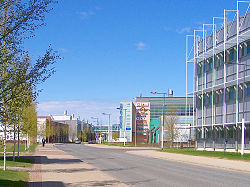
As of 31 December 2008, the active working population was employed as follows:[64]
| Industries | Working population |
|---|---|
| Services | 43,049 |
| Industry | 11,111 |
| Commerce | 10,848 |
| Construction | 5,449 |
| Transport | 3,698 |
| Farming, forestry and mining | 582 |
| Unknown | 431 |
| Unemployment rate | 13.8%[65] |
| Total | 75,158 |
In 2011, the most important employers were:[64]
| Employer | No. of employees |
|---|---|
| City of Oulu | 9,709 |
| Northern Ostrobothnia Hospital District | 6,144 |
| University of Oulu | 3,045 |
| Nokia Networks | 2,100 |
| Nokia Group | 2,000 |
| The Oulu Region Joint Authority for Vocational Training | 1,955 |
| Kesko Group | 1,426 |
| Cooperative Arina Group (S Group) | 1,107 |
| Stora Enso Group | 1,155 |
| Itella Corporation | 780 |
| ISS Palvelut Oy | 730 |
| ODL Group | 653 |
Culture
[edit]

Oulu has a diverse and active cultural scene, combining local traditions with contemporary and international influences. The city is known for its strong emphasis on music, festivals, and community-based cultural activities, and it has developed a reputation as one of the cultural centres of northern Finland.
One of Oulu’s most internationally recognised cultural events is the Air Guitar World Championships, held annually in August since 1996.[66] The event attracts participants and audiences from around the world and has become a symbol of the city’s creative and unconventional cultural identity. Other notable cultural exports include the avant-garde performance group Mieskuoro Huutajat (Screaming Men)[67] and the metal band Sentenced. The crime drama television series All the Sins (Kaikki synnit), filmed in the Oulu region between 2018 and 2021, has also contributed to the city’s cultural visibility.[68]
Music plays a central role in Oulu’s cultural life. The city hosts numerous concerts and festivals throughout the year, covering genres such as rock, classical music, and jazz. Major annual events include the Oulu Music Video Festival in August[69], as well as the popular rock festival Qstock in July, one of the largest music festivals in Finland.[70] The Oulu Music Festival takes place during the winter months, while the Oulunsalo Music Festival is held in summer. Additional recurring events include The Irish Festival of Oulu in October and the International Children's Film Festival in November.
The Madetoja Hall (Madetojan sali), completed in 1983, is home to the EU's northernmost professional symphony orchestra, Oulu Sinfonia.[71] The hall is named after the composer Leevi Madetoja.
Oulu also offers a range of museums and cultural institutions. These include the Northern Ostrobothnia Museum, which presents regional history and culture; the Oulu Museum of Art (OMA), focusing on contemporary art; the science centre Tietomaa, one of the first science centres in Finland; and the Turkansaari Open-Air Museum, which showcases traditional rural life in the region.[72]
Public art is a visible part of the cityscape. Notable works include a statue of the poet sculpture of Frans Michael Franzén and the well-known Toripolliisi (The Bobby at the Market Place), which has become an iconic symbol of Oulu.
Communication
[edit]Kaleva, an independent newspaper founded in 1899, is published in Oulu. In 2013 Kaleva had a circulation of 69,540 copies and was the sixth largest Finnish newspaper by circulation.[73]
Food
[edit]In the 1980s, rössypottu, salmon soup and sweet cheese (juhannusjuusto) were named Oulu's traditional parish dishes.[74]
Sights
[edit]


- Tietomaa, a science center with over 150 exhibits
- The Rapids Center, the area in the estuary of the Oulu river consisting of small islands connected with bridges and fountains in the middle of the river, and including a housing area of building blocks planned by Alvar Aalto
- The Market Square with the City Library, the City Theatre, the Toripolliisi statue and old salt and tar storehouses
- Hupisaaret Islands, a large park area located in the estuary of the Oulu river
- The F. M. Franzen memorial
- The Koitelinkoski rapids
- The Northern Ostrobothnia museum
- The Pateniemi Sawmill Museum
- The Vehicle Museum
- The University of Oulu Botanical Gardens (situated in Linnanmaa)
- The Arctic Gallery
- Turkansaari (historical open-air museum)
- Spa Hotel Eden and sand beach in Nallikari recreation and tourism area
- Mannerheim Park
- Old observatory in Linnansaari, built in 1875 on top of the ruins of the Castle of Oulu
- Oulu Museum of Art
Churches
[edit]

- Cathedral
- Haukipudas Church
- Holy Family of Nazareth Church
- Holy Trinity Cathedral of Oulu
- Kiiminki Church
- Oulujoki Church
- Oulunsalo Church
- St. Luke's Chapel
- Tuira Church
- Ylikiiminki Church
Other points of interest
[edit]- Qstock music festival
- Oulu Music Video Festival
- Air Guitar World Championships
- Jalometalli Metal Music Festival
- The Irish Festival of Oulu
- Laitakari beacon tower
- Madetoja Hall, housing the Oulu Music Centre, the residence of the Oulu Symphony Orchestra
- Oulu Hall (a large indoor sports facility consisting of a low dome, which looks somewhat like a landed flying saucer)
- Terwa Marathon & Run, event in late May (since 1989)
- The Terva-skiing event in early March (since 1889)
- The Winter Swimming World Championship [citation needed]
Transport
[edit]

Intercity
[edit]Oulu is served by Oulu Airport, the third largest airport in Finland by passenger volume. It is located 15 kilometres (9 mi) south-west of the city centre.
The Port of Oulu is one of the busiest harbours on the Bothnian Bay. It includes four separate harbour areas: Vihreäsaari oil and bulk docks, Nuottasaari docks and Oritkari docks. There is also a ferry service in Oulu, which is mostly used between Oulunsalo and the Hailuoto Island.[75] An 8.4-kilometer causeway, including two 750-meter-long bridges, is being built between the mainland and the island. The work is scheduled for completion in 2026.[76]
The shortest travel time from Oulu railway station to Helsinki Central railway station is 5 h 34 min, operated by VR. Other destinations include Kolari, Rovaniemi, Seinäjoki and Tampere.
The most important road in Oulu is Highway 4 (E8/E75) that runs from Helsinki to Utsjoki via Lahti, Jyväskylä, Oulu, Kemi and Rovaniemi. Other highways running to and from Oulu are Highway 20 to Kuusamo and Highway 22 to Kajaani.[77]
Within the city
[edit]Oulu is notable for its transportation network dedicated to non-motor vehicular traffic, including pedestrians and bicycles (termed "light" traffic in Finland). In 2022, the city contained more than 950 kilometres (590 mi) of pathways and more than 300 underpasses and bridges devoted exclusively to pedestrian and bicycle traffic. The network is used year-round. The ratio of walking and cycling traffic pathways to residents is the highest in Finland and the cycling mode share is 20 percent.[78][79][80]


Even in winter, bicycle commuting remains strong in Oulu, in spite of the cold, dark, and snow. About 12% of winter trips are by bicycle, and about half of trips to school or university are. The city has a robust system for keeping bike paths maintained and clear of snow, and bike paths and lanes are plowed before roadways to encourage such human-scale winter transit in the city where 12% already do so.[81] The Winter Cycling Federation was founded in Oulu in 2013, and the first Winter Cycling Congress was held there.[82]
In 2015, a large underground parking facility, Kivisydän (Stone Heart), opened in the city center directly beneath main shopping streets. The network of parallel roads for cars and pedestrians was drilled in the rock at the depth of 30 meters (98 ft). The parking facility includes two ramps, 900 visitor parking lots (expandable to 1500), six access points to the ground served by 19 elevators (expandable to nine and 25), a service facility for commercial delivery vehicles, and ubi-screens that guide the driver to the selected ground access point and help locate the parked car by its license number.[83][84]
Solar power
[edit]In 2015, the Kaleva Media printing plant in Oulu became the most powerful photovoltaic solar plant in Finland, with 1,604 solar photovoltaic (PV) units on its roof. Although the city of Oulu, located near the Arctic Circle, has only two hours of weak sunlight in December, the photovoltaic cells work almost around the clock in the summer. The cold climate means the PV panels can get up to a 25% boost per hour, as they don't overheat.[85]
Because the sun is quite low in the sky at this latitude, vertical PV installations are popular on the sides of buildings. These solar walls also capture light reflected from snow.[85]
Snow is not necessarily cleared from rooftop solar installations.[85]
The local utility, Oulun Energia, is owned by the city of Oulu. The energy mix it receives from the Nordic-wide grid includes wood pellets, waste incineration, bioenergy, hydro-electric, geothermal, wind, nuclear, peat, natural gas and coal.[85]
Sports
[edit]
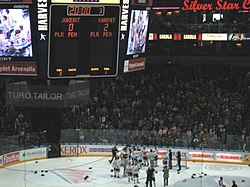


Ice hockey is the most popular spectator sport in Oulu. The local club Kärpät has won the SM-liiga championship title eight times (1981, 2004, 2005, 2007, 2008, 2014, 2015 and 2018). It has also twice been the runner-up in the IIHF European Champions Cup, in 2005 and in 2006.
In football AC Oulu plays in Veikkausliiga, the premier division of Finnish football. So far only OPS has claimed the Finnish football championship twice by winning Mestaruussarja in 1979 and in 1980. Other notable football clubs include OLS, OTP and JS Hercules.
Oulu has one well-known bandy club, OLS, which plays in Bandyliiga and has become Finnish champions 14 times, most recently in 2014. The other bandy club, OPS, with its 7 championships and a bronze medal as late as in 2009, announced it would be closing down after the 2009–10 season. In 2001 the city was the main venue for the Bandy World Championship.
Oulu is also home to several other sports clubs such as Oulu Northern Lights (American football), Oulun NMKY (Basketball), Oulun Lippo (Pesäpallo), Oulun Pyrintö (Track and field), SK Pohjantähti (Orienteering), OYUS (Rugby union), Oulu Irish Elks (Gaelic football) and ETTA (Volleyball).
Oulun Tervahiihto is an annual ski marathon event held since 1889.
Terwa Run & Marathon is an annual running event held since 1989 in late May.
Pokkinen Park in Oulu hosts the northern-most Parkrun every Saturday at 9:30.
A former motorcycle speedway track known as the Iinat Motor Sports Center was located north of the Pirttilammentie and east of the Iinatintie (64°57′31″N 25°34′23″E / 64.95861°N 25.57306°E / 64.95861; 25.57306).[86] The Center opened in 1979 and hosted many events, including the Finnish Final, as part of the qualifying round of the Speedway World Championship in 1983.[87][88]
Education
[edit]

The University of Oulu and Oulu University of Applied Sciences have their main campuses located in Oulu.
Oulu is home to the most northerly architecture school in the world. The school is best known for its strong regionalistic ideas for developing architecture. This movement is named "the Oulu school" ("Oulun koulu") of architecture.[89]
Oulu Vocational College has over 13 000 students. It houses several different study subjects in different units which are spread over Oulu and neighbouring municipalities. Oulu Vocational College School of Business Studies is one of the few vocational schools which has game programming in its curriculum.
Oulu International School is one of nine schools in Finland offering basic education in English. There's also a Swedish-speaking private school (Swedish Svenska Privatskolan i Uleåborg) for students up until high school. The school is the northernmost Swedish-speaking school in Finland.[90]
Notable people
[edit]- Saara Aalto, singer, X Factor UK finalist
- Eero Aho, actor
- Outi Alanko-Kahiluoto, politician
- Marcus Amand, Finnish-French racing driver
- Peter von Bagh, film historian and director
- Blind Channel, a post-hardcore band, Finland's Eurovision representatives 2021
- Vladislav Delay, electronic musician
- Eeva Riitta Fingerroos, Paralympic swimmer
- Frans Michael Franzén, poet
- Lars Gallenius, 17th century painter
- Heidi Hautala, politician
- Matti Hautamäki, ski jumper
- Aaro Hellaakoski, poet
- John von Julin, pharmacist, factory owner and vuorineuvos
- Yrjö Kallinen, politician
- Jorma Kontio, harness driver
- Pekka Korpi, harness driver
- V.A. Koskenniemi, poet
- Ville Laihiala, musician and former frontman of the discontinued local metal band Sentenced
- Vilho Lampi, painter
- Miki Liukkonen, writer, poet and musician
- Taavetti Lukkarinen, former foreman of Kemi Oy; man who was convicted to death and hanged of treason
- Fanni Luukkonen, the leader of Lotta Svärd
- Leevi Madetoja, composer
- Impaled Nazarene, nuclear metal band
- Iivo Niskanen, Olympic champion cross-country skier
- Kerttu Niskanen, cross-country skier
- Jaakko Ohtonen, actor
- Patrik Pasma, racing driver
- Leena Peltonen-Palotie, geneticist
- Michael Maria Penttilä, serial killer
- Susanna Pöykiö, figure skater
- Ville Ranta, comic artist
- Mika Ronkainen, filmmaker
- Keke Rosberg, 1982 Formula One world champion
- Kauko Röyhkä, author and rock musician
- Martti Suosalo, singer and actor
- Pertti Sveholm, actor
- Mikael Toppelius, church painter
- Risto Tuorila, actor
- Juha Väätäinen, athlete
- Sara Wacklin, teacher and writer
- Gustaf Wilson, Finnish-American pioneer and businessman
- Three former presidents of the country Kaarlo Juho Ståhlberg, Kyösti Kallio and Martti Ahtisaari, also a Nobel Peace Prize laureate
- Ice Hockey players: Kari Jalonen, Mikael Granlund, Markus Granlund, Joni Pitkänen, Reijo Ruotsalainen, Mika Pyörälä, Lasse Kukkonen, Markus Nutivaara and Sebastian Aho
- Football/soccer players: Rasmus Karjalainen, Otso Liimatta, Aki Lahtinen, Antti Niemi, Markus Heikkinen, Janne Hietanen, Mika Nurmela and Seppo Pyykkö
- Qiyu Zhou, chess player, commentator, and streamer
International relations
[edit]Twin towns and sister cities
[edit]- Alta Municipality, Norway (since 1948)[91][92]
- Arkhangelsk, Russia (since 1993)[91][93]
- Astana, Kazakhstan (since 2013)[94]
- Boden, Sweden (since 1948)[91]
- Bursa, Turkey (since 1978)[91][95]
- Halle, Germany (since 1968)[91]
- Leverkusen, Germany (since 1968)[91]
- Odesa, Ukraine (since 1957)[91]
- Siófok, Hungary (since 1978)[91]
- Hangzhou, China (since 2010)[91]
Oulu also maintains relationships with cities twinned to former municipalities merged with Oulu in 2013:[91]
- Matera, Italy (twinned with Oulunsalo since 2010)
- Szigetszentmiklós, Hungary (twinned with Haukipudas since 1992)
- Kronstadt, Russia (twinned with Haukipudas, Kiiminki, and Yli-Ii since 1991)
Partnership and twinning cities
[edit]In addition Oulu has eight 'Partnership & Twinning cities':[96]
International municipal projects
[edit]The educational department was a part of the Lifelong Learning Programme 2007–2013 in Finland.
Crime
[edit]Oulu was the site of the 2018 Oulu child sexual exploitation scandal. Prime Minister Juha Sipilä declared that "Sex crimes against children are inhumane acts of incomprehensible evil."[97]
Gallery
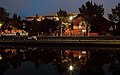
[edit]-
Kauppurienkatu in city center
-
Warehouses in marketplace
-
Residential area in Toppila
-
Nallikari beach
-
Koiteli rapids in Kiiminki




See also
[edit]


- Laanila Highschool
- Toppila Power Station – Power plant in Oulu, Finland
- Oulu Aircraft Hijacking – 1978 aircraft hijackingPages displaying short descriptions of redirect targets
- Lake Oulujärvi – Lake of Northern Ostrobothnia and Kainuu, FinlandPages displaying short descriptions of redirect targets
Notes
[edit]References
[edit]- ^ a b "Discover Oulu". Finland Convention Bureau. Retrieved 14 March 2024.
- ^ "Oulu – Capital of Northern Scandinavia". Archived from the original on 2022-03-07. Retrieved 2021-06-03.
- ^ "Area of Finnish Municipalities 1.1.2018" (PDF). National Land Survey of Finland. Retrieved 30 January 2018.
- ^ "Immigration fell again considerably in Finland in 2025". Population structure. Statistics Finland. 2026-01-22. ISSN 2243-3627. Retrieved 2026-03-29.
- ^ Tarkoma, Jari (2008-01-15). "Taajamissa asuu 84 prosenttia väestöstä". Tiedote (in Finnish). Statistics Finland (Tilastokeskus). Retrieved 11 February 2013.
- ^ "Population growth slowed down in 2025". Population structure. Statistics Finland. 2026-04-01. ISSN 1797-5395. Retrieved 2026-04-01.
- ^ "Population according to age (1-year) and sex by area and the regional division of each statistical reference year, 2003–2020". StatFin. Statistics Finland. Retrieved 2 May 2021.
- ^ a b "Luettelo kuntien ja seurakuntien tuloveroprosenteista vuonna 2023". Tax Administration of Finland. 14 November 2022. Retrieved 7 May 2023.
- ^ "Oulu". The American Heritage Dictionary of the English Language (5th ed.). HarperCollins. Retrieved 10 May 2019.
- ^ "Oulu". Merriam-Webster.com Dictionary. Merriam-Webster. OCLC 1032680871. Retrieved 10 May 2019.
- ^ Saylor, Michael (2012). The Mobile Wave: How Mobile Intelligence Will Change Everything. Perseus Books/Vanguard Press. p. 63. ISBN 9781593157203.
- ^ "QS World University Rankings for Computer Science and Information Systems 2022".
- ^ "Bachelor of Engineering, Information Technology – OAMK". Archived from the original on 2023-10-25. Retrieved 2021-07-01.
- ^ Oulu Innovation Alliance
- ^ Tietotekniikka, Tietotekniikan tutkinto-ohjelma, tekniikan kandidaatti ja diplomi-insinööri (3v + 2v) – Opintopolku Archived 2015-08-11 at the Wayback Machine (in Finnish)
- ^ "Kuntien imagotutkimus 2007" (in Finnish). July 11, 2008. Retrieved November 13, 2020.[permanent dead link]
- ^ Hurme, Anu (29 March 2023). "Tampere listattiin jo kolmatta kertaa Suomen vetovoimaisimmaksi kaupungiksi – muista suurista kaupungeista vain Oulu paransi tulostaan" [Tampere was listed as the most attractive city in Finland for the third time – of the other big cities, only Oulu improved its result]. Yle (in Finnish). Retrieved 29 March 2023.
- ^ "European city air quality viewer". European Environment Agency. 4 July 2025. Retrieved 11 July 2025.
- ^ "Oulu: the world's tar capital". Oulu Culture Foundation. Retrieved 14 March 2024.
- ^ "What makes Oulu a high tech hub in the north?". Helsinki Times. Retrieved 14 March 2024.
- ^ "Success for Finnish cities in EU innovation awards". www.goodnewsfinland.com. Retrieved 2025-10-03.
- ^ "Finnish industry: Constantly adapting to a changing world". This is Finland. Retrieved 14 March 2024.
- ^ Mattila, Mattias (2 June 2021). "Oulu on Euroopan kulttuuripääkaupunki 2026". Yle Uutiset (in Finnish). Helsinki: Yleisradio Oy. Retrieved 11 March 2026.
- ^ Oulu in Northern Finland selected as European Capital of Culture for 2026 – High North News
- ^ "The best places in the world to travel to in 2026". National Geographic. 21 October 2025. Retrieved 25 October 2025.
- ^ "The 20 best places to travel in 2026". BBC Travel. BBC. 11 December 2025. Retrieved 14 December 2025.
- ^ "Oulu-nimen etymologia". Kotimaisten kielten tutkimuskeskus. Archived from the original on 2011-05-24. Retrieved 2011-09-16.
- ^ "Founding of the city of Oulu and the Oulu Castle". oulunlinnankellari.fi. Archived from the original on 13 August 2025. Retrieved 25 September 2025.
- ^ a b Fält, Olavi K.; Juvani, Pertti; Kenttä, Risto; Julku, Kyösti; Paavola, Kirsti; Vahtola, Jouko; Satokangas, Reija; Mäkelä, Riitta; Siuruainen, Eino, eds. (1987). Valkean kaupungin vaiheet: Oulun historiaa. Studia historica septentrionalia. Rovaniemi: Pohjois-Suomen historiallinen yhdistys. ISBN 978-951-95473-4-3.
- ^ Virkkunen, A. H., ed. (1953). Oulun kaupungin historia. 1: kaupungin alkuajoilta Isonvihan loppuun (2. p ed.). Oulu: Kirjola.
- ^ "Aikajana | Kaupungin historia | Oulun kaupunki". www.ouka.fi (in Finnish). Retrieved 2024-06-09.
- ^ "Oulun historia". Oulu 1700-luku. Archived from the original on 11 February 2008. Retrieved 4 April 2008.
- ^ Korhonen, Markus H.; Niskala, Kaarina; Siliämaa, Marianne (2006). J. V. Snellman - pienenä Oulussa, suurena historiassa: Johan Vilhelm Snellman 12.5.1806 - 4.7.1881. Oulun kaupunki. Oulu: Oulun kaupungin opetusvirasto, Snellman-työryhmä. ISBN 978-952-5465-24-2.
- ^ "Oolannin sota Oulussa". Niilo Naakan tarinat (in Finnish). Pohjois-Pohjanmaan museo. Retrieved 15 June 2024.
- ^ "Oulun valtaus oli valkoisten ensimmäinen iso voitto sisällissodassa – taistelussa ammuttiin Suomen tykistön ensimmäiset laukaukset". Yle Uutiset (in Finnish). 2018-02-02. Retrieved 2023-08-06.
- ^ Kempeleenlahti Bay, Oulu, Finland
- ^ Kempeleenlahden suojelualue (in Finnish)
- ^ "Uusi Oulu" [New Oulu] (in Finnish). Oulu: City of Oulu. 9 September 2011. Archived from the original on 15 March 2012. Retrieved 19 September 2011.
- ^ "Oulu, Finland Köppen Climate Classification (Weatherbase)". Weatherbase. Retrieved 2019-03-03.
- ^ Learn Finnish – Level 5: Advanced: Volume 1: Lessons 1–25 (in Finnish). Innovative Language Learning.
- ^ Ilmatieteellinen Keskuslaitos: Suomen meteorologinen vuosikirja, osa 1a 1957.
- ^ Ilmatieteellinen Keskuslaitos:Suomen meteorologinen vuosikirja, osa 1a 1966.
- ^ "Sunrise and sunset times in Oulu". www.timeanddate.com. Retrieved 2022-03-12.
- ^ "FMI normals 1991–2020". FMI. Retrieved 31 May 2025.
- ^ "DSpace" (PDF). helda.helsinki.fi. Retrieved 2025-05-04.
- ^ "FMI open data". FMI. Retrieved 31 May 2025.
- ^ "Oulu climate guide". Weather 2 Travel. Retrieved 13 May 2022.
- ^ "Keskustavisio" (PDF) (in Finnish). City of Oulu. 2017.
- ^ "Puolesta ja vastaan: Tarvitseeko Oulun keskusta tornitaloja?" (in Finnish). Arkkitehti-lehti. 2023.
- ^ "Oulun kaupungin ikäluokkatilasto suuralueittain 31.12.2024" (in Finnish). Ouka. 2024.
- ^ "Asemakeskus" (in Finnish). City of Oulu.
- ^ "Trevian ja SRV valittu toteuttamaan Oulun elämysareena" (in Finnish). Trevian. 2023.
- ^ "Terwa Towerin kaava sai lopullisen sinetin" (in Finnish). Kaleva. 2024.
- ^ "Terwa Tower" (in Finnish). Terwa Kiinteistökehitys.
- ^ "Terwa Tower herkkyystarkastelut" (in Finnish). Harris Kjisik.
- ^ "Suomen tilastollinen vuosikirja 1940" (PDF) (in Finnish). Tilastollinen päätoimisto. 1941. Retrieved 5 January 2024.
- ^ "Number of foreign-language speakers grew by nearly 38,000 persons". Statistics Finland. 31 May 2023. Retrieved 12 September 2023.
- ^ a b c d e "Number of foreign-language speakers exceeded 600,000 during 2024". Population structure. Statistics Finland. 2025-04-04. ISSN 1797-5395. Retrieved 2025-04-07.
- ^ a b "Population growth slowed down in 2025". Population structure. Statistics Finland. 2026-04-01. ISSN 1797-5395. Retrieved 2026-04-01.
- ^ "Persons with foreign background". Statistics Finland. Archived from the original on 5 January 2021. Retrieved 18 September 2023.
- ^ Key figures on population by region, 1990-2023 Statistics Finland
- ^ Lestadiolaiset pitävät Pohjois-Pohjanmaan väkiluvun kasvussa – MTVuutiset (in Finnish)
- ^ Lestadiolaisyrittäjä hyötyy uskonyhteisön verkostoista – Taloushyödyt houkuttavat jäämään, vaikka vakaumus olisi jo mennyt – YLE (in Finnish)
- ^ a b "Business and industry" (PDF). Information about Oulu. Oulu: City of Oulu. 2012-01-01. Archived from the original (PDF) on 2013-05-26. Retrieved 27 June 2012.
- ^ "The mayor of Oulu published his budget estimate proposal for 2024 – the city invests heavily in the future". 28 September 2023. Retrieved 15 October 2025.
- ^ "Air Guitar World Championships". Air Guitar World Championships. Retrieved 21 March 2026.
- ^ "Mieskuoro Huutajat". Huutajat. Retrieved 21 March 2026.
- ^ "Kaikki synnit – rikossarja pohjoisesta". Yle (in Finnish). Retrieved 21 March 2026.
- ^ "Oulu Music Video Festival". OMVF. Retrieved 21 March 2026.
- ^ "Qstock Festival". Qstock. Retrieved 21 March 2026.
- ^ "Pohjois-Pohjanmaan liitto: Mistä on Pohjois-Pohjanmaa tehty?". Retrieved 2026-03-25.
- ^ "Oulun kesämuseot hurmaavat tunnelmallaan". Oulun museo. Retrieved 25 March 2026.
- ^ "Top 20 daily paid-for newspapers in the Nordic countries 2013". Nordicom. Retrieved 3 March 2015.
- ^ Jaakko Kolmonen (1988). Kotomaamme ruoka-aitta: Suomen, Karjalan ja Petsamon pitäjäruoat (in Finnish). Helsinki: Patakolmonen. p. 171. ISBN 951-96047-3-1.
- ^ IS: Vieraille lauttamatka on osa Hailuodon idylliä (in Finnish)
- ^ "Hailuoto FAQ - Hailuoto FAQ". Finnish Transport Infrastructure Agency. Retrieved 2024-06-23.
- ^ Autoilijan Tiekartta 2007 – Road map (Map). 1:800,000. AffectoGenimap Finland Oy. 2006. ISBN 978-951-593-047-7.
- ^ Jeffrey Pratte, "Mainstreaming Bicycling in Winter Cities: The case of Oulu, Finland", Masters thesis, University of Manitoba (Canada), 2011. P. 99-100
- ^ Anders Swanson, "Winter Cycling for Everyone", (Video, 21:30 min.), Vimeo, 2013
- ^ BBC, "The cycle-mad city in Finland that doesn't stop for snow", (Video, 2 min.)
- ^ Laurel Ives. (20 December 2023). "How Oulu became the winter cycling capital of the world". BBC website Retrieved 25 December 2023.
- ^ Sara Lilja Steensig (January 25, 2021). "Meet the bike-loving Finnish city that keeps pedalling even in the snow". Euronews. Retrieved December 21, 2023.Anders Swanson (12 February 2016). "Ice cycles: the northerly world cities leading the winter bicycle revolution". The Guardian. Retrieved December 21, 2023.
- ^ "Oulun Liikekeskus – Parking". Archived from the original on 2016-03-10. Retrieved 2016-03-09.
- ^ "Kivisydän parking facility in Oulu". Oulunliikekeskus.fi. Archived from the original on 2016-03-10. Retrieved 24 December 2017.
- ^ a b c d Hockenos, Paul (2020-02-24). "Solar Power Just Miles from the Arctic Circle? In Icy Nordic Climes, It's Become the Norm". InsideClimate News. Retrieved 2020-02-26.
- ^ "Track locations". Speedway Sanomat. Retrieved 14 February 2024.
- ^ "World Championship". Metal Speedway. Retrieved 14 February 2024.
- ^ "World Championship". Speedway.org. Retrieved 14 February 2024.
- ^ "Oulun koulu elää?" (in Finnish). Retrieved 2026-01-30.
- ^ "Språkstrategi – Svenska Privatskolan i Uleåborg" (in Swedish). Retrieved 2020-08-22.
- ^ a b c d e f g h i j k "Ystävyyskaupungit (Twin Cities)". Oulun kaupunki (City of Oulu) (in Finnish). Retrieved 2013-07-27.
- ^ "Vennskapsbyer" (in Norwegian). Alta kommune. Archived from the original on 2016-09-02. Retrieved 2013-07-27.
- ^ Информация о городах-побратимах. Arhcity.ru (in Russian). October 26, 2007. Retrieved 27 July 2013.
- ^ "Astana and Finnish Oulu become twin-cities". Tengrinews.kz. 19 April 2013. Retrieved 24 December 2017.
- ^ "Kardeş Şehirler". Bursa Büyükşehir Belediyesi Basın Koordinasyon Merkez. Tüm Hakları Saklıdır. Archived from the original on 2016-05-23. Retrieved 2013-07-27.
- ^ a b c d e f g h i "Partneri- ja kummikaupungit (Partnership and twinning cities)". Oulun kaupunki (City of Oulu) (in Finnish). Retrieved 2013-07-27.
- ^ Aleksi Teivainen (6 December 2018). "Police: 10 people suspected of sex crimes against minors in Oulu". Helsinki Times. Retrieved 31 January 2019.
Prime Minister Juha Sipilä (Centre) on Wednesday issued an official statement on the much-discussed case, saying the events have shocked many, for a good reason. "Sex crimes against children are inhumane acts of incomprehensible evil," he stated
External links
[edit]- 👁 Wikimedia Commons logo
Media from Commons - 👁 Wikivoyage logo
Travel information from Wikivoyage - 👁 Image
Data from Wikidata


- Pages using gadget WikiMiniAtlas
- Pages with non-numeric formatnum arguments
- Pages using the Phonos extension
- CS1 Finnish-language sources (fi)
- Webarchive template wayback links
- Articles with Finnish-language sources (fi)
- All articles with dead external links
- Articles with dead external links from December 2024
- Articles with permanently dead external links
- CS1 Swedish-language sources (sv)
- CS1 Norwegian-language sources (no)
- CS1 uses Russian-language script (ru)
- CS1 Russian-language sources (ru)
- Articles with short description
- Short description is different from Wikidata
- Articles containing Swedish-language text
- Articles containing Finnish-language text
- Coordinates on Wikidata
- Pages with Finnish IPA
- Pages including recorded pronunciations
- Pages with Swedish IPA
- All articles with unsourced statements
- Articles with unsourced statements from October 2015
- Articles with unsourced statements from March 2019
- Articles containing potentially dated statements from 2024
- All articles containing potentially dated statements
- Articles with unsourced statements from November 2014
- Pages displaying short descriptions of redirect targets via Module:Annotated link
- Pages using the Kartographer extension