

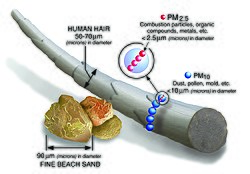


Particulate matter (PM) or particulates[a] are microscopic particles of solid or liquid matter, which are suspended in the air. An aerosol is a mixture of particulates and air, as opposed to the particulate matter itself.[1] Sources of particulate matter can be natural or result from human activities. Particulates adversely affect human health and have impacts on climate and precipitation.
Categories of atmospheric particles include inhalable coarse particles, designated PM10, which are coarse particles with a diameter of 10 micrometers (μm) or less; fine particles, designated PM2.5, with a diameter of 2.5 μm or less;[2] ultrafine particles, PM.10 with a diameter of 100 nanometers (nm) or less; and soot (fine or ultrafine particles primarily made up of carbon).[3]
Airborne particulate matter is a Group 1 carcinogen.[4] Particulate matter is considered the most dangerous type of air pollution[5][6] because particulates can penetrate deep into the lungs and travel through the blood stream to multiple organs including the brain.[7][6][8] Particulate matter contributes to health problems such as stroke, heart disease, lung disease, cancer, and preterm birth.[9] There is no safe level for exposure to particulates.[3]
Worldwide, exposure to PM2.5 contributed to 7.8 million deaths in 2021, of which 4.7 million were from outdoor air pollution and the remaining 3.1 million from household air pollution.[10] Fine particulate matter (PM2.5) is considered the leading environmental risk factor for earlier death worldwide.[3][11][12]
Sources
[edit]


Approximately 90 percent of the total mass of particulate matter in the atmosphere (as estimated in 2010) comes from natural sources such as volcanoes, dust storms, forest and grassland fires, living vegetation and sea spray, emitting particulates such as volcanic ash, desert dust, soot and sea salt.[13] Human-contributed (anthropogenic) particulate matter accounts for the remaining 10 percent of the total mass of aerosols.[13] Human activities that generate particulates include:
- Burning of fossil fuels (coal, oil, and natural gas) for electricity, heat and transportation,[14][15][16] biomass fuels (plants, wood, crop residue and manure) for heating and cooking,[17][18] waste,[19] joss paper,[20][21][22] and firecrackers.[23]
- Construction and renovation (including earthwork and foundation, demolition and rehabilitation).[24][25][26][27][28]
- Dusty materials that are not properly stored, cleaned up or disposed of (from construction sites, landfills, industrial facilities, and households).[29][30][31]
- Waste incineration.[32][33]
- Concrete.[34]
- Metalworking (grinding, cutting, welding).[35][36]
- Woodworking (sawing, sanding, and planing).[37][38]
- Industrial processes such as quarrying,[39] mining,[29][40][41] smelting[42] and oil refining.[43][44][45]
- Wet cooling towers in cooling systems.[46]
- Exhaust gas from motor vehicles, including diesel exhaust from heavy equipment used in construction, road building, and other industries.[47]
- Road dust from the wearing down of tires, brakes, and paved road surfaces[47][6] and from unpaved roads.[48][29]
- Agricultural activities (e.g. wind erosion,[49] ploughing, soil tilling, grain harvesting, and livestock management).[29][50][51]
- Cooking (frying, boiling, grilling).[52][17][18]
- Smoking[53]
- Microplastics (as a type of airborne PM).[54][55][56]
- Disasters[57] (e.g. wildfires, which may be human- or naturally-caused,[58][59] wars,[60][61][62] and the 11 September attacks.)[63]
Worldwide and seasonal sources
[edit]Human-generated particulates are often smaller in size (e.g. PM2.5 or PM1), and pose significant threats to human health.[64][65] Globally, major contributors to PM2.5 include residential energy use (40%), industrial processes (11.7%), and energy generation (10.2%), all of which involve fuel combustion.[66]
The types of emissions that contribute to particulate matter vary widely across countries and local regions, reflecting regional characteristics, seasonal variation, human activities, and types of fuels used. A worldwide analysis in 2021 reported that of anthropogenic fuels, coal was the highest contributor to PM2.5-related mortality in China; oil and natural gas dominated in Egypt, Russia, and the United States; and solid biofuels had the highest impact in Pakistan, Bangladesh, Indonesia, India, and Nigeria. Contributions due to residential fuel use varied from 4.0% in Egypt to 33.1% in Indonesia. Contributions from energy and industry sectors ranged from 3.2% in Nigeria to 27.3% in India. The most common PM2.5-related causes of death were ischemic heart disease (IHD) and stroke. The impact of windblown dust ranged from 1.5% in Bangladesh to 70.6% in Nigeria, where lower respiratory tract infections (LRIs) in childhood were the largest PM2.5-related cause of mortality. [66]
An examination of PM2.5 concentrations using data from 2000–2019 showed that during those two decades, PM2.5 concentrations in Europe and northern America decreased,[67] due to reductions in fossil fuel emissions.[66] However, exposures increased in southern Asia, Australia, New Zealand, Latin America and the Caribbean. Distinct seasonal patterns were seen in many parts of the world. There were regular high regional PM2.5 concentrations in the Amazon rainforest in August and September. Sub-Saharan Africa showed higher levels from June to September. Levels in eastern North America were higher in their summer months. Levels in China and north India were high in their winter months,[67][68] as are levels in South Korea.[69][70]
Domestic combustion
[edit]In the United Kingdom domestic combustion is the largest single source of PM2.5 and PM10 annually.[71] In 2019, domestic wood burning in both closed stoves and open fires was responsible for 38% of PM2.5 in the UK. Following the introduction of new laws in 2021 that restricted the sale of wet wood and house coal, particulate levels from domestic use decreased.[71][72] During 2024, domestic wood burning was responsible for 20% of PM2.5 and 11% of PM10 in the UK.[71] During the winter months, the impact of wood burning is higher and can contribute to half of PM2.5 concentrations.[73]
Given the health effects of wood smoke, it is recommended that people only use wood burners or fireplaces if they had no other source of heat.[72] If a stove or open fire is used, the release of particulates may be reduced by using an improved closed wood-burning stove of appropriate size for the space to be heated, maintaining the stove properly, using seasoned wood or kiln-dried wood, and managing the fire appropriately.[74][75][76][77][78] When cooking, use of improved cooking stoves and better quality fuels may help to reduce particulate exposure.[79]
Waste combustion
[edit]Composition of particles can vary greatly depending on their sources and production. Particles emitted from fuel combustion are not the same as those emitted from waste combustion. Particulates emitted from the burning of vegetation, incense paper and construction waste will all differ. Particulate matter from a fire in a recycling yard[80] or a ship full of scrap metal[81][82] may contain more toxic substances than other types of burning.
Construction
[edit]Different types of building activities produce different kinds of dust, that can have different effects on health. The composition of PM generated from cutting or mixing concrete made with Portland Cement would be different from those generated from cutting or mixing concrete made with different types of slag (e.g. GGBFS, EAF slag[83]), fly ash or even EAF dust (EAFD),[84] while EFAD, slag and fly ash are likely to be more toxic as they contain heavy metals. Besides slag cement that is sold and used as an environmental friendly product,[85][86][87] fake (adulterated) cement, where different types of slag, fly ash or other unknown substances are added, is also very common in some places[88][89] due to the much lower production cost.[90] To address quality[91] and toxicity problems, some places are starting to ban the use of EAF slag in cement used in buildings.[92]
Composition of welding fumes varies and it depends on the metals in the material being welded and the composition of the coatings, electrode, etc. being used.[93]
Since construction and refurbishment projects are prominent sources of particulate matter,[94][95] planning and mitigation measures regarding PM emission should be adopted and carefully monitored, particularly when such projects involve actively used health facilities.
Composition
[edit]The chemical composition of particulate matter (PM) in atmospheric aerosols varies widely with both time and space. It is affected by emission sources (both natural- and human-caused), geography, weather conditions, and chemical reactions.[97] Atmospheric aerosols can change between liquid, solid, and semisolid states depending on conditions.[98] The particulate matter in an aerosol can be described as primary (directly emitted) or secondary (formed through chemical reactions in the air).[6] PM can include both organic[99] and inorganic components such as minerals.[97]
Both chemical composition and particle size and shape have effects on human health.[100][3][9] Inhalable particles are often classified in terms of size as either coarse (PM10) with a diameter of 10 micrometers (μm) or less, or fine (PM2.5) with a diameter of 2.5 μm or less.[2] Smaller particulates can penetrate deeper into the lungs and travel through the blood stream to reach other organs.[7][6][8] Human-generated particulates are often smaller in size (e.g. PM2.5 or PM1), and pose significant threats to human health.[64][65]
The chemical composition and size of particulates in an aerosol also determine how the aerosol interacts with solar radiation and affects climate.[101] Chemical constituents within an aerosol change its overall refractive index, determining how much light is scattered or absorbed.[102]

Wind-blown mineral dust is a major component of particulate matter globally. Most sand and dust storms originate from a dust belt stretching from north Africa through the Middle East into Asia.[104][105] Dust storms can also arise in arid areas of North and South America and Australia.[106][107][108] Particles from dust storms can remain in the atmosphere and travel thousands of km from their source.[104][105] Mineral dust is a complex mixture that can be formed from quartz, feldspars, clays, calcites, iron oxides and other material blown from the Earth's crust. It often contains mineral oxides of major crustal elements such as aluminum (Al), silicon (Si), calcium (Ca), iron (Fe), and titanium (Ti). It can also contain alkali metals such as potassium (K), sodium (Na),[109][97] and lithium (Li);[110] alkaline earth metals such as magnesium (Mg);[97] and heavy metals such as lead (Pb), copper (Cu), nickel (Ni), and zinc (Zn).[110] Mineral dust in particulate matter is light-absorbing.[111] Higher levels of lead in top soil and dust are associated with higher blood levels of lead in people.[112][113]


Sea salt particles are another leading contributor to global particulate matter. Sea salt aerosols (SSAs) can develop over both open water and pack ice.[114] Approximately 80% of the surface of the Southern Hemisphere is oceanic,[115] and the average concentration of SSAs is generally higher there than in the Northern Hemisphere.[116] The production of sea salt aerosols is affected by aspects of the air-sea interface including wind speed, seawater temperature, surface tension, density, and viscosity.[116] Their distribution also varies with altitude, falling off rapidly at higher levels. Few sea-salt particles rise above the tropopause to reach the upper troposphere.[114] Sea salt aerosols reflect the composition of sea spray and evaporated sea water, consisting mainly of inorganic salts like sodium chloride (NaCl), along with magnesium, sulfate, calcium, bromine and potassium.[117] Sea salt aerosols can include biological and organic matter such as bacteria, viruses, proteins, enzymes, dissolved organic carbon, fatty acids and sugars.[118] SSA particles are key to the formation of clouds: hygroscopicity, the ability of an individual particle to take up water and eventually become a cloud droplet, is a function of particle size and composition. Sea salt aerosols affect climate both directly by scattering incoming solar radiation and indirectly through cloud formation.[118] They are relatively large compared to other aerosols.[114]
Organic matter (OM) contains carbon-based compounds, which can be either primary or secondary. Carbon combines with hydrogen and other elements to form complex molecules like carbohydrates, proteins, and DNA in living organisms.[119] Burning of living or once-living matter, whether natural or human-caused, releases black carbon (BC) and organic carbon (OC),[120] both of which are part of smoke and soot.[121] Approximately 85% of the world's population lives in the Northern Hemisphere, where human activities are the dominant sources of organic matter and fine particulate matter (PM25).[115] Black carbon tends to be released at higher temperatures[122] and contains mostly pure (elemental) carbon.[123] Organic carbon contains additional materials and is more complex.[124][123] Bioaerosols are a form of organic carbon, biological fragments of living microbial, fungal, animal, and plant sources.[125] Microplastics are synthetic polymer chains that are carbon-based.[126][127] Organic matter can influence the atmospheric radiation field by both scattering and absorption. Black carbon is the most strongly light-absorbing aerosol component, while organic carbon tends to be less absorptive, depending on its structure.[123][128] In addition to carbon compounds, the burning of petroleum and oil also releases sulfur oxides and many other chemicals into the atmosphere.[100][124]
Secondary organic aerosols (SOA) are major components of PM2.5, small inhalable particulate matter that is linked to health problems. Secondary organic aerosols form when gaseous vapors in the atmosphere (e.g. SO2, NO and NO2, NH3, VOCs) react chemically to produce compounds that then form particles. Precursor gases may be anthropogenic (e.g. from biomass and fossil fuel combustion) or natural (e.g. from dust, forest fires, or sea salt aerosols) in origin. Aerosols can mix rapidly in ambient air, forming new chemical compounds as well as diluting their concentration with distance from an emissions source.[101][129] The smallest class of particulates, PM1 frequently contain sulfate, ammonium, and nitrate.[65] Primary gases such as sulfur and nitrogen oxides can oxidize to form secondary particles of sulfuric acid (liquid) and nitric acid (gaseous). In the presence of ammonia, they often form ammonium salts such as ammonium sulfate and ammonium nitrate (both can be dry or in aqueous solution).[101] Secondary sulfate and nitrate aerosols tend to reflect solar radiation, but their ability to scatter light is affected by water absorption.[130][131][132][101]
Haze, particulate matter that generally causes visual effects, tends to consist of sulfur dioxide, nitrogen oxides, carbon monoxide, mineral dust, and organic matter. The particles are hygroscopic due to the presence of sulfur, and SO2 is converted to sulfate when high humidity and low temperatures are present.[133] This causes reduced visibility and red-orange-yellow colors.[134]
Measurement
[edit]Particulates have been measured in increasingly sophisticated ways since air pollution was first systematically studied in the early 20th century. The earliest methods included relatively crude Ringelmann charts, which were grey-shaded cards against which emissions from smokestacks could be visually compared, and deposit gauges, which collected the soot deposited in a particular location so it could be weighed.[135]


Modern air pollution measurement techniques characterize ambient air quality using data from three main sources: direct measurements of on site sources, computer models, and remote sensing platforms such as satellites.[136] Direct methods of measuring particulates can determine the total mass of particles per unit volume of air (particle mass concentration) using techniques such as gravimetric air quality analysis, beta attenuation monitoring, tapered element oscillating microbalances, and aethalometers (for black carbon).[137] Sometimes it is more useful to measure the total number of particles per unit volume of air (particle number concentration). This can be done with optical particle counters and condensation particle counters.[138][139] To measure the atomic composition of particulate samples, techniques such as X-ray spectrometry can be used.[140] Special filters and detection techniques can be used to select samples of a particular size (e.g. PM10 or PM2.5) or chemical composition (e.g. black carbon)[141][142] and to track their distribution over time.[143] Human-generated particulates are often smaller in size (e.g. PM2.5 or PM1) than naturally formed ones.[64][65]
Satellite-based estimates of PM2.5 are important tools. Satellite measurements of aerosols are based on the fact that particles change the way the atmosphere reflects and absorbs visible and infrared light. Satellites measure aerosol optical depth (AOD) and other factors that indicate the concentration and distribution of particulates in the atmosphere. PM2.5 concentrations are then inferred from the satellite data by using models or ground-based monitoring data. Combining these approaches can enhance the spatial coverage of PM2.5, to show patterns of distribution and movement in space and time. Such information can be used to create smoke forecasts and pollution advisories.[136]
Movement and deposition
[edit]Satellite data has shown that volcanic eruptions can send ash and particles high into the atmosphere, with fine particulates remaining in the air for long periods, traveling over long distances, and affecting global climate.[145][146][147] Particulate matter from wildfires in the western United States and Canada can travel to the United Kingdom and northern France in a few days.[148] Dust thrown into the air by sandstorms in the Sahara travels from North Africa to North America.[149]
Particles are transported globally and locally via characteristic atmospheric and oceanic currents, transitioning between air and water at the air-sea interface.[150][151][152][153] Particles move between land, water and air through mechanisms such as emission, suspension, and deposition. Circulation models take into account the release of particulates into the air, conditions under which they remain in air, their physical transport, and their removal from the atmosphere.[150]
Wet deposition or precipitation scavenging is the removal of particulate matter from the atmosphere through interactions with clouds, precipitation, and other particles that lead to settling. Particles may act as cloud condensation nuclei to create cloud droplets or collide with already-formed raindrops.[154]
Dry deposition involves the transfer of particles from the atmosphere onto surfaces (soil, water, living things, buildings) independent of precipitation. Dry deposition of particles is affected by gravity, wind speed, turbulence and the presence of surfaces (which can include other particles).[154][155]
Sedimentation (settling due to gravity) and evaporation are influenced by physical and chemical factors including temperature, humidity, particle radius, particle volume, and height at which an emission is released.[156] In general, the smaller and lighter a particle is, the longer it will stay suspended in air. Larger particles (greater than 50–100 µm in diameter) tend to settle to the ground quickly as a result of gravity, and may travel no more than a few meters from their source.[156] The smallest particles (less than 1 micrometer) can stay in the atmosphere for weeks, and are mostly likely to be removed by precipitation. They may also become resuspended and continue to circulate due to turbulence or collisions with other particulates.[156]
Solubility and evaporation significantly affect the size, phase, and behavior of particles and aerosols.[156] Aerosol particles grow by absorbing water at high relative humidity. Evaporation of water from particulates can lead to phase changes between solid, liquid, or gas, and the formation of crusts and solid particles. Changes of phase, internal structure, and diameter can affect both physical and chemical behaviors of particulate matter.[157]
Health effects
[edit]Size, shape, and solubility matter
[edit]Health effects of particulate matter are influenced by factors such as particle size, shape, solubility, charge, chemical composition, and concentration and rate of exposure.[125] Toxicity of particles tends to increase with smaller size, larger surface area, accumulation of material on particle surfaces (e.g. adsorption of VOCs on active carbon), and other physical characteristics of particles.[158]
Size
[edit]

The size of particulate matter (PM) is a key determinant of its potential to cause health problems. Particles of different sizes deposit in different regions of the respiratory tract, leading to various health effects.[159] Particles that can only reach as far as the upper respiratory tract are called inhalable, while particles that can enter the lungs are called respirable.[125] Particles are grouped by size:[160][161]
- Coarse particles (PM10), with diameters between 2.5 and 10 micrometers, can be inhaled and can deposit in the upper airways, including the nose, throat, and bronchi.[160] Exposure to PM10 is associated with respiratory diseases (e.g. asthma, bronchitis, and rhinosinusitis),[3][162] and cardiovascular effects (e.g. heart attacks and arrhythmias due to systemic inflammation).[163][164]
- Fine particles (PM2.5), with diameters less than 2.5 micrometers, can penetrate deep into the lungs, reaching the bronchioles and alveoli.[159] They are associated with chronic rhinosinusitis,[162] respiratory diseases (e.g. asthma and COPD due to deep lung penetration),[3] and cardiovascular diseases due to systemic inflammation and oxidative stress.[163]
- Ultrafine particles (PM0.1), with diameters less than 0.1 micrometers (100 nanometers), can enter the bloodstream and reach other organs, including the heart and brain.[165] Ultrafine particles contribute to health issues including neurodegenerative diseases (e.g. Alzheimer's)[166] and cardiovascular diseases (e.g. atherosclerosis and increased risk of heart attacks).[167]
Threshold Concentrations and Guidelines
[edit]The World Health Organization (WHO) provides guidelines to limit exposure.[168]
- PM10: Annual mean not to exceed 15 μg/m3; 24-hour mean not to exceed 45 μg/m3.[168]
- PM2.5: Annual mean not to exceed 5 μg/m3; 24-hour mean not to exceed 15 μg/m3.[168]
- Exposure above these levels increases the risk of adverse health effects.[168]
An examination of PM2.5 concentrations using data from 2000–2019 showed that almost all land areas and populations globally are exposed to PM2.5 at levels above the WHO's 2021 recommended guidelines.[67]
Shape
[edit]When particulate matter is described in terms of its diameter, as PM10 or PM2.5, particles are assumed to have a idealized spherical shape. The actual shape of particles from different sources (e.g. ashes, soot, paint, glass, plastic and fibres) can vary widely. The table below lists the colors and shapes of some common atmospheric particulates:[169][170]
| Type of particulate | Color | Shape |
|---|---|---|
| Portland cement | Gray | Irregular |
| Smolder smoke | White | Spherical |
| Soot | Black | Fractal aggregate |
| Water droplets | White | Spherical |
| Loess | Yellow Brown | Irregular |
| Lokon volcanic ash | Dark Brown | Irregular |
| Sahara sand (Libya) | Brown | Irregular |
Irregularly shaped particles are more likely to be deposited in airways than spherical ones of similar size.[127] Some particles are brittle and can break into smaller pieces. Those with sharp edges or longer needle-like shapes (e.g. asbestos fibres) are more likely to abrade tissues and lodge in the lungs.[125][171][172][173] Geometrically angular shapes have more surface area than rounder shapes, increasing the area available for binding to other substances.[171] Chemical composition can affect interactions with lung tissue and respiratory fluids and influence whether a particle will stick to a surface.[127] All of these factors can affect the ways in which particles are inhaled, deposited, cleared, and interact within the respiratory system.[125][171]
-
Scanning electron microscopy of glass powder originated from glass bottles[170]
-
Scanning electron microscopy of cement[170]
-
👁 Scanning electron microscopy of mortar glass powder (10%) which seems to have fibre-like structureScanning electron microscopy of mortar glass powder (10%) which seems to have fibre-like structure[170]
-
Scanning electron microscopy of white asbestos with needle-like shape fibre


Solubility
[edit]The behavior of particulates may also be altered by meteorological conditions. The site and extent of absorption of inhaled gases and vapors are determined by their solubility in water. Absorption is also dependent upon air flow rates and the partial pressure of the gases in the inspired air. The fate of a specific contaminant is dependent upon the form in which it exists (aerosol or particulate). Inhalation also depends upon the breathing rate of the subject.[174]
Quantity and duration of exposure are also important.[175][176]
Health problems
[edit]This section needs to be updated. Please help update this article to reflect recent events or newly available information. (July 2023) |

Mechanisms of health effects
[edit]Particles can cause health effects through several mechanisms: inflammation in the respiratory tract[3] oxidative stress via reactive oxygen species, leading to cellular damage,[177] and systemic effects, due to the movement of particles into the bloodstream and on to other organs including the brain.[163][158]
Outcomes
[edit]Exposure to particulate matter is linked to various diseases across body systems, such as respiratory system (asthma, chronic obstructive pulmonary disease (COPD), lung cancer, pulmonary fibrosis, pneumonia, acute respiratory distress syndrome[3] and rhinosinusitis[162]), cardiovascular system (heart attacks, hypertension, arrhythmias, and atherosclerosis),[164] nervous system (cognitive decline and neurodegenerative diseases),[178] metabolic system (diabetes and metabolic syndrome due to inflammatory pathways).[179] While randomized controlled trials are difficult or impossible to conduct, both correlations and causal relationships for at least some health problems (diabetes, high blood pressure) have been shown.[180]
Interaction with exercise
[edit]The health benefits of physical exercise may be affected by air quality. A 2025 cross-national study involving 1.5 million adults demonstrated that high levels of ambient PM2.5 can significantly diminish the protective effects of leisure-time physical activity against all-cause and cause-specific mortality. Below an annual average concentration of 25 μg/m³, regular exercise reduces all-cause mortality by approximately 30%. This benefit is halved (to 12–15%) when concentrations exceeded 25 μg/m³. In addition, the protective effects of exercise against cancer-related mortality become statistically non-significant when PM2.5 levels reach 35 μg/m³ or higher.[181]


The effects of inhaling particulate matter that have been widely studied in humans and animals include COVID-19,[182][183][184][185][186] asthma, lung cancer, respiratory diseases like silicosis, [187] [188] cardiovascular disease, premature delivery, birth defects, low birth weight, developmental disorders,[189][190][191][192] neurodegenerative disorders[193][194] mental disorders,[195][196][197] and premature death. Outdoor fine particulates with diameter less than 2.5 microns accounts for 4.2 million annual deaths worldwide, and more than 103 million disability-adjusted life-years lost, making it the fifth leading risk factor for death. Air pollution has also been linked to a range of other psychosocial problems.[196] Particulates may cause tissue damage by entering organs directly, or indirectly by systemic inflammation. Adverse effects may occur even at exposure levels lower than published air quality standards deemed safe.[198][199]
Anthropogenic fine particulates as main hazard
[edit]Increased levels of fine particles in the air as a result of anthropogenic particulate air pollution "is consistently and independently related to the most serious effects, including lung cancer[200] and other cardiopulmonary mortality".[201] The association between a large number of deaths[202] and other health problems and particulate pollution was first demonstrated in the early 1970s[203] and has been reproduced many times since. PM pollution is estimated to cause 22,000–52,000 deaths per year in the United States (from 2000)[204] contributed to ~370,000 premature deaths in Europe during 2005.[205] and 3.22 million deaths globally in 2010 per the global burden of disease collaboration.[206] A study by the European Environment Agency estimates that 307,000 people have died prematurely in 2019 due to fine particle pollution in the 27 EU member states.[207]
A study in 2000 conducted in the U.S. explored how fine particulate matter may be more harmful than coarse particulate matter. The study was based on six different cities. They found that deaths and hospital visits that were caused by particulate matter in the air were primarily due to fine particulate matter.[208] Similarly, a 1987 study of American air pollution data found that fine particles and sulfates, as opposed to coarser particles, most consistently and significantly correlated to total annual mortality rates in standard metropolitan statistical areas.[209]
A study published in 2022 in GeoHealth concluded that eliminating energy-related fossil fuel emissions in the United States would prevent 46,900–59,400 premature deaths each year and provide $537–678 billion in benefits from avoided PM2.5-related illness and death.[210]
Infertility, pregnancy, and birth defects
[edit]Higher rates of infertility have been correlated with exposure to particulates.[211] Maternal PM2.5 exposure during pregnancy is also associated with high blood pressure in children.[212]
Inhalation of PM2.5 – PM10 is associated with elevated risk of adverse pregnancy outcomes, such as low birth weight.[213] Exposure to PM2.5 has been associated with greater reductions in birth weight than exposure to PM10.[214] PM exposure can cause inflammation, oxidative stress, endocrine disruption, and impaired oxygen transport access to the placenta,[215] all of which are mechanisms for heightening the risk of low birth weight.[216] Overall epidemiologic and toxicological evidence suggests that a causal relationship exists between long-term exposures to PM2.5 and developmental outcomes (i.e. low birth weight).[214] Studies investigating the significance of trimester-specific exposure have proven to be inconclusive,[217] and results of international studies have been inconsistent in drawing associations of prenatal particulate matter exposure and low birth weight.[214] As perinatal outcomes have been associated with lifelong health[218][219] and exposure to particulate matter is widespread, this issue is of critical public health importance.
Cardiovascular and respiratory disease
[edit]PM2.5 leads to high plaque deposits in arteries, causing vascular inflammation and atherosclerosis – a hardening of the arteries that reduces elasticity, which can lead to heart attacks and other cardiovascular problems.[220] A 2014 meta analysis reported that long term exposure to particulate matter is linked to coronary events. The study included 11 cohorts participating in the European Study of Cohorts for Air Pollution Effects (ESCAPE) with 100,166 participants, followed for an average of 11.5 years. An increase in estimated annual exposure to PM 2.5 of just 5 μg/m3 was linked with a 13% increased risk of heart attacks.[221] Not only affecting human cells and tissues, PM also impacts bacteria which cause disease in humans.[222] Biofilm formation, antibiotic tolerance, and colonisation of both Staphylococcus aureus and Streptococcus pneumoniae was altered by black carbon exposure.
The largest US study on acute health effects of coarse particle pollution between 2.5 and 10 micrometers in diameter was published 2008 and found an association with hospital admissions for cardiovascular diseases but no evidence of an association with the number of hospital admissions for respiratory diseases.[223] After taking into account fine particle levels (PM2.5 and less), the association with coarse particles remained but was no longer statistically significant, which means the effect is due to the subsection of fine particles.
The Mongolian government agency recorded a 45% increase in the rate of respiratory illness in the past five years (reported in 2011).[224] Bronchial asthma, chronic obstructive pulmonary disease, and interstitial pneumonia were the most common ailments treated by area hospitals. Levels of premature death, chronic bronchitis, and cardiovascular disease are increasing at a rapid rate.[225]
Cognitive hazards and mental health
[edit]The effects of air pollution and particulate matter on cognitive performance has become an active area of research.[226]
Air pollution may increase the risk of developmental disorders (e.g., autism),[189][190][191][192] neurodegenerative disorders,[193][194] mental disorders,[195][196][197] and suicide,[195][197][227] although studies on the link between depression and some air pollutants are not consistent.[228] At least one study has identified "the abundant presence in the human brain of magnetite nanoparticles that match precisely the high-temperature magnetite nanospheres, formed by combustion and/or friction-derived heating, which are prolific in urban, airborne particulate matter (PM)."[229]
Particulates also appear to have a role in the pathogenesis of Alzheimer's disease and premature brain aging. There is increasing evidence to suggest a correlation between PM2.5 exposure and the prevalence of neurodegenerative diseases such as Alzheimer's. Several epidemiological studies have suggested a link between PM2.5 exposure and cognitive decline, particularly in the development of neurodegenerative diseases such as Alzheimer's.
Using geospatial analytical techniques, "NIEHS-funded researchers were able to confirm a strong association between cases of Parkinson's disease and fine particulate matter (known as PM2.5) across the U.S. In the study, regions of the country with a high rate of Parkinson's disease were associated generally with higher levels of PM2.5, of which sources include motor vehicles, wildfires, and power plants."[230] While the exact mechanisms behind the link between PM2.5 exposure and cognitive decline are not fully understood, research suggests that the fine particles may be able to enter the brain through the olfactory nerve and cause inflammation and oxidative stress, which can damage brain cells and contribute to the development of neurodegenerative diseases.[231]
Increased death
[edit]A 2011 study concluded that traffic exhaust is the single most serious preventable cause of heart attack in the general public, the cause of 7.4% of all attacks.[232]
Particulate matter studies in Bangkok, Thailand from 2008 indicated a 1.9% increased risk of dying from cardiovascular disease, and 1.0% risk of all disease for every 10 micrograms per cubic meter. Levels averaged 65 in 1996, 68 in 2002, and 52 in 2004. Decreasing levels may be attributed to conversions of diesel to natural gas combustion as well as improved regulations.[233]
Racial disparities
[edit]There have been many studies linking race to increased proximity to particulate matter, and thus susceptibility to adverse health effects of long term exposure. A U.S. study showed that "the proportions of Black residents in a tract was linked to higher asthma rates".[234] Many scholars link this disproportionality to racial housing segregation and their respective inequalities in "toxic exposures".[234] This reality is made worse by the finding that "health care occurs in the context of broader historic and contemporary social and economic inequality and persistent racial and ethnic discrimination in many sectors of American life".[235] Residential proximity to particulate emitting facilities increases exposure to PM 2.5 which is linked to increased morbidity and mortality rates.[236] Multiple studies confirm the burden of PM emissions is higher among non-White and poverty ridden populations,[236] though some say that income does not drive these differences.[237] This correlation between race and housing related health repercussions stems from a longstanding environmental justice problem linked to the practice of historic redlining. An example of these factors contextualized is an area of Southeastern Louisiana, colloquially dubbed 'Cancer Alley' for its high concentration of cancer related deaths due to neighboring chemical plants.[238] Cancer Alley being a majority African American community, with the neighborhood nearest to the plant being 90% Black,[238] perpetuates the scientific narrative that Black populations are located disproportionately closer to areas of high PM output than White populations. A 2020 article relates the long-term health effects of living in high PM concentrations to increased risk, spread, and mortality rates from the SARS-CoV-2 or COVID-19, and faults a history of racism for this outcome.[238]
Wildfire smoke risk
[edit]In regions where wildfires are persistent the risk of particulate exposure increased. Smoke from wildfires may impact sensitive groups such as the elderly, children, pregnant women, and people with lung, and cardiovascular disease.[239] It was found that in the 2008 wildfire season in California, the particulate matter was much more toxic to human lungs, as increased neutrophil infiltrate, cell influx and edema was observed versus particulate matter from ambient air.[240] Furthermore, particulate matter from wildfires have been linked to be a triggering factor of acute coronary events such as ischemic heart disease.[241] Wildfires also have been associated with increased emergency department visits due to particulate matter exposure, as well as an increased risk of asthma related events.[242][243] A link between PM2.5 from wildfires and increased risk of hospitalizations for cardiopulmonary diseases has been discovered.[244] Evidence also suggest wildfire smoke reduces mental performance.[245]
Vegetation effects
[edit]| 👁 [icon] | This section needs expansion. You can help by adding missing information. (February 2024) |

![👁 [icon]](https://upload.wikimedia.org/wikipedia/commons/thumb/1/1c/Wiki_letter_w_cropped.svg/20px-Wiki_letter_w_cropped.svg.png)
Particulate matter can clog stomatal openings of plants and interfere with photosynthesis functions.[246] In this manner, high particulate matter concentrations in the atmosphere can lead to growth stunting or mortality in some plant species.[citation needed]
Climate effects
[edit]This section may be too technical for most readers to understand. Please help improve it to make it understandable to non-experts, without removing the technical details. (August 2024) (Learn how and when to remove this message) |

_-_global_warming.svg)

Atmospheric aerosols affect the climate of the Earth by changing the amount of incoming solar radiation and outgoing terrestrial longwave radiation retained in the Earth's system. This occurs through several distinct mechanisms which are split into direct, indirect[248][249] and semi-direct aerosol effects. The aerosol climate effects are the biggest source of uncertainty in future climate predictions.[250] The Intergovernmental Panel on Climate Change (IPCC) stated in 2001:[251]
While the radiative forcing due to greenhouse gases may be determined to a reasonably high degree of accuracy... the uncertainties relating to aerosol radiative forcings remain large, and rely to a large extent on the estimates from global modeling studies that are difficult to verify at the present time.
Aerosol radiative
[edit]

Direct
[edit]

The direct aerosol effect consists of any direct interaction of radiation with atmospheric aerosols, such as absorption or scattering. It affects both short and longwave radiation to produce a net negative radiative forcing.[252] The magnitude of the resultant radiative forcing due to the direct effect of an aerosol is dependent on the albedo of the underlying surface, as this affects the net amount of radiation absorbed or scattered to space. For example, if a highly scattering aerosol is above a surface of low albedo it has a greater radiative forcing than if it was above a surface of high albedo. The converse is true of absorbing aerosol, with the greatest radiative forcing arising from a highly absorbing aerosol over a surface of high albedo.[248] The direct aerosol effect is a first-order effect and is therefore classified as a radiative forcing by the IPCC.[250] The interaction of an aerosol with radiation is quantified by the single-scattering albedo (SSA), the ratio of scattering alone to scattering plus absorption (extinction) of radiation by a particle. The SSA tends to unity if scattering dominates, with relatively little absorption, and decreases as absorption increases, becoming zero for infinite absorption. For example, the sea-salt aerosol has an SSA of 1, as a sea-salt particle only scatters, whereas soot has an SSA of 0.23, showing that it is a major atmospheric aerosol absorber.[citation needed]
Indirect
[edit]The Indirect aerosol effect consists of any change to the Earth's radiative budget due to the modification of clouds by atmospheric aerosols and consists of several distinct effects. Cloud droplets form onto pre-existing aerosol particles, known as cloud condensation nuclei (CCN). Droplets condensing around human-produced aerosols such as found in particulate pollution tend to be smaller and more numerous than those forming around aerosol particles of natural origin (such as windblown dust).
For any given meteorological conditions, an increase in CCN leads to an increase in the number of cloud droplets. This leads to more scattering of shortwave radiation i.e. an increase in the albedo of the cloud, known as the cloud albedo effect, First indirect effect or Twomey effect.[249] Evidence supporting the cloud albedo effect has been observed from the effects of ship exhaust plumes[253] and biomass burning[254] on cloud albedo compared to ambient clouds. The Cloud albedo aerosol effect is a first order effect and therefore classified as a radiative forcing by the IPCC.[250]
An increase in cloud droplet number due to the introduction of aerosol acts to reduce the cloud droplet size, as the same amount of water is divided into more droplets. This has the effect of suppressing precipitation, increasing the cloud lifetime, known as the cloud lifetime aerosol effect, second indirect effect or Albrecht effect.[250] This has been observed as the suppression of drizzle in ship exhaust plume compared to ambient clouds,[255] and inhibited precipitation in biomass burning plumes.[256] This cloud lifetime effect is classified as a climate feedback (rather than a radiative forcing) by the IPCC due to the interdependence between it and the hydrological cycle.[250] However, it has previously been classified as a negative radiative forcing.[257]
Semi-direct
[edit]The Semi-direct effect concerns any radiative effect caused by absorbing atmospheric aerosol such as soot, apart from direct scattering and absorption, which is classified as the direct effect. It encompasses many individual mechanisms, and in general is more poorly defined and understood than the direct and indirect aerosol effects. For instance, if absorbing aerosols are present in a layer aloft in the atmosphere, they can heat surrounding air which inhibits the condensation of water vapour, resulting in less cloud formation.[258] Additionally, heating a layer of the atmosphere relative to the surface results in a more stable atmosphere due to the inhibition of atmospheric convection. This inhibits the convective uplift of moisture,[259] which in turn reduces cloud formation. The heating of the atmosphere aloft also leads to a cooling of the surface, resulting in less evaporation of surface water. The effects described here all lead to a reduction in cloud cover i.e. an increase in planetary albedo. The semi-direct effect classified as a climate feedback) by the IPCC due to the interdependence between it and the hydrological cycle.[250] However, it has previously been classified as a negative radiative forcing.[257]
Specific aerosol roles
[edit]Sulfate
[edit]Sulfate aerosols are mostly inorganic sulfur compounds like SO2−
4, HSO−
4 and H
2SO
4,[260] which are mainly produced when sulfur dioxide reacts with water vapor to form gaseous sulfuric acid and various salts (often through an oxidation reaction in the clouds), which are then thought to experience hygroscopic growth and coagulation and then shrink through evaporation.[261][262] Some of them are biogenic (typically produced via atmospheric chemical reactions with dimethyl sulfide from mostly marine plankton[263]) or geological via volcanoes or weather-driven from wildfires and other natural combustion events,[262] but in the recent decades anthropogenic sulfate aerosols produced through combustion of fossil fuels with a high sulfur content, primarily coal and certain less-refined fuels, like aviation and bunker fuel, had dominated.[264] By 1990, global human-caused emissions of sulfur into the atmosphere became "at least as large" as all natural emissions of sulfur-containing compounds combined, and were at least 10 times more numerous than the natural aerosols in the most polluted regions of Europe and North America,[265] where they accounted for 25% or more of all air pollution.[266] This led to acid rain,[267][268] and also contributed to heart and lung conditions[266] and even the risk of preterm birth and low birth weight.[269] Sulfate pollution also has a complex relationship with NOx pollution and ozone, reducing the also harmful ground-level ozone, yet capable of damaging the stratospheric ozone layer as well.[270]


Once the problem became clear, the efforts to remove this pollution through flue-gas desulfurization measures and other pollution controls were largely successful,[271] reducing their prevalence by 53% and causing healthcare savings valued at $50 billion annually in the United States alone.[272][266][273] Yet, around the same time, research had shown that sulfate aerosols were affecting both the visible light received by the Earth and its surface temperature,[274] and as the so-called global dimming) began to reverse in the 1990s in line with the reduced anthropogenic sulfate pollution,[275][276][277] climate change accelerated.[278] As of 2021, state-of-the-art CMIP6 models estimate that total cooling from the currently present aerosols is between 0.1 °C (0.18 °F) to 0.7 °C (1.3 °F);[279] the IPCC Sixth Assessment Report uses the best estimate of 0.5 °C (0.90 °F),[280] with the uncertainty mainly caused by contradictory research on the impacts of aerosols of clouds.[281][282][283][284][285][286] Some are certain that they cool the planet, though, and this led to solar geoengineering proposals known as stratospheric aerosol injection, which seeks to replicate and enhance the cooling from sulfate pollution while minimizing the negative effects on health through deploying in the stratosphere, where only a fraction of the current sulfur pollution would be needed to avoid multiple degrees of warming,[287] but the assessment of costs and benefits remains incomplete,[288] even with hundreds of studies into the subject completed by the early 2020s.[278]
Black carbon
[edit]Black carbon (BC) or elemental carbon (EC), often called soot, is composed of pure carbon clusters, skeleton balls and fullerenes, and is one of the most important absorbing aerosol species in the atmosphere. It should be distinguished from organic carbon (OC): clustered or aggregated organic molecules on their own or permeating an EC buckyball. Black carbon from fossil fuels is estimated by the IPCC in the Fourth Assessment Report of the IPCC, 4AR, to contribute a global mean radiative forcing of +0.2 W/m2 (was +0.1 W/m2 in the Second Assessment Report of the IPCC, SAR), with a range +0.1 to +0.4 W/m2. A study published in 2013 however, states that "the best estimate for the industrial-era (1750 to 2005) direct radiative forcing of atmospheric black carbon is +0.71 W/m2 with 90% uncertainty bounds of (+0.08, +1.27) W/m2" with "total direct forcing by all-black carbon sources, without subtracting the preindustrial background, is estimated as +0.88 (+0.17, +1.48) W/m2".[289]
Instances
[edit]

Volcanoes are a large natural source of aerosol and have been linked to changes in the Earth's climate often with consequences for the human population. Eruptions linked to changes in climate include the 1600 eruption of Huaynaputina which was linked to the Russian famine of 1601–1603,[290][291][292] leading to the deaths of two million, and the 1991 eruption of Mount Pinatubo which caused a global cooling of approximately 0.5 °C lasting several years.[293][294] Research tracking the effect of light-scattering aerosols in the stratosphere during 2000 and 2010 and comparing its pattern to volcanic activity show a close correlation. Simulations of the effect of anthropogenic particles showed little influence at present levels.[295][296]
Aerosols are also thought to affect weather and climate on a regional scale. The failure of the Indian monsoon has been linked to the suppression of evaporation of water from the Indian Ocean due to the semi-direct effect of anthropogenic aerosol.[297]
Recent studies of the Sahel drought[298] and major increases since 1967 in rainfall in Australia over the Northern Territory, Kimberley, Pilbara and around the Nullarbor Plain have led some scientists to conclude that the aerosol haze over South and East Asia has been steadily shifting tropical rainfall in both hemispheres southward.[297][299]
Energy industry knowledge and response to adverse health effects
[edit]

Major energy companies understood at least since the 1960s that use of their products causes widespread adverse health effects and death but continued aggressive political lobbying in the United States and elsewhere against clean air regulation and launched major corporate propaganda campaigns to sow doubt regarding the causative link between the burning of fossil fuels and major risks to human life. Internal company memoranda reveal that energy industry scientists and executives knew that air pollutants created by fossil fuels lodge deep in human lung tissue, and cause birth defects in children of oil industry workers. The industry memos acknowledge that automobiles "are by far the greatest sources of air pollution" and also that air pollution causes adverse health effects and lodges toxins, including carcinogens, "deep into the lungs which would otherwise be removed in the throat".[301]
In response to mounting public concern, the industry eventually created the Global Climate Coalition, an industry lobby group, to derail governments' attempts to regulate air pollution and to create confusion in the public mind about the necessity of such regulation. Similar lobbying and corporate public relations efforts were undertaken by the American Petroleum Institute, a trade association of the oil and gas industry, and the climate change denier private think tank, The Heartland Institute. "The response from fossil-fuel interests has been from the same playbook – first they know, then they scheme, then they deny and then they delay. They've fallen back on delay, subtle forms of propaganda and the undermining of regulation," said Geoffrey Supran, a Harvard University researcher of the history of fossil-fuel companies and climate change. These efforts have been compared, by policy analysts such as Carroll Muffett of the Center for International Environmental Law, to the tobacco industry strategy of lobbying and corporate propaganda campaigns to create doubt regarding the causal connection between cigarette smoking and cancer and to forestall its regulation. In addition, industry-funded advocates, when appointed to senior government positions in the United States, have revised scientific findings showing the deadly effects of air pollution and have rolled back its regulation.[301][302][303]
Control
[edit]Technologies
[edit]Particulate matter emissions are highly regulated in most industrialized countries. Due to environmental concerns, most industries are required to operate some kind of dust collection system.[citation needed] These systems include inertial collectors (cyclonic separators), fabric filter collectors (baghouses), electrostatic filters used in facemasks,[304] wet scrubbers, and electrostatic precipitators.
Cyclonic separators are useful for removing large, coarse particles and are often employed as a first step or "pre-cleaner" to other more efficient collectors. Well-designed cyclonic separators can be very efficient in removing even fine particulates,[305] and may be operated continuously without requiring frequent shutdowns for maintenance.[citation needed]
Fabric filters or baghouses are the most commonly employed in general industry.[306] They work by forcing dust-laden air through a bag-shaped fabric filter leaving the particulate to collect on the outer surface of the bag and allowing the now clean air to pass through to either be exhausted into the atmosphere or in some cases recirculated into the facility. Common fabrics include polyester and fiberglass and common fabric coatings include PTFE (commonly known as Teflon). The excess dust buildup is then cleaned from the bags and removed from the collector.
Wet scrubbers pass the dirty air through a scrubbing solution (usually a mixture of water and other compounds) allowing the particulate to attach to the liquid molecules.[315] Electrostatic precipitators electrically charge the dirty air as it passes through. The now charged air then passes through large electrostatic plates which attract the charged particle in the airstream collecting them and leaving the now clean air to be exhausted or recirculated.[316]
Measures
[edit]For general building construction, some places that have acknowledged the possible health risks of construction dust for decades legally require the relevant contractor to adopt effective dust control measures, although inspections, fines and imprisonments are rare in recent years (for example, two prosecutions with a total fines of HK$6,000 in Hong Kong in the year 2021).[317][318]
Some of the mandatory dust control measures include[319][314][320][321] load, unload, handle, transfer, store or dispose of cement or dry pulverized fuel ash in a completely enclosed system or facility, and fit any vent or exhaust with an effective fabric filter or equivalent air pollution control system or equipment, enclose the scaffolding of the building with dust screens, use impervious sheeting to enclose both material hoist and debris chute, wet debris with water before it is dumped into a debris chute, have water sprayed on the facade surface before and during grinding work, use grinder equipped with vacuum cleaner for facade grinding work, spray water continuously on the surface for any pneumatic or power-driven drilling, cutting, polishing or other mechanical breaking operation that causes dust emission, unless there is the operation of an effective dust extraction and filtering device, provide hoarding of not less than 2.4 m in height along the whole length of the site boundary, have hard paving on open area and wash every vehicle that leaves the construction sites. Use of automatic sprinkler equipment, automatic carwash equipment and installation of video surveillance system for the pollution control facilities and retain the videos for one month for future inspections.[citation needed]
Besides removing particulates from the source of pollution, they may also be cleaned in the open air (e.g. smog tower, moss wall, and water truck),[322] while other control measures employ the use of barriers.[323]
Regulation
[edit]Most governments have created regulations both for the emissions allowed from certain types of pollution sources (motor vehicles, industrial emissions etc.) and for the ambient concentration of particulates. The IARC and WHO designate particulates a Group 1 carcinogen. Particulates are the deadliest form of air pollution due to their ability to penetrate deep into the lungs and blood streams unfiltered, causing respiratory diseases, heart attacks, and premature death.[324] In 2013, the ESCAPE study involving 312,944 people in nine European countries revealed that there was no safe level of particulates and that for every increase of 10 μg/m3 in PM10, the lung cancer rate rose 22%. For PM2.5 there was a 36% increase in lung cancer per 10 μg/m3.[200] A 2024 meta-analysis of 66 cancer studies globally reported that for every increase of 10 μg/m3 in PM2.5, the lung cancer rate rose 8.5%.[4]
Limits / standards set by governments
[edit]| Country/ Region | PM2.5 (μg⁄m3) | PM10 (μg⁄m3) | No. of exceedances allowed per year | ||
|---|---|---|---|---|---|
| Yearly avg. | Daily avg. (24-hour) |
Yearly avg. | Daily avg (24-hour) | ||
| Australia[325] | 8 | 25 | 25 | 50 | None |
| China[326] | 35 | 75 | 70 | 150 | None |
| European Union[327][b][c] | 25 | None | 40 | 50 | PM2.5: None; PM10: 35 |
| Hong Kong[328][d] | 35 | 75 | 50 | 100 | PM2.5: 9; PM10: 9 |
| Japan[329][330][e][f] | 15 | 35 | None | 100 | None |
| South Korea[331][332][g][h] | 15 | 35 | 50 | 100 | None |
| Taiwan[333][334] | 15 | 35 | 50 | 100 | None |
| United Kingdom[335] | 20 | 40 | 50 | 35 | |
| United States[336] | 9[i] | 35[j] | None[k] | 150[l] | PM2.5: Not applicable;[m] PM10: 1 |
| World Health Organization[338] | 5 | 15 | 15 | 45 | 3–4 |
Canada
[edit]In Canada the standard for particulate matter is set nationally by the federal-provincial Canadian Council of Ministers of the Environment (CCME). Jurisdictions (provinces and territories) may set more stringent standards. The CCME standard for particulate matter 2.5 (PM2.5) as of 2015 is 28 μg/m3 (calculated using the 3-year average of the annual 98th percentile of the daily 24-hr average concentrations) and 10 μg/m3 (3-year average of annual mean). PM2.5 standards will increase in stringency in 2020.[339]
European Union
[edit]The European Union has established the European emission standards, which include limits for particulates in the air:[327]
| European Air Quality Index | Good | Fair | Moderate | Poor | Very poor | Extremely poor |
|---|---|---|---|---|---|---|
| Particles less than 2.5μm (PM2,5) | 0–10 μg/m3 | 10–20 μg/m3 | 20–25 μg/m3 | 25–50 μg/m3 | 50–75 μg/m3 | 75–800 μg/m3 |
| Particles less than 10μm (PM10) | 0–20 μg/m3 | 20–40 μg/m3 | 40–50 μg/m3 | 50–100 μg/m3 | 100–150 μg/m3 | 150–1200 μg/m3 |
United Kingdom
[edit]To mitigate the problem of wood burning, starting from May 2021, traditional house coal (bituminous coal) and wet wood, two of the most polluting fuels, can no longer be sold. Wood sold in volumes of less than 2m3 must be certified as 'Ready to Burn', which means it has a moisture content of 20% or less. Manufactured solid fuels must also be certified as 'Ready to Burn' to ensure they meet sulfur and smoke emission limits.[340] Starting from January 2022, all new wood burning stoves have to meet new EcoDesign standards (Ecodesign stoves produce 450 times more toxic air pollution than gas central heating. Older stoves, which are now banned from sale, produce 3,700 times more).[341]
In 2023, the amount of smoke that burners in "smoke control areas" – most England's towns and cities – can emit per hour is reduced from 5g to 3g. Violation will result in an on-the-spot fine of up to £300. Those who do not comply may even get a criminal record.[342]
United States
[edit]

The United States Environmental Protection Agency (EPA) has set standards for PM10 and PM2.5 concentrations.[336] (See National Ambient Air Quality Standards.)
California
[edit]This section needs to be updated. Please help update this article to reflect recent events or newly available information. Last update: 22 January 2009 (September 2016) |


In October 2008, the Department of Toxic Substances Control (DTSC), within the California Environmental Protection Agency, announced its intent to request information regarding analytical test methods, fate and transport in the environment, and other relevant information from manufacturers of carbon nanotubes.[344] DTSC is exercising its authority under the California Health and Safety Code, Chapter 699, sections 57018–57020.[345] These sections were added as a result of the adoption of Assembly Bill AB 289 (2006).[345] They are intended to make information on the fate and transport, detection and analysis, and other information on chemicals more available. The law places the responsibility to provide this information to the department on those who manufacture or import the chemicals.
On 22 January 2009, a formal information request letter[346] was sent to manufacturers who produce or import carbon nanotubes in California, or who may export carbon nanotubes into the State.[347] This letter constitutes the first formal implementation of the authorities placed into statute by AB 289 and is directed to manufacturers of carbon nanotubes, both industry, and academia within the State, and to manufacturers outside California who export carbon nanotubes to California. This request for information must be met by the manufacturers within one year. DTSC is waiting for the upcoming 22 January 2010 deadline for responses to the data call-in.
The California Nano Industry Network and DTSC hosted a full-day symposium on 16 November 2009 in Sacramento, California. This symposium provided an opportunity to hear from nanotechnology industry experts and discuss future regulatory considerations in California.[348]
DTSC is expanding the Specific Chemical Information Call-in to members of the nanometal oxides, the latest information can be found on their website.[349]
Colorado
[edit]

Key points in the Colorado Plan include reducing emission levels and solutions by sector. Agriculture, transportation, green electricity, and renewable energy research are the main concepts and goals in this plan. Political programs such as mandatory vehicle emissions testing and the prohibition of smoking indoors are actions taken by local government to create public awareness and participation in cleaner air. The location of Denver next to the Rocky Mountains and wide expanse of plains makes the metro area of Colorado's capital city a likely place for smog and visible air pollution.[citation needed]
Affected areas
[edit]

To analyse the air pollution trend, 480 cities around the world (Ukraine excluded) was mapped by air experts[350] to calculate the average PM2.5 level of the first nine months of 2019 against that of 2022.[351] Average levels of PM2.5 were measured using aqicn.org's World Air Quality Index data, and a formula developed by AirNow was used to convert the PM2.5 figure into micrograms per cubic meter of air (μg⁄m3) values.
Among the 70 capital cities investigated, Baghdad, Iraq is the worst performing one, with PM2.5 levels going up +31.6 μg/m3. Ulan Bator (Ulaanbaatar), the capital city of Mongolia, is performing the best, with PM2.5 levels dropping by −23.4 μg/m3. Previously it was as one of the most polluted capital cities in the world. An air quality improvement plan in 2017 appears to be showing positive results.
Out of the 480 cities, Dammam in Saudi Arabia is performing the worst with PM2.5 levels going up +111.1 μg/m3. The city is a significant center for the Saudi oil industry and home to both the largest airport in the world and the largest port in the Persian Gulf. It is currently the most polluted city surveyed.
In Europe, the worst performing cities are located in Spain. They are Salamanca and Palma, with PM2.5 levels increase by +5.1 μg/m3 and +3.7 μg/m3 respectively. The best performing city is Skopje, the capital city of North Macedonia, with PM2.5 levels dropping by −12.4 μg/m3. It was once the most polluted capital city in Europe and still has a long way to go to achieve clean air.
In the U.S., Salt Lake City, Utah and Miami, Florida are the two cities with the highest PM2.5 level increases (+1.8 μg/m3). Salt Lake City suffers from a weather event known as 'inversion'. Located in a valley, cooler, polluted air is trapped close to ground level under the warmer air above when inversion occurs. On the other hand, Omaha, Nebraska is performing the best and has a decrease of −1.1 μg/m3 in PM2.5 levels.
The cleanest city in this report is Zürich, Switzerland with PM2.5 levels of just 0.5 μg/m3, placed first in both 2019 and 2022. The second cleanest city is Perth, with 1.7 μg/m3 and PM2.5 levels dropping by −6.2 μg/m3 since 2019. Of the top ten cleanest cities, five are from Australia. They are Hobart, Wollongong, Launceston, Sydney and Perth. Honolulu is the only U.S. city in the top ten list, ranking tenth with levels of 4 μg/m3, with a tiny increase since 2019.
Almost all of the top ten most polluted cities are in the Middle East and Asia. The worst is Dammam in Saudi Arabia with a PM2.5 level of 155 μg/m3. Lahore in Pakistan is the second worst with 98.1 μg/m3. The third is Dubai, home to the world's tallest building. In the bottom ten are three cities from India, Muzaffarnagar, Delhi and New Delhi. Here is a list of the 30 most polluted cities by PM2.5, Jan to Sep 2022:[350]


There are limits to the above survey. For example, not every city in the world is covered, and that the number of monitoring stations for each city would not be the same. The data is for reference only.
Australia
[edit]PM10 pollution in coal mining areas in Australia such as the Latrobe Valley in Victoria and the Hunter Region in New South Wales significantly increased during 2004 to 2014. Although the increase did not significantly add to non-attainment statistics the rate of increase has risen each year during 2010 to 2014.[352]
China
[edit]PM25 has been identified as the primary contributor to atmospheric particulate pollution in China.[353] Some cities in Northern China and South Asia have had concentrations above 200 μg/m3.[354] The PM levels in Chinese cities were extreme between 2010 and 2014, reaching an all-time high in Beijing on 12 January 2013, of 993 μg/m3,[225] but has been improving thanks to clean air actions.[355][356]
To monitor the air quality of south China, the U.S. Consulate Guangzhou set a PM2.5 and PM10 monitor on Shamian Island in Guangzhou and displays readings on its official website and social platforms.[357]
Europe
[edit]

Europe continues to experience poor air quality. In 2021, the World Health Organization strengthened its guideline levels on annual PM2.5, dropping its recommended guideline from 25 μg/m3 to 5 μg/m3.[99] In 2023, the European Environment Agency (EEA) reported that while only 1.2% of its monitoring stations reported concentrations of PM2.5 above the EU annual limit value (25 μg/m3), 92% registered concentrations above the WHO annual guideline level (5 μg/m3).[358]
Europe has a well-established air quality research infrastructure. Year-long datasets of organic aerosols (OA), a key component of total submicron particulate matter (PM1), were collected from 2013–2019 from both non-urban and urban sites. Depending on location, between 20 and 90% of the mass of PM1 was attributed to organic aerosols (OA). It was possible to identify contributions from specific sources. For example, solid fuel combustion contributed 16% yearly, being lowest during the summer and rising to 24% during the winter months. Overall PM1 (including organic aerosols, black carbon, nitrate, sulfate, ammonium, and chloride) averaged 9.7 ± 7.9 µg/m3, and was generally higher at urban than non-urban sites. Among the patterns observed, urban sites showed characteristic morning and evening peaks due to rush-hour traffic. Both urban and rural sites showed reduced values during the day and a marked evening peak due to particulates from biomass burning for heating. The impact of traffic was lower on weekends, cooking was higher on evenings and weekends, and wood-burning (e.g. open fire grills and residential heating) was also higher on weekends.[99]
South Korea
[edit]As of 2017, South Korea has the worst air pollution among the developed nations in the OECD (Organization for Economic Cooperation and Development).[359] According to a study conducted by NASA and NIER, 52% of PM2.5 measured in Olympic Park, Seoul in May and June 2016 came from local emissions. The rest was trans-boundary pollution coming from China's Shandong Province (22%), North Korea (9%), Beijing (7%), Shanghai (5%), and a combined 5% from China's Liaoning Province, Japan and the West Sea.[360] In December 2017, the environmental ministers from South Korea and China signed the China-Korea Environmental Cooperation Plan (2018–22), a five-year plan to jointly solve issues in the air, water, soil and waste. An environmental cooperation centre was also launched in 2018 to aid cooperation.[361]
Thailand
[edit]Air quality of Thailand is getting worse in 2023, which is described as a "post-COVID back-to-normal situation". In addition to the capital Bangkok, air quality in Chiang Mai, a popular tourist destination, is also deteriorating. Chiang Mai was listed as the most polluted city in a live ranking by a Swiss air quality company on 27 March 2023. The ranking includes data from about 100 world cities for which measured PM2.5 data is available.[362][363]
Mongolia
[edit]Mongolia's capital city Ulaanbaatar has an annual average mean temperature of about 0 °C, making it the world's coldest capital city. About 40% of the population lives in apartments, 80% of which are supplied with central heating systems from three combined heat and power plants. In 2007, the power plants consumed almost 3.4 million tons of coal. The pollution control technology is in poor condition. [citation needed]
The other 60% of the population reside in shantytowns (Ger districts), which have developed due to the country's new market economy and the very cold winter seasons. The poor in these districts cook and heat their wood houses with indoor stoves fueled by wood or coal. The resulting air pollution is characterized by raised sulfur dioxide and nitrogen oxide levels and very high concentrations of airborne particles and particulate matter (PM).[225] Annual seasonal average particulate matter concentrations have been recorded as high as 279 μg/m3 (micrograms per cubic meter).[citation needed] The World Health Organization's recommended annual mean PM10 level is 20 μg/m3,[364] which means that Ulaanbaatar's PM10 annual mean levels are 14 times higher than recommended.[citation needed]
During the winter months, in particular, the air pollution obscures the air, affecting the visibility in the city to such an extent that airplanes on some occasions are prevented from landing at the airport.[365]
In addition to stack emissions, another source unaccounted for in the emission inventory is fly ash from ash ponds, the final disposal place for fly ash that has been collected in settling tanks. Ash ponds are continually eroded by wind during the winter.[366]
United States
[edit]-
U.S. counties violating national PM2.5 standards, February 2026
-
U.S. counties violating national PM10 standards, June 2018


From the "State of Air 2022" report compiled by the American Lung Association using data from the U.S. Environmental Protection Agency from 2018 to 2020,[367] California cities are the most polluted cities (by PM2.5) in the U.S. while the East Coast is cleaner.
However, another study has come up with a very different conclusion. According to Forbes, a travel insurance comparison site InsureMyTrip conducted a survey of 50 U.S. cities in 2020 and ranked them by cleanliness with criteria like hand sanitizer demand, cleanliness of restaurants, quantity of recycling collectors, satisfaction of garbage disposal, electric vehicle market share and pollution.[368] On their top ten cleanest cities list, seven are from California, including Long Beach (No. 1), San Diego (No. 2), Sacramento (No. 3), San Jose (No. 6), Oakland (No. 7), Bakersfield (No. 9), and San Francisco (No. 10). The discrepancies maybe due to the differences in data choice, calculation methods, definitions of "cleanliness" and a large variation of air quality across the same state, etc. This again shows that one need to be very careful when drawing conclusions from the many air quality rankings available on the internet.
In mid-2023, air quality in eastern U.S. lowered significantly as particulates from Canada's wildfires blew down. According to NASA, some of the fires were ignited by lightning.[369][15]
See also
[edit]- Air filter
- Air quality index | Air quality law
- ASTDR
- Bioaerosol
- Black carbon
- CCN (Cloud condensation nuclei)
- Chip formation
- Cleanroom
- Contamination control
- Criteria air contaminants
- Dust
- Exposure assessment | Exposure science
- Fertilizer | Pesticides
- Fog | Pea soup fog
- Fugitive dust
- Heavy industry
- List of least polluted cities by particulate matter concentration
- List of most polluted cities by particulate matter concentration
- Metal swarf | Sawdust
- NIEHS
- Non-exhaust emissions
- Occupational dust exposure
- Respirator
- Recycling
- Scrubber
- Suspended solids
Health effects:
- Health effects of coal ash
- Health effects of pesticides
- Health impact of asbestos
- Health impacts of sawdust
Health-related:
Notes
[edit]- ^ Also known as "atmospheric particulate matter", "atmospheric aerosol particles" or "suspended particulate matter" (SPM)
- ^ PM10 limit since 1 January 2005
- ^ PM2.5 limit since 1 January 2015
- ^ Since 1 January 2014
- ^ PM10 referred to as Suspended Particulate Matter
- ^ PM2.5 limit since 21 September 2009
- ^ PM10 limit since 4 December 2006
- ^ PM2.5 limit since 27 March 2018
- ^ annual limit since 2024
- ^ daily limit since 2007
- ^ annual limit removed in 2006
- ^ daily limit since 1987[337]
- ^ 3-year average of annual 98th percentile
References
[edit]- ^ Seinfeld JH, Pandis S (1998). Atmospheric Chemistry and Physics: From Air Pollution to Climate Change (2nd ed.). Hoboken, New Jersey: John Wiley & Sons. p. 97. ISBN 978-0-471-17816-3.
- ^ a b US EPA, OAR (30 May 2025). "Particulate Matter (PM) Basics". Particulate Matter (PM) Pollution. United States Environmental Protection Agency. Archived from the original on 29 September 2023. Retrieved 26 August 2025.
- ^ a b c d e f g h i Hamanaka, RB; Mutlu, GM (2 September 2025). "Particulate matter air pollution: effects on the respiratory system". The Journal of Clinical Investigation. 135 (17) e194312. doi:10.1172/JCI194312. ISSN 1558-8238. PMC 12404767. PMID 40892514.
- ^ a b Arif, I; Adams, MD; Johnson, MTJ (15 June 2024). "A meta-analysis of the carcinogenic effects of particulate matter and polycyclic aromatic hydrocarbons". Environmental Pollution (Barking, Essex : 1987). 351 123941. Bibcode:2024EPoll.35123941A. doi:10.1016/j.envpol.2024.123941. PMID 38614427.
- ^ Bodor, K; Szép, R; Bodor, Z (2022). "The human health risk assessment of particulate air pollution (PM(2.5) and PM(10)) in Romania". Toxicology Reports. 9: 556–562. doi:10.1016/j.toxrep.2022.03.022. PMC 8978270. PMID 35386513.
- ^ a b c d e Kelly, FJ; Fussell, JC (30 October 2020). "Toxicity of airborne particles-established evidence, knowledge gaps and emerging areas of importance". Philosophical Transactions. Series A, Mathematical, Physical, and Engineering Sciences. 378 (2183) 20190322. Bibcode:2020RSPTA.37890322K. doi:10.1098/rsta.2019.0322. PMC 7536031. PMID 32981440.
- ^ a b Błaszczak, B; Słaby, K; Rogula-Kopiec, P (2 December 2025). "The role of fine and submicron aerosol particles in urban air pollution in the context of meeting new air quality standards". Scientific Reports. 16 (1): 915. doi:10.1038/s41598-025-30407-5. PMC 12783275. PMID 41331033.
- ^ a b Gimeno-Ferrer, F; Porschen, LT; Matthes, F; Gohlsch, K; Meissner, A (8 February 2026). "Airborne particulates and brain health: The role of PM(2.5) in blood-brain-barrier dysfunction". Journal of Cerebral Blood Flow and Metabolism : Official Journal of the International Society of Cerebral Blood Flow and Metabolism 271678X261418925. doi:10.1177/0271678X261418925. PMC 12885965. PMID 41656668.
- ^ a b Thangavel P, Park D, Lee YC (19 June 2022). "Recent Insights into Particulate Matter (PM2.5)-Mediated Toxicity in Humans: An Overview". Int. J. Environ. Res. Public Health (Review). 19 (12): 7511. doi:10.3390/ijerph19127511. PMC 9223652. PMID 35742761.
- ^ Health Effects Institute; Institute for Health Metrics and Evaluation; UNICEF (2024). State of Global Air Report 2024: A Special Report on Global Exposure to Air Pollution and its Health Impacts with a Focus on Children's Health (PDF). en: Health Effects Institute. pp. 3–4, 14. ISSN 2578-6873.
- ^ Burnett, R; Chen, H; Szyszkowicz, M; Fann, N; Hubbell, B; Pope CA, 3rd; Apte, JS; Brauer, M; Cohen, A; Weichenthal, S; Coggins, J; Di, Q; Brunekreef, B; Frostad, J; Lim, SS; Kan, H; Walker, KD; Thurston, GD; Hayes, RB; Lim, CC; Turner, MC; Jerrett, M; Krewski, D; Gapstur, SM; Diver, WR; Ostro, B; Goldberg, D; Crouse, DL; Martin, RV; Peters, P; Pinault, L; Tjepkema, M; van Donkelaar, A; Villeneuve, PJ; Miller, AB; Yin, P; Zhou, M; Wang, L; Janssen, NAH; Marra, M; Atkinson, RW; Tsang, H; Quoc Thach, T; Cannon, JB; Allen, RT; Hart, JE; Laden, F; Cesaroni, G; Forastiere, F; Weinmayr, G; Jaensch, A; Nagel, G; Concin, H; Spadaro, JV (18 September 2018). "Global estimates of mortality associated with long-term exposure to outdoor fine particulate matter". Proceedings of the National Academy of Sciences of the United States of America. 115 (38): 9592–9597. Bibcode:2018PNAS..115.9592B. doi:10.1073/pnas.1803222115. PMC 6156628. PMID 30181279.
Specifically the global estimates of mortality attributable to ambient fine particulate air pollution (8.9 million, 95% CI: 7.5–10.3) were 120% higher than previous estimates and suggest comparable impact to the leading global mortality risk factors of diet (10.3 million deaths, 95% CI: 8.8–11.9) and cigarette smoking (6.3 million deaths; 95% CI: 5.7–7.0).
{{cite journal}}: CS1 maint: numeric names: authors list (link) - ^ GBD 2017 Risk Factor Collaborators (10 November 2018). "Global, regional, and national comparative risk assessment of 84 behavioural, environmental and occupational, and metabolic risks or clusters of risks for 195 countries and territories, 1990-2017: a systematic analysis for the Global Burden of Disease Study 2017". Lancet. 392 (10159): 1923–1994. Bibcode:2018Lanc..392.1923S. doi:10.1016/S0140-6736(18)32225-6. PMC 6227755. PMID 30496105.
{{cite journal}}:|author=has generic name (help)CS1 maint: numeric names: authors list (link) - ^ a b Chin, Mian (2009). Atmospheric Aerosol Properties and Climate Impacts (PDF). U.S. Climate Change Science Program. p. 10. Retrieved 19 March 2026.
- ^ Lelieveld, J; Haines, A; Burnett, R; Tonne, C; Klingmüller, K; Münzel, T; Pozzer, A (29 November 2023). "Air pollution deaths attributable to fossil fuels: observational and modelling study". BMJ (Clinical Research Ed.). 383 e077784. doi:10.1136/bmj-2023-077784. PMC 10686100. PMID 38030155.
- ^ a b Lee, Giyoon; Ahn, Jinho; Park, Seung-Myung; Moon, Jonghan; Park, Rokjin; Sim, Min Sub; Choi, Hanna; Park, Jinsoo; Ahn, Joon-Young (December 2023). "Sulfur isotope-based source apportionment and control mechanisms of PM2.5 sulfate in Seoul, South Korea during winter and early spring (2017–2020)". Science of the Total Environment. 905 167112. doi:10.1016/j.scitotenv.2023.167112. PMID 37717778.
- ^ Henneman L, Choirat C, Dedoussi I, Dominici F, Roberts J, Zigler C (November 2023). "Mortality risk from United States coal electricity generation". Science. 382 (6673): 941–946. Bibcode:2023Sci...382..941H. doi:10.1126/science.adf4915. PMC 10870829. PMID 37995235.
- ^ a b Roy, Rajarshi; Schooff, Brian; Li, Xiaolong; Montgomery, Scott; Tuttle, Jacob; Wendt, Jost O. L.; Dickson, Kingsley; Iverson, Brian; Fry, Andrew (May 2023). "Ash aerosol particle size distribution, composition, and deposition behavior while co-firing coal and steam-exploded biomass in a 1.5 MWth combustor". Fuel Processing Technology. 243 107674. doi:10.1016/j.fuproc.2023.107674.
- ^ a b Yun, X; Shen, G; Shen, H; Meng, W; Chen, Y; Xu, H; Ren, Y; Zhong, Q; Du, W; Ma, J; Cheng, H; Wang, X; Liu, J; Wang, X; Li, B; Hu, J; Wan, Y; Tao, S (October 2020). "Residential solid fuel emissions contribute significantly to air pollution and associated health impacts in China". Science Advances. 6 (44) eaba7621. Bibcode:2020SciA....6.7621Y. doi:10.1126/sciadv.aba7621. PMC 7608780. PMID 33115732.
- ^ Ramadan, Bimastyaji Surya; Rosmalina, Raden Tina; Syafrudin; Munawir; Khair, Hafizhul; Rachman, Indriyani; Matsumoto, Toru (2023). "Potential Risks of Open Waste Burning at the Household Level: A Case Study of Semarang, Indonesia". Aerosol and Air Quality Research. 23 (5) 220412. Taiwan Association for Aerosol Research. Bibcode:2023AAQR...23v0412R. doi:10.4209/aaqr.220412.
- ^ Lin C, Huang RJ, Duan J, Zhong H, Xu W, Wu Y, Zhang R (April 2022). "Large contribution from worship activities to the atmospheric soot particles in northwest China". Environ Pollut. 299 118907. Bibcode:2022EPoll.29918907L. doi:10.1016/j.envpol.2022.118907. PMID 35091017.
- ^ Giang, Lam Van; Thanh, Tran; Hien, Truong Thanh; Tan, Lam Van; Thi Bich Phuong, Tran; Huu Loc, Ho (2021). "Heavy metals emissions from joss paper burning rituals and the air quality around a specific incinerator". Materials Today: Proceedings. 38: 2751–2757. doi:10.1016/j.matpr.2020.08.686.
- ^ Shen H, Tsai CM, Yuan CS, Jen YH, Ie IR (January 2017). "How incense and joss paper burning during the worship activities influences ambient mercury concentrations in indoor and outdoor environments of an Asian temple?". Chemosphere. 167: 530–540. Bibcode:2017Chmsp.167..530S. doi:10.1016/j.chemosphere.2016.09.159. PMID 27764746.
- ^ Shah R, Limaye S, Ujagare D, Madas S, Salvi S (2019). "Personal exposures to particulate matter <2.5 μm in mass median aerodynamic diameter (PM2.5) pollution during the burning of six most commonly used firecrackers in India". Lung India. 36 (4): 324–329. doi:10.4103/lungindia.lungindia_440_18. PMC 6625239. PMID 31290418.
- ^ Cheriyan, D; Choi, J (1 May 2020). "A review of research on particulate matter pollution in the construction industry". Journal of Cleaner Production. 254 120077. Bibcode:2020JCPro.25420077C. doi:10.1016/j.jclepro.2020.120077. ISSN 0959-6526.
- ^ Fang, Xingyue; Chang, Ruidong; Zhang, Yanquan; Zuo, Jian; Zou, Yang; Han, Yilong (1 June 2024). "Monitoring airborne particulate matter from building construction: A systematic review". Journal of Building Engineering. 86 108708. doi:10.1016/j.jobe.2024.108708. ISSN 2352-7102.
- ^ Yan, H; Li, Q; Feng, K; Zhang, L (May 2023). "The characteristics of PM emissions from construction sites during the earthwork and foundation stages: an empirical study evidence". Environmental Science and Pollution Research International. 30 (22): 62716–62732. Bibcode:2023ESPR...3062716Y. doi:10.1007/s11356-023-26494-4. PMC 10167100. PMID 36947374.
- ^ Halvorsen, JØ; Graff, P; Gjengedal, ELF; Ervik, TK (8 January 2025). "Measurements of dust and respirable crystalline silica during indoor demolition and renovation". Annals of Work Exposures and Health. 69 (1): 48–58. doi:10.1093/annweh/wxae082. PMC 11706796. PMID 39436770.
- ^ "Cut down construction dust" (PDF).
- ^ a b c d "Fugitive Dust Control Measures and Best Practices" (PDF). United States Environmental Protection Agency. 2022. Retrieved 18 March 2026.
- ^ Abubakar, IR; Maniruzzaman, KM; Dano, UL; AlShihri, FS; AlShammari, MS; Ahmed, SMS; Al-Gehlani, WAG; Alrawaf, TI (5 October 2022). "Environmental Sustainability Impacts of Solid Waste Management Practices in the Global South". International Journal of Environmental Research and Public Health. 19 (19) 12717. doi:10.3390/ijerph191912717. PMC 9566108. PMID 36232017.
- ^ "Proper Covering of Dusty Material on Dump Trucks". www.epd.gov.hk. Archived from the original on 4 July 2023. Retrieved 4 July 2023.
- ^ Sharma R, Sharma M, Sharma R, Sharma V (2013). "The impact of incinerators on human health and environment". Rev Environ Health. 28 (1): 67–72. Bibcode:2013RvEH...28.0035S. doi:10.1515/reveh-2012-0035. PMID 23612530.
- ^ Tait, PW; Brew, J; Che, A; Costanzo, A; Danyluk, A; Davis, M; Khalaf, A; McMahon, K; Watson, A; Rowcliff, K; Bowles, D (February 2020). "The health impacts of waste incineration: a systematic review". Australian and New Zealand Journal of Public Health. 44 (1): 40–48. doi:10.1111/1753-6405.12939. PMID 31535434.
- ^ Kholodov A, Zakharenko A, Drozd V, Chernyshev V, Kirichenko K, Seryodkin I, Karabtsov A, Olesik S, Khvost E, Vakhnyuk I, Chaika V, Stratidakis A, Vinceti M, Sarigiannis D, Hayes AW, Tsatsakis A, Golokhvast K (February 2020). "Identification of cement in atmospheric particulate matter using the hybrid method of laser diffraction analysis and Raman spectroscopy". Heliyon. 6 (2) e03299. Bibcode:2020Heliy...603299K. doi:10.1016/j.heliyon.2020.e03299. PMC 7042420. PMID 32128461.
- ^ Buljat, A; Čargonja, M; Mekterović, D (13 June 2024). "Source Apportionment of Particulate Matter in a Metal Workshop". International Journal of Environmental Research and Public Health. 21 (6): 768. doi:10.3390/ijerph21060768. PMC 11203473. PMID 38929014.
- ^ Levilly, R; Sauvain, JJ; Andre, F; Demange, V; Bourgkard, E; Wild, P; Hopf, NB (13 August 2024). "Characterization of occupational inhalation exposures to particulate and gaseous straight and water-based metalworking fluids". Scientific Reports. 14 (1): 18814. Bibcode:2024NatSR..1418814L. doi:10.1038/s41598-024-69677-w. PMC 11322652. PMID 39138292.
- ^ Basinas, I; Liukkonen, T; Sigsgaard, T; Andersen, NT; Vestergaard, JM; Galea, KS; van Tongeren, M; Wiggans, R; Savary, B; Eduard, W; Kolstad, HA; Vested, A; Kromhout, H; Schlünssen, V (6 July 2023). "Development of a quantitative North and Central European job exposure matrix for wood dust". Annals of Work Exposures and Health. 67 (6): 758–771. doi:10.1093/annweh/wxad021. PMC 10795000. PMID 37167588.
- ^ "Woodworking Dust Control: A Practical Guide to Safety, Compliance, and Cleaner Air". CECO Environmemental. Retrieved 18 March 2026.
- ^ Pham, TTK; Le, SH; Nguyen, T; Balasubramanian, R; Tran, PTM (15 March 2024). "Characteristics of airborne particles in stone quarrying areas: Human exposure assessment and mitigation". Environmental Research. 245 118087. Bibcode:2024ER....24518087P. doi:10.1016/j.envres.2023.118087. PMID 38159664.
- ^ Fan, Long; Liu, Shimin (2021). "Respirable nano-particulate generations and their pathogenesis in mining workplaces: a review". International Journal of Coal Science & Technology. 8 (2): 179–198. Bibcode:2021IJCST...8..179F. doi:10.1007/s40789-021-00412-w.
- ^ Rojano, R; Arregocés, HA; Restrepo, G (15 February 2025). "Analysis of PM(10) trends in open-pit mining: Assessing emission controls and WHO guideline compliance". Heliyon. 11 (3) e42277. doi:10.1016/j.heliyon.2025.e42277. PMC 11815905. PMID 39944335.
- ^ Jeong H, Choi JY, Ra K (March 2021). "Potentially toxic elements pollution in road deposited sediments around the active smelting industry of Korea". Sci Rep. 11 (1) 7238. Bibcode:2021NatSR..11.7238J. doi:10.1038/s41598-021-86698-x. PMC 8012626. PMID 33790361.
- ^ Kim, H; Festa, N; Burrows, K; Kim, DC; Gill, TM; Bell, ML (1 March 2024). "Is residential exposure to oil refineries a novel contextual risk factor for coronary heart disease?". Environmental Research. 244 117965. Bibcode:2024ER....24417965K. doi:10.1016/j.envres.2023.117965. PMC 10928382. PMID 38123048.
- ^ Jindamanee, Kanisorn; Thepanondh, Sarawut; Keawboonchu, Jutarat; Pinthong, Nattaporn; Meeyai, Aronrag (1 December 2024). "Manifesting the hidden pollutants: Quantifying emissions and environmental impact of petroleum refinery on PM2.5". Atmospheric Environment: X. 24 100300. Bibcode:2024AtmEX..2400300J. doi:10.1016/j.aeaoa.2024.100300. ISSN 2590-1621.
- ^ McLaughlin, Tim (6 January 2022). "Harmful soot unchecked as Big Oil battles EPA over testing". Reuters. Archived from the original on 14 February 2023. Retrieved 14 February 2023.
- ^ Wallis, Christopher D.; Leandro, Mason D.; Chuang, Patrick Y.; Wexler, Anthony S. (4 March 2025). "Positive and negative emissions from cooling towers, part 2: Particulate matter". Aerosol Science and Technology. 59 (3): 253–266. Bibcode:2025AerST..59..253W. doi:10.1080/02786826.2024.2439527. ISSN 0278-6826.
- ^ a b Non-exhaust Particulate Emissions from Road Transport. OECD. 2020. doi:10.1787/4a4dc6ca-en. ISBN 978-92-64-88885-2.
- ^ Khan RK, Strand MA (2018). "Road dust and its effect on human health: a literature review". Epidemiol Health. 40 e2018013. doi:10.4178/epih.e2018013. PMC 5968206. PMID 29642653.
- ^ Zhang, H; Wang, F; Zhou, S; Zhang, T; Qi, M; Song, H (January 2025). "Contribution of dust emissions from farmland to particulate matter concentrations in North China Plain: Integration of WRF-Chem and WEPS model". Environment International. 195 109191. Bibcode:2025EnInt.19509191Z. doi:10.1016/j.envint.2024.109191. PMID 39673873.
- ^ Domingo, NGG; Balasubramanian, S; Thakrar, SK; Clark, MA; Adams, PJ; Marshall, JD; Muller, NZ; Pandis, SN; Polasky, S; Robinson, AL; Tessum, CW; Tilman, D; Tschofen, P; Hill, JD (18 May 2021). "Air quality-related health damages of food". Proceedings of the National Academy of Sciences of the United States of America. 118 (20) e2013637118. Bibcode:2021PNAS..11813637D. doi:10.1073/pnas.2013637118. PMC 8158015. PMID 33972419.
- ^ Wyer, KE; Kelleghan, DB; Blanes-Vidal, V; Schauberger, G; Curran, TP (1 December 2022). "Ammonia emissions from agriculture and their contribution to fine particulate matter: A review of implications for human health". Journal of Environmental Management. 323 116285. Bibcode:2022JEnvM.32316285W. doi:10.1016/j.jenvman.2022.116285. PMID 36261990.
- ^ Patel, Sameer; Sankhyan, Sumit; Boedicker, Erin K.; DeCarlo, Peter F.; Farmer, Delphine K.; Goldstein, Allen H.; Katz, Erin F.; Nazaroff, William W; Tian, Yilin; Vanhanen, Joonas; Vance, Marina E. (16 June 2020). "Indoor Particulate Matter during HOMEChem: Concentrations, Size Distributions, and Exposures". Environmental Science & Technology. 54 (12): 7107–7116. Bibcode:2020EnST...54.7107P. doi:10.1021/acs.est.0c00740. PMID 32391692.
- ^ Ma, Lan; Wen, Zuoying; Gu, Xuejun; Ye, Shaoxin; Ma, Ziji; Zhang, Weijun; Tang, Xiaofeng (1 September 2024). "Ultrafine particles formation from ozonolysis of gas- and particle-phases of cigarette smoke". Atmospheric Environment. 332 120628. Bibcode:2024AtmEn.33220628M. doi:10.1016/j.atmosenv.2024.120628. ISSN 1352-2310.
- ^ Xie Y, Li Y, Feng Y, Cheng W, Wang Y (April 2022). "Inhalable microplastics prevails in air: Exploring the size detection limit". Environ Int. 162 107151. Bibcode:2022EnInt.16207151X. doi:10.1016/j.envint.2022.107151. PMID 35228011.
- ^ Liu C, Li J, Zhang Y, Wang L, Deng J, Gao Y, Yu L, Zhang J, Sun H (July 2019). "Widespread distribution of PET and PC microplastics in dust in urban China and their estimated human exposure". Environ Int. 128: 116–124. Bibcode:2019EnInt.128..116L. doi:10.1016/j.envint.2019.04.024. PMID 31039519.
- ^ Yuk, Hyeonseong; Jo, Ho Hyeon; Nam, Jihee; Kim, Young Uk; Kim, Sumin (2022). "Microplastic: A particulate matter(PM) generated by deterioration of building materials". Journal of Hazardous Materials. 437 129290. Elsevier BV. Bibcode:2022JHzM..43729290Y. doi:10.1016/j.jhazmat.2022.129290. PMID 35753297.
- ^ Chandrappa, R.; Chandra Kulshrestha, U. (2016). "Air Pollution and Disasters". Sustainable Air Pollution Management. Environmental Science and Engineering. pp. 325–343. doi:10.1007/978-3-319-21596-9_8. ISBN 978-3-319-21595-2. PMC 7121041.
- ^ Orr, A; Adam, CE; Graham, J; Holden, ZA; Hu, L; Jaffar, Z; Leary, C; Migliaccio, CT; Mullan, K; Noonan, C; Semmens, EO; Urbanski, S; Walker, E; Landguth, EL (June 2025). "A State of the Science Review of Wildfire-Specific Fine Particulate Matter Data Sources, Methods, and Models". Environmental Health Perspectives. 133 (6): 66001. Bibcode:2025EnvHP.133f6001O. doi:10.1289/EHP15672. PMC 12156208. PMID 40324008.
- ^ Burke, M; Childs, ML; de la Cuesta, B; Qiu, M; Li, J; Gould, CF; Heft-Neal, S; Wara, M (October 2023). "The contribution of wildfire to PM(2.5) trends in the USA". Nature. 622 (7984): 761–766. doi:10.1038/s41586-023-06522-6. PMID 37730996.
- ^ Levy, BS (2025). "The impacts of war on health, human rights, and the environment-an overview". Frontiers in Public Health. 13 1547784. Bibcode:2025FrPH...1347784L. doi:10.3389/fpubh.2025.1547784. PMC 12484150. PMID 41041369.
- ^ "Sand, Dust and Particulates Public Health". U.S. Department of Veteran's Affairs.
- ^ Zalakeviciute, Rasa; Mejia, Danilo; Alvarez, Hermel; Bermeo, Xavier; Bonilla-Bedoya, Santiago; Rybarczyk, Yves; Lamb, Brian (2022). "War Impact on Air Quality in Ukraine". Sustainability. 14 (21) 13832. Bibcode:2022Sust...1413832Z. doi:10.3390/su142113832.
- ^ Mears, MJ; Aslaner, DM; Barson, CT; Cohen, MD; Gorr, MW; Wold, LE (15 January 2022). "Health effects following exposure to dust from the World Trade Center disaster: An update". Life Sciences. 289 120147. doi:10.1016/j.lfs.2021.120147. PMC 8791014. PMID 34785191.
- ^ a b c Shaffer, Leah (16 June 2025). "Tiny and toxic: Researchers track smaller air pollution particles across US skies". The Source.
- ^ a b c d Li, C; Martin, RV; van Donkelaar, A; Jimenez, JL; Zhang, Q; Turner, JR; Liu, X; Rowe, M; Meng, J; Yu, W; Thurston, GD (June 2025). "Estimates of submicron particulate matter (PM(1)) concentrations for 1998-2022 across the contiguous USA: leveraging measurements of PM(1) with nationwide PM(2·5) component data". The Lancet. Planetary Health. 9 (6): e491–e502. doi:10.1016/S2542-5196(25)00094-4. PMC 12466669. PMID 40516540.
- ^ a b c McDuffie, EE; Martin, RV; Spadaro, JV; Burnett, R; Smith, SJ; O'Rourke, P; Hammer, MS; van Donkelaar, A; Bindle, L; Shah, V; Jaeglé, L; Luo, G; Yu, F; Adeniran, JA; Lin, J; Brauer, M (14 June 2021). "Source sector and fuel contributions to ambient PM(2.5) and attributable mortality across multiple spatial scales". Nature Communications. 12 (1): 3594. doi:10.1038/s41467-021-23853-y. PMC 8203641. PMID 34127654.
- ^ a b c Yu, Wenhua; Ye, Tingting; Zhang, Yiwen; Xu, Rongbin; Lei, Yadong; Chen, Zhuying; Yang, Zhengyu; Zhang, Yuxi; Song, Jiangning; Yue, Xu; Li, Shanshan; Guo, Yuming (1 March 2023). "Global estimates of daily ambient fine particulate matter concentrations and unequal spatiotemporal distribution of population exposure: a machine learning modelling study". The Lancet Planetary Health. 7 (3): e209–e218. doi:10.1016/S2542-5196(23)00008-6. ISSN 2542-5196.
- ^ Jia, Zixuan; Doherty, Ruth M.; Ordóñez, Carlos; Li, Chaofan; Wild, Oliver; Jain, Shipra; Tang, Xiao (19 May 2022). "The impact of large-scale circulation on daily fine particulate matter (PM2.5) over major populated regions of China in winter". Atmospheric Chemistry and Physics. 22 (10): 6471–6487. doi:10.5194/acp-22-6471-2022. ISSN 1680-7316.
{{cite journal}}: CS1 maint: unflagged free DOI (link) - ^ Jeong, Yong-Cheol; Yeh, Sang-Wook; Jeong, Jaein I.; Park, Rokjin J.; Yoo, Changhyun; Yoon, Jin-Ho (10 March 2023). "Intrinsic atmospheric circulation patterns associated with high PM2.5 concentration days in South Korea during the cold season". Science of The Total Environment. 863: 160878. doi:10.1016/j.scitotenv.2022.160878. ISSN 0048-9697.
{{cite journal}}: CS1 maint: article number as page number (link) - ^ Lee, Su Jeong; Lee, Sang-Hyun; Choi, Hyung-Jin; Kim, Joowan; Kim, Maeng-Ki (2024). "Influence of Local Circulation on Short-term Variations in Ground-level PM2.5 Concentrations". Aerosol and Air Quality Research. 24 (10): 240042. doi:10.4209/aaqr.240042. ISSN 2071-1409.
{{cite journal}}: CS1 maint: article number as page number (link) - ^ a b c "Emissions of air pollutants in the UK – Particulate matter (PM10 and PM2.5)". GOV.UK. 12 February 2026.
- ^ a b Carrington, Damian (16 February 2021). "Wood burning at home now biggest cause of UK particle pollution". The Guardian. Archived from the original on 27 December 2022. Retrieved 13 February 2022.
- ^ Brierley, Louise (10 December 2024). "Air pollution: Wood burners more polluting than traffic - Birmingham research". www.bbc.com. Retrieved 24 March 2026.
- ^ Kuye, A; Kumar, P (1 July 2025). "Particulate matter exposure from different heating stoves and fuels in UK homes". Scientific Reports. 15 (1): 21394. Bibcode:2025NatSR..1521394K. doi:10.1038/s41598-025-05886-1. PMC 12217894. PMID 40594781.
- ^ Rahman, M; Petersen, H; Irshad, H; Liu, C; McDonald, J; Sood, A; Meek, PM; Tesfaigzi, Y (17 October 2022). "Cleaning the Flue in Wood-Burning Stoves Is a Key Factor in Reducing Household Air Pollution". Toxics. 10 (10): 615. Bibcode:2022Toxic..10..615R. doi:10.3390/toxics10100615. PMC 9609584. PMID 36287895.
- ^ "How to use your wood fired heater the right way". State Government of Victoria. 2 December 2024. Retrieved 24 March 2026.
- ^ "Focus on Cleaner Wood Burning" (PDF). Department of the Environment, State of Washington, USA. Retrieved 24 March 2026.
- ^ "Residential Wood Burning". American Lung Association. Retrieved 24 March 2026.
- ^ Adhikari, Bipin; Kang, Sophie Suh Young; Dahal, Aaryan; Mshamu, Salum; Deen, Jacqueline; Pell, Christopher; Seidlein, Lorenz von; Knudsen, Jakob; Bøjstrup, Thomas Chevalier (7 January 2025). "Acceptability of improved cook stoves-a scoping review of the literature". PLOS Global Public Health. 5 (1) e0004042. doi:10.1371/journal.pgph.0004042. ISSN 2767-3375. PMC 11706475. PMID 39775247.
- ^ "The dangers of a scrap yard fire in your community". 10 October 2022. Archived from the original on 16 February 2023. Retrieved 16 February 2023.
- ^ "Cargo boat fire put out in Hong Kong's Victoria Harbour after burning for 15 hours and sending fumes across city". 3 June 2021.
- ^ "Stench from burning metal-waste ship blows across HK". The Standard. Archived from the original on 16 February 2023. Retrieved 16 February 2023.
- ^ "Electric Arc Furnace (EAF) Slag". 3 June 2021.
- ^ Nair, Abhilash T.; Mathew, Aneesh; A R, Archana; Akbar, M Abdul (December 2022). "Use of hazardous electric arc furnace dust in the construction industry: A cleaner production approach". Journal of Cleaner Production. 377 134282. Bibcode:2022JCPro.37734282N. doi:10.1016/j.jclepro.2022.134282.
- ^ "Sustainability". Archived from the original on 20 March 2023. Retrieved 20 March 2023.
- ^ "Hong Kong Housing Authority Sustainability Report 2012/13" (PDF). Archived from the original (PDF) on 28 June 2023.
- ^ "Hong Kong Housing Authority – Environmental Report 2020/21". Archived from the original on 28 June 2023.
- ^ "Cement industry news from Global Cement". Archived from the original on 3 December 2022.
- ^ "黑水泥厂"围城" 打假队一年揪出13家" [City "besieged" with dishonest cement factories, anti-counterfeiting teams found 13 of them in one year] (in Chinese). Archived from the original on 20 March 2023. Retrieved 20 March 2023.
- ^ "Growing Importance of Slag Cement in the Global Cement Industry". 6 July 2022. Archived from the original on 20 March 2023. Retrieved 20 March 2023.
- ^ "房市新制大調查 爐渣屋掰 2021年起禁用爐渣" [A look into the property market new regulations. No more slag house. Slag will be banned from 2021] (in Chinese). 10 December 2020.
- ^ "新版預售屋契約禁用「煉鋼爐碴」 建商違規將挨罰" [The new version of the pre-sale house contract prohibits "steelmaking furnace slag" and builders will be fined for violations]. Yahoo News (in Chinese). 8 May 2019. Archived from the original on 20 March 2023. Retrieved 20 March 2023.
- ^ "Welding – Fumes And Gases, OSH Answers". 10 February 2023. Archived from the original on 24 January 2023. Retrieved 6 February 2023.
- ^ "10-year Hospital Development Plan". Archived from the original on 13 February 2023. Retrieved 13 February 2023.
- ^ "Architectural Services Department – Capital Projects Under Construction". Archived from the original on 13 February 2023. Retrieved 13 February 2023.
- ^ Ott, Joseph V. Ardizzone, Helen-Nicole Kostis, and Lesley (8 August 2025). "NASA Scientific Visualization Studio | GEOS Aerosols". NASA Scientific Visualization Studio. Retrieved 1 April 2026.
{{cite web}}: CS1 maint: multiple names: authors list (link) - ^ a b c d Drudi, Lia; Giardino, Matteo; Tedone, Marilena; Tiano, Andrea; Janner, Davide; Pognant, Federica; Matera, Francesco; Sacco, Milena; Bardi, Luisella; Bellopede, Rossana (15 November 2024). "An analysis of the PM10 chemical composition and its spatial and seasonal variation in Piedmont (Italy) using Raman spectroscopy". Science of the Total Environment. 951 175427. doi:10.1016/j.scitotenv.2024.175427. ISSN 0048-9697. PMID 39128512.
- ^ Su, H; Cheng, Y; Pöschl, U (20 October 2020). "New Multiphase Chemical Processes Influencing Atmospheric Aerosols, Air Quality, and Climate in the Anthropocene". Accounts of Chemical Research. 53 (10): 2034–2043. doi:10.1021/acs.accounts.0c00246. PMC 7581287. PMID 32927946.
- ^ a b c Chen, Gang; Canonaco, Francesco; Tobler, Anna; Aas, Wenche; Alastuey, Andres; Allan, James; Atabakhsh, Samira; Aurela, Minna; Baltensperger, Urs; Bougiatioti, Aikaterini; De Brito, Joel F.; Ceburnis, Darius; Chazeau, Benjamin; Chebaicheb, Hasna; Daellenbach, Kaspar R.; Ehn, Mikael; El Haddad, Imad; Eleftheriadis, Konstantinos; Favez, Olivier; Flentje, Harald; Font, Anna; Fossum, Kirsten; Freney, Evelyn; Gini, Maria; Green, David C; Heikkinen, Liine; Herrmann, Hartmut; Kalogridis, Athina-Cerise; Keernik, Hannes; Lhotka, Radek; Lin, Chunshui; Lunder, Chris; Maasikmets, Marek; Manousakas, Manousos I.; Marchand, Nicolas; Marin, Cristina; Marmureanu, Luminita; Mihalopoulos, Nikolaos; Močnik, Griša; Nęcki, Jaroslaw; O'Dowd, Colin; Ovadnevaite, Jurgita; Peter, Thomas; Petit, Jean-Eudes; Pikridas, Michael; Matthew Platt, Stephen; Pokorná, Petra; Poulain, Laurent; Priestman, Max; Riffault, Véronique; Rinaldi, Matteo; Różański, Kazimierz; Schwarz, Jaroslav; Sciare, Jean; Simon, Leïla; Skiba, Alicja; Slowik, Jay G.; Sosedova, Yulia; Stavroulas, Iasonas; Styszko, Katarzyna; Teinemaa, Erik; Timonen, Hilkka; Tremper, Anja; Vasilescu, Jeni; Via, Marta; Vodička, Petr; Wiedensohler, Alfred; Zografou, Olga; Cruz Minguillón, María; Prévôt, André S. H. (1 August 2022). "European aerosol phenomenology − 8: Harmonised source apportionment of organic aerosol using 22 Year-long ACSM/AMS datasets". Environment International. 166 107325. arXiv:2201.00579. Bibcode:2022EnInt.16607325C. doi:10.1016/j.envint.2022.107325. ISSN 0160-4120. PMID 35716508.
- ^ a b Damiati, S; AlMashrea, BA; Rabiei, N; Sujatha, AP; Sabir, DK; Alhosani, M; Kodzius, R (December 2025). "Aerosol Pollutants and Health: Role of Size and Chemical Composition". Public Health Challenges. 4 (4) e70134. doi:10.1002/puh2.70134. PMC 12466196. PMID 41020050.
- ^ a b c d Manavi, Stella E.I.; Aktypis, Andreas; Siouti, Evangelia; Skyllakou, Ksakousti; Myriokefalitakis, Stelios; Kanakidou, Maria; Pandis, Spyros N. (March 2025). "Atmospheric aerosol spatial variability: Impacts on air quality and climate change". One Earth. 8 (3) 101237. doi:10.1016/j.oneear.2025.101237. ISSN 2590-3322.
- ^ Li, Yaowei; Bai, Bin; Dykema, John; Shin, Nara; Lambe, Andrew T.; Chen, Qi; Kuwata, Mikinori; Ng, Nga Lee; Keutsch, Frank N.; Liu, Pengfei (28 June 2023). "Predicting Real Refractive Index of Organic Aerosols From Elemental Composition". Geophysical Research Letters. 50 (12) e2023GL103446. Bibcode:2023GeoRL..5003446L. doi:10.1029/2023GL103446. ISSN 0094-8276.
- ^ "NASA Sensor Produces First Global Maps of Surface Minerals in Arid Regions - NASA". NASA. 11 December 2023. Retrieved 1 April 2026.
- ^ a b Li, T; Cohen, AJ; Krzyzanowski, M; Zhang, C; Gumy, S; Mudu, P; Pant, P; Liu, Q; Kan, H; Tong, S; Chen, S; Kang, U; Basart, S; Touré, NE; Al-Hemoud, A; Rudich, Y; Tobias, A; Querol, X; Khomsi, K; Samara, F; Hashizume, M; Stafoggia, M; Malkawi, M; Wang, S; Zhou, M; Shi, X; Jiang, G; Shen, H (January 2025). "Sand and dust storms: a growing global health threat calls for international health studies to support policy action". The Lancet. Planetary Health. 9 (1): e34–e40. doi:10.1016/S2542-5196(24)00308-5. PMC 11755727. PMID 39855230.
- ^ a b Shetty, Disha (14 July 2025). "Sand And Dust Storms Are Taking A Rising Toll On Health And Economies - Health Policy Watch". Health Policy Watch. Retrieved 1 April 2026.
- ^ "Dust Storms and Haboobs". NOAA. US Department of Commerce. Retrieved 1 April 2026.
- ^ "Desert Winds Blow Dust Plume Over Southwestern Argentina". National Environmental Satellite, Data, and Information Service. 1 April 2026. Retrieved 1 April 2026.
- ^ "Australian skies turned blood red. A weather expert explains how". The Independent. 31 March 2026. Retrieved 1 April 2026.
- ^ Liu, X; Turner, JR; Hand, JL; Schichtel, BA; Martin, RV (27 September 2022). "A Global-Scale Mineral Dust Equation". Journal of Geophysical Research. Atmospheres : JGR. 127 (18) e2022JD036937. Bibcode:2022JGRD..12736937L. doi:10.1029/2022JD036937. PMC 9787586. PMID 36591339.
- ^ a b Elsayed, Yehya; Kanan, Sofian; Farhat, Ahmad (15 January 2021). "Meteorological patterns, technical validation, and chemical comparison of atmospheric dust depositions and bulk sand in the Arabian Gulf region". Environmental Pollution. 269 116190. Bibcode:2021EPoll.26916190E. doi:10.1016/j.envpol.2020.116190. ISSN 0269-7491. PMID 33316506.
- ^ Guan, Xu; Meng, Siyu; Tian, Pengfei; Wang, Wenfang; Cui, Chen; Ren, Zhuoyue; Wang, Min; Yang, Shengli; Zhang, Lei (24 March 2026). "Distinct Roles of Industrial and Natural Mineral Dust in Aerosol Spectral Absorption in a Semi-Arid Industrial City". Environmental Science & Technology acs.est.5c17112. doi:10.1021/acs.est.5c17112. PMID 41876967.
- ^ Li Y, Chen J, Bu S, Wang S, Geng X, Guan G, Zhao Q, Ao L, Qu W, Zheng Y, Jin Y, Tang J (May 2021). "Blood lead levels and their associated risk factors in Chinese adults from 1980 to 2018". Ecotoxicol Environ Saf. 218 112294. Bibcode:2021EcoES.21812294L. doi:10.1016/j.ecoenv.2021.112294. PMID 33984660.
- ^ Han Z, Guo X, Zhang B, Liao J, Nie L (June 2018). "Blood lead levels of children in urban and suburban areas in China (1997-2015): Temporal and spatial variations and influencing factors". Sci Total Environ. 625: 1659–1666. Bibcode:2018ScTEn.625.1659H. doi:10.1016/j.scitotenv.2017.12.315. PMID 29996461.
- ^ a b c Murphy, Daniel M.; Froyd, Karl D.; Bian, Huisheng; Brock, Charles A.; Dibb, Jack E.; DiGangi, Joshua P.; Diskin, Glenn; Dollner, Maximillian; Kupc, Agnieszka; Scheuer, Eric M.; Schill, Gregory P.; Weinzierl, Bernadett; Williamson, Christina J.; Yu, Pengfei (2 April 2019). "The distribution of sea-salt aerosol in the global troposphere". Atmospheric Chemistry and Physics. 19 (6): 4093–4104. Bibcode:2019ACP....19.4093M. doi:10.5194/acp-19-4093-2019. ISSN 1680-7316.
- ^ a b Fossum, Kirsten N.; Ovadnevaite, Jurgita; Liu, Dantong; Flynn, Michael; O'Dowd, Colin; Ceburnis, Darius (15 June 2022). "Background levels of black carbon over remote marine locations". Atmospheric Research. 271: 106119. doi:10.1016/j.atmosres.2022.106119. ISSN 0169-8095.
{{cite journal}}: CS1 maint: article number as page number (link) - ^ a b Jiang, Bei; Xie, Zhouqing; Lam, Paul K. S.; He, Pengzhen; Yue, Fange; Wang, Longquan; Huang, Yikang; Kang, Hui; Yu, Xiawei; Wu, Xudong (27 March 2021). "Spatial and Temporal Distribution of Sea Salt Aerosol Mass Concentrations in the Marine Boundary Layer From the Arctic to the Antarctic". Journal of Geophysical Research: Atmospheres. 126 (6). doi:10.1029/2020JD033892. ISSN 2169-897X.
- ^ Zhang, Yan; Yang, Lingxiao; Bie, Shujun; Zhao, Tong; Huang, Qi; Li, Jingshu; Wang, Pengcheng; Wang, Yiming; Wang, Wenxing (1 March 2021). "Chemical compositions and the impact of sea salt in atmospheric PM1 and PM2.5 in the coastal area". Atmospheric Research. 250 105323. doi:10.1016/j.atmosres.2020.105323. ISSN 0169-8095.
- ^ a b Schiffer, J. M.; Mael, L. E.; Prather, K. A.; Amaro, R. E.; Grassian, V. H. (2018). "Sea Spray Aerosol: Where Marine Biology Meets Atmospheric Chemistry". ACS Central Science. 4 (12): 1617–1623. Bibcode:2018ACSCS...4.1617S. doi:10.1021/acscentsci.8b00674. PMC 6311946. PMID 30648145.
- ^ Seager, Spencer L.; Slabaugh, Michael R. (2004). Chemistry for Today: General, Organic, and Biochemistry. Thomson Brooks/Cole. p. 342. ISBN 978-0-534-39969-6. OCLC 155910842.
- ^ Karthik, V; Vijay Bhaskar, B; Ramachandran, S; Gertler, AW (15 September 2022). "Quantification of organic carbon and black carbon emissions, distribution, and carbon variation in diverse vegetative ecosystems across India". Environmental Pollution (Barking, Essex : 1987). 309 119790. Bibcode:2022EPoll.30919790K. doi:10.1016/j.envpol.2022.119790. PMID 35850316.
- ^ Kahnert, Michael; Kanngießer, Franz (1 March 2020). "Modelling optical properties of atmospheric black carbon aerosols". Journal of Quantitative Spectroscopy and Radiative Transfer. 244 106849. Bibcode:2020JQSRT.24406849K. doi:10.1016/j.jqsrt.2020.106849. ISSN 0022-4073.
- ^ Zhang, Z; Cheng, Y; Liang, L; Liu, J (1 December 2023). "The Measurement of Atmospheric Black Carbon: A Review". Toxics. 11 (12). doi:10.3390/toxics11120975. PMC 10748019. PMID 38133376.
- ^ a b c Gupta, T; Rajeev, P; Rajput, R (18 January 2022). "Emerging Major Role of Organic Aerosols in Explaining the Occurrence, Frequency, and Magnitude of Haze and Fog Episodes during Wintertime in the Indo Gangetic Plain". ACS Omega. 7 (2): 1575–1584. Bibcode:2022ACSOm...7.1575G. doi:10.1021/acsomega.1c05467. PMC 8771687. PMID 35071853.
- ^ a b Hu, Dawei; Alfarra, M. Rami; Szpek, Kate; Langridge, Justin M.; Cotterell, Michael I.; Belcher, Claire; Rule, Ian; Liu, Zixia; Yu, Chenjie; Shao, Yunqi; Voliotis, Aristeidis; Du, Mao; Smith, Brett; Smallwood, Greg; Lobo, Prem; Liu, Dantong; Haywood, Jim M.; Coe, Hugh; Allan, James D. (3 November 2021). "Physical and chemical properties of black carbon and organic matter from different combustion and photochemical sources using aerodynamic aerosol classification". Atmospheric Chemistry and Physics. 21 (21): 16161–16182. doi:10.5194/acp-21-16161-2021. ISSN 1680-7316.
- ^ a b c d e Mack, SM; Madl, AK; Pinkerton, KE (18 December 2019). "Respiratory Health Effects of Exposure to Ambient Particulate Matter and Bioaerosols". Comprehensive Physiology. 10 (1): 1–20. doi:10.1002/cphy.c180040. PMID 31853953.
- ^ Uchmanowicz, D; Styszko, K; Chen, X; Terribile, G; Jakhar, R; Sancini, G; Pyssa, J (23 October 2025). "Microplastics in Airborne Particulate Matter: A Comprehensive Review of Separation Techniques, In Vitro Toxicity and Health Impacts". International journal of molecular sciences. 26 (21). doi:10.3390/ijms262110332. PMID 41226370.
{{cite journal}}: CS1 maint: unflagged free DOI (link) - ^ a b c Saha, SC; Saha, G (30 January 2024). "Effect of microplastics deposition on human lung airways: A review with computational benefits and challenges". Heliyon. 10 (2): e24355. doi:10.1016/j.heliyon.2024.e24355. PMID 38293398.
{{cite journal}}: CS1 maint: article number as page number (link) CS1 maint: unflagged free DOI (link) - ^ Barringer, Felicity (18 February 2012). "Scientists Find New Dangers in Tiny but Pervasive Particles in Air Pollution". The New York Times. Archived from the original on 19 February 2012. Retrieved 19 February 2012.
- ^ Delbari, Seyed Hamid; Zare Shahne, Maryam; Hosseini, Vahid (1 October 2024). "An Analysis of Primary Contributing Sources to the PM2.5 Composition in a Port City in Canada Influenced by Traffic, Marine, and Wildfire Emissions". Atmospheric Environment. 334 120712. doi:10.1016/j.atmosenv.2024.120712. ISSN 1352-2310.
- ^ Zhang, Xi; Murakami, Takuya; Wang, Jinhe; Aikawa, Masahide (1 April 2021). "Sources, species and secondary formation of atmospheric aerosols and gaseous precursors in the suburb of Kitakyushu, Japan". Science of the Total Environment. 763 143001. Bibcode:2021ScTEn.76343001Z. doi:10.1016/j.scitotenv.2020.143001. ISSN 0048-9697. PMID 33131869.
- ^ Li, Jing; Carlson, Barbara E.; Yung, Yuk L.; Lv, Daren; Hansen, James; Penner, Joyce E.; Liao, Hong; Ramaswamy, V.; Kahn, Ralph A.; Zhang, Peng; Dubovik, Oleg; Ding, Aijun; Lacis, Andrew A.; Zhang, Lu; Dong, Yueming (June 2022). "Scattering and absorbing aerosols in the climate system". Nature Reviews Earth & Environment. 3 (6): 363–379. Bibcode:2022NRvEE...3..363L. doi:10.1038/s43017-022-00296-7. ISSN 2662-138X.
- ^ Li, Lingjun; Li, Mengren; Fan, Xiaolong; Chen, Yuping; Lin, Ziyi; Hou, Anqi; Zhang, Siqing; Zheng, Ronghua; Chen, Jinsheng (27 March 2025). "Measurement report: The variation properties of aerosol hygroscopic growth related to chemical composition during new particle formation days in a coastal city of Southeast China". Atmospheric Chemistry and Physics. 25 (6): 3669–3685. Bibcode:2025ACP....25.3669L. doi:10.5194/acp-25-3669-2025. ISSN 1680-7316.
- ^ Su, Hang; Cheng, Yafang; Pöschl, Ulrich (20 October 2020). "New Multiphase Chemical Processes Influencing Atmospheric Aerosols, Air Quality, and Climate in the Anthropocene". Accounts of Chemical Research. 53 (10): 2034–2043. doi:10.1021/acs.accounts.0c00246. ISSN 0001-4842. PMC 7581287. PMID 32927946.
- ^ "Haze & Visibility". Mass.gov. Retrieved 26 March 2026.
- ^ Brimblecombe, Peter (1987). The Big Smoke: A History of Air Pollution in London Since Medieval Times. Routledge. pp. 136–160. ISBN 978-1-136-70329-4.
- ^ a b Holloway, T; Miller, D; Anenberg, S; Diao, M; Duncan, B; Fiore, AM; Henze, DK; Hess, J; Kinney, PL; Liu, Y; Neu, JL; O'Neill, SM; Odman, MT; Pierce, RB; Russell, AG; Tong, D; West, JJ; Zondlo, MA (20 July 2021). "Satellite Monitoring for Air Quality and Health". Annual review of biomedical data science. 4: 417–447. doi:10.1146/annurev-biodatasci-110920-093120. PMID 34465183.
- ^ "Particulate Matter in the United Kingdom Summary" (PDF). Air Quality Expert Group. Defra. 2005. Archived (PDF) from the original on 19 January 2022. Retrieved 28 June 2023.
- ^ "Condensation particle counters". Center for Atmospheric Science. University of Manchester. Archived from the original on 30 June 2023. Retrieved 5 July 2023.
- ^ Department for Environment, Food and Rural Affairs (Defra) webmaster@defra gsi gov uk. "Particle Numbers and Concentrations Network- Defra, UK". uk-air.defra.gov.uk. Archived from the original on 5 July 2023. Retrieved 5 July 2023.
- ^ Gilfrich, J. V.; Burkhalter, P. G.; Birks, L. S. (October 1973). "X-ray spectrometry for particulate air pollution. Quantitative comparison of techniques". Analytical Chemistry. 45 (12): 2002–2009. Bibcode:1973AnaCh..45.2002G. doi:10.1021/ac60334a033. PMID 4762375.
- ^ Tronville, P; Gentile, V; Marval, J (1 September 2023). "Guidelines for measuring and reporting particle removal efficiency in fibrous media". Nature communications. 14 (1): 5323. doi:10.1038/s41467-023-41154-4. PMID 37658063.
- ^ Jeronimo, M; Stewart, Q; Weakley, AT; Giacomo, J; Zhang, X; Hyslop, N; Dillner, AM; Shupler, M; Brauer, M (15 February 2020). "Analysis of black carbon on filters by image-based reflectance". Atmospheric environment (Oxford, England : 1994). 223. doi:10.1016/j.atmosenv.2020.117300. PMID 32095102.
- ^ Power, AL; Tennant, RK; Stewart, AG; Gosden, C; Worsley, AT; Jones, R; Love, J (2 June 2023). "The evolution of atmospheric particulate matter in an urban landscape since the Industrial Revolution". Scientific reports. 13 (1): 8964. doi:10.1038/s41598-023-35679-3. PMID 37268751.
- ^ "Aerosol Size, Earth Observatory". NASA. 31 August 2016. Archived from the original on 24 March 2023. Retrieved 24 March 2023.👁 Public Domain
This article incorporates text from this source, which is in the public domain. - ^ Zhu, Yunqian; Toon, Owen B.; Jensen, Eric J.; Bardeen, Charles G.; Mills, Michael J.; Tolbert, Margaret A.; Yu, Pengfei; Woods, Sarah (10 September 2020). "Persisting volcanic ash particles impact stratospheric SO2 lifetime and aerosol optical properties". Nature Communications. 11 (1): 4526. doi:10.1038/s41467-020-18352-5. ISSN 2041-1723.
- ^ "How Volcanoes Influence Climate | Center for Science Education". University Corporation for Atmospheric Research. Retrieved 2 April 2026.
- ^ "Satellite Catalogs Volcanic Sulfur Emissions - NASA Science". NASA Science. 10 March 2017. Retrieved 2 April 2026.
- ^ "An American Aerosol in Paris". 15 September 2017.
- ^ Georgakopoulou, VE; Taskou, C; Diamanti, A; Beka, D; Papalexis, P; Trakas, N; Spandidos, DA (December 2024). "Saharan dust and respiratory health: Understanding the link between airborne particulate matter and chronic lung diseases (Review)". Experimental and therapeutic medicine. 28 (6): 460. doi:10.3892/etm.2024.12750. PMID 39478735.
- ^ a b Baker, AR; Landing, WM; Bucciarelli, E; Cheize, M; Fietz, S; Hayes, CT; Kadko, D; Morton, PL; Rogan, N; Sarthou, G; Shelley, RU; Shi, Z; Shiller, A; van Hulten, MMP (28 November 2016). "Trace element and isotope deposition across the air-sea interface: progress and research needs". Philosophical transactions. Series A, Mathematical, physical, and engineering sciences. 374 (2081). doi:10.1098/rsta.2016.0190. PMID 29035268.
- ^ DeVries, Tim (17 October 2022). "The Ocean Carbon Cycle". Annual Review of Environment and Resources. 47: 317–341. doi:10.1146/annurev-environ-120920-111307. ISSN 1543-5938.
- ^ Gray, Alison R. (17 January 2024). "The Four-Dimensional Carbon Cycle of the Southern Ocean". Annual Review of Marine Science. 16: 163–190. doi:10.1146/annurev-marine-041923-104057. ISSN 1941-1405.
- ^ Norgren, M.; Kalnajs, L. E.; Deshler, T. (28 July 2024). "Measurements of Total Aerosol Concentration in the Stratosphere: A New Balloon‐Borne Instrument and a Report on the Existing Measurement Record". Journal of Geophysical Research: Atmospheres. 129 (14). doi:10.1029/2024JD040992. ISSN 2169-897X.
- ^ a b "Air-Surface Exchange Process Overview". US EPA. 10 November 2016. Retrieved 2 April 2026.
- ^ Farmer, Delphine K.; Boedicker, Erin K.; DeBolt, Holly M. (20 April 2021). "Dry Deposition of Atmospheric Aerosols: Approaches, Observations, and Mechanisms". Annual Review of Physical Chemistry. 72: 375–397. doi:10.1146/annurev-physchem-090519-034936. ISSN 0066-426X.
- ^ a b c d Nagy, A; Czitrovszky, A; Lehoczki, A; Farkas, Á; Füri, P; Osán, J; Groma, V; Kugler, S; Micsinai, A; Horváth, A; Ungvári, Z; Müller, V (February 2025). "Creating respiratory pathogen-free environments in healthcare and nursing-care settings: a comprehensive review". GeroScience. 47 (1): 543–571. doi:10.1007/s11357-024-01379-7. PMID 39392557.
- ^ Rezaei, M; Netz, RR (September 2021). "Water evaporation from solute-containing aerosol droplets: Effects of internal concentration and diffusivity profiles and onset of crust formation". Physics of fluids (Woodbury, N.Y. : 1994). 33 (9): 091901. doi:10.1063/5.0060080. PMID 34588758.
- ^ a b Schraufnagel, DE (March 2020). "The health effects of ultrafine particles". Experimental & molecular medicine. 52 (3): 311–317. doi:10.1038/s12276-020-0403-3. PMID 32203102.
- ^ a b Review of evidence on health aspects of air pollution – REVIHAAP Project (PDF). World Health Organization Regional Office for Europe. 2013. Archived (PDF) from the original on 2 March 2023. Retrieved 24 October 2023.
- ^ a b "Health and Environmental Effects of Particulate Matter (PM)". United States Environmental Protection Agency. 11 April 2019. Archived from the original on 15 December 2019. Retrieved 24 October 2023.
- ^ Xue, Tao; Kang, Ning; Zhu, Tong (4 April 2025). "Health-Oriented Strategy for Clean Air and Climate Actions: Differential Health Effects of Atmospheric Components". Annual Review of Public Health. 46 (Volume 46, 2025): 275–294. doi:10.1146/annurev-publhealth-071723-015722. ISSN 0163-7525.
{{cite journal}}:|issue=has extra text (help) - ^ a b c Kim, JS; Lee, DC (July 2023). "Association Between Particulate Matter Exposure and Chronic Rhinosinusitis". Journal of Rhinology : Official Journal of the Korean Rhinologic Society. 30 (2): 57–61. doi:10.18787/jr.2023.00017. PMC 11524351. PMID 39664877.
- ^ a b c Krittanawong, C; Qadeer, YK; Hayes, RB; Wang, Z; Thurston, GD; Virani, S; Lavie, CJ (December 2023). "PM(2.5) and cardiovascular diseases: State-of-the-Art review". International Journal of Cardiology. Cardiovascular Risk and Prevention. 19 200217. doi:10.1016/j.ijcrp.2023.200217. PMC 10585625. PMID 37869561.
- ^ a b Brook, Robert D.; et al. (2010). "Particulate Matter Air Pollution and Cardiovascular Disease: An Update to the Scientific Statement From the American Heart Association". Circulation. 121 (21): 2331–2378. Bibcode:2010Circu.121.2331B. doi:10.1161/CIR.0b013e3181dbece1. PMID 20458016.
- ^ Mills, N. L.; Donaldson, K.; Hadoke, P. W. F. (2009). "Adverse cardiovascular effects of air pollution". Nature Clinical Practice Cardiovascular Medicine. 6 (1): 36–44. doi:10.1038/ncpcardio1399. PMID 19029991.
- ^ Calderón-Garcidueñas, Lilian (2008). "Air Pollution and Alzheimer's Disease: Neuroinflammation, Synaptic Plasticity, Oxidative Stress, and Adaptive Systems in Human and Animal Models". Journal of Alzheimer's Disease. 15 (3): 287–303. doi:10.3233/JAD-2008-15309. PMC 2757121. PMID 18953105.
- ^ Araujo, Jesus A. (2008). "Ambient Particulate Pollutants in the Ultrafine Range Promote Early Atherosclerosis and Systemic Oxidative Stress". Circulation Research. 102 (5): 589–596. doi:10.1161/CIRCRESAHA.107.164970. PMC 3014059. PMID 18202315.
- ^ a b c d WHO global air quality guidelines: particulate matter (PM2.5 and PM10), ozone, nitrogen dioxide, sulfur dioxide and carbon monoxide. World Health Organization. 2021. hdl:10665/345329. ISBN 978-92-4-003422-8.
- ^ Liu, Jia; Zhang, Yongming; Zhang, Qixing; Wang, Jinjun (27 March 2018). "Scattering Matrix for Typical Urban Anthropogenic Origin Cement Dust and Discrimination of Representative Atmospheric Particulates". Journal of Geophysical Research: Atmospheres. 123 (6): 3159–3174. Bibcode:2018JGRD..123.3159L. doi:10.1002/2018JD028288.
- ^ a b c d Nasry, Oumaima; Samaouali, Abderrahim; Belarouf, Sara; Moufakkir, Abdelkrim; Sghiouri El Idrissi, Hanane; Soulami, Houda; El Rhaffari, Younes; Hraita, Mohamed; Fertahi, Saïf Ed Dîn; Hafidi-Alaoui, Adil (27 April 2021). "Thermophysical Properties of Cement Mortar Containing Waste Glass Powder". Crystals. 11 (5): 488. doi:10.3390/cryst11050488. ISSN 2073-4352.
{{cite journal}}: CS1 maint: unflagged free DOI (link) - ^ a b c Fatima, Sadaf; Mishra, Sumit Kumar; Kumar, Uma; Ahlawat, Ajit; Dabodiya, Tulsi Satyavir; Khosla, Dheeraj (1 January 2023). "Role of morphology and chemical composition of PM for particle deposition in human respiratory system: A case study over megacity-Delhi". Urban Climate. 47: 101344. doi:10.1016/j.uclim.2022.101344. ISSN 2212-0955.
{{cite journal}}: CS1 maint: article number as page number (link) - ^ Isa, Valerio; Saliu, Francesco; Becchi, Alessandro; Spadaccino, Giuseppina; Quinto, Maurizio; Veronelli, Maurizio; Lasagni, Marina; Galli, Paolo; Lavorano, Silvia (1 May 2025). "Impacts of microplastics on reef-building corals: Disentangling the contribution of the chain scission products released by weathering". Science of The Total Environment. 975: 179239. doi:10.1016/j.scitotenv.2025.179239. ISSN 0048-9697.
{{cite journal}}: CS1 maint: article number as page number (link) - ^ "Exposure and Disposition". Asbestos: Selected Cancers. National Academies Press (US). 2006.
- ^ Lippmann, Morton; Schlesinger, Richard B. (2017). Environmental Health Science: Recognition, Evaluation, and Control of Chemical Health Hazards. Oxford University Press. ISBN 978-0-19-068862-2.[page needed]
- ^ Ren, J.; Tang, M.; Novoselac, A. (2022). "Experimental study to quantify airborne particle deposition onto and resuspension from clothing using a fluorescent-tracking method". Building and Environment. 209 108580. Bibcode:2022BuEnv.20908580R. doi:10.1016/j.buildenv.2021.108580. PMC 8620412. PMID 34848915.
- ^ "地盤工滿身泥衣鞋入茶餐廳 網民批成身水泥累慘清潔工: 做死阿姐". 香港01 (in Chinese). 20 July 2023. Retrieved 14 August 2023.
- ^ Soberanes, Sebastian (2006). "Nanoparticle-generated ROS damages surfactant proteins A and D". Environmental Health Perspectives. 114 (9): 1353–1358. doi:10.1289/ehp.8871 (inactive 5 January 2026). PMC 1570009. PMID 16966095.
{{cite journal}}: CS1 maint: DOI inactive as of January 2026 (link) - ^ Block, Michelle L. (2007). "Ultrafine Particulate Matter and Nanoparticle Exposure: Toxicological Considerations". Environmental Health Perspectives. 115 (12): 1691–1697. doi:10.1289/ehp.9759 (inactive 5 January 2026). PMC 2137139. PMID 18087593.
{{cite journal}}: CS1 maint: DOI inactive as of January 2026 (link) - ^ Pan, An (2011). "Effect of Air Pollution on Type 2 Diabetes through Insulin Resistance and β-Cell Dysfunction: Evidence from Epidemiological Observations". Journal of Diabetes. 3 (4): 243–250. doi:10.1111/j.1753-0407.2011.00147.x. PMID 21649873.
- ^ "Clean air protects children from high blood pressure and elevated diabetes markers". www.bips-institut.de. 9 October 2025. Retrieved 5 November 2025.
- ^ Ku, PW; Steptoe, A; Hamer, M; Zaninotto, P; Stamatakis, E; Lin, CH; Yu, B; Hvidtfeldt, UA; Lao, XQ; Lin, HH; Lo, WC; Raaschou-Nielsen, O; Sun, S; Tian, L; Wang, SF; Zeng, Y; Zhang, Y; Chen, ST; Huang, CF; Xia, Y; Chen, LJ (28 November 2025). "Does ambient PM(2.5) reduce the protective association of leisure-time physical activity with mortality? A systematic review, meta-analysis, and individual-level pooled analysis of cohort studies involving 1.5 million adults". BMC Medicine. 23 (1): 647. doi:10.1186/s12916-025-04496-y. PMC 12661664. PMID 41310726.
- ^ Renard, J. B.; Surcin, J.; Annesi-Maesano, I.; Delaunay, G.; Poincelet, E.; Dixsaut, G. (2022). "Relation between PM2.5 pollution and Covid-19 mortality in Western Europe for the 2020–2022 period". The Science of the Total Environment. 848 157579. Bibcode:2022ScTEn.84857579R. doi:10.1016/j.scitotenv.2022.157579. PMC 9310379. PMID 35901896.
- ^ Perone, Gaetano (2022). "Assessing the impact of long-term exposure to nine outdoor air pollutants on COVID-19 spatial spread and related mortality in 107 Italian provinces". Scientific Reports. 12 (1) 13317. Bibcode:2022NatSR..1213317P. doi:10.1038/s41598-022-17215-x. PMC 9349267. PMID 35922645.
- ^ Kiser, Daniel; Elhanan, Gai; Metcalf, William J.; Schnieder, Brendan; Grzymski, Joseph J. (2021). "SARS-CoV-2 test positivity rate in Reno, Nevada: Association with PM2.5 during the 2020 wildfire smoke events in the western United States". Journal of Exposure Science & Environmental Epidemiology. 31 (5): 797–803. Bibcode:2021JESEE..31..797K. doi:10.1038/s41370-021-00366-w. PMC 8276229. PMID 34257389.
- ^ Solimini, Angelo; Filipponi, F.; Fegatelli, D. Alunni; Caputo, B.; De Marco, C. M.; Spagnoli, A.; Vestri, A. R. (2021). "A global association between Covid-19 cases and airborne particulate matter at regional level". Scientific Reports. 11 (1): 6256. Bibcode:2021NatSR..11.6256S. doi:10.1038/s41598-021-85751-z. PMC 7973572. PMID 33737616.
- ^ "With metals and maybe even coronavirus, wildfire smoke is more dangerous than you think". Los Angeles Times. 22 July 2021. Archived from the original on 7 January 2023. Retrieved 6 January 2023.
- ^ "Silicosis, OSH Answers Fact Sheets". 13 June 2023. Archived from the original on 4 February 2023. Retrieved 4 February 2023.
- ^ Preventing Silicosis and Deaths From Sandblasting (Report). Centers for Disease Control and Prevention. 1992. doi:10.26616/NIOSHPUB92102.
- ^ a b Flores-Pajot, Marie-Claire; Ofner, Marianna; Do, Minh T.; Lavigne, Eric; Villeneuve, Paul J. (November 2016). "Childhood autism spectrum disorders and exposure to nitrogen dioxide, and particulate matter air pollution: A review and meta-analysis". Environmental Research. 151: 763–776. Bibcode:2016ER....151..763F. doi:10.1016/j.envres.2016.07.030. PMID 27609410.
- ^ a b Chun, HeeKyoung; Leung, Cheryl; Wen, Shi Wu; McDonald, Judy; Shin, Hwashin H. (January 2020). "Maternal exposure to air pollution and risk of autism in children: A systematic review and meta-analysis". Environmental Pollution. 256 113307. Bibcode:2020EPoll.25613307C. doi:10.1016/j.envpol.2019.113307. PMID 31733973.
- ^ a b Lam, Juleen; Sutton, Patrice; Kalkbrenner, Amy; Windham, Gayle; Halladay, Alycia; Koustas, Erica; Lawler, Cindy; Davidson, Lisette; Daniels, Natalyn; Newschaffer, Craig; Woodruff, Tracey (21 September 2016). "A Systematic Review and Meta-Analysis of Multiple Airborne Pollutants and Autism Spectrum Disorder". PLOS ONE. 11 (9) e0161851. Bibcode:2016PLoSO..1161851L. doi:10.1371/journal.pone.0161851. PMC 5031428. PMID 27653281.
- ^ a b Weisskopf, Marc G.; Kioumourtzoglou, Marianthi-Anna; Roberts, Andrea L. (December 2015). "Air Pollution and Autism Spectrum Disorders: Causal or Confounded?". Current Environmental Health Reports. 2 (4): 430–439. Bibcode:2015CEHR....2..430W. doi:10.1007/s40572-015-0073-9. PMC 4737505. PMID 26399256.
- ^ a b Fu, Pengfei; Yung, Ken Kin Lam (15 September 2020). "Air Pollution and Alzheimer's Disease: A Systematic Review and Meta-Analysis". Journal of Alzheimer's Disease. 77 (2): 701–714. doi:10.3233/JAD-200483. PMID 32741830.
- ^ a b Tsai, Tsung-Lin; Lin, Yu-Ting; Hwang, Bing-Fang; Nakayama, Shoji F.; Tsai, Chon-Haw; Sun, Xian-Liang; Ma, Chaochen; Jung, Chau-Ren (October 2019). "Fine particulate matter is a potential determinant of Alzheimer's disease: A systemic review and meta-analysis". Environmental Research. 177 108638. Bibcode:2019ER....17708638T. doi:10.1016/j.envres.2019.108638. PMID 31421449.
- ^ a b c Braithwaite, Isobel; Zhang, Shuo; Kirkbride, James B.; Osborn, David P. J.; Hayes, Joseph F. (December 2019). "Air Pollution (Particulate Matter) Exposure and Associations with Depression, Anxiety, Bipolar, Psychosis and Suicide Risk: A Systematic Review and Meta-Analysis". Environmental Health Perspectives. 127 (12): 126002. Bibcode:2019EnvHP.127l6002B. doi:10.1289/EHP4595. PMC 6957283. PMID 31850801.
- ^ a b c Lu, Jackson G (April 2020). "Air pollution: A systematic review of its psychological, economic, and social effects". Current Opinion in Psychology. 32: 52–65. doi:10.1016/j.copsyc.2019.06.024. PMID 31557706.
- ^ a b c Liu, Qisijing; Wang, Wanzhou; Gu, Xuelin; Deng, Furong; Wang, Xueqin; Lin, Hualiang; Guo, Xinbiao; Wu, Shaowei (February 2021). "Association between particulate matter air pollution and risk of depression and suicide: a systematic review and meta-analysis". Environmental Science and Pollution Research. 28 (8): 9029–9049. Bibcode:2021ESPR...28.9029L. doi:10.1007/s11356-021-12357-3. PMID 33481201.
- ^ Schraufnagel, Dean E.; Balmes, John R.; Cowl, Clayton T.; De Matteis, Sara; Jung, Soon-Hee; Mortimer, Kevin; Perez-Padilla, Rogelio; Rice, Mary B.; Riojas-Rodriguez, Horacio; Sood, Akshay; Thurston, George D.; To, Teresa; Vanker, Anessa; Wuebbles, Donald J. (February 2019). "Air Pollution and Noncommunicable Diseases". Chest. 155 (2): 409–416. doi:10.1016/j.chest.2018.10.042. PMC 6904855. PMID 30419235.
- ^ Carrington, Damian; McMullan, Lydia; Blight, Garry; Roberts, Simon; Hulley-Jones, Frank (17 May 2019). "Revealed: air pollution may be damaging 'every organ in the body'". The Guardian.
- ^ a b Raaschou-Nielsen, Ole; Andersen, Zorana J; Beelen, Rob; Samoli, Evangelia; Stafoggia, Massimo; Weinmayr, Gudrun; et al. (August 2013). "Air pollution and lung cancer incidence in 17 European cohorts: prospective analyses from the European Study of Cohorts for Air Pollution Effects (ESCAPE)". The Lancet Oncology. 14 (9): 813–822. doi:10.1016/S1470-2045(13)70279-1. PMID 23849838.
- ^ Cohen AJ, Ross Anderson H, Ostro B, Pandey KD, Krzyzanowski M, Künzli N, et al. (2005). "The global burden of disease due to outdoor air pollution". Journal of Toxicology and Environmental Health. Part A. 68 (13–14): 1301–7. Bibcode:2005JTEHA..68.1301C. doi:10.1080/15287390590936166. PMID 16024504.
- ^ "Air Pollution & Cardiovascular Disease". National Institute of Environmental Health Sciences. Archived from the original on 14 May 2011.
- ^ Lave, Lester B.; Seskin, Eugene P. (June 1973). "An Analysis of the Association between U.S. Mortality and Air Pollution". Journal of the American Statistical Association. 68 (342): 284–290. doi:10.1080/01621459.1973.10482421.
- ^ Mokdad AH, Marks JS, Stroup DF, Gerberding JL (March 2004). "Actual causes of death in the United States, 2000". JAMA. 291 (10): 1238–45. Bibcode:2004JAMA..291.1238M. doi:10.1001/jama.291.10.1238. PMID 15010446.
- ^ European Environment Agency (2009). Spatial assessment of PM10 and ozone concentrations in Europe (2005). Publications Office. doi:10.2800/165. ISBN 978-92-9167-988-1.[page needed]
- ^ Lim SS, Vos T, Flaxman AD, Danaei G, Shibuya K, Adair-Rohani H, et al. (December 2012). "A comparative risk assessment of burden of disease and injury attributable to 67 risk factors and risk factor clusters in 21 regions, 1990–2010: a systematic analysis for the Global Burden of Disease Study 2010". Lancet. 380 (9859): 2224–60. Bibcode:2012Lanc..380.2224L. doi:10.1016/s0140-6736(12)61766-8. PMC 4156511. PMID 23245609.
- ^ "Air pollution in Europe: These are the worst-hit cities to live in". euronews. 24 December 2021. Archived from the original on 1 April 2022. Retrieved 1 April 2022.
- ^ Laden, F; Neas, L M; Dockery, D W; Schwartz, J (October 2000). "Association of fine particulate matter from different sources with daily mortality in six U.S. cities". Environmental Health Perspectives. 108 (10): 941–947. Bibcode:2000EnvHP.108..941L. doi:10.1289/ehp.00108941 (inactive 5 January 2026). PMC 1240126. PMID 11049813.
{{cite journal}}: CS1 maint: DOI inactive as of January 2026 (link) - ^ Ozkaynak, Haluk; Thurston, George D. (December 1987). "Associations Between 1980 U.S. Mortality Rates and Alternative Measures of Airborne Particle Concentration". Risk Analysis. 7 (4): 449–461. Bibcode:1987RiskA...7..449O. doi:10.1111/j.1539-6924.1987.tb00482.x. PMID 3444932.
- ^ Mailloux, Nicholas A.; Abel, David W.; Holloway, Tracey; Patz, Jonathan A. (16 May 2022). "Nationwide and Regional PM2.5-Related Air Quality Health Benefits From the Removal of Energy-Related Emissions in the United States". GeoHealth. 6 (5) e2022GH000603. Bibcode:2022GHeal...6..603M. doi:10.1029/2022GH000603. PMC 9109601. PMID 35599962.
- ^ Carrington, Damian (17 February 2021). "Air pollution significantly raises risk of infertility, study finds". The Guardian.
- ^ Zhang M, Mueller NT, Wang H, Hong X, Appel LJ, Wang X (July 2018). "Maternal Exposure to Ambient Particulate Matter ≤2.5 μm During Pregnancy and the Risk for High Blood Pressure in Childhood". Hypertension. 72 (1): 194–201. doi:10.1161/HYPERTENSIONAHA.117.10944. PMC 6002908. PMID 29760154.
- ^ Sapkota A, Chelikowsky AP, Nachman KE, Cohen AJ, Ritz B (1 December 2012). "Exposure to particulate matter and adverse birth outcomes: a comprehensive review and meta-analysis". Air Quality, Atmosphere & Health. 5 (4): 369–381. Bibcode:2012AQAH....5..369S. doi:10.1007/s11869-010-0106-3.
- ^ a b c Sacks J. "2009 Final Report: Integrated Science Assessment for Particulate Matter". US EPA National Center for Environmental Assessment, Research Triangle Park Nc, Environmental Media Assessment Group. Archived from the original on 1 April 2017. Retrieved 31 March 2017.
- ^ Erickson AC, Arbour L (26 November 2014). "The shared pathoetiological effects of particulate air pollution and the social environment on fetal-placental development". Journal of Environmental and Public Health. 2014 901017. doi:10.1155/2014/901017. PMC 4276595. PMID 25574176.
- ^ Lee PC, Talbott EO, Roberts JM, Catov JM, Bilonick RA, Stone RA, et al. (August 2012). "Ambient air pollution exposure and blood pressure changes during pregnancy". Environmental Research. 117: 46–53. Bibcode:2012ER....117...46L. doi:10.1016/j.envres.2012.05.011. PMC 3656658. PMID 22835955.
- ^ Woodruff TJ, Parker JD, Darrow LA, Slama R, Bell ML, Choi H, et al. (April 2009). "Methodological issues in studies of air pollution and reproductive health". Environmental Research. 109 (3): 311–320. Bibcode:2009ER....109..311W. doi:10.1016/j.envres.2008.12.012. PMC 6615486. PMID 19215915.
- ^ Byrne CD, Phillips DI (November 2000). "Fetal origins of adult disease: epidemiology and mechanisms". Journal of Clinical Pathology. 53 (11): 822–8. doi:10.1136/jcp.53.11.822. PMC 1731115. PMID 11127263.
- ^ Barker DJ (November 1990). "The fetal and infant origins of adult disease". BMJ. 301 (6761): 1111. doi:10.1136/bmj.301.6761.1111. PMC 1664286. PMID 2252919.
- ^ Pope CA, Burnett RT, Thun MJ, Calle EE, Krewski D, Ito K, Thurston GD (March 2002). "Lung cancer, cardiopulmonary mortality, and long-term exposure to fine particulate air pollution". JAMA. 287 (9): 1132–41. doi:10.1001/jama.287.9.1132. PMC 4037163. PMID 11879110.
- ^ EU's PM2.5 Limit Festering: New Study Linked PM with Heart Attack Cesaroni G, Forastiere F, Stafoggia M, Andersen ZJ, Badaloni C, Beelen R, et al. (January 2014). "Long term exposure to ambient air pollution and incidence of acute coronary events: prospective cohort study and meta-analysis in 11 European cohorts from the ESCAPE Project". BMJ. 348 f7412. doi:10.1136/bmj.f7412. PMC 3898420. PMID 24452269.
- ^ Hussey SJ, Purves J, Allcock N, Fernandes VE, Monks PS, Ketley JM, et al. (May 2017). "Air pollution alters Staphylococcus aureus and Streptococcus pneumoniae biofilms, antibiotic tolerance and colonisation". Environmental Microbiology. 19 (5): 1868–1880. Bibcode:2017EnvMi..19.1868H. doi:10.1111/1462-2920.13686. PMC 6849702. PMID 28195384.
- ^ "National Study Examines Health Risks of Coarse Particle Pollution". www.newswise.com. Archived from the original on 11 January 2023. Retrieved 11 January 2023.
- ^ "Mongolia: Ulaanbaatar Air Pollution Linked to Public Health Crisis".
- ^ a b c "Mongolia: Air Pollution in Ulaanbaatar – Initial Assessment of Current Situations and Effects of Abatement Measures" (PDF). The World Bank. 2010. Archived from the original (PDF) on 19 September 2016.
- ^ Matthews, Dylan (27 December 2021). "How humans could live two years longer". Vox.
- ^ Symons, Angela (15 December 2022). "Suicide rates rise as air quality worsens, study finds". euronews. Retrieved 19 December 2022.
- ^ Fan, Shu-Jun; Heinrich, Joachim; Bloom, Michael S.; Zhao, Tian-Yu; Shi, Tong-Xing; Feng, Wen-Ru; Sun, Yi; Shen, Ji-Chuan; Yang, Zhi-Cong; Yang, Bo-Yi; Dong, Guang-Hui (January 2020). "Ambient air pollution and depression: A systematic review with meta-analysis up to 2019". Science of the Total Environment. 701 134721. Bibcode:2020ScTEn.70134721F. doi:10.1016/j.scitotenv.2019.134721. PMID 31715478.
- ^ Maher, Barbara A.; Ahmed, Imad A. M.; Karloukovski, Vassil; MacLaren, Donald A.; Foulds, Penelope G.; Allsop, David; Mann, David M. A.; Torres-Jardón, Ricardo; Calderon-Garciduenas, Lilian (27 September 2016). "Magnetite pollution nanoparticles in the human brain". Proceedings of the National Academy of Sciences. 113 (39): 10797–10801. Bibcode:2016PNAS..11310797M. doi:10.1073/pnas.1605941113. PMC 5047173. PMID 27601646.
- ^ "Parkinson's Disease".
- ^ Kanninen, K.M.; Lampinen, R.; Rantanen, L.M.; Odendaal, L.; Jalava, P.; Chew, S.; White, A.R. (June 2020). "Olfactory cell cultures to investigate health effects of air pollution exposure: Implications for neurodegeneration". Neurochemistry International. 136 104729. doi:10.1016/j.neuint.2020.104729. PMID 32201281.
- ^ Nawrot TS, Perez L, Künzli N, Munters E, Nemery B (February 2011). "Public health importance of triggers of myocardial infarction: a comparative risk assessment". Lancet. 377 (9767): 732–40. doi:10.1016/S0140-6736(10)62296-9. PMID 21353301.
Taking into account the OR and the prevalences of exposure, the highest PAF was estimated for traffic exposure (7.4%)... [O]dds ratios and frequencies of each trigger were used to compute population-attributable fractions (PAFs), which estimate the proportion of cases that could be avoided if a risk factor were removed. PAFs depend not only on the risk factor strength at the individual level but also on its frequency in the community. ... [T]he exposure prevalence for triggers in the relevant control time window ranged from 0.04% for cocaine use to 100% for air pollution. ... Taking into account the OR and the prevalences of exposure, the highest PAF was estimated for traffic exposure (7.4%) ...
- ^ "Resources and Information" (PDF). ww16.baq2008.org. Archived from the original (PDF) on 17 December 2008.
- ^ a b Smiley, Kevin T. (2019). "Racial and Environmental Inequalities in Spatial Patterns in Asthma Prevalence in the US South". Southeastern Geographer. 59 (4): 389–402. doi:10.1353/sgo.2019.0031. Project MUSE 736789.
- ^ "Erratum: Eur. Phys. J. C.22, 695–705 (2002) – DOI 10.1007/s100520100827 Published online: 7 December 2001". The European Physical Journal C. 24 (4): 665–666. August 2002. Bibcode:2002EPJC...24..665.. doi:10.1007/s10052-002-0987-x.
- ^ a b Mikati, Ihab; Benson, Adam F.; Luben, Thomas J.; Sacks, Jason D.; Richmond-Bryant, Jennifer (1 April 2018). "Disparities in Distribution of Particulate Matter Emission Sources by Race and Poverty Status". American Journal of Public Health. 108 (4): 480–485. doi:10.2105/AJPH.2017.304297. PMC 5844406. PMID 29470121.
- ^ American Lung Association (2001). "Urban air pollution and health inequities: A workshop report". Environmental Health Perspectives. 109 (Suppl 3): 357–374. Bibcode:2001EnvHP.109S.357.. doi:10.1289/ehp.109-1240553 (inactive 5 January 2026). PMC 1240553. PMID 11427385.
{{cite journal}}: CS1 maint: DOI inactive as of January 2026 (link) - ^ a b c Jervis, Rick; Gomez, Alan (12 October 2020). "Racism turned their neighborhood into 'Cancer Alley.' Now they're dying from COVID-19". USA Today. Archived from the original on 25 January 2021. Retrieved 11 February 2021.
- ^ US EPA, OAR (12 November 2018). "How Smoke from Fires Can Affect Your Health". US EPA. Archived from the original on 1 November 2020. Retrieved 26 November 2020.
- ^ Wegesser TC, Pinkerton KE, Last JA (June 2009). "California wildfires of 2008: coarse and fine particulate matter toxicity". Environmental Health Perspectives. 117 (6): 893–7. Bibcode:2009EnvHP.117..893W. doi:10.1289/ehp.0800166 (inactive 5 January 2026). PMC 2702402. PMID 19590679.
{{cite journal}}: CS1 maint: DOI inactive as of January 2026 (link) - ^ Haikerwal A, Akram M, Del Monaco A, Smith K, Sim MR, Meyer M, et al. (July 2015). "Impact of Fine Particulate Matter (PM2.5) Exposure During Wildfires on Cardiovascular Health Outcomes". Journal of the American Heart Association. 4 (7) e001653. doi:10.1161/JAHA.114.001653. PMC 4608063. PMID 26178402.
- ^ Reid CE, Considine EM, Watson GL, Telesca D, Pfister GG, Jerrett M (August 2019). "Associations between respiratory health and ozone and fine particulate matter during a wildfire event". Environment International. 129: 291–298. Bibcode:2019EnInt.129..291R. doi:10.1016/j.envint.2019.04.033. PMID 31146163.
- ^ Haikerwal A, Akram M, Sim MR, Meyer M, Abramson MJ, Dennekamp M (January 2016). "Fine particulate matter (PM2.5 ) exposure during a prolonged wildfire period and emergency department visits for asthma". Respirology. 21 (1): 88–94. doi:10.1111/resp.12613. PMID 26346113.
- ^ DeFlorio-Barker S, Crooks J, Reyes J, Rappold AG (March 2019). "Cardiopulmonary Effects of Fine Particulate Matter Exposure among Older Adults, during Wildfire and Non-Wildfire Periods, in the United States 2008–2010". Environmental Health Perspectives. 127 (3) 037006: 37006. Bibcode:2019EnvHP.127c7006D. doi:10.1289/EHP3860 (inactive 5 January 2026). PMC 6768318. PMID 30875246.
{{cite journal}}: CS1 maint: DOI inactive as of January 2026 (link) - ^ Jiang, Kevin (27 June 2023). "What is 'smoke brain'? How air pollution can harm our cognition and mental health". Toronto Star. Archived from the original on 3 July 2023. Retrieved 3 July 2023.
- ^ Hogan CM (2010). Emily Monosson and C. Cleveland (ed.). "Abiotic factor". Encyclopedia of Earth. National Council for Science and the Environment. Archived from the original on 8 June 2013. Retrieved 12 November 2010.
- ^ Forster, Piers M.; Smith, Christopher J.; Walsh, Tristram; Lamb, William F.; et al. (2023). "Indicators of Global Climate Change 2022: annual update of large-scale indicators of the state of the climate system and human influence". Earth System Science Data. 15 (6). Copernicus Programme: 2295–2327. Bibcode:2023ESSD...15.2295F. doi:10.5194/essd-15-2295-2023. Fig. 2(a).
- ^ a b Haywood, James; Boucher, Olivier (November 2000). "Estimates of the direct and indirect radiative forcing due to tropospheric aerosols: A review". Reviews of Geophysics. 38 (4): 513–543. Bibcode:2000RvGeo..38..513H. doi:10.1029/1999RG000078.
- ^ a b Twomey S (1977). "The influence of pollution on the shortwave albedo of clouds". Journal of the Atmospheric Sciences. 34 (7): 1149–1152. Bibcode:1977JAtS...34.1149T. doi:10.1175/1520-0469(1977)034<1149:TIOPOT>2.0.CO;2.
- ^ a b c d e f Forster P, Ramaswamy V, Artaxo P, Berntsen T, Betts R, Fahey DW, Haywood J, et al. (October 2007). "Contribution of Working Group I to the Fourth Assessment Report of the Intergovernmental Panel on Climate Change in Climate Change 2007: The Physical Science Basis". In Solomon S, Qin D, Manning M, Chen Z, Marquis M, Averyt KB, Tignor M, Miller HL (eds.). Changes in Atmospheric Constituents and in Radiative Forcing. Cambridge, United Kingdom and New York, NY, US: Cambridge University Press. pp. 129–234. Archived from the original on 19 December 2013. Retrieved 12 July 2012.
- ^ "6.7.8 Discussion of Uncertainties". IPCC Third Assessment Report – Climate Change 2001. Archived from the original on 28 February 2002. Retrieved 14 July 2012.
- ^ Charlson RJ, Schwartz SE, Hales JM, Cess RD, Coakley JA, Hansen JE, Hofmann DJ (January 1992). "Climate forcing by anthropogenic aerosols". Science. 255 (5043): 423–30. Bibcode:1992Sci...255..423C. doi:10.1126/science.255.5043.423. PMID 17842894.
- ^ Ackerman, Andrew S.; Toon, Owen B.; Taylor, Jonathan P.; Johnson, Doug W.; Hobbs, Peter V.; Ferek, Ronald J. (August 2000). "Effects of Aerosols on Cloud Albedo: Evaluation of Twomey's Parameterization of Cloud Susceptibility Using Measurements of Ship Tracks". Journal of the Atmospheric Sciences. 57 (16): 2684–2695. Bibcode:2000JAtS...57.2684A. doi:10.1175/1520-0469(2000)057<2684:EOAOCA>2.0.CO;2.
- ^ Kaufman, Yoram J.; Fraser, Robert S. (12 September 1997). "The Effect of Smoke Particles on Clouds and Climate Forcing". Science. 277 (5332): 1636–1639. doi:10.1126/science.277.5332.1636.
- ^ Ferek RJ, Garrett T, Hobbs PV, Strader S, Johnson D, Taylor JP, Nielsen K, Ackerman AS, Kogan Y, Liu Q, Albrecht BA, et al. (2000). "Drizzle Suppression in Ship Tracks". Journal of the Atmospheric Sciences. 57 (16): 2707–2728. Bibcode:2000JAtS...57.2707F. doi:10.1175/1520-0469(2000)057<2707:DSIST>2.0.CO;2. hdl:10945/46780.
- ^ Rosenfeld D (1999). "TRMM observed first direct evidence of smoke from forest fires inhibiting rainfall". Geophysical Research Letters. 26 (20): 3105–3108. Bibcode:1999GeoRL..26.3105R. doi:10.1029/1999GL006066.
- ^ a b Hansen J, Sato M, Ruedy R (1997). "Radiative forcing and climate response". Journal of Geophysical Research. 102 (D6): 6831–6864. Bibcode:1997JGR...102.6831H. doi:10.1029/96JD03436.
- ^ Ackerman AS, Toon OB, Stevens DE, Heymsfield AJ, Ramanathan V, Welton EJ (May 2000). "Reduction of tropical cloudiness by soot". Science. 288 (5468): 1042–7. Bibcode:2000Sci...288.1042A. doi:10.1126/science.288.5468.1042. PMID 10807573.
- ^ Koren I, Kaufman YJ, Remer LA, Martins JV (February 2004). "Measurement of the effect of Amazon smoke on inhibition of cloud formation". Science. 303 (5662): 1342–5. Bibcode:2004Sci...303.1342K. doi:10.1126/science.1089424. PMID 14988557.
- ^ Riva, Matthieu; Chen, Yuzhi; Zhang, Yue; Lei, Ziying; Olson, Nicole E.; Boyer, Hallie C.; Narayan, Shweta; Yee, Lindsay D.; Green, Hilary S.; Cui, Tianqu; Zhang, Zhenfa; Baumann, Karsten; Fort, Mike; Edgerton, Eric; Budisulistiorini, Sri H. (6 August 2019). "Increasing Isoprene Epoxydiol-to-Inorganic Sulfate Aerosol Ratio Results in Extensive Conversion of Inorganic Sulfate to Organosulfur Forms: Implications for Aerosol Physicochemical Properties". Environmental Science & Technology. 53 (15): 8682–8694. Bibcode:2019EnST...53.8682R. doi:10.1021/acs.est.9b01019. PMC 6823602. PMID 31335134.
- ^ Seinfeld, John H.; Pandis, Spyros N. (2016). Atmospheric Chemistry and Physics: From Air Pollution to Climate Change. John Wiley & Sons. ISBN 978-1-119-22116-6.[page needed]
- ^ a b Legras, Bernard; Duchamp, Clair; Sellitto, Pasquale; Podglajen, Aurélien; Carboni, Elisa; Siddans, Richard; Grooß, Jens-Uwe; Khaykin, Sergey; Ploeger, Felix (23 November 2022). "The evolution and dynamics of the Hunga Tonga plume in the stratosphere". Atmospheric Chemistry and Physics. 22 (22): 14957–14970. doi:10.5194/acp-22-14957-2022.
- ^ Charlson, Robert J.; Wigley, Tom M. L. (1994). "Sulfate Aerosol and Climatic Change". Scientific American. 270 (2): 48–57. Bibcode:1994SciAm.270b..48C. doi:10.1038/scientificamerican0294-48. JSTOR 24942590.
- ^ Allen, Bob (6 April 2015). "Atmospheric Aerosols: What Are They, and Why Are They So Important?". NASA. Archived from the original on 14 May 2022. Retrieved 17 April 2023.
- ^ IPCC, 1990: Chapter 1: Greenhouse Gases and Aerosols Archived 26 May 2023 at the Wayback Machine [R.T. Watson, H. Rodhe, H. Oeschger and U. Siegenthaler]. In: Climate Change: The IPCC Scientific Assessment Archived 15 June 2023 at the Wayback Machine [J.T.Houghton, G.J.Jenkins and J.J.Ephraums (eds.)]. Cambridge University Press, Cambridge, United Kingdom and New York, NY, USA, pp. 31–34,
- ^ a b c Effects of Acid Rain – Human Health . Epa.gov (2 June 2006). Retrieved on 9 February 2013.
- ^ "Effects of Acid Rain – Surface Waters and Aquatic Animals". US EPA. 8 September 2006. Archived from the original on 14 May 2009.
- ^ Likens, G. E.; Driscoll, C. T.; Buso, D. C. (12 April 1996). "Long-Term Effects of Acid Rain: Response and Recovery of a Forest Ecosystem". Science. 272 (5259): 244–246. Bibcode:1996Sci...272..244L. doi:10.1126/science.272.5259.244.
- ^ Wang, X.; Ding, H.; Ryan, L.; Xu, X. (May 1997). "Association between air pollution and low birth weight: a community-based study". Environmental Health Perspectives. 105 (5): 514–20. Bibcode:1997EnvHP.105..514W. doi:10.1289/ehp.97105514 (inactive 5 January 2026). PMC 1469882. PMID 9222137.
{{cite journal}}: CS1 maint: DOI inactive as of January 2026 (link) - ^ Tie, X.; et al. (2003). "Effect of sulfate aerosol on tropospheric NOx and ozone budgets: Model simulations and TOPSE evidence". J. Geophys. Res. 108 (D4) 2001JD001508: 8364. Bibcode:2003JGRD..108.8364T. doi:10.1029/2001JD001508.
- ^ "Clean Air Act Reduces Acid Rain In Eastern United States". ScienceDaily (Press release). Penn State. 28 September 1998.
- ^ "Air Emissions Trends – Continued Progress Through 2005". U.S. Environmental Protection Agency. 8 July 2014. Archived from the original on 17 March 2007. Retrieved 17 March 2007.
- ^ Moses, Elizabeth; Cardenas, Beatriz; Seddon, Jessica (25 February 2020). "The Most Successful Air Pollution Treaty You've Never Heard Of". Archived from the original on 8 June 2023. Retrieved 28 June 2023.
- ^ Stanhill, G.; S. Cohen (2001). "Global dimming: a review of the evidence for a widespread and significant reduction in global radiation with discussion of its probable causes and possible agricultural consequences". Agricultural and Forest Meteorology. 107 (4): 255–278. Bibcode:2001AgFM..107..255S. doi:10.1016/S0168-1923(00)00241-0.
- ^ Cohen, Shabtai; Stanhill, Gerald (2021). "Changes in the Sun's radiation". Climate Change. pp. 687–709. doi:10.1016/b978-0-12-821575-3.00032-3. ISBN 978-0-12-821575-3.
- ^ "Global 'Sunscreen' Has Likely Thinned, Report NASA Scientists". NASA. 15 March 2007. Archived from the original on 22 December 2018. Retrieved 28 June 2023.
- ^ "A bright sun today? It's down to the atmosphere". The Guardian. 2017. Archived from the original on 20 May 2017. Retrieved 19 May 2017.
- ^ a b Intergovernmental Panel on Climate Change (2023). "Global Carbon and Other Biogeochemical Cycles and Feedbacks". Climate Change 2021 – the Physical Science Basis (PDF). pp. 673–816. doi:10.1017/9781009157896.007. ISBN 978-1-009-15789-6.
- ^ Gillett, Nathan P.; Kirchmeier-Young, Megan; Ribes, Aurélien; Shiogama, Hideo; Hegerl, Gabriele C.; Knutti, Reto; Gastineau, Guillaume; John, Jasmin G.; Li, Lijuan; Nazarenko, Larissa; Rosenbloom, Nan; Seland, Øyvind; Wu, Tongwen; Yukimoto, Seiji; Ziehn, Tilo (18 January 2021). "Constraining human contributions to observed warming since the pre-industrial period". Nature Climate Change. 11 (3): 207–212. Bibcode:2021NatCC..11..207G. doi:10.1038/s41558-020-00965-9. hdl:20.500.11820/a93e20cb-b6fe-4233-8358-94842d651b2b.
- ^ Intergovernmental Panel on Climate Change (2023). "Summary for Policymakers". Climate Change 2021 – the Physical Science Basis. pp. 3–32. doi:10.1017/9781009157896.001. ISBN 978-1-009-15789-6.
- ^ Andrew, Tawana (27 September 2019). "Behind the Forecast: How clouds affect temperatures". Science Behind the Forecast. LOUISVILLE, Ky. (WAVE). Archived from the original on 4 January 2023. Retrieved 4 January 2023.
- ^ McCoy, Daniel T.; Field, Paul; Gordon, Hamish; Elsaesser, Gregory S.; Grosvenor, Daniel P. (6 April 2020). "Untangling causality in midlatitude aerosol–cloud adjustments". Atmospheric Chemistry and Physics. 20 (7): 4085–4103. Bibcode:2020ACP....20.4085M. doi:10.5194/acp-20-4085-2020.
- ^ Rosenfeld, Daniel; Zhu, Yannian; Wang, Minghuai; Zheng, Youtong; Goren, Tom; Yu, Shaocai (2019). "Aerosol-driven droplet concentrations dominate coverage and water of oceanic low level clouds". Science. 363 (6427) eaav0566. doi:10.1126/science.aav0566. PMID 30655446.
- ^ Glassmeier, Franziska; Hoffmann, Fabian; Johnson, Jill S.; Yamaguchi, Takanobu; Carslaw, Ken S.; Feingold, Graham (29 January 2021). "Aerosol-cloud-climate cooling overestimated by ship-track data". Science. 371 (6528): 485–489. Bibcode:2021Sci...371..485G. doi:10.1126/science.abd3980. PMID 33510021.
- ^ Manshausen, Peter; Watson-Parris, Duncan; Christensen, Matthew W.; Jalkanen, Jukka-Pekka; Stier, Philip Stier (7 March 2018). "Invisible ship tracks show large cloud sensitivity to aerosol". Nature. 610 (7930): 101–106. doi:10.1038/s41586-022-05122-0. PMC 9534750. PMID 36198778.
- ^ Jongebloed, U. A.; Schauer, A. J.; Cole-Dai, J.; Larrick, C. G.; Wood, R.; Fischer, T. P.; Carn, S. A.; Salimi, S.; Edouard, S. R.; Zhai, S.; Geng, L.; Alexander, B. (2 January 2023). "Underestimated Passive Volcanic Sulfur Degassing Implies Overestimated Anthropogenic Aerosol Forcing". Geophysical Research Letters. 50 (1) e2022GL102061. Bibcode:2023GeoRL..5002061J. doi:10.1029/2022GL102061.
- ^ Visioni, Daniele; Slessarev, Eric; MacMartin, Douglas G; Mahowald, Natalie M; Goodale, Christine L; Xia, Lili (1 September 2020). "What goes up must come down: impacts of deposition in a sulfate geoengineering scenario". Environmental Research Letters. 15 (9): 094063. Bibcode:2020ERL....15i4063V. doi:10.1088/1748-9326/ab94eb.
- ^ Andrew Charlton-Perez & Eleanor Highwood. "Costs and benefits of geo-engineering in the Stratosphere" (PDF). Archived from the original (PDF) on 14 January 2017. Retrieved 17 February 2009.
- ^ Bond, T. C. (2013). "Bounding the role of black carbon in the climate system: A scientific assessment". Journal of Geophysical Research: Atmospheres. 118 (11): 5380–5552. Bibcode:2013JGRD..118.5380B. doi:10.1002/jgrd.50171.
- ^ "1600 Eruption Caused Global Disruption" Archived 15 February 2011 at the Wayback Machine, Geology Times, 25 April 2008, accessed 13 November 2010
- ^ Andrea Thompson, "Volcano in 1600 caused global disruption", NBC News, 5 May 2008, accessed 13 November 2010
- ^ "The 1600 eruption of Huaynaputina in Peru caused global disruption" Archived 28 April 2010 at the Wayback Machine, Science Centric
- ^ McCormick, M. Patrick; Thomason, Larry W.; Trepte, Charles R. (February 1995). "Atmospheric effects of the Mt Pinatubo eruption". Nature. 373 (6513): 399–404. Bibcode:1995Natur.373..399M. doi:10.1038/373399a0.
- ^ Stowe LL, Carey RM, Pellegrino PP (1992). "Monitoring the Mt. Pinatubo aerosol layer with NOAA/11 AVHRR data". Geophysical Research Letters. 19 (2): 159–162. Bibcode:1992GeoRL..19..159S. doi:10.1029/91GL02958.
- ^ Perkins, Sid (4 March 2013). "Earth Not So Hot Thanks to Volcanoes". Science. doi:10.1126/article.26322 (inactive 30 March 2026). Archived from the original on 26 January 2022. Retrieved 26 January 2022.
{{cite journal}}: CS1 maint: DOI inactive as of March 2026 (link) - ^ Neely III RR, Toon OB, Solomon S, Vernier JP, Alvarez C, English JM, Rosenlof KH, Mills MJ, Bardeen CG, Daniel JS, Thayer JP (2013). "Recent anthropogenic increases in SO2 from Asia have minimal impact on stratospheric aerosol". Geophysical Research Letters. 40 (5): 999–1004. Bibcode:2013GeoRL..40..999N. doi:10.1002/grl.50263. hdl:1721.1/85851.
moderate volcanic eruptions, rather than anthropogenic influences, are the primary source of the observed increases in stratospheric aerosol.
- ^ a b Chung CE, Ramanathan V (2006). "Weakening of North Indian SST Gradients and the Monsoon Rainfall in India and the Sahel". Journal of Climate. 19 (10): 2036–2045. Bibcode:2006JCli...19.2036C. doi:10.1175/JCLI3820.1.
- ^ "Pollutants and Their Effect on the Water and Radiation Budgets". Archived from the original on 16 December 2008.
- ^ "Australian rainfall and Asian aerosols" (PDF). Archived from the original (PDF) on 16 June 2012.
- ^ Ritchie, Hannah; Roser, Max (2021). "What are the safest and cleanest sources of energy?". Our World in Data. Archived from the original on 15 January 2024. Data sources: Markandya & Wilkinson (2007); UNSCEAR (2008; 2018); Sovacool et al. (2016); IPCC AR5 (2014); Pehl et al. (2017); Ember Energy (2021).
- ^ a b Milman, Oliver (18 March 2021). "Oil firms knew decades ago fossil fuels posed grave health risks, files reveal". The Guardian.
- ^ Chang, Alvin; Holden, Emily; Milman, Oliver; Yachot, Noa. "75 ways Trump made America dirtier and the planet warmer". The Guardian.
- ^ Union of Concerned Scientists, 27 April 2020 "Oil Industry Ghostwrites Trump's Deadly Anti-Environmental Policies"
- ^ "What are PM2.5 filters and why are they effective?". Puraka Masks. Archived from the original on 15 November 2020. Retrieved 4 January 2021.
- ^ Chen, J.; Jiang, Z. A.; Chen, J. (2018). "Effect of Inlet Air Volumetric Flow Rate on the Performance of a Two-Stage Cyclone Separator". ACS Omega. 3 (10): 13219–13226. doi:10.1021/acsomega.8b02043. PMC 6644756. PMID 31458040.
- ^ Dominick DalSanto (February 2011). "The Encyclopedia of Dust Collection". Archived from the original on 6 June 2013. Retrieved 28 March 2012.
- ^ "Integrated Building Rehabilitation Assistance Scheme". Archived from the original on 1 March 2023. Retrieved 1 March 2023.
- ^ "Operation Building Bright 2.0".
- ^ "DEVB – Press Releases: Operation Building Bright launched (with photos, 2009)". Archived from the original on 6 March 2023. Retrieved 6 March 2023.
- ^ "Hong Kong watchdog arrests 49 suspects in housing renovation scam involving contracts worth HK$500 million". 6 January 2023.
- ^ "大廈外牆維修,你地會搬走嗎?" [Will you move out because there is building exterior wall repair work?] (in Chinese).
- ^ "買樓難題: 大廈維修, 住得難頂嗎?" [The problem of buying a house: Is it difficult to live in a building under rehabilitation?] (in Chinese). Archived from the original on 1 March 2023. Retrieved 1 March 2023.
- ^ "Operation Building Bright improves living environment of residents (with photos/video)".
- ^ a b "Hong Kong eLegislation, AIR POLLUTION CONTROL (CONSTRUCTION DUST) REGULATION (Cap.311 section 43) 16 June 1997, L.N. 304 of 1997".
- ^ "Monitoring by Control Technique – Wet Scrubber For Particulate Matter". 25 May 2016.
- ^ "Monitoring by Control Technique – Electrostatic Precipitators". 24 May 2016. Archived from the original on 24 March 2023. Retrieved 24 March 2023.
- ^ "Enforcement Activities and Statistics under the Air Pollution Control Ordinance and the Ozone Layer Protection Ordinance 2021". Archived from the original on 19 January 2023. Retrieved 19 January 2023.
- ^ "Construction contractor fined for carrying out building demolition work in Shek O without appropriate dust control measures". Archived from the original on 19 January 2023. Retrieved 19 January 2023.
- ^ "Pollution Problems & Practical Solutions". Archived from the original on 19 January 2023. Retrieved 19 January 2023.
- ^ Singh, Alok (6 October 2022). "Delhi Govt To Impose Fines On Violation Of Anti-Dust Norms". THE NEW INDIAN. Archived from the original on 22 January 2023. Retrieved 22 January 2023.
- ^ "Management Regulations for Construction Project Air Pollution Control Facilities". Archived from the original on 1 March 2023. Retrieved 1 March 2023.
- ^ "Revised GRAP to deal with adverse air quality scenario". Archived from the original on 22 January 2023. Retrieved 22 January 2023.
- ^ "Achievements in environmental pollution control on construction activities, 2004". Archived from the original on 8 July 2003.
- ^ US EPA, OAR (26 April 2016). "Health and Environmental Effects of Particulate Matter (PM)". US EPA. Archived from the original on 15 December 2019. Retrieved 5 October 2019.
- ^ Department of the Environment (25 February 2016). "National Environment Protection (Ambient Air Quality) Measure". Federal Register of Legislation. Archived from the original on 1 January 2020. Retrieved 16 November 2018.
- ^ "Ambient air quality standards" (PDF). Archived (PDF) from the original on 30 April 2013. Retrieved 30 April 2013.
- ^ a b "Air Quality Standards – Environment – European Commission". Ec.europa.eu. Archived from the original on 22 October 2018. Retrieved 1 February 2015.
- ^ "Air Quality Objectives". Environmental Protection Department, Hong Kong. 19 December 2012. Retrieved 27 July 2013.
- ^ "微小粒子状物質(PM2.5)対策|東京都環境局 大気・騒音・振動・悪臭対策". Kankyo.metro.tokyo.jp. Archived from the original on 28 February 2015. Retrieved 1 February 2015.
- ^ "Air Quality Standards" (PDF).
- ^ "Home". airkorea.or.kr.
- ^ "미세먼지 환경기준 선진국 수준 강화...'나쁨' 4배 늘 듯". Archived from the original on 20 March 2018. Retrieved 20 March 2018.
- ^ "細懸浮微粒管制". Environmental Protection Administration, ROC. Archived from the original on 20 November 2016. Retrieved 16 November 2015.
- ^ "FEATURE: Air pollution reason for concern: groups – Taipei Times". www.taipeitimes.com. 5 February 2014.
- ^ "Particulate matter (PM10/PM2.5)". Archived from the original on 28 September 2024. Retrieved 6 November 2024.
- ^ a b "Pm Naaqs | Us Epa". Epa.gov. Retrieved 1 February 2015.
{{cite web}}: CS1 maint: deprecated archival service (link) - ^ "Environmental Protection Agency – Particulate Matter (PM-10)". Epa.gov. 28 June 2006. Archived from the original on 1 September 2012. Retrieved 1 February 2015.
- ^ WHO global air quality guidelines: particulate matter (PM2.5 and PM10), ozone, nitrogen dioxide, sulfur dioxide and carbon monoxide: executive summary. World Health Organization. 2021. hdl:10665/345334. ISBN 978-92-4-003443-3.[page needed]
- ^ "Canadian Ambient Air Quality Standards (CAAQS) for Fine Particulate Matter (PM2.5) and Ozone" (PDF). Archived from the original (PDF) on 20 December 2016. Retrieved 11 December 2016.
- ^ "Burn better: Making changes for cleaner air". Archived from the original on 5 March 2023. Retrieved 5 March 2023.
- ^ "Guidance for wood burning in London".
- ^ "Log burners: What are the new rules and are they going to be banned?". Independent.co.uk. 6 February 2023. Archived from the original on 5 March 2023. Retrieved 5 March 2023.
- ^ "Air Quality Trends – How to Interpret the Graphs". 16 May 2016. Archived from the original on 15 May 2024. Retrieved 15 May 2024.
- ^ "Nanotechnology web page". Department of Toxic Substances Control. 2008. Archived from the original on 1 January 2010.
- ^ a b "Chemical Information Call-In web page". Department of Toxic Substances Control. 2008. Archived from the original on 18 March 2010. Retrieved 28 December 2009.
- ^ Wong J (22 January 2009), Call in letter (PDF), archived from the original (PDF) on 27 January 2017, retrieved 28 December 2009
- ^ "Contact List for CNT January 22 & 26 2009 Document" (PDF). Archived from the original (PDF) on 31 January 2017. Retrieved 28 December 2009.
- ^ "Archived DTSC Nanotechnology Symposia". Department of Toxic Substances Control. Archived from the original on 1 January 2010.
- ^ Chemical Information Call-in: Nanomaterials dtsc.ca.gov Archived 1 January 2010 at the Wayback Machine
- ^ a b c "The Cities Where Air Pollution Has Increased and Decreased the Most since 2019". 20 February 2023. Archived from the original on 28 March 2023. Retrieved 28 March 2023.
- ^ Madden, Duncan. "Mapped: New Survey Shows Air Pollution Changes In Cities Around The World". Forbes. Archived from the original on 28 March 2023. Retrieved 28 March 2023.
- ^ Oliver Milman (1 April 2015). "Call for action on pollution as emissions linked to respiratory illnesses double". The Guardian. Retrieved 3 April 2015.
emissions of a key pollutant linked to respiratory illness have doubled over the past five years
- ^ Lin Y, Zou J, Yang W, Li CQ (March 2018). "A Review of Recent Advances in Research on PM2.5in China". Int J Environ Res Public Health. 15 (3): 438. doi:10.3390/ijerph15030438. PMC 5876983. PMID 29498704.
- ^ Li, Jie; Du, Huiyun; Wang, Zifa; Sun, Yele; Yang, Wenyi; Li, Jianjun; Tang, Xiao; Fu, Pingqing (April 2017). "Rapid formation of a severe regional winter haze episode over a mega-city cluster on the North China Plain". Environmental Pollution. 223: 605–615. Bibcode:2017EPoll.223..605L. doi:10.1016/j.envpol.2017.01.063. PMID 28159396.
- ^ Zhong, Junting; Zhang, Xiaoye; Gui, Ke; Liao, Jie; Fei, Ye; Jiang, Lipeng; Guo, Lifeng; Liu, Liangke; Che, Huizheng; Wang, Yaqiang; Wang, Deying; Zhou, Zijiang (12 July 2022). "Reconstructing 6-hourly PM2.5 datasets from 1960 to 2020 in China". Earth System Science Data. 14 (7): 3197–3211. Bibcode:2022ESSD...14.3197Z. doi:10.5194/essd-14-3197-2022.
- ^ "China: annual PM2.5 levels Beijing 2022". Statista. Archived from the original on 1 April 2023. Retrieved 1 April 2023.
- ^ Consulate General of the United States of America Guangzhou, China (n.d.). "U.S. Consulate Air Quality Monitor and StateAir". U.S. Department of State. Archived from the original on 1 July 2011. Retrieved 24 December 2014.
- ^ a b "Particulate matter - PM2.5". European Environment Agency. 9 April 2025. Retrieved 27 March 2026.
- ^ Hu, Elise (10 October 2017). "Armed With NASA Data, South Korea Confronts Its Choking Smog". NPR.
- ^ "NASA and NIER study finds that 48% of particulate matter comes from outside S. Korea".
- ^ "China, South Korea build environment cooperation". 26 June 2018. Archived from the original on 23 September 2022. Retrieved 3 May 2023.
- ^ "Air pollution chokes Thailand as campaigners call for stricter laws". TheGuardian.com. 27 March 2023.
- ^ "Air pollution hospitalises 200,000 in one week as fumes, emissions and smoke descend on Thailand". 13 March 2023. Archived from the original on 28 March 2023. Retrieved 28 March 2023.
- ^ "Ambient (outdoor) air pollution". www.who.int. Archived from the original on 8 October 2021. Retrieved 11 January 2023.
- ^ "Aviation Pollution". Environmental Protection UK. Archived from the original on 31 July 2021. Retrieved 31 July 2021.
- ^ "Chapter 1 – Fly Ash – An Engineering Material – Fly Ash Facts for Highway Engineers – Recycling – Sustainability – Pavements – Federal Highway Administration". Federal Highway Administration (FHWA). Archived from the original on 31 July 2021. Retrieved 31 July 2021.
- ^ "City Rankings, State of the Air, American Lung Association". Archived from the original on 28 March 2023. Retrieved 28 March 2023.
- ^ Bloom, Laura Begley. "The Dirtiest And Cleanest Cities In America (The Worst Will Surprise You)". Forbes. Archived from the original on 20 April 2023. Retrieved 20 April 2023.
- ^ Park, Alice (7 June 2023). "An N95 Mask Is Your Best Defense Against Wildfire Smoke". TIME.

Further reading
[edit]Control
[edit]- "Best Practices for Indoor Air Quality when Remodeling Your Home". US EPA. 7 January 2015.
- "Examples of how to manage dust in the workplace". EPA Victoria. 25 June 2025.
Health
[edit]- Carrington, Damian (17 September 2019). "Air pollution particles found on foetal side of placentas – study". TheGuardian.com.
- Liu XQ, Huang J, Song C, Zhang TL, Liu YP, Yu L (2023). "Neurodevelopmental toxicity induced by PM2.5 Exposure and its possible role in Neurodegenerative and mental disorders". Hum Exp Toxicol. 42 09603271231191436: 9603271231191436. Bibcode:2023HETox..4291436L. doi:10.1177/09603271231191436. PMID 37537902.
{{cite journal}}: CS1 maint: article number as page number (link) - Invernizzi, G.; Ruprecht, A.; Mazza, R.; Rossetti, E.; Sasco, A.; Nardini, S.; Boffi, R. (September 2004). "Particulate matter from tobacco versus diesel car exhaust: an educational perspective". Tobacco Control. 13 (3): 219–221. doi:10.1136/tc.2003.005975. PMC 1747905. PMID 15333875.
- Hunt, A.; Abraham, J. L.; Judson, B.; Berry, C. L. (2003). "Toxicologic and epidemiologic clues from the characterization of the 1952 London smog fine particulate matter in archival autopsy lung tissues". Environmental Health Perspectives. 111 (9): 1209–1214. Bibcode:2003EnvHP.111.1209H. doi:10.1289/ehp.6114 (inactive 5 January 2026). PMC 1241576. PMID 12842775.
{{cite journal}}: CS1 maint: DOI inactive as of January 2026 (link)
More
[edit]2020 to 2025
[edit]- Cascio W, Stone SL, Sacks J, Brown JS, Wildermann E (21 July 2025). "Particulate Pollution and Your Patients' Health". United States Environmental Protection Agency (epa.gov) (Medical Education Course). Retrieved 23 August 2025.
- Di Antonio L, Di Biagio C, Foret G, Formenti P, Siour G, Doussin JF, Beekmann M (6 October 2023). "Aerosol optical depth climatology from the high-resolution MAIAC product over Europe: differences between major European cities and their surrounding environments". Atmos. Chem. Phys. 23 (19): 12455–12475. Bibcode:2023ACP....2312455D. doi:10.5194/acp-23-12455-2023.
- Papachristopoulou K, Raptis IP, Gkikas A, Fountoulakis I, Masoom A, Kazadzis S (15 December 2022). "Aerosol optical depth regime over megacities of the world". Atmos. Chem. Phys. 22 (24): 15703–15727. Bibcode:2022ACP....2215703P. doi:10.5194/acp-22-15703-2022.
- "70 years since the great London smog: 1952, air quality in a modern context". Environment and Climate Change (Government Report). Greater London Authority. 5 December 2022. Retrieved 23 August 2025.
- Alves CA, Evtyugina M, Vicente E, Vicente A, Gonçalves C, Neto AI, Nunes T, Kováts N (September 2022). "Outdoor charcoal grilling: Particulate and gas-phase emissions, organic speciation and ecotoxicological assessment". Atmospheric Environment. 285 119240. Bibcode:2022AtmEn.28519240A. doi:10.1016/j.atmosenv.2022.119240.
- Lo, Alex (4 December 2021). "Hong Kong's illegal barbecue site something to chew on". South China Morning Post (Opinion). Archived from the original on 4 December 2021. Retrieved 23 August 2025.
- Ogasa, Nikk (25 May 2021). "Air pollution helps wildfires create their own lightning: Finding could have wide-ranging ramifications for weather patterns". Environment. Science. doi:10.1126/science.abj6782.
- Jelonek Z, Drobniak A, Mastalerz M, Jelonek I (December 2020). "Environmental implications of the quality of charcoal briquettes and lump charcoal used for grilling". Sci Total Environ. 747 141267. Bibcode:2020ScTEn.74741267J. doi:10.1016/j.scitotenv.2020.141267. PMID 32777507.
- Zangari S, Hill DT, Charette AT, Mirowski JE (November 2020). "Air quality changes in New York City during the COVID-19 pandemic". Sci Total Environ. 742 140496. Bibcode:2020ScTEn.74240496Z. doi:10.1016/j.scitotenv.2020.140496. PMC 7314691. PMID 32640401.
2010 to 2019
[edit]- "The Weight of Numbers: Air Pollution and PM2.5". Undark. 9 August 2018. Retrieved 23 August 2025.
- Krajick, Kevin (16 May 2016). "A Major Source of Air Pollution: Farms - The Earth Institute". State of the Planet. New York: Columbia Climate School. Retrieved 23 August 2025.
- Voiland, Adam (2 November 2010). "Aerosols: Tiny Particles, Big Impact". NASA Earth Observatory (Feature Article). Retrieved 23 August 2025.
- "What is a particle?". University of Florida, Particle Engineering Research Center. 23 July 2010. Archived from the original on 23 September 2015. Retrieved 10 September 2015.
2000 to 2009
[edit]- McMurry PH, Shepherd MF, Vickery JS (2004). Particulate matter science for policy makers: a NARSTO assessment. Cambridge, UK: Cambridge University Press. ISBN 0-521-84287-5. OCLC 56643495.
- Penner JE, Andreae M, Annegarn H, Barrie L, Feichter J, Hegg F, Jayaraman A, leaitch R, Murphy D, Nganga J, Pitari G (2001). "5. Aerosols, Their Direct and Indirect Effects" (PDF). In Houghton JT, Ding Y, Griggs DJ, Noguer M, van der Linden PJ, Dai X, Maskell K, Johnson CA (eds.). TAR Climate Change 2001: The Scientific Basis. United Nations Environment Programme. Retrieved 23 August 2025.
- Preining O, Davis EJ, eds. (2000). History of Aerosol Science. Symposium on the History of Aerosol Science (Vienna, Austria: 31 August to 2 September 1999). Austria: Verlag der Österreichische Akademie der Wissenschaften. ISBN 3-7001-2915-7. Retrieved 23 August 2025 – via Internet Archive.
1990 to 1999
[edit]- HInds, William C. (1999). Aerosol Technology: properties, behavior, and measurement of airborne particles (2nd ed.). New York: Wiley. ISBN 0-471-19410-7. OCLC 39060733.
External links
[edit]Control
[edit]- Controlling construction dust with on-tool extraction (4 page PDF with photos)
- What is Local Exhaust Ventilation (LEV)?, GOV.UK
- Welding fume: protect your workers, GOV.UK
- Environmental Toolbox Training Kit, August 2019, from the Hong Kong Construction Association with many illustrated useful tips on particle pollution control. Archived from original on 3 July 2023.
Others
[edit]- NASA's Earth Minute: My Name is Aerosol
- Current global map of PM1 distribution | Current global map of PM1 and PM2.5 distribution | Current global map of PM1, PM2.5 and PM10 distribution
- Current global map of the aerosol optical thickness of organic matter in green light
- Air Pollution in World: Real-time Air Quality Index Visual Map | About
- Air quality map | About
- Sources of Respirable and Fine Suspended Particulates. EPD HK. *Archived from original on 21 September 2024.


- CS1 maint: numeric names: authors list
- CS1 errors: generic name
- CS1 maint: unflagged free DOI
- CS1 maint: article number as page number
- CS1 Chinese-language sources (zh)
- CS1 maint: multiple names: authors list
- Source attribution
- CS1 errors: extra text: issue
- Wikipedia articles needing page number citations from January 2022
- CS1 maint: DOI inactive as of January 2026
- Wikipedia articles needing page number citations from August 2025
- Webarchive template wayback links
- CS1 maint: DOI inactive as of March 2026
- CS1 maint: deprecated archival service
- Articles with short description
- Short description matches Wikidata
- Use dmy dates from November 2025
- Pages using sidebar with the child parameter
- Wikipedia articles in need of updating from July 2023
- All Wikipedia articles in need of updating
- Articles to be expanded from February 2024
- All articles to be expanded
- All articles with unsourced statements
- Articles with unsourced statements from March 2023
- Wikipedia articles that are too technical from August 2024
- All articles that are too technical
- Articles with unsourced statements from September 2025
- Articles with unsourced statements from August 2025
- Wikipedia articles in need of updating from September 2016
- Articles with unsourced statements from December 2014
- Articles containing video clips