Abu Abdullah Muhammad ibn Yusuf ibn Nasr (Arabic: أبو عبد الله محمد بن يوسف بن نصر, romanized: Muḥammad ibn Yūsuf ibn Naṣr; c. 1195 – 22 January 1273), also known as Ibn al-Ahmar (ابن الأحمر, lit.'Son of the Red') and by his honorifical-Ghalib billah (الغالب بالله, lit.'The Victor by the Grace of God'), was the first ruler of the Emirate of Granada, the last independent Muslim state on the Iberian Peninsula, and the founder of its ruling Nasrid dynasty. He lived during a time when Iberia's Christian kingdoms—especially Portugal, Castile and Aragon—were expanding at the expense of the Islamic territory in Iberia, called Al-Andalus. Muhammad ibn Yusuf took power in his native Arjona in 1232 when he rebelled against the de facto leader of Al-Andalus, Ibn Hud. During this rebellion, he was able to take control of Córdoba and Seville briefly, before he lost both cities to Ibn Hud. Forced to acknowledge Ibn Hud's suzerainty, Muhammad was able to retain Arjona and Jaén. In 1236, he betrayed Ibn Hud by helping Ferdinand III of Castile take Córdoba. In the years that followed, Muhammad was able to gain control over southern cities, including Granada (1237), Almería (1238), and Málaga (1239). In 1244, he lost Arjona to Castile. Two years later, in 1246, he agreed to surrender Jaén and accept Ferdinand's overlordship in exchange for a 20-year truce.
In the 18 years that followed, Muhammad consolidated his domain by maintaining relatively peaceful relations with the Crown of Castile; in 1248; he even helped the Christian kingdom take Seville from the Muslims. But in 1264, he turned against Castile and assisted in the unsuccessful rebellion of Castile's newly conquered Muslim subjects. In 1266 his allies in Málaga, the Banu Ashqilula, rebelled against the emirate. When these former allies sought assistance from Alfonso X of Castile, Muhammad was able to convince the leader of the Castilian troops, Nuño González de Lara, to turn against Alfonso. By 1272 Nuño González was actively fighting Castile. The emirate's conflict with Castile and the Banu Ashqilula was still unresolved in 1273 when Muhammad died after falling off his horse. He was succeeded by his son, Muhammad II. (Full article...)
In the 1980s he started a bottom-up community development initiative of Orangi Pilot Project, based in the outskirts of Karachi, which became a model of participatory development initiatives. He also directed many programmes, from microcredit to self-finance and from housing provision to family planning, for rural communities and urban slums. It earned him international recognition and high honours in Pakistan. Khan was fluent in at least seven languages and dialects. Apart from many scholarly books and articles, he also published a collection of poems and travelogues in Urdu. (Full article...)
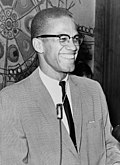
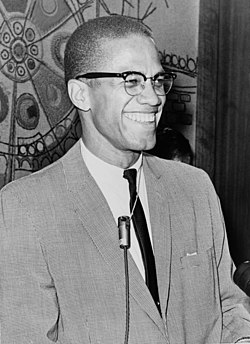
Malcolm X (born Malcolm Little, later el-Hajj Malik el-Shabazz; May 19, 1925 – February 21, 1965) was an African American revolutionary and Black nationalist leader who rose from a background of poverty, family disruption, and criminal activity to a prominent figure during the civil rights movement until his assassination in 1965. He discovered the religious organization the Nation of Islam while in prison and served as its spokesperson from 1952 until 1964. He was also a vocal advocate for Black empowerment and the promotion of Islam within the African American community. A controversial figure accused of preaching violence, Malcolm X is also a celebrated figure with Black people and Muslims worldwide for his pursuit of racial justice.
Malcolm spent his adolescence living in a series of foster homes and with various relatives, after his father's death and his mother's hospitalization. He committed various crimes, being sentenced to eight to ten years in prison in 1946 for larceny and burglary. In prison, he joined the Nation of Islam, adopting the name Malcolm X to symbolize his unknown African ancestral surname while discarding "the white slavemaster name of 'Little'", and after his parole in 1952, he quickly became one of the organization's most influential leaders. He was the public face of the organization for 12 years, advocating black empowerment and separation of Black and white Americans, as well as criticizing Martin Luther King Jr. and the mainstream civil rights movement for its emphasis on non-violence and racial integration. Malcolm X also expressed pride in some of the Nation's social welfare achievements, such as its free drug rehabilitation program. From the 1950s onward, Malcolm X was subjected to surveillance by the Federal Bureau of Investigation (FBI). (Full article...)
Abū Bakr al-Rāzī, also known as Rhazes (full name: أبو بکر محمد بن زکریاء الرازي, Abū Bakr Muḥammad ibn Zakariyyāʾ al-Rāzī), 864 or 865 – 925 or 935 CE, was a Persian physician, philosopher and alchemist who lived during the Islamic Golden Age. He is widely regarded as one of the most important figures in the history of medicine, and also wrote on logic, astronomy and grammar. He is also known for his criticism of religion, especially with regard to the concepts of prophethood and revelation. However, the religio-philosophical aspects of his thought, which also included a belief in five "eternal principles", are fragmentary and only reported by authors who were often hostile to him.
A comprehensive thinker, al-Razi made fundamental and enduring contributions to various fields, which he recorded in over 200 manuscripts, and is particularly remembered for numerous advances in medicine through his observations and discoveries. An early proponent of experimental medicine, he became a successful doctor, and served as chief physician of Baghdad and Ray hospitals. As a teacher of medicine, he attracted students of all backgrounds and interests and was said to be compassionate and devoted to the service of his patients, whether rich or poor. Along with Thābit ibn Qurra (836–901), he was one of the first to clinically distinguish between smallpox and measles. (Full article...)
Scene from Siyer-i Nebi, Hamza and Ali leading the Muslim armies at Badr. The writing is OttomanNaskh.
The Battle of Badr or sometimes called The Raid of Badr (Arabic: غَزْوَةُ بَدْرٍ[ɣazwatubadr]; Ghazwatu Badr), also referred to as The Day of the Criterion (Arabic: يَوْمُ الْفُرْقَانْ, Arabic pronunciation:[jawm'ulfur'qaːn]; Yawm al-Furqan) in the Qur'an and by Muslims, was fought on 13 March 624 CE (17 Ramadan, 2 AH), near the present-day city of Badr, Al Madinah Province in Saudi Arabia. Muhammad, commanding an army of his Sahaba, defeated an army of the Quraysh led by Amr ibn Hishām, better known among Muslims as Abu Jahl. The battle marked the beginning of the six-year war between Muhammad and his tribe. The Battle of Badr took place after five or six unsuccessful attempts by the Muslims to intercept and raid Meccan trade caravans between 623 and early 624 CE.
Muhammad took a keen interest in capturing Meccan caravans and their wealth after his migration to Medina. A few days before the battle, when he learnt of a Makkan caravan returning from the Levant led by Abu Sufyan ibn Harb, Muhammad gathered a small expeditionary force to raid it. Abu Sufyan, learning of the Muslim plan to ambush his caravan, changed course and took a longer route away from Muhammad's base at Medina and sent a messenger to Mecca, asking for help. Amr ibn Hisham commanded an army nearly one-thousand strong, approaching Badr and encamping at the dune al-'Udwatul Quswa. (Full article...)
The First Crusade (1096–1099) was the first of a series of religious wars, or Crusades, which were initiated, supported and at times directed by the Latin Church in the Middle Ages. Their aim was to return the Holy Land—which had been conquered by the Rashidun Caliphate in the 7th century—to Christian rule. By the 11th century, although Jerusalem had then been ruled by Muslims for hundreds of years, the practices of the Seljuk rulers in the region began to threaten local Christian populations, pilgrimages from the West and the Byzantine Empire itself. The earliest impetus for the First Crusade came in 1095 when Byzantine emperor Alexios I Komnenos sent ambassadors to the Council of Piacenza to request military support in the empire's conflict with the Seljuk-led Turks. This was followed later in the year by the Council of Clermont, at which Pope Urban II gave a speech supporting the Byzantine request and urging faithful Christians to undertake an armed pilgrimage to Jerusalem.
This call was met with an enthusiastic popular response across all social classes in western Europe. Thousands of predominantly poor Christians, led by the French priest Peter the Hermit, were the first to respond. What has become known as the People's Crusade passed through Germany and indulged in wide-ranging anti-Jewish activities, including the Rhineland massacres. On leaving Byzantine-controlled territory in Anatolia, they were annihilated in a Turkish ambush led by the Seljuk Kilij Arslan I at the Battle of Civetot in October 1096. (Full article...)
Alchemists attempted to purify, mature, and perfect certain materials. Common aims were chrysopoeia, the transmutation of "base metals" (e.g., lead) into "noble metals" (particularly gold); the creation of an elixir of immortality; and the creation of panaceas able to cure any disease. The perfection of the human body and soul was thought to result from the alchemical magnum opus ("Great Work"). The concept of creating the philosopher's stone was variously connected with all of these projects. (Full article...)
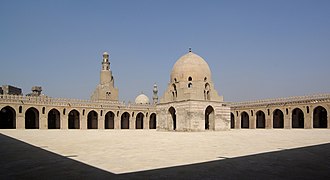
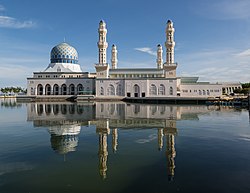
Originally, mosques were simple places of prayer for the early Muslims, and may have been open spaces rather than elaborate buildings. In the first stage of Islamic architecture (650–750 CE), early mosques comprised open and closed covered spaces enclosed by walls, often with minarets, from which the Islamic call to prayer was issued on a daily basis. It is typical of mosque buildings to have a special ornamental niche (a mihrab) set into the wall in the direction of the city of Mecca (the qibla), which Muslims must face during prayer, as well as a facility for ritual cleansing (wudu). The pulpit (minbar), from which public sermons (khutbah) are delivered on the event of Friday prayer, was, in earlier times, characteristic of the central city mosque, but has since become common in smaller mosques. To varying degrees, mosque buildings are designed so that there are segregated spaces for men and women. This basic pattern of organization has assumed different forms depending on the region, period, and Islamic denomination. (Full article...)
Sir Muhammad Iqbal (9 November 1877 – 21 April 1938) was an Islamic philosopher and poet. His poetry in Urdu is considered to be among the greatest of the 20th century, and his vision of a cultural and political ideal for the Muslims of British India is widely regarded as having animated the impulse for the Pakistan Movement. He is commonly referred to by the honorific Allamah (Persian: علامه, transl. "learned") and widely considered one of the most important and influential Muslim thinkers and Islamic religious philosophers of the 20th century.
Iqbal was born and raised in Sialkot, Punjab, British India and studied at Scotch Mission College in Sialkot and Government College in Lahore. He taught Arabic at the Oriental College, Lahore, from 1899 until 1903, during which time he wrote prolifically. Notable among his Urdu poems from this period are "Parinde Ki Faryad" ("A Bird's Prayer"), an early contemplation on animal rights, and "Tarana-e-Hindi" ("Anthem of the Indians"), a patriotic poem—both composed for children. In 1905, he departed from India to pursue further education in Europe, first in England and later in Germany. In England, he earned a second BA at Trinity College, Cambridge, and subsequently qualified as a barrister at Lincoln's Inn. In Germany, he obtained a PhD in philosophy at the Ludwig-Maximilians-Universität München (LMU), with his thesis focusing on "The Development of Metaphysics in Persia" in 1908. Upon his return to Lahore in 1908, Iqbal established a law practice but primarily focused on producing scholarly works on politics, economics, history, philosophy, and religion. He is most renowned for his poetic compositions, including "Asrar-e-Khudi", "Rumuz-e-Bekhudi", and "Bang-e-Dara." His literary works in the Persian language garnered him recognition in Iran. (Full article...)
Image 4The Tughra (طغراء) of Mahmud II. A tughra is a Turkish paisley-like calligraphicseal or signature used at the beginning of sultans' decrees. These colorful emblems incorporated the ruler's name and title in intricate vegetal inscriptions designed by neshanis, or court calligraphers. Parallel to the Europeansignet, tughras often appeared on coins and stamps of the Ottoman Empire.
Image 6The Faisal Mosque (Urdu: فیصل مسجد) is a mosque located in Islamabad, Pakistan. It is Located on the foothills of Margalla Hills in Islamabad, the mosque features a contemporary design consisting of eight sides of concrete shell and is inspired by a Bedouin tent, and is considered to be the city's main Landmark.
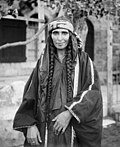
Image 9A Bedouin woman in Jerusalem, sometime between 1898 and 1914, dressed in Palestinian costume, the traditional clothing worn by Palestinians. Many of the handcrafted garments were richly embroidered and the creation and maintenance of these items played a significant role in the lives of the region's women. Until the 1940s, traditional Palestinian costumes reflected a woman's economic status, whether married or single, and the town or district of origin, and a knowledgeable observer could glean such information from the fabric, colors, cut, and embroidery motifs (or lack thereof) in a given woman's apparel.
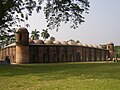
Image 11The Sixty Dome Mosque is a medieval mosque located in Bagerhat, Bangladesh, built by Muslim saint Khan Jahan Ali in mid 15th century. This unique masonry mosque with 81 domes (including 4 corner domes) is a UNESCO world heritage site.
Image 14A young woman from Ramallah, c. 1898-1914. Until the 1940s, women of Palestine wore elaborate handcrafted garments. The creation and maintenance of these items played a significant role in their lives. A knowledgeable observer could determine a woman's village of origin and social status from her clothing. The circular band near this woman's forehead is a ring of coins made from a portion of her dowry money, and indicates that she is unmarried.
19 April 2007 - Organization Islamic State of Iraq announces it had set up a provisional government termed "the first Islamic administration" of post-invasion Iraq
Iranian forces shoot down a U.S.F-15E fighter jet in Iranian airspace. U.S. officials say a search is underway for the two crew members, one of whom is rescued. Iran's state media says a reward will be given to any citizen who helps capture an American pilot. (CNN)(Reuters)(The Guardian
This is a list of recognized content, updated weekly by JL-Bot (talk·contribs) (typically on Saturdays). There is no need to edit the list yourself. If an article is missing from the list, make sure it is tagged (e.g. {{WikiProject Islam}}) or categorized correctly and wait for the next update. See WP:RECOG for configuration options.





_2.jpg)


.jpg)

















.jpg)


.jpg)


.jpg)




-Aerial-Temple_Mount-(south_exposure).jpg)

.jpg)


.jpg)





.jpg)




,_1819._Charles_Willson_Peale.jpg)


.jpeg)