Herodotus (c. 484 BC – c. 425 BC) is often considered the "father of history"
History is the systematic study of the past, focusing primarily on the human past. As an academic discipline, it analyses and interprets evidence to construct narratives about what happened and explain why it happened. Some theorists categorize history as a social science, while others see it as part of the humanities or consider it a hybrid discipline. Similar debates surround the purpose of history—for example, whether its main aim is theoretical, to uncover the truth, or practical, to learn lessons from the past. In a more general sense, the term history refers not to an academic field but to the past itself, times in the past, or to individual texts about the past.
History emerged as a field of inquiry in antiquity to replace myth-infused narratives, with influential early traditions originating in Greece, China, and later in the Islamic world. Historical writing evolved throughout the ages and became increasingly professional, particularly during the 19th century, when a rigorous methodology and various academic institutions were established. History is related to many fields, including historiography, philosophy, education, and politics. (Full article...)
👁 Image The Cenotaph is a war memorial on Whitehall in London, England. Designed by Sir Edwin Lutyens, it was unveiled in 1920 as the United Kingdom's national memorial to the dead of Britain and the British Empire of the First World War. It was rededicated in 1946 to include those of the Second World War, and has since come to represent the Commonwealth casualties from those and later conflicts. The word cenotaph is derived from Greek, meaning 'empty tomb'. Most of the dead were buried close to where they fell; thus, the Cenotaph symbolises their absence and is a focal point for public mourning. The original temporary Cenotaph was erected in 1919 for a parade celebrating the end of the First World War, at which more than 15,000 servicemen, including French and American soldiers, saluted the monument. More than a million people visited the site within a week of the parade.
Calls for the Cenotaph to be rebuilt in permanent form began almost immediately. After some debate, the government agreed and construction work began in May 1920. Lutyens added entasis (curvature) but otherwise made minimal design alterations. The Cenotaph is built from Portland stone. It takes the form of a tomb chest atop a rectangular pylon, which diminishes as it rises. Three flags hang from each of the long sides. The memorial is austere, containing almost no decoration. The permanent Cenotaph was unveiled by King George V on 11 November 1920 in a ceremony combined with the repatriation of the Unknown Warrior, an unidentified British serviceman to be interred in Westminster Abbey. After the unveiling, millions more people visited the Cenotaph and the Unknown Warrior. The memorial met with public acclaim and has largely been praised by academics, though some Christian organisations disapproved of its lack of overt religious symbolism. (Full article...)
The 2nd Indiana Battery in action at Cane Hill, during the beginning of the battle.
The Battle of Cane Hill was fought between Union and Confederate forces during the American Civil War on November 28, 1862, in northwestern Arkansas, near the town of Cane Hill. Confederate Major GeneralThomas C. Hindman had made an abortive offensive into southwestern Missouri from Arkansas earlier in the year, but had withdrawn to Arkansas. Union troops under Brigadier GeneralJames G. Blunt had followed Hindman into northwestern Arkansas, and the Confederate general saw an opportunity to attack Blunt while his division was separated from the rest of the Union Army of the Frontier. Hindman then sent a force under Brigadier General John S. Marmaduke to Cane Hill, which was also known as Boonsboro, to collect supplies. In early November, a detachment of Blunt's command led by ColonelWilliam F. Cloud defeated a small Confederate force commanded by Colonel Emmett MacDonald in the Cane Hill area.
After MacDonald's defeat, Marmaduke remained in the Cane Hill area with his force. Blunt moved to attack Marmaduke on November 27. The Confederates expected the Union attack to come up the Cincinnati Road, but it instead followed the Ridge Road and then the Fayetteville Road. Cloud's men led the Union advance and made contact with Colonel Joseph O. Shelby's Confederate troopers on the morning of November 28. Shelby withdrew from the Cane Hill area after an artillery duel, and Marmaduke reformed his line in the Newburg area. (Full article...)
Thomas Currie "Diver" Derrick, VC, DCM (20 March 1914 – 24 May 1945) was an Australian soldier and a recipient of the Victoria Cross, the highest decoration for gallantry "in the face of the enemy" awarded to members of the British and Commonwealth armed forces. In November 1943, during the Second World War, Derrick was awarded the Victoria Cross for his assault on a heavily defended Japanese position at Sattelberg, New Guinea. During the engagement, he scaled a cliff face while under heavy fire and silenced seven machine gun posts, before leading his platoon in a charge that destroyed a further three.
Born in the Adelaide suburb of Medindie, South Australia, Derrick left school at the age of fourteen and found work in a bakery. As the Great Depression grew worse he lost his job and moved to Berri, working on a fruit farm before marrying in 1939. In July 1941, Derrick enlisted in the Second Australian Imperial Force, joining the 2/48th Battalion. He was posted to the Middle East, where he took part in the siege of Tobruk, was recommended for the Military Medal and promoted to corporal. Later, at El Alamein, Derrick was awarded the Distinguished Conduct Medal for knocking out three German machine gun posts, destroying two tanks, and capturing one hundred prisoners. (Full article...)
The Second War of Scottish Independence broke out in 1332, when Edward Balliol led an English-backed invasion of Scotland. Balliol, the son of former Scottish king John Balliol, was attempting to make good his claim to the Scottish throne. He was opposed by Scots loyal to the occupant of the throne, eight-year-old David II. At the Battle of Dupplin Moor Balliol's force defeated a Scottish army ten times their size and Balliol was crowned king. Within three months David's partisans had regrouped and forced Balliol out of Scotland. He appealed to the English king, Edward III, who invaded Scotland in 1333 and besieged the important trading town of Berwick. A large Scottish army attempted to relieve it but was heavily defeated at the Battle of Halidon Hill. Balliol established his authority over most of Scotland, ceded to England the eight counties of south-east Scotland and did homage to Edward for the rest of the country as a fief.
As allies of Scotland via the Auld Alliance, the French were unhappy about an English expansion into Scotland and so covertly supported and financed David's loyalists. Balliol's allies fell out among themselves and he lost control of most of Scotland again by late 1334. In early 1335, the French attempted to broker a peace. However, the Scots were unable to agree on a position and Edward prevaricated while building a large army. He invaded in July and again overran most of Scotland. Tensions with France increased. Further French-sponsored peace talks failed in 1336; in May 1337, King Philip VI of France engineered a clear break between France and England, starting the Hundred Years' War. The Anglo-Scottish war became a subsidiary theatre of this larger Anglo-French war. Edward sent what troops he could spare to Scotland, in spite of which the English slowly lost ground in Scotland as they were forced to focus on the French theatre. Achieving his majority, David returned to Scotland from France in 1341; by 1342, the English had been cleared from north of the border. (Full article...)
German paratroopers dropping near Heraklion; a Ju 52 is visible and the smoke (centre) marks where another has crashed after being hit by anti-aircraft fire.
The attack on Heraklion during the afternoon of 20 May was one of four airborne assaults on Crete that day, following German attacks against Maleme airfield and the main port of Chania in the west of Crete in the morning. The aircraft that dropped the morning attackers were scheduled to drop the 1st Regiment over Heraklion later the same day. Confusion and delays at the airfields in mainland Greece meant that the assault was launched without direct air support, and over several hours rather than simultaneously; some units were still at the airfields by the end of the day. Those German units dropping near Heraklion suffered very high casualties, both from ground fire and upon landing. Those dropping further away were severely hampered by armed Cretan civilians. The initial German attack failed; when it was renewed the next day it failed again. The fighting then settled into a stalemate. (Full article...)
Topographic map of Switzerland highlighting the location of the battle
The Battle of Winterthur (27 May 1799) was an important action between elements of the Army of the Danube and elements of the Habsburg army, commanded by Friedrich Freiherr von Hotze, during the War of the Second Coalition, part of the French Revolutionary Wars. The small town of Winterthur lies 18 kilometers (11 mi) northeast of Zürich, in Switzerland. Because of its position at the junction of seven roads, the army that held the town controlled access to most of Switzerland and points crossing the Rhine into southern Germany. Although the forces involved were small, the ability of the Austrians to sustain their 11-hour assault on the French line resulted in the consolidation of three Austrian forces on the plateau north of Zürich, leading to the French defeat a few days later.
In the course of the warship's eight-month career, Bismarck conducted only one offensive operation that lasted eight days in May 1941, codenamed Rheinübung. The ship, along with the heavy cruiser Prinz Eugen, was to break into the Atlantic Ocean and raid Allied shipping from North America to Great Britain. The two ships were detected several times off Scandinavia, and British naval units were deployed to block their route. At the Battle of the Denmark Strait, the battlecruiserHMS Hood initially engaged Prinz Eugen, probably by mistake, while HMS Prince of Wales engaged Bismarck. In the ensuing battle Hood was destroyed by the combined fire of Bismarck and Prinz Eugen, which then damaged Prince of Wales and forced her retreat. Bismarck suffered sufficient damage from three hits by Prince of Wales to force an end to the raiding mission. (Full article...)
👁 Image The first page of the MAUD Committee report, March 1941 The MAUD Committee was a British scientific working group formed during the Second World War. It was established to perform the research required to determine if an atomic bomb was feasible. The name MAUD came from a strange line in a telegram from Danish physicist Niels Bohr referring to his housekeeper, Maud Ray.
The Ustaše used the mysterious deaths of two of their local followers as a pretext for the killings. The victims were drawn from Gudovac and its surroundings on 28 April. Most were arrested under the guise that they were rebels loyal to the ousted Yugoslav government. They were taken to a nearby field and collectively shot by a firing squad of up to 70 Ustaše guards. Five of the prisoners managed to survive the initial volley and crawled away to safety. The Ustaše forced Gudovac's surviving inhabitants to dig a mass grave for the victims and pour quicklime on the bodies to speed up decomposition. The following day, relatives of one of the victims informed the Germans of what had transpired. The Germans ordered a partial exhumation of the mass grave, and had 40 suspected perpetrators arrested. Mladen Lorković, a senior Ustaše official, used his influence to have the detained men released and promised German ambassador Siegfried Kasche that the Croatian authorities would carry out a thorough investigation. No investigation took place. (Full article...)
👁 Image The Third of May 1808 in Madrid (commonly known as The Third of May 1808) and also known, in Spanish, as El tres de mayo de 1808 en Madrid or Los fusilamientos de la montaña del Príncipe Pío, or Los fusilamientos del tres de mayo, is a painting completed in 1814 by the Spanish painter Francisco Goya, now in the Museo del Prado, Madrid. In the work, Goya sought to commemorate Spanish resistance to Napoleon's armies during the occupation of Madrid in 1808 at the start of the Peninsular War. Along with its companion piece of the same size, The Second of May 1808 (or The Charge of the Mamelukes), it was commissioned by the provisional government of Spain at Goya's own suggestion shortly after the ousting of the French occupation and the restoration of King Ferdinand VII.
The painting's content, presentation, and emotional force secure its status as a ground-breaking, archetypal image of the horrors of war. Although it draws on many sources from both high and popular art, The Third of May marks a clear break from convention. By diverging from the traditions of Christian art and traditional depictions of war, it has no distinct precedent, and is acknowledged as one of the first paintings of the modern era. According to the art historian Kenneth Clark, it is "the first great picture which can be called revolutionary in every sense of the word, in style, in subject, and in intention". (Full article...)
Nine years later, he defeated and killed Edwin's eventual successor, Oswald, at the Battle of Maserfield; from this point he was probably the most powerful of the Anglo-Saxon rulers of the time, laying the foundations for the Mercian Supremacy over the Anglo-Saxon Heptarchy. He repeatedly defeated the East Angles and drove Cenwalh the king of Wessex into exile for three years. He continued to wage war against the Bernicians of Northumbria. Thirteen years after Maserfield, he suffered a crushing defeat by Oswald's successor and brother Oswiu and was killed at the Battle of the Winwaed in the course of a final campaign against the Bernicians. (Full article...)
👁 Image The Midland Railway War Memorial is a First World War memorial in Derby in the East Midlands of England. It was designed by Sir Edwin Lutyens and unveiled in 1921. The memorial commemorates employees of the Midland Railway who died while serving in the armed forces during the First World War. The Midland was one of the largest railway companies in Britain in the early 20th century, and the largest employer in Derby, where it had its headquarters. Around a third of the company's workforce, some 23,000 men, left to fight, of whom 2,833 were killed.
Standing on Midland Road, within sight of Derby railway station and backing on to the garden of the Midland Hotel, the memorial consists of a cenotaph partially enclosed by a screen wall on three sides. Affixed to the wall are bronze plaques listing the names of the dead. On either side of the cenotaph is the Midland's coat of arms, enclosed in a laurel wreath. The crest is surmounted by a catafalque with sculpted lion heads at the corners, supporting the recumbent effigy of a soldier, covered by a coat. Lutyens renders the soldier anonymous by lifting him high above eye level, allowing the viewer to believe it could be somebody they knew. (Full article...)
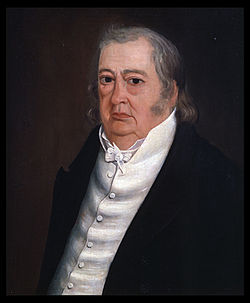
James Garrard (/ˈɡærərd/GARR-ərd; January 14, 1749 – January 9, 1822) was an American farmer, Baptist minister and politician who served as the second governor of Kentucky from 1796 to 1804. Because of term limits imposed by the state constitution adopted in 1799, he was the last Kentucky governor elected to two consecutive terms until the restriction was eased by a 1992 amendment, allowing Paul E. Patton's re-election in 1999.
After serving in the Revolutionary War, Garrard moved west to the part of Virginia that is now Bourbon County, Kentucky. He held several local political offices and represented the area in the Virginia House of Delegates. He was chosen as a delegate to five of the ten statehood conventions that secured Kentucky's separation from Virginia and helped write the state's first constitution. Garrard was among the delegates who unsuccessfully tried to exclude guarantees of the continuance of slavery from the document. In 1795, he sought to succeed Isaac Shelby as governor. In a three-way race, Benjamin Logan received a plurality, but not a majority, of the electoral votes cast. Although the state constitution did not specify whether a plurality or a majority was required, the electors held another vote between the top two candidates – Logan and Garrard – and on this vote, Garrard received a majority. Logan protested Garrard's election to state attorney generalJohn Breckinridge and the state senate, but both claimed they had no constitutional power to intervene. (Full article...)
The British farthing (derived from the Old Englishfeorthing, a fourth part) was a British coin worth a quarter of an old penny (1⁄960 of a pound sterling). It ceased to be struck after 1956 and was demonetised from 1 January 1961.
The British farthing is a continuation of the English farthing, struck by English monarchs prior to the Act of Union 1707, which unified the crowns of England and Scotland into the Kingdom of Great Britain. Only pattern farthings were struck under Queen Anne as there was a glut of farthings from previous reigns. The coin was struck intermittently under George I and George II, but by the reign of George III, counterfeits were so prevalent the Royal Mint ceased striking copper coinage after 1775. The next farthings were the first struck by steam power, in 1799 by Matthew Boulton at his Soho Mint under licence. Boulton coined more in 1806, and the Royal Mint resumed production in 1821. The farthing was struck fairly regularly under George IV and William IV. By then it carried a scaled-down version of the penny's design, and would continue to mirror the penny and halfpenny until after 1936. (Full article...)
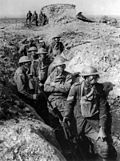
A group of Australianinfantry wearing Small Box Respirators (SBRs) at the Third Battle of Ypres in September 1917. After the introduction of poison gas in World War I, countermeasures were developed. SBRs represented the pinnacle of gas mask development during the war, a mouthpiece connected via a hose to a box filter (hanging around the wearer's neck in this picture), which in turn contained granules of chemicals that neutralised the gas. The SBR was the prized possession of the ordinary infantryman; when the British were forced to retreat during the German Spring Offensive of 1918, it was found that while some troops had discarded their rifles, hardly any had left behind their respirators.
Petra is an archaeological site in Jordan, lying in a basin among the mountains which form the eastern flank of Wadi Araba, the great valley running from the Dead Sea to the Gulf of Aqaba. It is famous for having many stone structures carved into the rock.
A Chola dynasty sculpture depicting Shiva. In Hinduism, Shiva is the deity of destruction and one of the most important gods; in this sculpture he is dancing as Nataraja, the divine dancer who unravels the world in preparation for it being remade by Brahma.
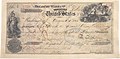
The check used for the Alaska Purchase, issued on August 1, 1868, and signed by US Secretary of State William H. Seward. For a total of $7.2 million, the United States government purchased Russian America from the Russian Empire (represented here by Russian Minister to the United States Eduard de Stoeckl). The lands involved became the modern state of Alaska in 1959.
Jews captured by SS and SD troops during the suppression of the Warsaw Ghetto Uprising are forced to leave their shelter and march to the Umschlagplatz for deportation. The SD trooper pictured second from the right, is Josef Blösche, who was identified by Polish authorities using this photograph. Blösche was tried for war crimes in Erfurt, East Germany in 1969, sentenced to death and executed in July of that year.
A samurai with his sword and armor, photographed by Felice Beato c. 1860. The samurai, records of which date back to the early 10th-century Kokin Wakashū, were the military nobility of medieval and early-modern Japan. As Japan modernized during the Meiji period beginning in the late 1860s, the samurai lost much of their power, and the status was ultimately dissolved. However, samurai values remain common in Japanese society.
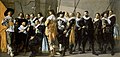
De Magere Compagnie (completed 1637), which depicts a company of schutterij, a voluntary city guard or citizen militia in the medieval and early modernNetherlands. Frans Hals was commissioned to create this, but he was unable to complete it after three years, and the company hired Pieter Codde to finish it. Group portraits such as this of schutterij were known as schuttersstuk, and were popular among the guards themselves.
"The Trumpet Calls", a recruitment poster for the Australian Army in World War I. When the United Kingdom declared war on Germany, Australia followed without hesitation. This was considered to be expected by the Australian public, because of the very large number of British-born citizens and first generation Anglo-Australians at the time. A total of 331,814 Australians were sent overseas to serve as part of the Australian Imperial Force with a casualty rate (killed or wounded) of 64%.
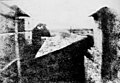
The first successful permanent photograph, created in 1826, is titled "View from the Window at Le Gras". It required an eight-hour exposure in bright sunshine and was printed on a polished pewter plate covered with a petroleum derivative called bitumen of Judea. Due to the long exposure, the buildings are illuminated by the sun from both right and left.
... that Hostage, a book written by Eli Sharabi after surviving 491 days in Hamas captivity, became the fastest-selling book in Hebrew-language publishing history?
... that alongside a 7th-century BC Phoenician shipwreck, two additional wrecks from various historical periods were unearthed in Bajo de la Campana, situated off the coast of Cartagena, Spain?
... that Cliff Christl, who became the Green Bay Packers team historian in 2014, estimated that he had recorded more than 250 oral histories with past players and coaches since the 1990s?
Neferefre Isi (fl. 25th century BC; also known as Raneferef, Ranefer and in Greek as Χέρης, Cherês) was an ancient Egyptian pharaoh of the Fifth Dynasty during the Old Kingdom period. He was most likely the eldest son of pharaoh Neferirkare Kakai and queen Khentkaus II. He was known as prince Ranefer before he ascended to the throne.
Neferefre started a pyramid for himself in the royal necropolis of Abusir called Netjeribau Raneferef, which means "The bas of Neferefre are divine". The pyramid was never finished, with a mason's inscription showing that works on the stone structure were abandoned during or shortly after the king's second year of reign. Together with the sparsity of attestations contemporaneous with his reign, this is taken by Egyptologists as evidence that Neferefre died unexpectedly after two to three years on the throne. Neferefre was nonetheless buried in his pyramid, hastily completed in the form of a mastaba by his second successor and presumably younger brother, pharaoh Nyuserre Ini. Fragments of his mummy were uncovered there, showing that he died in his early twenties. (Full article...)
Truth alone will endure, all the rest will be swept away before the tide of time. I must continue to bear testimony to truth even if I am forsaken by all. Mine may today be a voice in the wilderness, but it will be heard when all other voices are silenced, if it is the voice of Truth.
Are you a historian : i.e. one who studies and writes history, and who has a keen interest in writing outstanding articles? Join our group by adding Category:Wikipedian historians to the bottom of your user page.
Associated Wikimedia
The following Wikimedia Foundation sister projects provide more on this subject:


.jpg)








.jpg)