👁 Image The wheel, invented sometime before the 4th millennium BC, is one of the most ubiquitous and important technologies. This detail of the "Standard of Ur", c. 2500 BCE., displays a Sumerian chariot
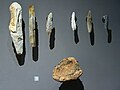
Technological advancements have led to significant changes in society. The earliest known technology is the stone tool, used during prehistory, followed by the control of fire—which in turn contributed to the growth of the human brain and the development of language during the Ice Age, according to the cooking hypothesis. The invention of the wheel in the Bronze Age allowed greater travel and the creation of more complex machines. More recent technological inventions, including the printing press, telephone, and the Internet, have lowered barriers to communication and ushered in the knowledge economy. (Full article...)
104 (also known as Barge 104, or No.104) was an American whaleback barge in service between 1890 and 1898. The fourth whaleback constructed, she was built between October 1889 and February 1890, in Duluth, Minnesota by Alexander McDougall's American Steel Barge Company, for McDougall's fleet of the same name, based in Buffalo, New York. She was a whaleback, a class of distinctive, experimental ship designed and built by McDougall. The whalebacks were designed to be more stable in high seas. They had rounded decks, and lacked the normal straight sides seen on traditional lake freighters. 104 entered service on April 21, hauling iron ore from Two Harbors, Minnesota.
On November 10, 1898, while being towed out of Cleveland harbour with a cargo of coal bound for Duluth, she broke away from the tug Alva B.104 crashed into Cleveland's west breakwater. She sank quickly, with her crew being rescued by the Cleveland United States Life-Saving Service. 104 was a total loss, becoming the first whaleback to be lost on the Great Lakes. (Full article...)
New York State Route 17A (NY 17A) is a state highway in southern New York in the United States, entirely within Orange County. Its western terminus is located in the village of Goshen at a junction with NY 17 (Future I-86), and its eastern terminus is at another intersection with NY 17 located in Southfields. It runs concurrently with NY 94 from Warwick to Florida. It serves mainly to connect Warwick with the rest of the county. While it is an east–west route, many sections run in a more north–south orientation. Its circuitous route allows it to offer much scenery to drivers.
The Greenwood Lake–Goshen portion of NY 17A was originally designated as part of New York State Route 55 in the 1920s. South of Greenwood Lake, NY 55 used modern NY 210. NY 55 was split into NY 17A and NY 210 as part of the 1930 renumbering of state highways in New York. Initially, only NY 210 continued east from Greenwood Lake to Southfields; however, NY 17A was extended to Southfields by 1933, overlapping NY 210. The overlap was eliminated in 1982 when NY 210 was truncated to Greenwood Lake. (Full article...)
The viaduct which carried the Axholme Joint Railway over the Folly Drain and the South Engine Drain
The Axholme Joint Railway was a committee created as a joint enterprise between the Lancashire and Yorkshire Railway (L&Y) and the North Eastern Railway (NER) and was established by the North Eastern Railway Act 1902 (2 Edw. 7. c. clxviii) of 31 July 1902. It took over the Goole and Marshland Railway, running from Marshland Junction near Goole to Reedness Junction and Fockerby, and the Isle of Axholme Light Railway, running from Reedness Junction to Haxey Junction. Construction of the Goole and Marshland Railway had begun in 1898, and by the time of the takeover in early 1903, was virtually complete. The Isle of Axholme Light Railway was started in 1899, but only the section from Reedness Junction to Crowle was complete at the takeover. The northern section opened on 10 August 1903, and the line from Crowle to Haxey Junction opened for passengers on 2 January 1905.
A branch to Hatfield Moor was opened in 1909, but traffic from the peat works at Hatfield did not start to use the railway until 1913, when the company extended their line into the works. Traffic was mainly agricultural produce, together with peat from Hatfield Moor and from Swinefleet Peat Works which processed peat from Thorne Moors. Passenger services ceased in 1933, although occasional excursion trains continued to be run. The Haxey Junction to Epworth section closed in 1956, the Hatfield Moor Branch closed in 1964, and the remainder closed in 1965. However, most of the tracks were retained and operated as a long siding, to allow it to be used to carry heavy parts from Keadby Power Station across the Stainforth and Keadby Canal, as the bridge on the A161 road could not support the weight. The road bridge was replaced in 1970, and the rails were finally removed in 1972. (Full article...)
The program launched on the platform in 2021 and became widespread in 2023. Initially shown to U.S. users only, notes were popularized in March 2022 over misinformation in the Russian invasion of Ukraine followed by COVID-19 misinformation in October. Birdwatch was then rebranded to Community Notes and expanded in November 2022. As of November 2023, it had approximately 133,000 contributors; notes reportedly receive tens of millions of views per day, with its goal being to counter propaganda and misinformation. According to investigation and studies, the vast majority of users do not see notes correcting content. In May 2024, a study of COVID-19 vaccine notes were deemed accurate 97% of the time. (Full article...)
👁 Image Oneworld (CRS: *O, stylised as oneworld) is a global airline alliance consisting of 15 member airlines. It was founded on 1 February 1999. The alliance's stated objective is to be the first-choice airline alliance for the world's frequent international travellers. Its headquarters have been located in Fort Worth, Texas, since December 2022.
Built by the California Department of Water Resources, Oroville Dam is one of the key features of the California State Water Project (SWP), one of two major projects passed that set up California's statewide water system. Construction was initiated in 1961, and despite numerous difficulties encountered during its construction, including multiple floods and a major train wreck on the rail line used to transport materials to the dam site, the embankment was topped out in 1967 and the entire project was ready for use in 1968. The dam began to generate electricity shortly afterwards with completion of the Edward Hyatt Power Plant, then the country's largest underground power station. (Full article...)
m-derived filters or m-type filters are a type of electronic filter designed using the image method. They were invented by Otto Zobel in the early 1920s. This filter type was originally intended for use with telephone multiplexing and was an improvement on the existing constant k type filter. The main problem being addressed was the need to achieve a better match of the filter into the terminating impedances. In general, all filters designed by the image method fail to give an exact match, but the m-type filter is a big improvement with suitable choice of the parameter m. The m-type filter section has a further advantage in that there is a rapid transition from the cut-off frequency of the passband to a pole of attenuation just inside the stopband. Despite these advantages, there is a drawback with m-type filters; at frequencies past the pole of attenuation, the response starts to rise again, and m-types have poor stopband rejection. For this reason, filters designed using m-type sections are often designed as composite filters with a mixture of k-type and m-type sections and different values of m at different points to get the optimum performance from both types. (Full article...)
The Geneva drive is a gear mechanism that translates a continuous rotation into an intermittent rotary motion. The rotating drive wheel has a pin that reaches into a slot of the driven wheel advancing it by one step. The drive wheel also has a raised circular blocking disc that locks the driven wheel in position between steps. Such a mechanism is used in film projectors, watches, and indexing tables, among others.
The rotor of a modern steam turbine , which converts steam (heat) energy into kinetic (mechanical) energy. The steam path is from the smallest blade, expanding through progressively larger blade elements. Steam turbines are used in power plants to extract mechanical work from pressurized steam and benefit from their high efficiency and high power-to-weight ratio compared to other technologies, leading to their widespread deployment from electricity generation to marine propulsion.
An escalator is a moving staircase for carrying people between floors of a building. The device consists of a motor-driven chain of individual, linked steps that move up or down on tracks, allowing the step treads to remain horizontal.
The Commodore 64 is an 8-bit home computer introduced in 1982 by Commodore International. Its low retail price and easy availability led to the system becoming the market leader for three years. It remains the best-selling single personal computer model of all time.
The cycle was invented by Nikolaus Otto in 1876, and is also called the Otto cycle. The cycle is characterized by four strokes, or straight movements in a single direction, of the piston.
The ULPower UL260i, a flat-four engine produced by ULPower Aero Engines of Belgium. Flat-four engines are flat engines with four cylinders arranged horizontally in two banks of two cylinders on each side of a central crankcase; they can be used in cars, motorcycles, or aircraft. This type of engine tends to be well-balanced and have efficient cooling, but is expensive to manufacture and considerably wider than other engines.
A structural worker bolts beams on the framework during the construction of the Empire State Building in New York City. The 1,250-foot (380 m) building opened on May 1, 1931, at the time the tallest building in the world, overtaking the Chrysler Building (seen to the right), which had just been completed the year before. The addition of a pinnacle and antennas later increased its overall height to 1,472 feet (449 m).
A filling station in Sabah, Malaysia, operated by Royal Dutch Shell. Filling stations, also known under a wide variety of names, are facilities that sell fuel and engine lubricants for motor vehicles. They include one or more fuel dispensers, which distribute fuels such as gasoline and diesel into the tanks within vehicles and calculate the financial cost of the fuel transferred. Filling stations may also include air compressors and electricity sockets, which may inflate tyres or offer charging stations. Many filling stations also incorporate a convenience store, where customers can purchase snacks and other goods.
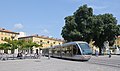
The Nice tramway crossing Place Garibaldi, Nice, where it lowers its pantograph and is powered by batteries. This 8.7-kilometre (5.4 mi), single-line tramway is operated by Veolia Transdev. It opened on 24 November 2007, replacing bus lines 1, 2, 5 and 18.
A telephone, or phone, is a telecommunications device that converts sound, typically the human voice, into electronic signals suitable for transmission via cables or other transmission media over long distances through satellite.
The Wiesen Viaduct is a single-track railway viaduct (concrete blocks with dimension stone coverage) which spans the Landwasser southwest of the hamlet of Wiesen, Switzerland. Designed by Henning Friedrich, then the chief engineer of the Rhaetian Railway, it was built between 1906 and 1909 by the contractor G. Marasi (Westermann & Cie, Zürich) under the supervision of P. Salaz and Hans Studer (RhB). The Rhaetian Railway still owns and uses the viaduct today for regular service with 29 passenger trains per day. An important element of the Davos–Filisur railway, the viaduct is 88.9 metres (292 ft) high, 210 metres (690 ft) long, and has a main span of 55 metres (180 ft). In 1926, the viaduct was the inspiration for Ernst Ludwig Kirchner's painting Brücke bei Wiesen.
A wheel is a circular component that is intended to rotate on an axial bearing. The wheel is one of the main components of the wheel and axle which is one of the six simple machines.
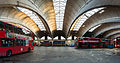
An interior view of Stockwell Garage, a large bus garage in Stockwell, London, designed by Adie, Button and Partners and opened in 1952. The 393-foot-long (120 m) roof structure, seen here, is supported by ten very shallow "two-hinged" arched ribs, between which are cantilevered barrel vaults topped by large skylights. The garage, which could originally hold 200 buses, has been a Grade II* Listed Building since 1988.
A diagram of a typical turbojet engine. Air is compressed as it enters the engine, and is mixed with fuel that burns in the combustion section. Released through the exhaust, the resulting hot gases provide forward thrust and turn the turbines that drive the fan blades of the compressor.
Image 3A rare 1884 photo showing the experimental recording of voice patterns by a photographic process at the Alexander Graham Bell Laboratory in Washington, D.C. Many of their experimental designs panned out in failure. (from Invention)
Image 4The wheel, invented sometime before the 4th millennium BC, is one of the most ubiquitous and important technologies. This detail of the "Standard of Ur", c. 2500 BCE., displays a Sumerian chariot. (from History of technology)
... that astrophysicist Alan C. Cummings has led more than 1,700 weekly birdwatching walks at Caltech since 1986?
... that Zirconic was a U.S. government effort to create reconnaissance satellites equipped with stealth technology?
... that several science fiction critics praised "Rock Diver", the first short story by American writer Harry Harrison, for its compelling take on technology for passing through matter?
... that the Japanese manga series Mink featured futuristic technology even though its creator was unfamiliar with computers?
... that vehicles in Star Trucker still look like American semi-trucks from the 1970s, despite having technology such as warp drivers and maglocks?
A QR code, short for quick-response code, is a type of two-dimensional matrix barcode invented in 1994 by Masahiro Hara of the Japanese company Denso Wave for labelling automobile parts. It features white and black squares within a square grid featuring fiducial markers on the corners, readable by imaging devices like cameras, and processed using Reed–Solomon error correction until the image can be appropriately interpreted. The required data is then extracted from patterns that are present in both the horizontal and the vertical components of the QR image. (Full article...)
Moltbook is an internet forum for artificial intelligence agents, launched on January 28, 2026, by entrepreneur Matt Schlicht. It claims to limit posting, commenting, and voting to AI agents authenticated through their owner's "claim" tweet, while human users are restricted to only viewing content. Initially, the platform lacked a mechanism to verify whether a poster is actually an AI agent or a human; the prompts given to agents contain cURL commands that humans can replicate. However, in February 2026, a reverse CAPTCHA system was introduced to filter out human users. (Full article...)
South Korea enacts a law that requires human oversight of high-impact artificial intelligence (AI) systems, mandates disclosure and labeling of certain AI uses, and institutes fines of up to ₩30 million (around US$20,400) for violations. (Reuters)





.jpg)






_(Art._IWM_LD_2850).jpg)







_i009.jpg)






.jpg)





.jpg)


.jpg)


.jpg)

.JPG)




.jpg)

_(cropped_2)_(b).jpg)


