Electronic devices have significantly influenced the development of many aspects of modern society, such as telecommunications, entertainment, education, health care, industry, and security. The main driving force behind the advancement of electronics is the semiconductor industry, which continually produces ever-more sophisticated electronic devices and circuits in response to global demand. The semiconductor industry is one of the global economy's largest and most profitable industries, with annual revenues exceeding $481 billion in 2018. The electronics industry also encompasses other branches that rely on electronic devices and systems, such as e-commerce, which generated over $29 trillion in online sales in 2017. (Full article...)
This approach is especially useful in the design of mechanical filters—these use mechanical devices to implement an electrical function. However, the technique can be used to solve purely mechanical problems, and can also be extended into other, unrelated energy domains. Nowadays, analysis by analogy is a standard design tool wherever more than one energy domain is involved. It has the major advantage that the entire system can be represented in a unified, coherent way. Electrical analogies are particularly used by transducer designers, by their nature they cross energy domains, and in control systems, whose sensors and actuators will typically be domain-crossing transducers. A given system being represented by an electrical analogy may conceivably have no electrical parts at all. For this reason domain-neutral terminology is preferred when developing network diagrams for control systems. (Full article...)
m-derived filters or m-type filters are a type of electronic filter designed using the image method. They were invented by Otto Zobel in the early 1920s. This filter type was originally intended for use with telephone multiplexing and was an improvement on the existing constant k type filter. The main problem being addressed was the need to achieve a better match of the filter into the terminating impedances. In general, all filters designed by the image method fail to give an exact match, but the m-type filter is a big improvement with suitable choice of the parameter m. The m-type filter section has a further advantage in that there is a rapid transition from the cut-off frequency of the passband to a pole of attenuation just inside the stopband. Despite these advantages, there is a drawback with m-type filters; at frequencies past the pole of attenuation, the response starts to rise again, and m-types have poor stopband rejection. For this reason, filters designed using m-type sections are often designed as composite filters with a mixture of k-type and m-type sections and different values of m at different points to get the optimum performance from both types. (Full article...)
It is distinguished from its predecessor by its larger and higher-resolution screen, higher storage options, a larger battery, and a video camera with stereo audio recording for a spatial effect on headphones and external speakers. While the picture and video resolutions of the camera stayed the same, its launching speed and shutter lag improved. (Full article...)
👁 Image Late model (c.1998) LS3/5A from Spendor, one of the BBC licensees The LS3/5A (each element pronounced separately, without the stroke) is a small studio monitor loudspeaker originated by the BBC for use by outside broadcast vans to ensure quality of their broadcasts. The speaker concept set out transparent and natural sound as the goal, and the achievement of the result is widely acknowledged.
The BBC granted licences to a small number of British firms, which first manufactured the product in 1975. The product underwent a change in 1987 due to consistency issues in manufacturing, and again in around 2003 when original parts from KEF ran out. Upwards of 60,000 pairs of the speaker have been sold. Reviewers have recognised its enormous importance as a bookshelf design. (Full article...)
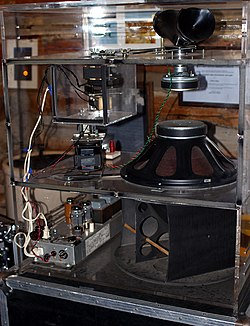
👁 Image A Leslie speaker in a clear plastic cabinet The Leslie speaker is a combined amplifier and loudspeaker that modifies the sound of an electric musical instrument by rotating a baffle chamber (drum) in front of the loudspeaker. A similar effect is provided by a rotating system of horns in front of the treble driver. It is most commonly associated with the Hammond organ, though it was later used for the electric guitar and other instruments. A typical Leslie speaker contains an amplifier, a treble horn and a bass speaker—though specific components depend upon the model. Some models have two speed settings, known as chorale and tremolo.
The speaker is named after its inventor, Donald Leslie, who began working in the late 1930s to get a speaker for a Hammond organ that better emulated a pipe or theatre organ, and discovered that baffles rotating along the axis of the speaker cone gave the best effect. Hammond was not interested in marketing or selling the speakers, so Leslie sold them himself as an add-on, targeting other organs as well as Hammond, beginning in 1941. The sound of the organ being played through his speaker received national radio exposure across the US, and it became a commercial and critical success, becoming popular with jazz organists. In 1965, Leslie sold his business to CBS who, in 1980, sold it to Hammond. Suzuki Musical Instrument Corporation subsequently acquired the Hammond and Leslie brands. (Full article...)
Passive linear electronic analogue filters are those filters which can be described with linear differential equations (linear); they are composed of capacitors, inductors and, sometimes, resistors (passive) and are designed to operate on continuously varying analogue signals. There are many linear filters which are not analogue in implementation (digital filter), and there are many electronic filters which may not have a passive topology – both of which may have the same transfer function of the filters described in this article. Analogue filters are most often used in wave filtering applications, that is, where it is required to pass particular frequency components and to reject others from analogue (continuous-time) signals. (Full article...)
👁 Image The first-generation iPad (/ˈaɪpæd/; EYE-pad; retrospectively referred to unofficially as the iPad 1 or original iPad) is a tablet computer designed and marketed by Apple as the first device in the iPad lineup of tablet computers. It features an Apple A4SoC, a 9.7 in (250 mm) touchscreen display, and, on certain variants, the capability of accessing cellular networks. Using the iOS operating system, the iPad can play music, send and receive emails and browse the web. Other functions, which include the ability to play games and access references, GPS navigation software and social network services, can be enabled by downloading apps.
The device was announced and unveiled on January 27, 2010 by Apple CEO Steve Jobs at an Apple press event. On April 3, 2010, the Wi-Fi variant of the device was released in the United States, followed by the release of the "Wi-Fi + 3G" variant on April 30. On May 28, 2010, it was released in Australia, Canada, France, Japan, Italy, Germany, Spain, Switzerland and the United Kingdom. (Full article...)
The image method of filter design determines the properties of filter sections by calculating the properties they would have in an infinite chain of identical sections. In this, the analysis parallels transmission line theory on which it is based. Filters designed by this method are called image parameter filters, or just image filters. An important parameter of image filters is their image impedance, the impedance of an infinite chain of identical sections. (Full article...)
The Electro-Dynamic Light Company of New York was a lighting and electrical distribution company organized in 1878. The company held the patents for the first practical incandescent electric lamp and electrical distribution system of incandescent electric lighting. They also held a patent for an electric meter to measure the amount of electricity used. The inventions were those of Albon Man and William E. Sawyer. They gave the patent rights to the company, which they had formed with a group of businessmen. It was the first company in the world formally established to provided electric lighting and was the first company organized specifically to manufacture and sell incandescent electric light bulbs.
Man, an attorney from New York City, supplied money for experimentation to Sawyer, an electrical engineer. This partnership developed into the Electro-Dynamic Light Company that brought in other investors that became partners. Sawyer devised a unique electrical distribution system where electrical power could be obtained anywhere in the city from an electrical generator with the turn of a switch to light up electric lamps to produce glowing light like a gas lamp. It was unique in that it produced this power without consumers having to maintain local galvanic batteries and at a fraction of the cost of producing the same lighting as from gas lamps. Other features of the system were that safety devices were built in to prevent the early destroying of the other electric lamps in the circuit should there be a power surge due to a lamp burning up early and leaving the distribution circuit. The patents for the Man and Sawyer system were in place before any other electrical companies had similar systems. (Full article...)
The impedance analogy is a method of representing a mechanical system by an analogous electrical system. The advantage of doing this is that there is a large body of theory and analysis techniques concerning complex electrical systems, especially in the field of filters. By converting to an electrical representation, these tools in the electrical domain can be directly applied to a mechanical system without modification. A further advantage occurs in electromechanical systems: Converting the mechanical part of such a system into the electrical domain allows the entire system to be analysed as a unified whole.
The mathematical behaviour of the simulated electrical system is identical to the mathematical behaviour of the represented mechanical system. Each element in the electrical domain has a corresponding element in the mechanical domain with an analogous constitutive equation. All laws of circuit analysis, such as Kirchhoff's circuit laws, that apply in the electrical domain also apply to the mechanical impedance analogy. (Full article...)
👁 Image The Sinclair Sovereign was a high-end calculator introduced by Clive Sinclair's company Sinclair Radionics in 1976. It was an attempt to escape from the unprofitable low end of the market, and one of the last calculators Sinclair produced. Made with a case of pressed steel that a variety of finishes, it cost between £30 and £60 at a time when other calculators could be purchased for under £5. A number of factors meant that the Sovereign was not a commercial success, including the cost, high import levies on components, competition from cheaper calculators manufactured abroad, and the development of more power-efficient designs using liquid-crystal displays. Though it came with a five-year guarantee, issues such as short battery life limited its usefulness. The company moved on to producing computers soon afterwards.
Numerically controlled oscillators offer several advantages over other types of oscillators in terms of agility, accuracy, stability and reliability. NCOs are used in many communications systems including digital up/down converters used in 3G wireless and software radio systems, digital phase-locked loops, radar systems, drivers for optical or acoustic transmissions, and multilevel FSK/PSK modulators/demodulators. (Full article...)
Staggered tuning is a technique used in the design of multi-stage tuned amplifiers whereby each stage is tuned to a slightly different frequency. In comparison to synchronous tuning (where each stage is tuned identically) it produces a wider bandwidth at the expense of reduced gain. It also produces a sharper transition from the passband to the stopband. Both staggered tuning and synchronous tuning circuits are easier to tune and manufacture than many other filter types.
The function of stagger-tuned circuits can be expressed as a rational function and hence they can be designed to any of the major filter responses such as Butterworth and Chebyshev. The poles of the circuit are easy to manipulate to achieve the desired response because of the amplifier buffering between stages. (Full article...)
👁 Image A time-domain reflectometer; an instrument used to locate the position of faults on lines from the time taken for a reflected wave to return from the discontinuity. A signal travelling along an electrical transmission line will be partly, or wholly, reflected back in the opposite direction when the travelling signal encounters a discontinuity in the characteristic impedance of the line, or if the far end of the line is not terminated in its characteristic impedance. This can happen, for instance, if two lengths of dissimilar transmission lines are joined.
This article is about signal reflections on electrically conducting lines. Such lines are loosely referred to as copper lines, and indeed, in telecommunications are generally made from copper, but other metals are used, notably aluminium in power lines. Although this article is limited to describing reflections on conducting lines, this is essentially the same phenomenon as optical reflections in fibre-optic lines and microwave reflections in waveguides. (Full article...)
Introduced in 2003, HDMI largely replaced older analog video standards such as composite video, S-Video, and VGA in consumer electronics. It was developed based on the CEA-861 standard, which was also used with the earlier Digital Visual Interface (DVI). HDMI is electrically compatible with DVI video signals, and adapters allow interoperability between the two without signal conversion or loss of quality. Adapters and active converters are also available for connecting HDMI to other video interfaces, including the older analog formats, as well as digital formats such as DisplayPort. (Full article...)
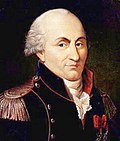
Charles Augustin de Coulomb (June 14, 1736 – August 23, 1806) was a Frenchphysicist, born in Angoulême, France. Coulomb is distinguished in the history of mechanics and of electricity and magnetism. Coulomb explained the laws of attraction and repulsion between electric charges and magnetic poles, although he did not find any relationship between the two phenomena. He thought that the attraction and repulsion were due to different kinds of fluids. The SI unit of charge, the coulomb, and Coulomb's law are named after him.
👁 Image Many e-readers, devices meant to replace traditional books, utilize electronic paper for their displays in order to further resemble paper books; one such example is the Kindle series by Amazon.
Electronic paper or intelligent paper, is a display device that reflects ambient light, mimicking the appearance of ordinary ink on paper – unlike conventional flat-panel displays which need additional energy to emit their own light. This may make them more comfortable to read, and provide a wider viewing angle than most light-emitting displays. The contrast ratio in electronic displays available as of 2008 approaches newspaper, and newly developed displays are slightly better.[needs update] An ideal e-paper display can be read in direct sunlight without the image appearing to fade.
A barcode reader is a computer peripheral for reading barcodes printed on various surfaces. Like a flatbed scanner, it generally consists of a light source, a lens and a photo conductor translating optical impulses into electrical ones. Additionally, nearly all barcode readers currently produced contain decoder circuitry analyzing the barcode's image data provided by the photo conductor and sending the barcode's content to the scanner's output port.