Mathematics is the study of representing and reasoning about abstract objects (such as numbers, points, spaces, sets, structures, and games). Mathematics is used throughout the world as an essential tool in many fields, including natural science, engineering, medicine, and the social sciences. Applied mathematics, the branch of mathematics concerned with application of mathematical knowledge to other fields, inspires and makes use of new mathematical discoveries and sometimes leads to the development of entirely new mathematical disciplines, such as statistics and game theory. Mathematicians also engage in pure mathematics, or mathematics for its own sake, without having any application in mind. There is no clear line separating pure and applied mathematics, and practical applications for what began as pure mathematics are often discovered. (Full article...)
👁 Image Euclid's method for finding the greatest common divisor (GCD) of two starting lengths BA and DC, both defined to be multiples of a common "unit" length. The length DC being shorter, it is used to "measure" BA, but only once because the remainder EA is less than DC. EA now measures (twice) the shorter length DC, with remainder FC shorter than EA. Then FC measures (three times) length EA. Because there is no remainder, the process ends with FC being the GCD. On the right Nicomachus's example with numbers 49 and 21 resulting in their GCD of 7 (derived from Heath 1908:300).
In mathematics, the Euclidean algorithm, or Euclid's algorithm, is an efficient method for computing the greatest common divisor (GCD) of two integers, the largest number that divides them both without a remainder. It is named after the ancient Greek mathematicianEuclid, who first described it in his Elements (c. 300 BC). It is an example of an algorithm, and is one of the oldest algorithms in common use. It can be used to reduce fractions to their simplest form, and is a part of many other number-theoretic and cryptographic calculations.
The Euclidean algorithm is based on the principle that the greatest common divisor of two numbers does not change if the larger number is replaced by its difference with the smaller number. For example, 21 is the GCD of 252 and 105 (as 252 = 21 × 12 and 105 = 21 × 5), and the same number 21 is also the GCD of 105 and 252 − 105 = 147. Since this replacement reduces the larger of the two numbers, repeating this process gives successively smaller pairs of numbers until the two numbers become equal. When that occurs, that number is the GCD of the original two numbers. By reversing the steps or using the extended Euclidean algorithm, the GCD can be expressed as a linear combination of the two original numbers, that is the sum of the two numbers, each multiplied by an integer (for example, 21 = 5 × 10⁵ + (−2) × 252). The fact that the GCD can always be expressed in this way is known as Bézout's identity. (Full article...)
Zhang Heng began his career as a minor civil servant in Nanyang. Eventually, he became Chief Astronomer, Prefect of the Majors for Official Carriages, and then Palace Attendant at the imperial court. His uncompromising stance on historical and calendrical issues led to his becoming a controversial figure, preventing him from rising to the status of Grand Historian. His political rivalry with the palace eunuchs during the reign of Emperor Shun (r. 125–144) led to his decision to retire from the central court to serve as an administrator of Hejian Kingdom in present-day Hebei. Zhang returned home to Nanyang for a short time, before being recalled to serve in the capital once more in 138. He died there a year later, in 139. (Full article...)
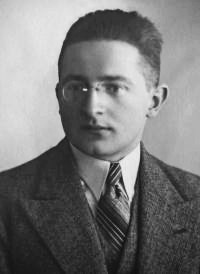
Noether was born to a Jewish family in the Franconian town of Erlangen; her father was the mathematician Max Noether. She originally planned to teach French and English after passing the required examinations, but instead studied mathematics at the University of Erlangen–Nuremberg, where her father lectured. After completing her doctorate in 1907 under the supervision of Paul Gordan, she worked at the Mathematical Institute of Erlangen without pay for seven years. At the time, women were largely excluded from academic positions. In 1915, she was invited by David Hilbert and Felix Klein to join the mathematics department at the University of Göttingen, a world-renowned center of mathematical research. The philosophical faculty objected, and she spent four years lecturing under Hilbert's name. Her habilitation was approved in 1919, allowing her to obtain the rank of Privatdozent. (Full article...)
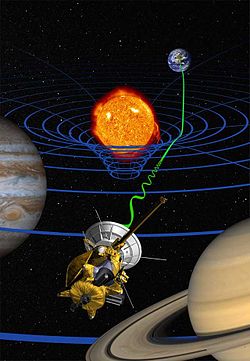
👁 Image High-precision test of general relativity by the Cassini space probe (artist's impression): radio signals sent between the Earth and the probe (green wave) are delayed by the warping of spacetime (blue lines) due to the Sun's mass.
By the beginning of the 20th century, Newton's law of universal gravitation had been accepted for more than two hundred years as a valid description of the gravitational force between masses. In Newton's model, gravity is the result of an attractive force between massive objects. Although even Newton was troubled by the unknown nature of that force, the basic framework was extremely successful at describing motion. (Full article...)
Robert Hues (1553 – 24 May 1632) was an English mathematician and geographer. He attended St. Mary Hall at Oxford, and graduated in 1578. Hues became interested in geography and mathematics, and studied navigation at a school set up by Walter Raleigh. During a trip to Newfoundland, he made observations which caused him to doubt the accepted published values for variations of the compass. Between 1586 and 1588, Hues travelled with Thomas Cavendish on a circumnavigation of the globe, performing astronomical observations and taking the latitudes of places they visited. Beginning in August 1591, Hues and Cavendish again set out on another circumnavigation of the globe. During the voyage, Hues made astronomical observations in the South Atlantic, and continued his observations of the variation of the compass at various latitudes and at the Equator. Cavendish died on the journey in 1592, and Hues returned to England the following year.
In 1594, Hues published his discoveries in the Latin work Tractatus de globis et eorum usu (Treatise on Globes and Their Use) which was written to explain the use of the terrestrial and celestial globes that had been made and published by Emery Molyneux in late 1592 or early 1593, and to encourage English sailors to use practical astronomical navigation. Hues's work subsequently went into at least 12 other printings in Dutch, English, French and Latin. (Full article...)
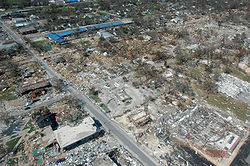
Damage from Hurricane Katrina in 2005. Actuaries need to estimate long-term levels of such damage in order to accurately price property insurance, set appropriate reserves, and design appropriate reinsurance and capital management strategies.
An actuary is a professional with advanced mathematical skills who deals with the measurement and management of risk and uncertainty. These risks can affect both sides of the balance sheet and require asset management, liability management, and valuation skills. Actuaries provide assessments of financial security systems, with a focus on their complexity, their mathematics, and their mechanisms. The name of the corresponding academic discipline is actuarial science.
While the concept of insurance dates to antiquity, the concepts needed to scientifically measure and mitigate risks have their origins in 17th-century studies of probability and annuities. Actuaries in the 21st century require analytical skills, business knowledge, and an understanding of human behavior and information systems; actuaries use this knowledge to design programs that manage risk, by determining if the implementation of strategies proposed for mitigating potential risks does not exceed the expected cost of those risks actualized. The steps needed to become an actuary, including education and licensing, are specific to a given country, with various additional requirements applied by regional administrative units; however, almost all processes impart universal principles of risk assessment, statistical analysis, and risk mitigation, involving rigorously structured training and examination schedules, taking many years to complete. (Full article...)
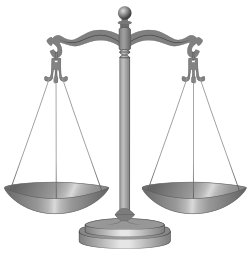
👁 Empty balance scale The weighing pans of this balance scale contain zero objects, divided into two equal groups. In mathematics, zero is an even number. In other words, its parity—the quality of an integer being even or odd—is even. This can be easily verified based on the definition of "even": zero is an integer multiple of 2, specifically 0 × 2. As a result, zero shares all the properties that characterize even numbers: for example, 0 is neighbored on both sides by odd numbers, any decimal integer has the same parity as its last digit—so, since 10 is even, 0 will be even, and if y is even then y + x has the same parity as x—indeed, 0 + x and x always have the same parity.
Zero also fits into the patterns formed by other even numbers. The parity rules of arithmetic, such as even − even = even, require 0 to be even. Zero is the additive identity element of the group of even integers, and it is the starting case from which other even natural numbers are recursively defined. Applications of this recursion from graph theory to computational geometry rely on zero being even. Not only is 0 divisible by 2, it is divisible by every power of 2, which is relevant to the binary numeral system used by computers. In this sense, 0 is the "most even" number of all. (Full article...)
In 1863, Yale University awarded Gibbs the first American doctorate in engineering. After a three-year sojourn in Europe, Gibbs spent the rest of his career at Yale, where he was a professor of mathematical physics from 1871 until his death in 1903. Working in relative isolation, he became the earliest theoretical scientist in the United States to earn an international reputation and was praised by Albert Einstein as "the greatest mind in American history". In 1901, Gibbs received what was then considered the highest honor awarded by the international scientific community, the Copley Medal of the Royal Society of London, "for his contributions to mathematical physics". (Full article...)
Although elements of the indispensability argument may have originated with thinkers such as Gottlob Frege and Kurt Gödel, Quine's development of the argument was unique for introducing to it a number of his philosophical positions such as naturalism, confirmational holism, and the criterion of ontological commitment. Putnam gave Quine's argument its first detailed formulation in his 1971 book Philosophy of Logic. He later came to disagree with various aspects of Quine's thinking, however, and formulated his own indispensability argument based on the no miracles argument in the philosophy of science. A standard form of the argument in contemporary philosophy is credited to Mark Colyvan; whilst being influenced by both Quine and Putnam, it differs in important ways from their formulations. It is presented in the Stanford Encyclopedia of Philosophy: (Full article...)
Elementary algebra is the main form of algebra taught in schools. It examines mathematical statements using variables for unspecified values and seeks to determine for which values the statements are true. To do so, it uses different methods of transforming equations to isolate variables. Linear algebra is a closely related field that investigates linear equations and combinations of them called systems of linear equations. It provides methods to find the values that solve all equations in the system at the same time, and to study the set of these solutions. (Full article...)
Lemoine is best known for his proof of the existence of the Lemoine point (or the symmedian point) of a triangle. Other mathematical work includes a system he called Géométrographie and a method which related algebraic expressions to geometric objects. He has been called a co-founder of modern triangle geometry, as many of its characteristics are present in his work. (Full article...)
Early cases of mirror symmetry were discovered by physicists. Mathematicians became interested in this relationship around 1990 when Philip Candelas, Xenia de la Ossa, Paul Green, and Linda Parkes showed that it could be used as a tool in enumerative geometry, a branch of mathematics concerned with counting the number of solutions to geometric questions. Candelas and his collaborators showed that mirror symmetry could be used to count rational curves on a Calabi–Yau manifold, thus solving a longstanding problem. Although the original approach to mirror symmetry was based on physical ideas that were not understood in a mathematically precise way, some of its mathematical predictions have since been proven rigorously. (Full article...)
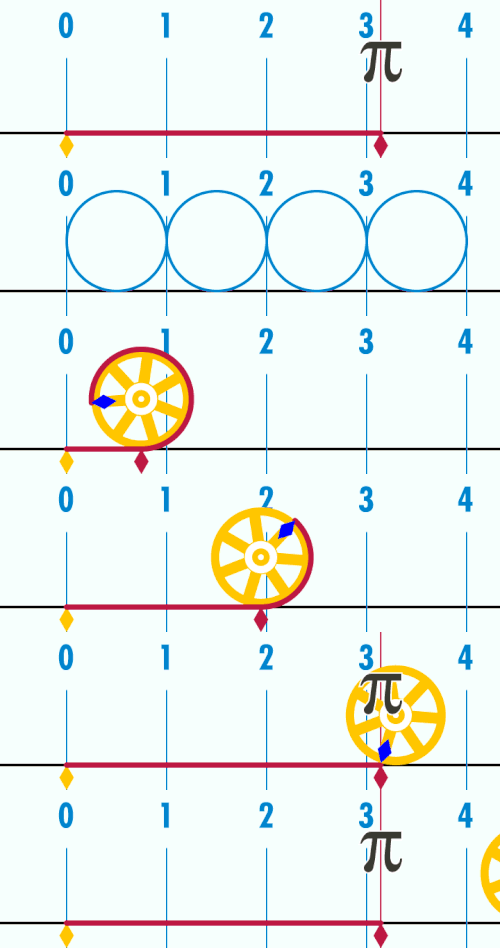
Pi, represented by the Greek letter π, is a mathematical constant whose value is the ratio of any circle's circumference to its diameter in Euclidean space (i.e., on a flat plane); it is also the ratio of a circle's area to the square of its radius. (These facts are reflected in the familiar formulas from geometry, C = π d and A = π r2.) In this animation, the circle has a diameter of 1 unit, giving it a circumference of π. The rolling shows that the distance a point on the circle moves linearly in one complete revolution is equal to π. Pi is an irrational number and so cannot be expressed as the ratio of two integers; as a result, the decimal expansion of π is nonterminating and nonrepeating. To 50 decimal places, π ≈ 3.14159 26535 89793 23846 26433 83279 50288 41971 69399 37510, a value of sufficient precision to allow the calculation of the volume of a sphere the size of the orbit of Neptune around the Sun (assuming an exact value for this radius) to within 1 cubic angstrom. According to the Lindemann–Weierstrass theorem, first proved in 1882, π is also a transcendental (or non-algebraic) number, meaning it is not the root of any non-zero polynomial with rational coefficients. (This implies that it cannot be expressed using any closed-formalgebraic expression—and also that solving the ancient problem of squaring the circle using a compass and straightedge construction is impossible). Perhaps the simplest non-algebraic closed-form expression for π is 4 arctan 1, based on the inverse tangent function (a transcendental function). There are also many infinite series and some infinite products that converge to π or to a simple function of it, like 2/π; one of these is the infinite series representation of the inverse-tangent expression just mentioned. Such iterative approaches to approximating π first appeared in 15th-century India and were later rediscovered (perhaps not independently) in 17th- and 18th-century Europe (along with several continued fractions representations). Although these methods often suffer from an impractically slow convergence rate, one modern infinite series that converges to 1/π very quickly is given by the Chudnovsky algorithm, first published in 1989; each term of this series gives an astonishing 14 additional decimal places of accuracy. In addition to geometry and trigonometry, π appears in many other areas of mathematics, including number theory, calculus, and probability.
👁 Image The red graph is the dual graph of the blue graph, and vice versa. In the mathematical discipline of graph theory, the dual graph of a planar graphG is a graph that has a vertex for each face of G. The dual graph has an edge for each pair of faces in G that are separated from each other by an edge, and a self-loop when the same face appears on both sides of an edge. Thus, each edge e of G has a corresponding dual edge, whose endpoints are the dual vertices corresponding to the faces on either side of e. The definition of the dual depends on the choice of embedding of the graph G, so it is a property of plane graphs (graphs that are already embedded in the plane) rather than planar graphs (graphs that may be embedded but for which the embedding is not yet known). For planar graphs generally, there may be multiple dual graphs, depending on the choice of planar embedding of the graph.
Historically, the first form of graph duality to be recognized was the association of the Platonic solids into pairs of dual polyhedra. Graph duality is a topological generalization of the geometric concepts of dual polyhedra and dual tessellations, and is in turn generalized combinatorially by the concept of a dual matroid. Variations of planar graph duality include a version of duality for directed graphs, and duality for graphs embedded onto non-planar two-dimensional surfaces. (Full article...)
He is best remembered as the first known person to calculate the Earth's circumference. He was also the first to calculate Earth's axial tilt, which similarly proved to have remarkable accuracy. He created the first global projection of the world incorporating parallels and meridians based on the geographic knowledge of his era. Eratosthenes was the founder of scientific chronology; he used Egyptian and Persian records to estimate the dates of the main events of the Trojan War, dating the sack of Troy to 1184 BC. In number theory, he introduced the sieve of Eratosthenes, an efficient method of identifying prime numbers and composite numbers. (Full article...)
👁 Image A unit cube with a hole cut through it, large enough to allow Prince Rupert's cube to pass In geometry, Prince Rupert's cube is the largest cube that can pass through a hole cut through a unit cube without splitting it into separate pieces. Its side length is approximately 1.06, 6% larger than the side length 1 of the unit cube through which it passes. The problem of finding the largest square that lies entirely within a unit cube is closely related, and has the same solution.
Prince Rupert's cube is named after Prince Rupert of the Rhine, who asked whether a cube could be passed through a hole made in another cube of the same size without splitting the cube into two pieces. A positive answer was given by John Wallis. Approximately 100 years later, Pieter Nieuwland found the largest possible cube that can pass through a hole in a unit cube. (Full article...)
👁 Image Quadratrix (red); snapshot of E and F having completed 60% of their motions The quadratrix or trisectrix of Hippias (also called the quadratrix of Dinostratus) is a curve which is created by a uniform motion. It is traced out by the crossing point of two lines, one moving by translation at a uniform speed, and the other moving by rotation around one of its points at a uniform speed. An alternative definition as a parametric curve leads to an equivalence between the quadratrix, the image of the Lambert W function, and the graph of the function 👁 {\displaystyle y=x\cot x} .
The discovery of this curve is attributed to the Greek sophist Hippias of Elis, around 420 BC. Historians of mathematics have suggested that Hippias used it to solve the angle trisection problem, hence its name as a trisectrix. Later around 350 BC Dinostratus used it to solve the problem of squaring the circle, hence its name as a quadratrix. Dinostratus's theorem, used by Dinostratus to square the circle, relates an endpoint of the curve to the value of π. Both angle trisection and squaring the circle can be solved using a compass, a straightedge, and a given copy of this curve; however, they cannot be solved with compass and straightedge alone. Although a dense set of points on the curve can be constructed by compass and straightedge, allowing these problems to be approximated, the whole curve cannot be constructed in this way. (Full article...)
Rules of inference include rules of implication, which operate only in one direction from premises to conclusions, and rules of replacement, which state that two expressions are equivalent and can be freely swapped. They contrast with formal fallacies—invalid argument forms involving logical errors. (Full article...)
👁 Image The graph of the 3-3 duoprism (the line graph of 👁 {\displaystyle K_{3,3}} ) is perfect. Here it is colored with three colors, with one of its 3-vertex maximum cliques highlighted. In graph theory, a perfect graph is a graph in which the chromatic number equals the size of the maximum clique, both in the graph itself and in every induced subgraph. In all graphs, the chromatic number is greater than or equal to the size of the maximum clique, but they can be far apart. A graph is perfect when these numbers are equal, and remain equal after the deletion of arbitrary subsets of vertices.
👁 Image The convex hull of the red set is the blue and red convex set. In geometry, the convex hull, convex envelope or convex closure of a shape is the smallest convex set that contains it. The convex hull may be defined either as the intersection of all convex sets containing a given subset of a Euclidean space, or equivalently as the set of all convex combinations of points in the subset. For a bounded subset of the plane, the convex hull may be visualized as the shape enclosed by a rubber band stretched around the subset.
Convex hulls of open sets are open, and convex hulls of compact sets are compact. Every compact convex set is the convex hull of its extreme points. The convex hull operator is an example of a closure operator, and every antimatroid can be represented by applying this closure operator to finite sets of points. The algorithmic problems of finding the convex hull of a finite set of points in the plane or other low-dimensional Euclidean spaces, and its dual problem of intersecting half-spaces, are fundamental problems of computational geometry. They can be solved in time 👁 {\displaystyle O(n\log n)} for two or three dimensional point sets, and in time matching the worst-case output complexity given by the upper bound theorem in higher dimensions. (Full article...)
Aderemi Oluyomi KukuNNOMOON (20 March 1941 – 13 February 2022) was a Nigerian mathematician and academic, known for his contributions to the fields of algebraic K-theory and non-commutative geometry. Born in Ijebu-Ode, Ogun State, Nigeria, Kuku began his academic journey at Makerere University College and the University of Ibadan, where he earned his B.Sc. in Mathematics, followed by his M.Sc. and Ph.D. under Joshua Leslie and Hyman Bass. His doctoral research focused on the Whitehead group of p-adic integral group-rings of finite p-groups. Kuku held positions as a lecturer and professor at various Nigerian universities, including the University of Ife and the University of Ibadan, where he served as Head of the Department of Mathematics and Dean of the Postgraduate School. His research involved developing methods for computing higher K-theory of non-commutative rings and articulating higher algebraic K-theory in the language of Mackey functors. His work on equivariant higher algebraic K-theory and its generalisations impacted the field.
A Garden of Eden is determined by the state of every cell in the automaton (usually a one- or two-dimensional infinite square lattice of cells). However, for any Garden of Eden there is a finite pattern (a subset of cells and their states, called an orphan) with the same property of having no predecessor, no matter how the remaining cells are filled in. A configuration of the whole automaton is a Garden of Eden if and only if it contains an orphan. For one-dimensional cellular automata, orphans and Gardens of Eden can be found by an efficient algorithm, but for higher dimensions this is an undecidable problem. Nevertheless, computer searches have succeeded in finding these patterns in Conway's Game of Life. (Full article...)
The number e is of great importance in mathematics, alongside 0, 1, π, and i. All five appear in one formulation of Euler's identity👁 {\displaystyle e^{i\pi }+1=0} and play important and recurring roles across mathematics. e is irrational, meaning that it cannot be represented as a ratio of integers. Moreover, like the constant π, it is transcendental, meaning that it is not a root of any non-zero polynomial with rational coefficients. To 30 decimal places, the value of e is: (Full article...)
... that formal semantics uses logic and mathematics to study language?
... that the identity of Cleo, who provided online answers to complex mathematics problems without showing any work, was revealed over a decade later in 2025?
...that as of April 2010 only 35 even numbers have been found that are not the sum of two primes which are each in a Twin Primes pair? ref
...the Piphilology record (memorizing digits of Pi) is 70000 as of Mar 2015?
...that people are significantly slower to identify the parity of zero than other whole numbers, regardless of age, language spoken, or whether the symbol or word for zero is used?
At least since the Renaissance, many artists and architects have proportioned their works to approximate the golden ratio—especially in the form of the golden rectangle, in which the ratio of the longer side to the shorter is the golden ratio—believing this proportion to be aesthetically pleasing. Mathematicians have studied the golden ratio because of its unique and interesting properties.
Other names frequently used for or closely related to the golden ratio are golden section (Latin: sectio aurea), golden mean, golden number, divine proportion (Italian: proporzionedivina), divine section (Latin: sectio divina), golden proportion, golden cut, and mean of Phidias. (Full article...)




.jpg)